
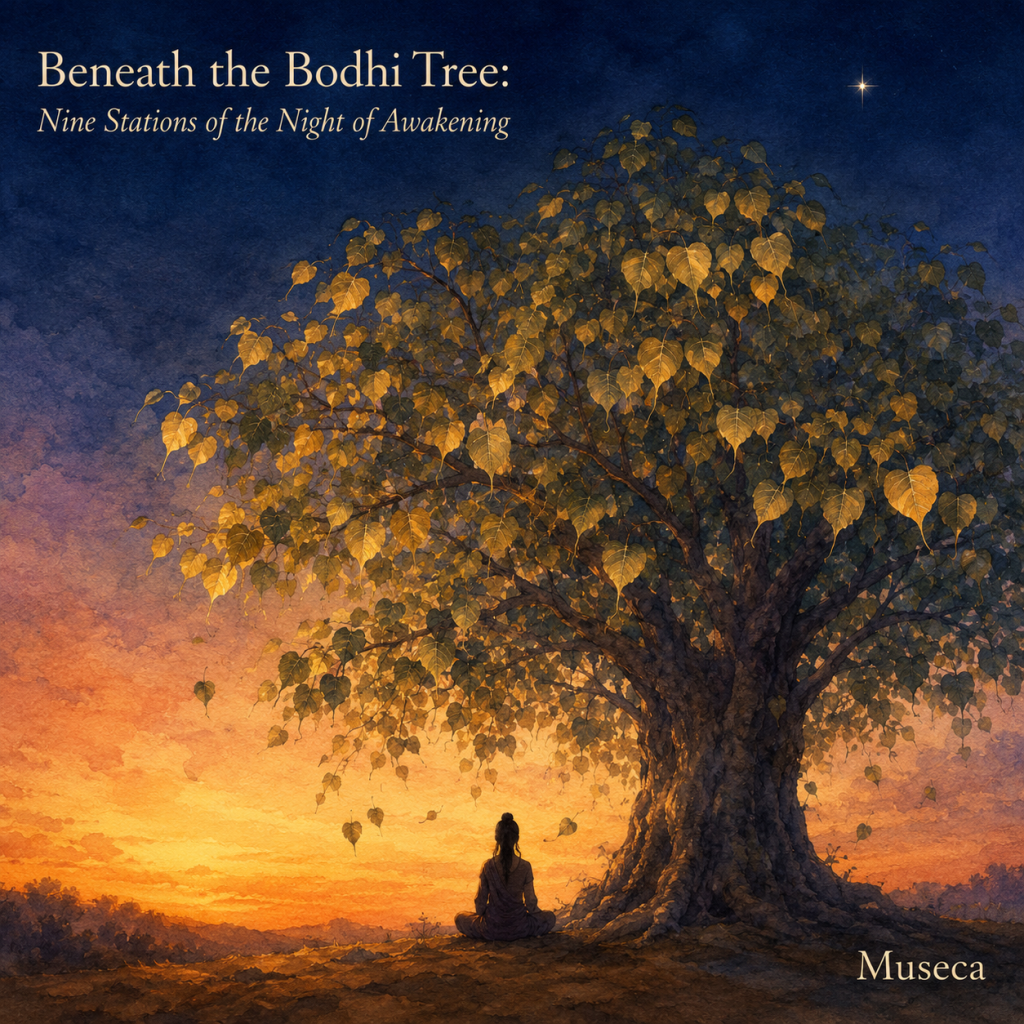
Introduction
One word, many nights. Enlightenment may be the most translated — and mistranslated — word in the human spiritual vocabulary. We use it as though it named one thing, but the traditions that pursued it never agreed on what that thing was, and their disagreements are recorded in their metaphors. The Buddhist word, bodhi, does not actually mean enlightenment at all: it comes from a root meaning to wake — the Buddha is, literally, “the one who woke up.” The Christian mystics spoke instead of illumination, yet insisted, paradoxically, that the light arrives through darkness — San Juan de la Cruz called the night itself more lovely than the dawn, and Meister Eckhart located God’s birth in a soul that had first become a desert. Vedanta spoke of remembering: liberation not as a journey but as the recognition that the wave was always ocean, that nothing changes but knowing. The Sufis spoke of love and annihilation — the moth entering the flame, the reed flute crying because it was cut from the reed bed, every melody the sound of exile longing for home. Zen refused metaphor altogether and offered the lightning strike: sudden, wordless, followed by chopping wood and carrying water as before. And in our own time, teachers of alignment describe enlightenment as nothing more exotic than allowing a connection that was never actually broken — the curtain pulled back from a sun that was always shining.
What they share. Sit with these traditions long enough and something remarkable emerges beneath their arguments. Not one of them describes enlightenment as an achievement. Alignment is allowed, not earned. The Buddha awakened only after abandoning six years of self-mortification — fed, bathed, seated at ease. Eckhart taught that the birth in the soul comes only through Gelassenheit, releasement; the soul cannot seize it, only stop preventing it. Vedanta’s method is pure subtraction — neti neti, not this, not this — and Zen’s koan exists to exhaust the grasping mind until something else sees. Every tradition, from a Toledo prison cell to a fig tree in Gaya, arrives at the same instruction: the door opens from the other side. Your work is to stop holding it shut. Across this album I have come to think of that shared gesture as the open hand — and it is visible in the story’s two most iconic images: the Buddha’s fingertips touching the earth, and the whirling dervish turning with one palm open to the sky.
One night as the vessel. Rather than compare these traditions from the outside, this album places them inside a single story: the night Siddhartha sat beneath the Bodhi Tree and vowed not to rise until the star rose. Nine stations trace that night from evening to morning. The seating and the vow. The storm of Mara — fear, desire, and the great unanswered question, who will witness you? The Spanish midnight of San Juan, where the dark itself becomes the guide. Eckhart’s desert, where a litany of letting-go empties itself down to two words and something is born in the silence that follows. Rumi’s reed-song and the rising whirl. The vast remembering of tat tvam asi — that thou art. The earth-touching, rendered here as the stillest music I have ever made. The morning star. And finally the marketplace: the return to wood, water, the kettle, the cat in the lap — because every tradition insists that awakening does not leave the world; it comes home to it.
The music of the night. The album’s sound-world is sacred minimalism — slow harmonic motion, vast stillness, dynamics that rarely rise above a murmur — but each station is visited by the instrumental voice of its own tradition. A Spanish classical guitar answers the singer through San Juan’s midnight, phrase for phrase, cast not as accompaniment but as the heart’s own flame in dialogue with the soul. A low male choir appears exactly once in the entire album, on a single vast chord, at the moment of Eckhart’s birth. A breathy Persian ney opens Rumi’s station with a lament that quietly echoes the guitar’s earlier figure — two exiles recognizing each other across the night — before the frame drum lifts the music into the album’s only dance. A solo cello rises out of the drone in the Vedanta station carrying a melody that returns, transformed, as the final track’s benediction. And a solo violin is withheld for seven full stations, entering for the first time — high, alone, pianissimo, in darkness — as the morning star itself.
The tree beneath everything. One presence never leaves. A deep continuous drone runs beneath all nine tracks without interruption, crossing every boundary, fading in before the first word is sung and fading out only after the last. It is the album’s witness — the tree that was ancient before the sitter arrived and remains after she walks away; the unchanging ground beneath all appearance that Vedanta calls Brahman and the tanpura has hummed for centuries. In the sixth station everything else falls away and the drone is heard alone for the first time since the opening seconds — and it blooms, overtones unfurling from inside the single tone, revealing that what seemed like mere foundation was the subject all along. Above it, almost as constant, is a high trembling shimmer: the leaves. The Bodhi tree — Ficus religiosa — has heart-shaped leaves on long flexible stems that flutter in air that feels perfectly still; tradition says they move even when there is no wind. That ceaseless whisper falls silent only twice in the album: once before a single dry piano note touches the earth, and once at the very end. I will let the ending keep its secret, except to say that silence is not the final word.
The album is best heard the way the night was kept: in one sitting, in the dark, from the first low tone to the last trembling leaf.
Liner Notes
Beneath This Tree I Will Not Move. The album opens the way the story does: the place is already ancient. Out of silence comes the drone alone — the deep sustained tone that will not stop again until the final track — and above it wakes a high trembling shimmer of harp harmonics and celesta: the leaves, moving in windless air. Only after this world is established does the voice arrive, settling into E major over warm chamber strings and organ, unhurried, at ease. The melody she sings here — the vow, until the star has risen, I will not rise — is the seed of the entire album. Listen to it closely; you will meet it again, twice, and neither time will it be quite what it was.
Lyrics
Verse 1
The road has ended where the branches start,
the dust of every mile is on my hands.
The evening opens slowly like a heart —
I lay my wandering down where this tree stands.
Verse 2
The grass is cool, the light is growing thin,
the first stars gather at the edge of blue.
Whatever comes tonight, I let it in —
the storm, the dark, the doubt, the quiet too.
Verse 3 — The Vow
Beneath this tree I will not move,
though all the night should pass through me —
until the star has risen,
I will not rise.
Refrain
Until the star has risen,
I will not rise.
All That Trembles Is Not the Tree. The only violence on the record, and even here the storm is held in the fabric, not the volume. Mara arrives in three waves over an ostinato that keeps trying, and failing, to establish itself against the unmoved drone: first fear — a low taiko pulse and short dissonant string clusters, the singer’s voice fractured into whispering doubles of itself; then desire, the most dangerous wave, in which the texture suddenly sweetens into a false lullaby and layered honeyed voices sing the vow melody back to her, subtly bent — temptation never arrives as something foreign, only as your own song, slightly wrong; and finally the question, everything stripped away but a crowd of her own voices asking who will witness you? No answer comes. A single low note settles toward the earth and is left there, waiting. The music moves at two speeds throughout — an agitated surface over a ground that never once changes pace. Remember that device; it returns transfigured.
Lyrics
Verse 1 — Fear
Rise — run — the dark has teeth,
the roots are cold, the ground gives way.
Who sits alone beneath such branches?
Rise — run — the night is long —
no one is coming — no one knows you here.
Verse 2 — Desire
Beneath this tree the night is long,
and all the warm world waits for you —
before the star has risen,
rise and live.
Refrain
Before the star has risen,
rise and live.
Verse 3 — The Question
Who will witness you?
Who saw the vow? Who heard it spoken?
The earth is silent — the stars are far —
who will witness you?
Who? Who?
The Night More Lovely Than the Dawn. San Juan de la Cruz, in his own Spanish, in his own 1591 stanzas — the soul slipping out of the stilled house with no light but the one burning in the heart. The visitor here is a Spanish classical guitar, and it is cast not as accompaniment but as a second voice: it opens alone with a slow falling figure in sarabande rhythm — the aching half-step at its center is the album’s entire harmonic story in miniature — and then answers the singer stanza by stanza, the two drawing gradually closer until voice and guitar intertwine at the great apostrophe: o night more lovely than the dawn. The poem’s famous consummation is deliberately withheld; the guitar states its figure one last time, alone, and the night’s claim is left standing — a question the rest of the album must answer.
Lyrics
Text: San Juan de la Cruz, 1591
Verse 1
En una noche oscura,
con ansias, en amores inflamada,
¡oh dichosa ventura!,
salí sin ser notada,
estando ya mi casa sosegada.
Verse 2
En la noche dichosa,
en secreto, que nadie me veía,
ni yo miraba cosa,
sin otra luz y guía
sino la que en el corazón ardía.
Verse 3
Aquésta me guiaba
más cierto que la luz del mediodía,
adonde me esperaba
quien yo bien me sabía,
en parte donde nadie parecía.
Verse 4
¡Oh noche que guiaste!
¡oh noche amable más que la alborada!
¡oh noche que juntaste
Amado con amada,
amada en el Amado transformada!
Refrain
¡Oh noche amable
más que la alborada!
Der Funke im Grund. Meister Eckhart’s station, sung in German built from his own vocabulary — the spark, the ground, the letting-go. The lyric is a litany of release in which each verse is shorter than the last: let go the images, let go the willing, let go the knowing, let go even God for God’s sake — the text emptying itself as the meter dissolves and the organ, in its darkest register, loosens into unmetered breathing washed with whole-tone haze, a harmony with the landmarks removed. At the point of complete emptiness the singer falls silent mid-phrase. Into that silence comes the album’s single appearance of a low male choir — one vast warm chord, one word: Geboren. Born. The birth cannot be seized, Eckhart taught; it can only be allowed. So the singer vacates the climax, and something else arrives.
Lyrics
Verse 1
Im Grunde der Seele
brennt ein Fünklein,
tiefer als alle Namen,
älter als Licht und Zeit.
Verse 2
Lass die Bilder los.
Lass das Wollen los.
Lass das Wissen los.
Verse 3
Lass Gott
um Gottes willen los.
Werde Wüste.
Lass los —
The Birth — male choir
Geboren.
Coda
Es ist geboren — in mir.
Song of the Reed Cut from the Reed Bed. Rumi’s station begins with the breathy grain of the ney — the Persian reed flute — playing a free, grieving lament whose falling contour quietly echoes the Spanish guitar’s figure from two stations earlier: the two exiles recognize each other across the night. The singer begins by telling the reed’s story and, mid-thought, becomes it: they hollowed out my heart with knives, and only then could music pass through me. The wound is the instrument. Then the daf — the Persian frame drum — enters with a slow pulse in six-eight, and the album’s only acceleration begins: the whirl, ney and strings wheeling gradually faster while the singer refuses to accelerate at all, returning again and again with the Masnavi’s opening line at her own serene pace — the still axis at the center of the turning. Two speeds at once, again: what was conflict in Mara’s storm is ecstasy here. At the peak the harmony touches, for one radiant moment, the major key in which the album will end — then releases it, and the whirl does not stop so much as widen, slowing outward like a circle expanding beyond hearing.
Lyrics
After Rumi, Masnavi I:1
Verse 1
Listen to the reed, how it cries,
telling the tale of separations —
since they cut me from the reed bed
every breath I draw is song and sorrow.
Verse 2
They hollowed out my heart with knives,
and only then could music pass through me —
whoever hears me hears the reed bed,
the green water, the home I burn for.
I sing because I am empty.
Refrain
Beshno az ney,
chon hekāyat mikonad.
Refrain
Beshno az ney,
chon hekāyat mikonad.
Refrain — at the peak
Beshno az ney —
beshno.
Tat Tvam Asi. The whirl becomes ocean. In vast, cloudless C major, over tidal strings, the singer offers the old Upanishadic petition — lead me from the unreal to the real, from darkness to light — while a solo cello searches upward beneath her in short, tentative phrases. Then the subtraction: neti, neti — not this, not this — and with each phrase a layer of the music is taken away, strings, shimmer, cello, until the drone stands alone for the first time since the album’s opening seconds. And it blooms. Overtones unfurl from inside the single tone — fifths and octaves breathing out of the fundamental like a rope finally seen in daylight — revealing that the ground beneath the entire album was never accompaniment. It was the subject. Into the revealed drone she sings the answer, three slow words: tat tvam asi — that thou art. The prayer asked to be led somewhere; the sentence replies that she was the destination. Out of the bloomed drone the cello rises with a complete flowing melody — the wave discovering it is ocean — and this wave-theme, born here from the ground itself, will return at the album’s close.
Lyrics
Texts: Bṛhadāraṇyaka Upaniṣad I.3.28; Chāndogya Upaniṣad VI.8.7
Verse 1
Asato mā sad gamaya —
from the unreal, to the real.
Tamaso mā jyotir gamaya —
out of darkness, into dawn.
Mṛtyor mā amṛtaṁ gamaya —
from dying, to the deathless.
Verse 2
Asato mā sad gamaya,
tamaso mā jyotir gamaya,
mṛtyor mā amṛtaṁ gamaya.
Bridge — The Subtraction
Neti, neti —
na iti, na iti —
neti, neti.
Verse 3 — The Answer
Tat tvam asi.
Tat tvam asi.
The Open Hand. The stillest music I have ever made, and the singer’s deepest utterance on the album: she is not here. A breathy Japanese flute offers a few falling phrases — each shorter than the last, more air than tone, islands in widening true silence — while the drone, settled back to its bare fundamental, simply holds. Then the trembling leaves, ceaseless since the first track, do something they have never done: they stop. What remains is the longest silence on the record. And into it, late, falls a single dry, close, unreverberated low piano note — one finger touching the earth. It is the same pitch the drone has sounded all night. The question Mara asked four stations ago — who will witness you? — is answered here, wordlessly: the witness was the ground itself, present since before the first word. Nothing reacts. The drone continues. And at the very edge of hearing, the leaves begin, faintly, to move again.
Lyrics
Instrumental. The singer is silent; one note touches the earth.
More Lovely Than the Night. Still night, still darkness — and then, high above the dark strings, a solo violin enters: the first violin sound on the entire album, withheld through seven stations for this moment. Alone, pianissimo, it sings the vow melody complete — until the star has risen, fulfilled by the star itself before any voice confirms it. Only then does the singer return, her first phrase since the remembering, and on her breath the harmony lifts — the half-step rise that this album, and everything I have written in this style, has always been moving toward — E major opening into F major as the sky answers the star, a single Sanskrit word, jyothir, light, placed exactly on the moment of rising. The record’s fullest bar follows, and inside it, once, the male choir’s birth chord from Eckhart’s station resounds again beneath the soaring violin — but listen to what the fullness carries: not triumph. Gratitude. Her answer to San Juan does not correct him; it completes him. This dawn is more lovely than the night only because the night was lovely first — the dark that held her was the light unlearned. The vow said I will not rise. The answer, when it comes, is gentler: I may rise.
Lyrics
Verse 1
There — above the branches — burning,
one small fire in all that dark:
the star I vowed by, rising, rising,
keeping what I could not keep.
Verse 2
Jyotir — the light — it is not other,
it is the night grown bright enough to see:
every dark hour held inside it,
every silence singing now in me.
Verse 3
O dawn more lovely than the night —
but only, only
because the night was lovely first:
the dark that held me was the light unlearned,
the star was in the branches all along.
Refrain
Until the star has risen —
the star has risen.
I may rise.
As Good As It Gets. Morning, and the return. In settled F major, with the faintest sway — the album’s only ease of step — the singer walks back into the ordinary world: water drawn, wood carried, the kettle’s one note, the cat on the warm stone. The strophes ride the cello’s wave-theme from the remembering, now warmed into a benediction, while the violin — no longer a portent, simply a member of the morning — weaves easily above: the album’s first music of companionship after a night of solitudes. Joy, she sings, is not the prize; it is the proof of being home. Nothing is finished; nothing needs to be. And then, for the first time in nine stations, she turns and speaks directly to the tree — old one, you never moved; you held the night so I could lay it down — a farewell offered at the door, the way gratitude is only ever truly offered: on leaving, needing nothing. Then she is gone. The instruments withdraw one by one; the leaves still for the second and last time; and the drone — sounding since before the first word was sung — does the one thing it has never done, and begins to fade. The witness withdraws. Silence approaches. And then, out of the quiet, one single faint tremble of the leaves — one leaf moving in windless air — and the album ends there, mid-whisper. The night is over. The tree is still singing. It always was.
Lyrics
Verse 1
The morning asks for nothing —
water drawn, and wood to carry,
the same small road, the same worn gate,
and all of it is shining.
Verse 2
The cat has found the one warm stone,
the kettle hums its only note,
and joy — joy is not the prize at all,
it is the proof that I am home.
Verse 3
Nothing is finished, nothing needs to be —
the star will set, the night will come again,
and every now the door swings open —
this is as good, as good as it gets,
and it is always just beginning.
Verse 4 — The Farewell
Old one — you never moved.
You held the night so I could lay it down.
The leaves were singing all along —
keep whispering. I’ll listen from the road.
Playlist
- Track 1 - Beneath This Tree I Will Not Move (The Seating) Museca 3:55
- Track 2 - All That Trembles Is Not the Tree (Mara) Museca 3:38
- Track 3 - The Night More Lovely Than the Dawn (Noche oscura) Museca 4:19
- Track 4 - Der Funke im Grund (Der Funke) Museca 2:37
- Track 5 - Song of the Reed Cut from the Reed Bed (The Reed) Museca 3:37
- Track 6 - Tat Tvam Asi (The Remembering) Museca 4:15
- Track 7 - The Open Hand (The Earth-Touching) Museca 4:14
- Track 8 - More Lovely Than the Night (The Morning Star) Museca 4:14
- Track 9 - As Good As It Gets (The Marketplace) Museca 4:25