Keep moving together
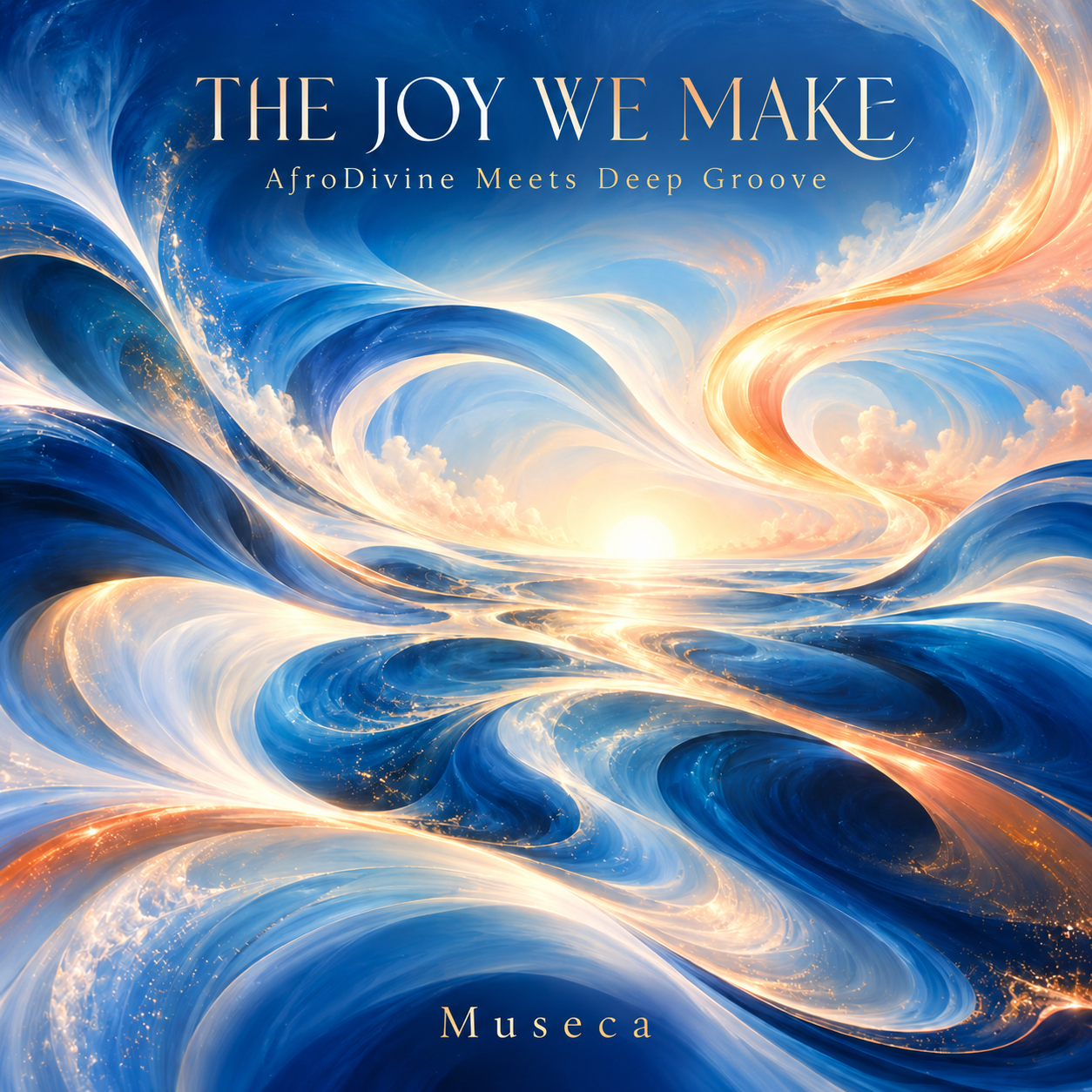
The Joy We Make
Continue the celebration of groove in ten compositions about movement and human connection. AfroDivine meets warm bass, hand percussion, and the joy of voices joining together.
Explore album ↗
There is something extraordinary about music that makes us want to move.
We hear a rhythm, perhaps nothing more than a bass guitar and a drum, and almost instinctively our bodies begin to respond. A foot starts tapping. Our shoulders move. Our heads begin to nod. Before long, we may find ourselves swaying, dancing, or simply surrendering to the irresistible motion of the music.
We call this phenomenon groove.
Yet groove is far more than a steady beat. It is one of music’s most fascinating and subtle qualities: the sensation of movement created when musicians combine their individual rhythmic contributions into a unified, living musical experience.
All Aboard the Groovy Train! is an album built around that phenomenon. It explores groove not merely as a characteristic of musical performance, but as the foundation of an entire approach to composition.
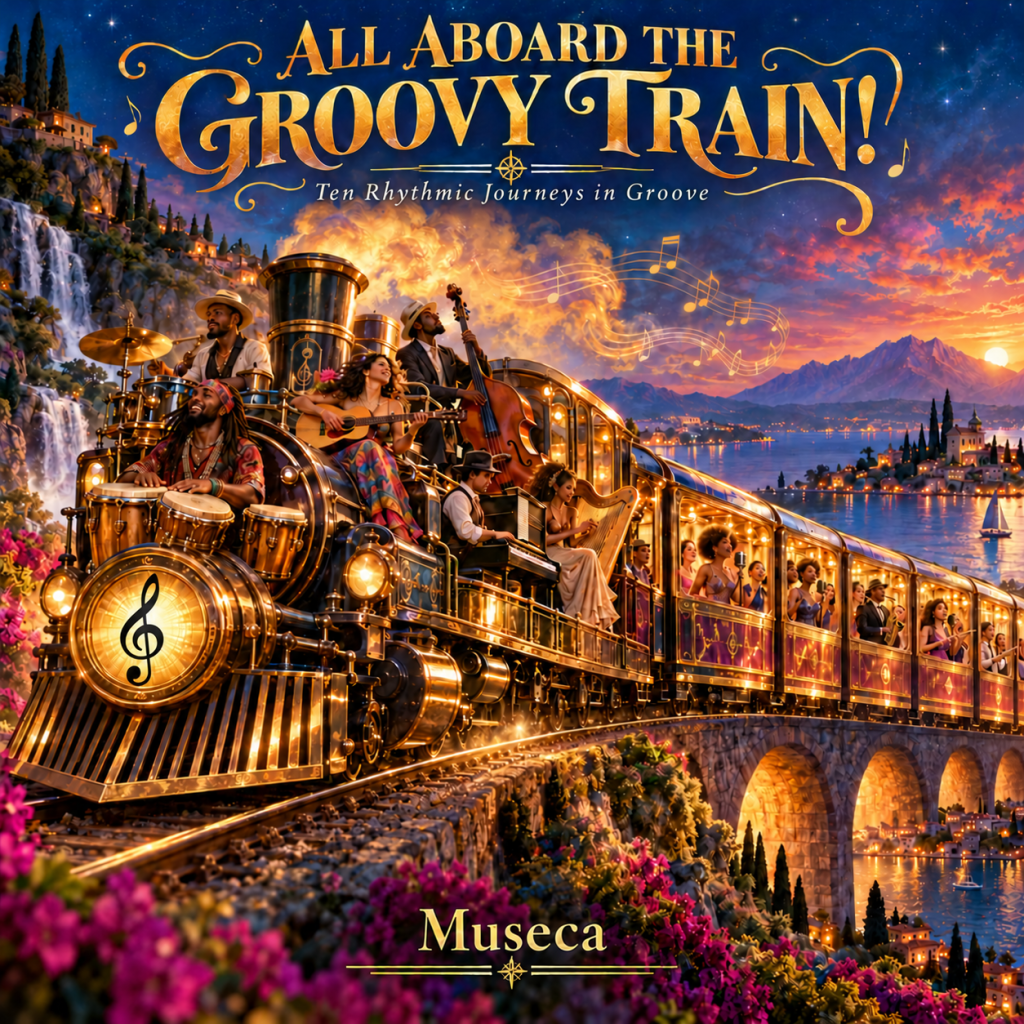
The album invites the listener aboard ten different musical trains, each propelled by its own ensemble of musicians, carrying its own instrumental and vocal passengers, and following its own musical route.
To understand the idea behind this album, we must first understand what groove actually is.
In music, rhythm refers to the organization of sounds and silences through time. Tempo tells us how fast the underlying beat moves. Meter organizes beats into recurring patterns.
Groove, however, is something more.
Groove emerges from the relationships among rhythmic patterns, instrumental performances, and the listener’s perception of musical motion. It involves repetition, anticipation, syncopation, articulation, and the subtle ways musicians interact with one another.
Consider a drummer playing a steady four-beat pulse. The rhythm is clear, but that alone may not produce an especially compelling groove.
Now introduce a bassist who plays a repeating melodic figure, occasionally anticipating a beat or leaving an unexpected space. Add a guitarist whose short, clipped chords fall between the bass notes. A percussionist contributes a contrasting rhythmic pattern, while a keyboard player adds a repeating figure that moves around the others.
Each musician performs a distinct part.
Yet together, they create something that belongs to none of them individually: a groove.
This is the essential musical relationship that interests us.
Several elements contribute to this experience.
Pulse provides the underlying sense of regular motion. It allows us to anticipate when the next beat will occur.
Syncopation introduces rhythmic tension and surprise by emphasizing unexpected positions between or around the principal beats.
Ostinato, a repeated musical figure, provides continuity. A bass ostinato, for example, may become the defining rhythmic identity of an entire composition.
Counter-rhythm occurs when different instruments play complementary rhythmic patterns. One musician fills the spaces left by another, creating a complex but coherent musical texture.
Microtiming and articulation contribute the subtle characteristics of performance. The way a bassist places a note, a percussionist accents a phrase, or a guitarist releases a chord can make a groove feel relaxed, urgent, elastic, or deeply settled.
Musicians often describe an especially satisfying rhythmic relationship as being in the pocket.
But perhaps the most important quality of groove is the balance between familiarity and surprise.
If a rhythmic pattern never changes, it may eventually become monotonous. If it changes constantly, the listener may struggle to find a stable pulse.
A compelling groove often lies somewhere between these extremes. It provides enough repetition for the listener to recognize and anticipate its movement, while introducing sufficient variation to remain engaging.
And when this balance is achieved, something remarkable happens.
We do not merely hear the rhythm.
We feel it.
The history of the word groovy reveals a surprising transformation in meaning, one that connects beautifully with the musical concept behind this album.
The noun groove has existed in English for centuries. Originally, it referred to a hollow, a furrow, or a narrow channel cut into a surface.
By the nineteenth century, the word also carried a figurative meaning. To be in a groove could mean following an established routine, sometimes so rigidly that one became trapped by habit.
The adjective groovy was recorded in its literal sense by the middle of the nineteenth century. By the 1880s, it could describe a person inclined toward routine or narrow patterns of thought.
In other words, being groovy was not necessarily a compliment.
It could mean being stuck in a rut.
This older meaning is particularly intriguing because a train also follows a predetermined path. Its wheels are guided by rails, restricting the train’s lateral movement while allowing it to travel forward.
The railway analogy is poetic rather than etymological, but the connection is irresistible.
A groove can constrain movement. Yet a guided path can also make sustained movement possible.
In the early twentieth century, the word acquired another physical association: the spiral groove of a phonograph record. The record’s groove guided the playback stylus through the recorded performance, translating its physical pattern into sound.
Then came one of the word’s most important cultural transformations.
During the 1920s and 1930s, African American jazz culture developed the positive musical expression in the groove, describing musicians who played with exceptional rhythmic assurance, fluency, and collective understanding.
The expression is documented in jazz-related usage by the early 1930s, and groovy appears in its approving musical sense by 1937.
The physical grooves of records offered an evocative parallel, although they should not be regarded as the single proven origin of the jazz expression.
Within jazz, being in the groove became associated with a performance in which the musicians seemed to understand one another almost instinctively. Their individual parts fit together with ease, conviction, and a shared sense of time.
The music flowed.
The musicians were groovy.
During the 1940s and 1950s, the positive meaning spread beyond jazz circles into broader American popular culture.
By the 1960s, groovy had become one of the defining expressions of the counterculture. It suggested something wonderful, pleasurable, exciting, fashionable, or simply right. Popular music helped carry the word into everyday language, including Simon & Garfunkel’s 1966 recording The 59th Street Bridge Song (Feelin’ Groovy).
By the 1970s, the word had become so familiar that it appeared throughout advertising, television, and popular entertainment.
Yet its musical meaning remained fundamental.
Today, a musician describing a performance as groovy is usually referring to something more specific than whether the music is fashionable or enjoyable.
The musician is recognizing a quality of rhythmic interaction that makes the performance move.
The history of the word therefore contains a remarkable reversal.
It begins with a groove as a physical channel, develops into the negative idea of being trapped in routine, and eventually becomes an expression of musical fluency, rhythmic freedom, and collective motion.
This transformation offers a guiding thought for our album:
A rut can imprison motion. A groove can organize freedom.
And that brings us to the Groovy Train.
The idea behind All Aboard the Groovy Train! began as a visual response to listening closely to groove-driven music.
In particular, the powerful rhythmic arrangements of Malian music, Afro-house, AfroDivine, and recordings such as Salif Keïta’s Madan, famously reworked for the dance floor by Martin Solveig, inspired an unusual image.
Imagine closing your eyes while listening to a song with a particularly compelling groove.
Instead of imagining musicians performing on a conventional stage, picture a train moving steadily along a railway track.
Now imagine that the train’s engine is not propelled by a mechanical motor.
Instead, musicians are seated all around its locomotive.
At the front are the percussionists, playing drums, shakers, bells, and other rhythmic instruments. Along the sides are bassists and guitarists. Keyboard players, marimba musicians, and other instrumentalists occupy their own positions.
The musicians are playing together.
And through their collective musical performance, the train moves.
There is no hidden machinery generating the motion.
The musicians themselves are the engine.
Behind the locomotive are passenger cars carrying singers, choruses, soloists, and additional instrumentalists.
As the train travels, these musical passengers enter the composition, contribute melodies and harmonies, exchange phrases, and interact with the engine musicians.
Some passengers eventually move forward and join the musicians on the locomotive, adding their own rhythmic patterns to its propulsion.
Others withdraw, leaving space for new musical ideas.
Sometimes the engine musicians become quiet. Sometimes they stop playing altogether.
Yet the train continues to move.
This is the central image of the Groovy Train.
It is a metaphor for the construction of music, but it also offers a surprisingly practical way of understanding how successful groove-based compositions work.
The method has three fundamental components:
The Train. The Passengers. The Route.
Together, they become the finished musical composition.
Every Groovy Train begins with its engine.
The first question is not necessarily what melody the song will have, what lyrics the singer will perform, or which chord progression will accompany the chorus.
Instead, we ask:
What collection of musicians will make this train move?
A train might begin with nothing more than a kick drum and bass guitar.
Another might be powered by interlocking hand percussion and a repeating plucked-string figure.
A third could derive its propulsion from syncopated piano chords, guitar riffs, and a deeply rhythmic bass line.
The possibilities are almost limitless.
What matters is that each musician has a meaningful role in the collective rhythm.
The percussionist may establish the pulse. The bassist may introduce a repeating pattern that anticipates selected beats. A guitarist might answer the bass with short, syncopated chords. A keyboard player may contribute an ostinato that adds another layer of rhythmic movement.
Not every engine musician must play continuously.
Some enter after the groove has begun. Others withdraw temporarily, allowing different rhythmic relationships to emerge.
An instrument can even change its responsibility during the composition.
A guitar that initially plays short percussive chords may gradually develop an expressive melodic figure. A keyboard may move from rhythmic accompaniment to harmonic foreground. A repeating bass line may become sufficiently melodic to act as a principal theme.
The important consideration is not how many musicians are aboard the engine.
It is how effectively their musical contributions work together.
An engine with four beautifully coordinated musicians may be more compelling than one with fifteen competing instrumental parts.
We therefore judge an engine by its capacity to generate musical motion.
Does the bass interact naturally with the percussion? Are the repeating figures interesting? Do the instruments leave space for one another? Does the groove have its own recognizable personality?
And, most importantly for this album:
Does the engine make us want to get up and dance?
Only when the rhythmic foundation is compelling do we consider what else the train might carry.
Once the engine is moving, the musical passengers enter.
These may include a solo vocalist, a chorus, a melodic instrument, an improvising soloist, or additional harmonic and atmospheric layers.
The passengers provide much of the composition’s expressive personality.
A singer introduces words, narrative, and emotional character. A chorus may transform a private musical statement into a communal celebration. A solo instrument may provide a melodic contrast to the engine’s rhythmic patterns.
Yet passengers are not merely decorations placed above a repeating beat.
Their relationship with the engine is essential.
A vocalist may phrase a melody slightly behind the rhythmic pulse, creating a relaxed, intimate character. A chorus might answer the singer with short, syncopated phrases that fit precisely into the spaces left by the percussion.
An instrumental soloist may play a lyrical passage over the groove, allowing the listener to experience two contrasting musical movements simultaneously.
And sometimes a passenger becomes part of the engine.
Imagine a female chorus introducing a short melodic refrain.
Initially, it functions as a vocal hook. But as the singers repeat the phrase, its accents begin to reinforce the instrumental rhythm. The chorus effectively becomes another percussion section, contributing directly to the train’s propulsion.
Or consider a steelpan introducing an attractive melody. Later, the same instrument develops a short repeating figure that interlocks with the bass and percussion.
It has moved from melodic passenger to engine musician.
These transformations can create a composition that feels alive rather than mechanically assembled.
Throughout All Aboard the Groovy Train!, particular attention is given to unusual combinations of instruments.
A bass clarinet converses with a Cuban tres. A sitar exchanges lyrical phrases with a mellow flugelhorn. An Ethiopian krar interacts with a breathy washint flute. A Moroccan guembri provides a deep rhythmic foundation while a vibraphone contributes luminous melodic lines. A Brazilian cuíca introduces an almost vocal quality into the percussion.
These combinations are not chosen merely because they are unusual.
They are selected for their contrasting musical personalities and their potential to create beautiful, memorable interactions.
Every passenger should have a reason to be aboard.
A wonderfully constructed rhythmic engine can sustain the listener’s attention for a considerable time.
But even an exceptional groove may eventually become monotonous if nothing meaningful changes.
This is where the third component becomes essential.
The Route is the musical journey.
It determines how the composition develops through time: when musicians enter, when passengers take the foreground, when instrumental conversations begin, when textures become denser or more transparent, and how the music eventually concludes.
A route might begin with one percussionist establishing the pulse.
The bass enters, followed by a second percussion instrument. A rhythmic guitar joins, and the engine gradually develops its full identity.
Then a singer boards.
A chorus responds. A melodic instrument introduces a contrasting phrase. The bass varies its ostinato, and one of the engine musicians temporarily withdraws.
A new instrumental conversation develops.
Eventually the arrangement reaches a moment of reduced activity.
Perhaps nearly everyone stops playing.
And something extraordinary happens.
The train continues moving.
One of the most fascinating characteristics of groove is that its motion can continue in the listener’s imagination even when the audible rhythmic foundation disappears.
Once a strong pulse has been established, the listener begins anticipating its recurrence.
The brain has learned the rhythmic pattern.
When the musicians suddenly stop playing for a beat, two beats, or even an entire measure, the listener may continue feeling the rhythm internally.
In our imaginary railway, the train is coasting.
The musicians are resting, but the momentum they created carries the train forward.
This is the Groovy Train Coast.
The sensation is particularly powerful when the ensemble returns after a brief interruption.
The bass and percussion may re-enter simultaneously, creating an exhilarating impression that the train has suddenly accelerated.
Interestingly, the actual tempo need not change.
The music may remain at precisely the same number of beats per minute. What changes is the density of rhythmic activity, the strength of the instrumental attacks, and the listener’s experience of renewed propulsion.
We perceive greater energy even though the underlying tempo remains constant.
The Groovy Train Coast is therefore not simply a moment of silence.
It is a compositional use of anticipation, memory, contrast, and release.
The same principle can be explored more gently by withdrawing only selected engine musicians. A bass ostinato may continue quietly while the percussion disappears. A singer may sustain a phrase over the remembered pulse. A keyboard may offer a few sparse notes before the full rhythm section returns.
Sometimes the most exciting moment in a groove-based composition is the instant when the musicians stop.
And sometimes the most satisfying moment is when they begin playing again.
Every train also needs a destination.
A composition should not end merely because the recording has reached its allotted duration.
Its ending is part of its musical architecture.
Sometimes the final arrival is exuberant: a chorus delivers its last refrain, the singers withdraw, and the engine musicians conclude together on a powerful rhythmic accent.
Sometimes the arrival is intimate. A solo instrument answers the final vocal phrase, the bass completes its recurring pattern, and the remaining sounds fade naturally into silence.
Other compositions may deliberately end with unresolved momentum or an expressive fade.
What matters is that the ending feels artistically intentional.
The route should create the sensation that the listener has traveled somewhere, rather than simply heard a repeated pattern until the music stopped.
The Train, the Passengers, and the Route are more than three descriptive images.
Together, they provide a practical framework for conceiving and organizing an original musical composition.
We begin by identifying the desired rhythmic personality.
Will the train feel buoyant or forceful, relaxed or exuberant, sensual or celebratory? Will its movement be based on syncopated bass, interlocking guitars, polyrhythmic percussion, a repeating keyboard figure, or some unexpected combination of instruments?
Next, we select the musicians who will form its rhythmic engine.
Each musician receives a role. Rather than merely listing instruments, we consider their musical relationships: who establishes the pulse, who anticipates the beat, who answers another musician, who sustains a repeating pattern, and who provides rhythmic contrast.
We then determine which passengers will enrich the composition.
These decisions include the singers, their languages, vocal registers, harmonies, instrumental soloists, and the ways they interact with the rhythmic foundation.
Finally, we compose the route.
We decide how the arrangement begins, how its layers develop, where musical conversations occur, when the engine becomes more restrained, whether a coast would strengthen the experience, and how the composition reaches its final destination.
Importantly, these three elements do not have to be recorded or constructed separately.
They can be conceived together as one integrated musical design. The composer may imagine the complete ensemble, its changing instrumental roles, and its structural journey before the first performance begins.
The method therefore concerns musical relationships, not a particular recording technique or production technology.
Nor is the Groovy Train a claim to have invented pulse, ostinato, syncopation, improvisation, or ensemble interplay. These musical practices have rich histories across numerous traditions.
Instead, it is a way of organizing established musical principles into a coherent, imaginative, and accessible compositional framework.
Its purpose is to encourage the composer to think beyond melody supported by accompaniment.
The rhythmic foundation becomes a living musical entity.
The other instruments and voices become active participants.
And the entire composition becomes a journey through motion, interaction, expectation, and change.
All Aboard the Groovy Train! explores this method through ten original compositions inspired by different rhythmic traditions and instrumental cultures.
The journey begins in a Malian-inspired Afro-house landscape, where balafon, kora, percussion, and bass combine beneath joyful Bambara vocals.
It continues through Ghanaian highlife, where interlocking guitars and trombone create a buoyant, flowing dance groove, and then moves into Brazilian samba-soul, where cavaquinho, Rhodes piano, and the expressive cuíca produce a distinctive rhythmic conversation.
An Afro-Cuban train introduces the intricate relationships of clave, tres, piano montuno, and bass clarinet.
An Indian-inspired soul-house composition brings sitar and flugelhorn into an intimate exchange beneath a danceable Hindi duet.
A Moroccan Gnawa-inspired engine draws its propulsion from guembri and qraqeb, while a vibraphone introduces a contrasting melodic atmosphere.
An Ethiopian jazz-funk train combines the plucked krar, washint flute, and modal rhythmic patterns.
South African amapiano supplies a bouncing log-drum bass engine, enriched by the cheerful melodic personality of the kwela pennywhistle.
The penultimate journey returns to the warmth and spiritual energy of AfroDivine, combining Afro-house propulsion, neo-soul harmony, expressive saxophone, and gospel-influenced vocal responses.
Finally, the album arrives at its title composition, All Aboard the Groovy Train!—an exuberant Afro-funk and disco-soul celebration that embodies the entire musical philosophy.
Throughout the album, songs are performed in different languages, including Bambara, Twi, Brazilian Portuguese, Spanish, Hindi, Moroccan Arabic, Amharic, isiZulu, and English.
These different musical traditions are approached as sources of creative inspiration, with the aim of producing original compositions rather than reproducing established songs.
Despite their contrasting instrumentation, rhythmic foundations, languages, and emotional personalities, all ten compositions share one essential quality.
They are designed to make us move.
Some invite exuberant dancing. Others inspire swaying, turning, partner dancing, or a more intimate physical response.
Some grooves are powerful and insistent. Others are subtle and elastic.
But in every composition, the engine remains central to the musical experience.
There is a final thought behind the Groovy Train that extends beyond rhythm and musical arrangement.
No single musician creates the entire journey.
The percussionist may establish the first pulse, but the bassist changes its character. The guitarist introduces a new rhythmic possibility. A singer brings an emotional voice. Another instrument responds, and the music moves into territory that none of the musicians could have created in quite the same way alone.
The beauty emerges from their relationships.
Each participant contributes something individual, yet the resulting music belongs to the ensemble.
That is the deeper meaning of our imaginary train.
It has no mechanical engine hidden beneath its musicians. Its power comes from the musical intelligence, imagination, rhythmic sensitivity, and cooperation of the people aboard.
Sometimes they play together. Sometimes they take turns. Sometimes they listen while someone else carries the melody. Sometimes everyone becomes silent, trusting the momentum they have already created.
And when the musicians return, the train moves forward with renewed energy.
This is the art of groove.
It is the transformation of separate sounds into shared motion, of repetition into anticipation, and of rhythmic structure into physical pleasure.
All Aboard the Groovy Train! celebrates that transformation.
It is an album about rhythm, but also about conversation, cooperation, spontaneity, beauty, and the joy of making music together.
Its invitation is simple:
Build the Train. Invite the Passengers. Choose the Route.
Then let the music travel.
All aboard!
Musical Style: Malian Afro-House · West African Rhythmic Fusion · Bambara Vocals
The Train: Our journey begins in Mali, where a hypnotic Afro-house groove brings the first Groovy Train to life. A warm, insistent kick drum establishes the pulse, joined by syncopated djembe and calabash percussion, a rolling electric bass ostinato, and the bright, resonant tones of the balafon. The kora contributes intricate plucked figures that weave through the rhythm, sometimes reinforcing the engine and sometimes venturing into melody. These musicians create a deeply interlocking rhythmic foundation whose energy seems to build naturally with every passing measure.
The Passengers: An expressive female vocalist singing in Bambara invites everyone aboard with the recurring refrain An ka taa—“Let’s go!” A spirited female chorus responds, its overlapping voices gradually becoming part of the rhythmic propulsion. The kora emerges with graceful melodic phrases, answering the singers while the balafon continues its infectious patterns. Voices and instruments interact with the spontaneity of musicians celebrating together.
The Route: The train departs with its rhythmic engine already gathering momentum. As the singers and instrumental passengers join, the music expands into a joyful, communal celebration. Instrumental exchanges and changing rhythmic layers sustain the excitement, while moments of reduced activity provide contrast before the full ensemble returns. The journey concludes with a strong, decisive rhythmic arrival. The First Departure establishes the album’s essential promise: a groove so compelling that the listener cannot help but move.
[Verse 1]
Dugu jɛra
Dugu jɛra
An ka taa
An ka taa
[Chorus]
An ka taa, an ka taa
An bɛ dɔn kɛ, an bɛ dɔn kɛ
An ka taa ɲɔgɔn fɛ
An ka taa, an ka taa
[Verse 2]
An ka dɔnkili da
An ka ɲagali
Dugu jɛra
An ka taa ɲɔgɔn fɛ
[Call and Response]
Lead:
An ka taa!
Women’s Chorus:
An ka taa!
Lead:
An ka dɔnkili da!
Women’s Chorus:
An bɛ dɔn kɛ!
[Wordless Interlude]
Aa — eh — aa
Aa — eh — aa
[Final Chorus]
An ka taa, an ka taa
An bɛ dɔn kɛ, an bɛ dɔn kɛ
An ka taa ɲɔgɔn fɛ
An ka ɲagali
An ka taa!
[Instrumental Outro]
Musical Style: Ghanaian Highlife-Soul · Guitar-Driven Dance Fusion · Twi Vocals
The Train: Our second train travels through the bright, melodic world of Ghanaian highlife. Unlike the deep Afro-house propulsion of the opening composition, this engine is powered by a pair of clean electric guitars whose interlocking figures create a buoyant, flowing rhythm. An agile, melodic bass line dances between the guitar phrases, while congas, bell accents, and a light drum kit maintain a lively but relaxed pulse. The result is a groove that seems to glide and bounce simultaneously, inviting the listener into a gentle, joyful dance.
The Passengers: A warm male tenor sings in Twi, answered by a cheerful female chorus. Their natural call-and-response exchanges bring warmth and personality to the composition, while a mellow trombone enters with expressive melodic phrases. The trombone’s rounded voice contrasts beautifully with the crisp guitar riffs, sometimes answering the singer and sometimes offering its own musical observations. The instrumental conversation is playful, elegant, and wonderfully human.
The Route: Golden Wheels unfolds like an afternoon celebration, its musical energy flowing from one instrumental exchange to another. The guitars establish their rhythmic conversation before the voices join, and the trombone gradually becomes a distinctive melodic presence. The arrangement moves through lively choruses, instrumental passages, and moments of lighter accompaniment without losing its rhythmic momentum. The final instrumental exchange brings the train to a satisfying destination. Its distinctive groove suggests partner dancing—something relaxed, graceful, and full of movement—demonstrating that a Groovy Train need not be forceful to be irresistible.
[Verse 1]
Awia repue
Ɛyɛ fɛ paa
M’ani agye
Bra, bra
[Chorus]
Male Lead:
Anigye, anigye!
Female Chorus:
Yɛn ani agye!
Male Lead:
Akwaaba, akwaaba!
Female Chorus:
Anigye wɔ hɔ!
Both:
Anigye, anigye!
[Verse 2]
Hwɛ wiase yi
Ɛyɛ fɛ paa
Yɛnkɔ, yɛnkɔ
Yɛn ani agye
[Chorus]
Male Lead:
Anigye, anigye!
Female Chorus:
Yɛn ani agye!
Male Lead:
Akwaaba, akwaaba!
Female Chorus:
Anigye wɔ hɔ!
[Bridge]
Female Chorus:
Anigye wɔ hɔ
Male Lead:
M’ani agye
Female Chorus:
Yɛn ani agye
[Final Chorus]
Male Lead:
Anigye, anigye!
Female Chorus:
Yɛn ani agye!
Male Lead:
Yɛnkɔ, yɛnkɔ!
Female Chorus:
Anigye wɔ hɔ!
Both:
Anigye, anigye!
[Instrumental Outro]
Musical Style: Brazilian Samba-Soul House · Contemporary Brazilian Dance Fusion · Portuguese Vocals
The Train: Our third train awakens beneath the Brazilian sun, propelled by the buoyant rhythmic language of samba. A deep surdo pulse and lively pandeiro establish the foundation, accompanied by agogô accents and an elastic electric bass line. Above them, the bright, clipped rhythms of the cavaquinho engage in a delightful conversation with the warm, syncopated chords of a Rhodes electric piano. Together, these instruments create an engine that rolls, sways, and sparkles with rhythmic invention. The music is both sophisticated and immediately danceable.
The Passengers: A warm female alto sings in Brazilian Portuguese, joined by a small mixed chorus whose rhythmic responses reinforce the groove. The song’s playful instrumental personality is enriched by the cuíca, a distinctive Brazilian friction drum capable of producing remarkably vocal-like sounds. Its expressive calls seem almost to imitate another singer, punctuating the musical conversation with unexpected humor and character. The cavaquinho and Rhodes move effortlessly between supporting the engine and contributing melodic responses.
The Route: The composition begins with a gradual awakening of its rhythmic musicians, as though the city itself is coming alive. The singers invite everyone into the dance, while the instrumental passages develop an increasingly animated conversation. A quieter interlude briefly reduces the rhythmic density without losing the sense of motion, allowing the full ensemble’s return to feel especially exhilarating. The final refrain gives way to a concise instrumental conclusion. The Rhythm of the Sun celebrates the pleasure of movement, the warmth of human connection, and the contagious energy of a Brazilian groove.
[Verse 1]
O sol riscou a calçada
A cidade abriu a janela
O pandeiro chamou da esquina
E o baixo respondeu pra ela
[Pre-Chorus]
Tem um passo que me chama
Não consigo mais parar
[Chorus]
Female Lead:
O sol me chama, eu vou dançar
Mixed Chorus:
Vem pra roda, vem girar
Female Lead:
Pé no chão, deixa o corpo falar
Mixed Chorus:
Gira, gira, sem parar
All Voices:
É o ritmo do sol!
[Verse 2]
O cavaquinho abre caminho
O teclado vem conversar
Um baixo inventa outro passo
E a rua inteira quer dançar
[Chorus]
Female Lead:
O sol me chama, eu vou dançar
Mixed Chorus:
Vem pra roda, vem girar
Female Lead:
Pé no chão, deixa o corpo falar
Mixed Chorus:
Gira, gira, sem parar
All Voices:
É o ritmo do sol!
[Bridge]
Se o tambor descansa um pouco
Meu corpo sabe continuar
Mesmo quando tudo se aquieta
O balanço fica no ar
[Final Chorus]
Female Lead:
O sol me chama, eu vou dançar
Mixed Chorus:
Vem pra roda, vem girar
Female Lead:
Pé no chão, deixa o corpo falar
Mixed Chorus:
Gira, gira, sem parar
All Voices:
É o ritmo do sol!
[Instrumental Outro]
Musical Style: Afro-Cuban Son-House · Latin Rhythmic Fusion · Spanish Vocals
The Train: Our fourth Groovy Train introduces the intricate rhythmic relationships of Afro-Cuban son. A two-measure son-clave framework coordinates the percussion, while congas and bongó establish lively syncopated patterns. A bass tumbao provides the distinctive forward movement, complemented by the bright, repeating figures of the Cuban tres and the interlocking chords of a piano montuno. Together, these musicians create an agile and infectious rhythmic engine in which every instrument seems to answer another. The sensation is one of continuous movement, full of playful tension and release.
The Passengers: A smoky female contralto sings in Spanish, answered by a small, low male chorus in the traditional spirit of coro-pregón, where a recurring group refrain responds to changing solo phrases. Their conversational vocal interplay strengthens the dancing groove. The most unexpected passenger is the bass clarinet, whose dark, woody resonance provides a beautiful contrast to the brilliant, percussive sound of the Cuban tres. Rather than replacing the electric bass, the bass clarinet contributes a separate melodic personality, engaging the tres and piano in expressive musical exchanges.
The Route: The song begins with the rhythmic engine firmly established before its vocal passengers join. As the journey develops, the tres and piano trade increasingly animated figures, while the bass clarinet introduces a contrasting lyrical dimension. A more intimate passage creates a sense of suspension before the ensemble returns with renewed excitement. The repeated invitation Dale la vuelta, corazón—“Turn it around, my heart”—becomes both a dance refrain and a metaphor for discovering a new direction. The train concludes with a satisfying instrumental arrival, its final accents gathering the musicians into one unified gesture.
[Verse 1]
Al doblar aquella esquina
Otro ritmo me encontró
Tú sonreíste de pronto
Y la calle se encendió
[Pre-Chorus]
Un paso cambia el camino
Dos pasos cambian la voz
Si la clave nos pregunta
Respondemos tú y yo
[Chorus]
Female Contralto:
¡Dale la vuelta, corazón!
Male Chorus:
¡Que siga, que siga el son!
Female Contralto:
Gira conmigo sin temor
Male Chorus:
¡Que siga, que siga el son!
All Voices:
¡Dale la vuelta, corazón!
[Verse 2]
La noche cambia de traje
La plaza empieza a girar
Nadie sabe adónde vamos
Nadie quiere regresar
[Chorus]
Female Contralto:
¡Dale la vuelta, corazón!
Male Chorus:
¡Que siga, que siga el son!
Female Contralto:
Gira conmigo sin temor
Male Chorus:
¡Que siga, que siga el son!
[Bridge]
Cuando el camino se calle
Que tu mano siga aquí
Aunque el tambor se detenga
Hay un pulso dentro de mí
[Coro-Pregón]
Male Chorus:
¡Que siga, que siga el son!
Female Contralto:
A la vuelta de esta calle
Male Chorus:
¡Que siga, que siga el son!
Female Contralto:
Otro camino nos llamó
Male Chorus:
¡Que siga, que siga el son!
Female Contralto:
¡Y seguimos tú y yo!
[Final Chorus]
Female Contralto:
¡Dale la vuelta, corazón!
Male Chorus:
¡Que siga, que siga el son!
All Voices:
¡Dale la vuelta, corazón!
[Instrumental Outro]
Musical Style: Indian Organic Soul-House · Sitar–Flugelhorn Fusion · Hindi Duet
The Train: Our fifth train moves with a more intimate, sensual rhythm. A warm house pulse, tabla, kanjira, and a beautifully syncopated bass ostinato create a flowing foundation that encourages swaying and close dancing. The sitar becomes an essential engine musician, contributing intricate repeating figures whose plucked resonance adds both rhythmic definition and melodic beauty. The interplay of Indian percussion, rounded bass, and sitar produces a groove that feels graceful, deeply physical, and almost effortless.
The Passengers: The composition’s defining instrumental partnership is the extraordinary combination of sitar and flugelhorn. The sitar’s bright, ornamented phrases contrast with the flugelhorn’s warm, rounded, breath-shaped melodies, creating an expressive conversation between two very different musical voices. An intimate female mezzo-soprano and male baritone sing a Hindi duet, alternating phrases and occasionally joining together in beautiful harmony. Their voices seem to dance around one another, mirroring the instrumental exchanges beneath them.
The Route: The engine begins with its relaxed but irresistible rhythmic movement, and the flugelhorn establishes its melodic identity before the vocal journey fully unfolds. As the two singers exchange their invitations to dance, the sitar and flugelhorn gradually develop an increasingly expressive dialogue. An exposed brass solo allows the flugelhorn to reveal its full lyrical character, while quieter moments create intimacy without abandoning the underlying groove. The ensemble returns with renewed warmth before the instruments offer their final melodic exchange and a graceful musical conclusion. Silk and Brass demonstrates that a Groovy Train can be profoundly romantic, harmonically beautiful, and completely danceable at the same time.
[Verse 1]
साँझ ढली, शहर मुस्काया
तेरे आने से रंग आया
सितार ने जब धुन छेड़ी
दिल ने चुपके से गुनगुनाया
[Refrain]
Female Mezzo:
झूमो, मेरे साथ झूमो
Male Baritone:
दिल की धुन पर झूमो
Female Mezzo:
थोड़ा पास तो आओ
Male Baritone:
साँसों की ताल सुनो
Both Voices:
झूमो, मेरे साथ झूमो
[Verse 2]
तेरे क़दमों की आहट से
रात ने ताल पकड़ ली
बिन बोले ही इस धुन ने
दिल की हर बात कह दी
[Refrain]
Male Baritone:
झूमो, मेरे साथ झूमो
Female Mezzo:
दिल की धुन पर झूमो
Male Baritone:
थोड़ा पास तो आओ
Female Mezzo:
साँसों की ताल सुनो
Both Voices:
झूमो, मेरे साथ झूमो
[Bridge]
Female Mezzo:
कभी जो रुक जाए ये साज़
Male Baritone:
दिल की लय चलती रहती है
Female Mezzo:
तेरी आँखों की ख़ामोशी
Male Baritone:
मुझसे बातें करती है
[Final Refrain]
Female Mezzo:
झूमो, मेरे साथ झूमो
Male Baritone:
दिल की धुन पर झूमो
Female Mezzo:
थोड़ा पास तो आओ
Male Baritone:
साँसों की ताल सुनो
Both Voices:
झूमो, मेरे साथ झूमो
[Instrumental Outro]
Musical Style: Moroccan Gnawa-Inspired Organic House · North African Rhythmic Fusion · Moroccan Arabic Vocals
The Train: Our sixth Groovy Train travels through a darker, more mysterious musical landscape, drawing inspiration from the hypnotic rhythmic traditions of Moroccan Gnawa music. The central engine is the guembri, a traditional three-string bass lute whose deep, buzzing ostinato provides the composition’s distinctive foundation. Interlocking qraqeb—metallic castanets—create a powerful cyclical rhythm, reinforced by tbel drum accents and a restrained organic-house pulse. Together, these instruments establish an earthy, mesmerizing groove that feels ancient in character yet strikingly contemporary in its arrangement.
The Passengers: An earthy male vocalist sings in Moroccan Arabic, answered by a small female chorus whose recurring phrases become increasingly integrated into the rhythmic engine. The composition’s most luminous passenger is the vibraphone. Its warm, resonant metallic tones provide a remarkable contrast to the guembri’s dark, plucked sound and the crisp articulation of the qraqeb. Rather than appearing immediately, the vibraphone waits until well into the journey before introducing its distinctive melodic personality, creating a beautiful sense of discovery.
The Route: The train begins with a hypnotic rhythmic foundation, gradually inviting its singers into a nocturnal musical celebration. The recurring refrain الليلة ليلتنا—“Tonight is our night”—creates a sense of shared anticipation and movement. As the arrangement develops, the guembri and qraqeb maintain their compelling rhythmic relationship while the vibraphone introduces melodic contrast. The engine briefly becomes more restrained before returning with renewed strength. A final exchange between the low guembri and luminous vibraphone guides the train toward its destination. The Midnight Crossing demonstrates how mystery, atmosphere, and deeply physical rhythm can coexist within a single captivating groove.
[Verse 1]
الليل جا والمدينة ساكتة
والريح جاية من البحر
هاد الدقة دخلات لقلبي
وخلّات خطوتي تسافر
[Chorus]
Male Lead:
يلا نشطحو، يلا نشطحو!
Female Chorus:
الليلة ليلتنا!
Male Lead:
معايا، معايا!
Female Chorus:
حتى للصباح!
All Voices:
الليلة ليلتنا، يلا نشطحو!
[Verse 2]
الطريق قدامنا طويلة
والضو كيلمع بعيد
نمشيو شوية بشوية
والإيقاع كيرجع جديد
[Chorus]
Male Lead:
يلا نشطحو، يلا نشطحو!
Female Chorus:
الليلة ليلتنا!
Male Lead:
معايا، معايا!
Female Chorus:
حتى للصباح!
All Voices:
الليلة ليلتنا، يلا نشطحو!
[Bridge]
Male Lead:
إلا سكتو الطبول
القلب باقي كيدق
Female Chorus:
والليل باقي معانا
Male Lead:
والخطوة ما كتوقفش
[Final Chorus]
Female Chorus:
الليلة ليلتنا!
الليلة ليلتنا!
Male Lead:
يلا نشطحو، يلا نشطحو!
All Voices:
حتى للصباح!
الليلة ليلتنا!
[Instrumental Outro]
Musical Style: Ethiopian Ethio-Jazz Dance-Funk · Modal African Fusion · Amharic Vocals
The Train: Our seventh train draws its musical identity from the modal colors and inventive rhythmic language of Ethiopian jazz. A rolling electric bass line establishes the propulsion, supported by dry congas, a tight drum kit, and clipped wah-guitar accents. The Ethiopian krar, a traditional plucked lyre, contributes a distinctive repeating figure that interlocks with the modern rhythm section. The resulting engine combines the hypnotic repetition of African rhythmic traditions with the syncopated sophistication of jazz-funk, creating a darker, glowing musical atmosphere.
The Passengers: A warm female contralto sings in Amharic, answered by a brighter female chorus whose recurring phrases celebrate movement and shared joy. The featured instrumental passenger is the washint, a traditional Ethiopian flute with an airy, expressive sound. Its breath-shaped melodic phrases contrast beautifully with the krar’s bright plucked articulation. The two instruments develop a memorable conversation, moving between rhythmic accompaniment and lyrical expression while the bass and percussion maintain the groove.
The Route: Blue Fire begins in a mysterious modal atmosphere, gradually gathering energy as the engine musicians establish their interlocking patterns. The female lead and chorus bring emotional warmth and rhythmic excitement, while an exposed washint passage introduces a more spacious, lyrical dimension. The krar develops new variations around its original ostinato, and the instrumental exchanges create a sense of discovery. A quieter passage briefly softens the engine before the full rhythmic ensemble returns. The final journey moves toward collective celebration, suggesting light and renewal emerging from darkness. The composition’s fire is not explosive; it is a sustained, glowing musical energy that moves beneath every phrase.
[Verse 1]
ዛሬ ማታ ብርሃን አለ
በከተማው ድምፅ አለ
ከሩቅ ሙዚቃ ይሰማል
ልቤ ከበሮውን ይከተላል
[Chorus]
Contralto Lead:
ሰማያዊ እሳት!
Female Chorus:
አብረን እንጨፍር!
Contralto Lead:
ዛሬ ማታ!
Female Chorus:
አብረን እንጨፍር!
All Voices:
ሰማያዊ እሳት! እንጨፍር!
[Verse 2]
ጨለማው ቀስ ብሎ ይሄዳል
እኛ ግን እንቀጥላለን
በዚህ ሙዚቃ እንጨፍር
ብርሃን በልባችን ውስጥ አለ
[Chorus]
Contralto Lead:
ሰማያዊ እሳት!
Female Chorus:
አብረን እንጨፍር!
Contralto Lead:
ዛሬ ማታ!
Female Chorus:
አብረን እንጨፍር!
All Voices:
ሰማያዊ እሳት! እንጨፍር!
[Bridge]
Contralto Lead:
ከበሮው ቢቆምም
ልቤ ይቀጥላል
Female Chorus:
አብረን እንጨፍር
[Final Chorus]
Contralto Lead:
ሰማያዊ እሳት!
Female Chorus:
አብረን እንጨፍር!
Contralto Lead:
ዛሬ ማታ!
Female Chorus:
አብረን እንጨፍር!
All Voices:
ሰማያዊ እሳት! እንጨፍር!
[Instrumental Outro]
Musical Style: South African Amapiano–Kwela Fusion · Contemporary South African Dance Music · isiZulu Vocals
The Train: Our eighth Groovy Train introduces a completely different sensation of rhythmic movement through South African amapiano. Its engine is built around a distinctive pitched log-drum bass, whose short, sliding, syncopated notes create a deep, elastic bounce. A soft kick, swinging shakers, dry rim-clicks, and warm jazzy piano chords complete the rhythmic foundation. Unlike the more insistent Afro-house engines heard earlier in the album, this train seems to spring forward through the spaces between the beats. Its propulsion is relaxed, playful, and extraordinarily physical.
The Passengers: A soulful male tenor sings in isiZulu, answered by a bright female chorus. Their recurring refrain, Siyaphakama, sisonke—“We rise, together”—expresses the composition’s central message of renewal and collective joy. The featured instrumental passenger is the kwela pennywhistle, whose lively, breathy melodies bring an unmistakably cheerful personality to the arrangement. Its nimble high-register phrases contrast beautifully with the low, bouncing log-drum bass, producing a musical conversation between two very different generations of South African-inspired sounds.
The Route: The journey begins with light percussion and piano before the log drum establishes the train’s distinctive motion. The singers gradually join, transforming the rhythmic foundation into an uplifting celebration. The pennywhistle emerges with a memorable melodic solo, later exchanging short phrases with the bass and piano. A quieter passage creates a moment of reflection before the engine returns with renewed energy and the chorus rises into its final refrain. A deliberate instrumental ending brings the train to its destination. Rising Again celebrates the possibility of renewal through rhythm, movement, and the shared pleasure of making music together.
[Verse 1]
Izolo bekumnyama
Namuhla kuyakhanya
Ngizwa umculo kude
Inhliziyo iyavuka
[Pre-Chorus]
Male Lead:
Woza, woza
Female Chorus:
Sisonke, sisonke
Male Lead:
Asambe, asambe
Female Chorus:
Siyaphakama!
[Chorus]
Male Lead:
Siyaphakama!
Female Chorus:
Sisonke, sisonke!
Male Lead:
Asambe, asambe!
Female Chorus:
Siyajabula!
All Voices:
Siyaphakama, sisonke!
[Verse 2]
Ilanga liyaphuma
Izinyawo ziyadansa
Umculo uyasibiza
Asambe, sisonke
[Chorus]
Male Lead:
Siyaphakama!
Female Chorus:
Sisonke, sisonke!
Male Lead:
Asambe, asambe!
Female Chorus:
Siyajabula!
All Voices:
Siyaphakama, sisonke!
[Bridge]
Male Lead:
Ngizwa umculo
Female Chorus:
Sisonke
Male Lead:
Asambe
Female Chorus:
Siyaphakama!
[Final Chorus]
Male Lead:
Siyaphakama!
Female Chorus:
Sisonke, sisonke!
Male Lead:
Asambe, asambe!
Female Chorus:
Siyajabula!
All Voices:
Siyaphakama, sisonke!
[Instrumental Outro]
Musical Style: AfroDivine Soul-House · Afro-House and Neo-Soul Fusion · English Vocals
The Train: Our ninth Groovy Train returns to the AfroDivine sound that helped inspire the entire album. A deep Afro-house kick, interlocking congas, shimmering shakers, and a remarkably elastic electric-bass ostinato generate an irresistible rhythmic foundation. A clipped clavinet contributes short, percussive funk figures, while the warm extended harmonies of a Rhodes electric piano bring the sophistication and emotional richness of neo-soul. The clavinet and Rhodes perform complementary functions, creating a rhythmic and harmonic conversation that gives the engine extraordinary depth and character.
The Passengers: A soulful female alto delivers an intimate English-language melody, answered by a mixed gospel-influenced chorus. Their recurring exchange—“Where does the joy begin?” and “Right here, right here!”—becomes one of the composition’s defining musical features. As the chorus repeats its responses, the voices themselves become part of the rhythmic engine. A warm tenor saxophone enters as the principal instrumental soloist, contributing expressive, breath-driven melodies that converse beautifully with the Rhodes piano. The instrumental and vocal performances combine spiritual warmth, rhythmic excitement, and emotional generosity.
The Route: The composition begins with a captivating AfroDivine groove before introducing its reflective vocal theme: the discovery that the joy we seek in the world may already exist within us. As the singers develop their musical dialogue, the instrumental arrangement becomes increasingly rich and expressive. An exposed tenor saxophone solo creates a lyrical interlude, while the Rhodes and clavinet maintain their beautifully coordinated relationship. A brief reduction in the rhythmic foundation prepares the return of the full ensemble and its uplifting chorus. The train concludes with a warm, deliberate instrumental arrival. The Joy Within is the emotional culmination of the album—a celebration of music’s ability to awaken happiness, connection, and the irresistible desire to dance.
[Verse 1]
I took the long way through the city
Looking for a place to start
Till a drum beneath the doorway
Fell in step with my own heart
[Pre-Chorus]
I was looking past the moment
For a light beyond the bend
Then the rhythm rose around me
Like a welcome from a friend
[Chorus]
Female Lead:
Where does the joy begin?
Mixed Chorus:
Right here, right here!
Female Lead:
Where does the light come in?
Mixed Chorus:
Right here, right here!
All Voices:
The joy within, the joy within
Let the whole world turn, let the dance begin!
[Verse 2]
I heard a laugh across the pavement
Someone answered from the street
One by one the doors swung open
And the night began to move its feet
[Pre-Chorus]
Every hand found its own timing
Every voice could find a part
What I crossed the world to look for
Had been beating in my heart
[Chorus]
Female Lead:
Where does the joy begin?
Mixed Chorus:
Right here, right here!
Female Lead:
Where does the light come in?
Mixed Chorus:
Right here, right here!
All Voices:
The joy within, the joy within
Let the whole world turn, let the dance begin!
[Bridge]
I thought I’d find it far away
At the end of some unknown road
But in the space between two heartbeats
I could feel it in my bones
Mixed Chorus:
Right here, right here
[Final Chorus]
Female Lead:
Where does the joy begin?
Mixed Chorus:
Right here, right here!
Female Lead:
Where does the light come in?
Mixed Chorus:
Right here, right here!
All Voices:
The joy within, the joy within
Let the whole world turn, let the dance begin!
Mixed Chorus:
Right here! Right here!
[Instrumental Outro]
Musical Style: Afro-Funk · Disco-Soul · Contemporary Groove Fusion · English Vocals
The Train: Our final composition brings the Groovy Train philosophy into its most exuberant musical form. A powerful, rolling electric bass ostinato joins warm kick drum, congas, cowbell, and clipped rhythm guitar to create the album’s most forceful rhythmic engine. The music draws on the infectious physical energy of Afro-funk and disco-soul, but its strength comes from the carefully coordinated relationships among the musicians. Each rhythmic figure contributes to the forward momentum, creating the sensation of an entire ensemble propelling the train through collective musical performance.
The Passengers: A soulful female alto and expressive male tenor exchange animated vocal phrases, answered by a jubilant mixed chorus. Their recurring invitation—“All aboard the Groovy Train! Let it roll, let it roll!”—becomes the album’s celebratory anthem. The featured instrumental passengers are a bright, resonant steelpan and a warm, expressive muted cornet. Their contrasting sounds create a distinctive melodic partnership: the steelpan contributes playful, percussive figures while the cornet answers with lyrical, breath-shaped phrases. As the composition develops, the steelpan’s repeating melodic figure becomes another element of the rhythmic engine, illustrating how passengers can eventually contribute to the train’s propulsion.
The Route: The finale begins by establishing an exceptionally powerful instrumental groove before its vocal passengers invite everyone aboard. The singers, steelpan, and muted cornet gradually develop a joyous musical conversation, with exposed instrumental passages allowing each featured musician to contribute a distinctive performance. A quieter moment briefly reduces the rhythmic activity, suggesting the train coasting on the momentum already created. Then the full engine returns, carrying the ensemble into its most exuberant collective refrain. Finally, the voices withdraw and the instrumental musicians bring the train to a decisive, satisfying arrival.
All Aboard the Groovy Train! is more than the final song. It is the musical embodiment of the album’s central philosophy: the instruments create the motion, the passengers bring melody and expression, and the route transforms their collective performance into a complete musical journey.
The train has no hidden engine.
The musicians are the engine.
And together, they make the music move.
[Verse 1]
One drum started a conversation
Then the bass came rolling through
A guitar found a space between them
And the street began to move
[Pre-Chorus]
Male Tenor:
No iron engine pulls us forward
Female Alto:
No hidden motor keeps the time
Male Tenor:
Every hand becomes the engine
Both Voices:
Every voice another line
[Chorus]
Female Alto:
All aboard the Groovy Train!
Mixed Chorus:
Let it roll, let it roll!
Male Tenor:
Feel the fire beneath our feet!
Mixed Chorus:
Let it grow, let it grow!
Female Alto:
Different hearts, a common beat
All Voices:
One great rhythm, moving free!
All aboard the Groovy Train!
[Verse 2]
I came carrying a small melody
You were walking to a different time
Then the steelpan met the cornet
And your rhythm answered mine
Female Alto:
Now the music moves between us
And the road becomes our own
[Chorus]
Female Alto:
All aboard the Groovy Train!
Mixed Chorus:
Let it roll, let it roll!
Male Tenor:
Feel the fire beneath our feet!
Mixed Chorus:
Let it grow, let it grow!
Female Alto:
Different hearts, a common beat
All Voices:
One great rhythm, moving free!
All aboard the Groovy Train!
[Bridge]
Female Alto:
When the drums fall into silence
Male Tenor:
I can feel the motion still
Mixed Chorus:
Keep it rolling, keep it rolling
Both Soloists:
Let the music have its will
[Final Chorus]
Female Alto:
All aboard the Groovy Train!
Mixed Chorus:
Let it roll, let it roll!
Male Tenor:
Feel the fire beneath our feet!
Mixed Chorus:
Let it grow, let it grow!
Female Alto:
Different hearts, a common beat
All Voices:
One great rhythm, moving free!
All aboard the Groovy Train!
[Final Call and Response]
Female Alto:
All aboard!
Mixed Chorus:
Let it roll!
Male Tenor:
All aboard!
Mixed Chorus:
Let it roll!
All Voices:
The Groovy Train!
[Instrumental Outro]