
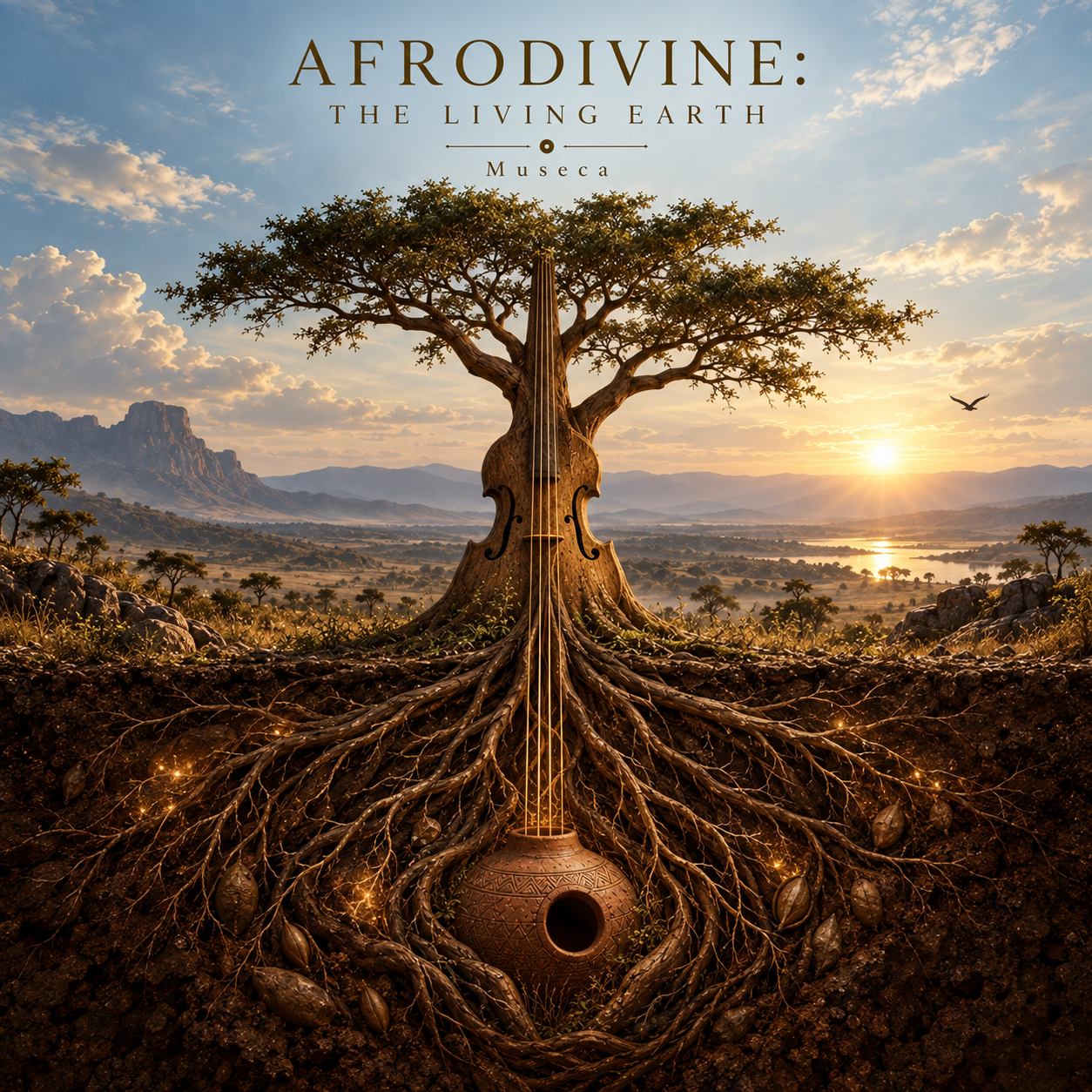
AfroDivine: The Living Earth
AfroDivine: The Living Earth marks a new chapter in the evolution of AfroDivine. The earlier albums explored the inner spiritual landscape: awakening, identity, shadow, becoming, unity, remembrance, and the recognition of the sacred within the self. The Living Earth turns the gaze outward—not away from the spiritual, but toward the physical world as another source of spiritual knowledge. Here, earth, rain, stone, wind, drought, tide, migration, seed, and bloom are not merely images drawn from nature. They are processes through which life reveals how it works.
The central idea of the album is simple:
The Earth does not teach through words. It teaches through processes.
A seed grows before anyone can see it. Rain arrives without being commanded. Stone changes under pressure. Wind touches without possessing. Roots survive beneath apparently lifeless ground. Tides advance and withdraw. Living things migrate when conditions change. Flowers emerge only after long periods of invisible preparation. Nothing keeps its form forever, yet life continually moves from one form into another.
The songs do not attempt to turn these processes into easy spiritual slogans. The Living Earth is less interested in telling the listener what to believe than in noticing what the living world already demonstrates. Growth is not always visible. Retreat is not always failure. Stillness is not always absence. Receiving is not passivity. Movement is not necessarily escape. Expression does not require permission. Transformation does not require permanence.
This gives The Living Earth a different philosophical character from the previous AfroDivine albums. Where earlier works often approached spirituality through consciousness, self-knowledge, sacred identity, inner freedom, or metaphysical realization, this album begins with observation. Its wisdom is embodied rather than abstract. The listener is not asked to leave the material world in search of something higher. The material world itself becomes the teacher.
Musically, the album also represents one of the largest expansions of the AfroDivine sound to date. The fundamental AfroDivine identity remains intact: percussion remains the narrative engine, the groove is warm and polyrhythmic, harmony moves slowly, the vocal remains intimate and prayer-adjacent, and each track moves through a ritual arc toward an emotional rather than explosive arrival. But The Living Earth introduces a new musical synthesis:
AfroDivine + Desert Blues + Chamber Groove + Udu.
The dry, circular electric-guitar language of Desert Blues brings movement, distance, repetition, and landscape into the music. Short modal guitar figures circle through the percussion rather than sitting above it, often repeating with small changes until they become almost elemental. The udu, with its resonant clay body, becomes one of the album’s defining sounds—at different moments functioning as heartbeat, breath, weight, dialogue, opening, impact, or the low voice of the ground itself.
The most unusual development, however, may be the emergence of Chamber Groove. Cello and viola are not simply added as orchestral decoration. They enter the rhythmic machinery of the music. Pizzicato cello locks against desert guitar and udu; short bowed figures become percussion; viola establishes counter-rhythms; only later do these instruments open into sustained lyrical lines. The strings therefore earn their lyricism through participation in the groove. When the cello finally rises into arco at an emotional peak, the effect is not that an orchestra has been added—it is that something which has been moving close to the earth has suddenly learned to rise.
Around this central trio of udu, desert guitar, and cello, the album gradually reveals a wider organic ensemble: djembe, conga, calabash, shakers, frame drum, fretless bass, ngoni, gyil, wooden flute, bass clarinet, viola, violin, and restrained communal voices. Each instrument is given a distinct role within the ecosystem rather than being used simply for exotic color. The ngoni converses with electric guitar; gyil adds wooden brightness to the groove; frame drum suggests larger cycles of movement; bass clarinet gives subterranean breath to periods of dormancy; wooden flute introduces air and spaciousness. The resulting music is simultaneously earthy and elegant, ancient and contemporary, physical and contemplative.
Throughout the album, the instrumentation can almost be understood as two interacting realms. Earth is heard in udu, kick, hand percussion, fretless bass, low guitar, ngoni, and pizzicato cello—the instruments of gravity, contact, pulse, and movement. Sky appears through bowed cello, viola, violin, wooden flute, voice, and atmospheric harmonic color—the instruments of breath, expansion, and elevation. Much of the album’s emotional power comes from the continual conversation between these two worlds.
The ten vocal tracks form a progression through the processes of living: belonging in “Under Every Step,” hidden becoming in “What the Seed Knows,” receptivity in “When the Rain Comes,” formation in “Stone Remembers Pressure,” freedom in “The Wind Owns Nothing,” dormancy in “Drought Is Not Death,” retreat and return in “The Tide Knows When to Leave,” purposeful movement in “The Wisdom of Migration,” emergence in “Bloom Without Permission,” and transformation in “Everything Returns to the Living.” Together, they suggest that life is not defined by a single direction. Life roots and moves, opens and closes, receives and releases, appears and disappears, changes form and begins again.
The album concludes with the bonus instrumental “The Earth Without Words.” After ten songs in which human language attempts to interpret what the Earth teaches, the words finally fall away. Udu, desert guitar, cello, percussion, fretless bass, chamber instruments, and the album’s other acoustic colors are allowed to speak for themselves. The gesture completes the idea with which the album began:
The Earth does not teach through words. It teaches through processes.
AfroDivine: The Living Earth is therefore not simply another AfroDivine album with different instrumentation. It expands what AfroDivine can be. The sacred groove remains, but it has moved into soil, weather, body, breath, movement, and matter. The dance floor is still a ritual space—but now the ritual is taking place upon the oldest floor of all: the living Earth.
Liner Notes
AfroDivine: The Living Earth
The Living Earth extends the AfroDivine language into a new sonic world: AfroDivine + Desert Blues + Chamber Groove + Udu. The percussion-led ritual foundation of AfroDivine remains intact, but this album places extraordinary emphasis on instrumental conversation—especially among udu, desert-blues electric guitar, cello, fretless bass, hand percussion, and chamber instruments.
Across the album, the instruments often behave almost like characters. Udu becomes heartbeat, earth, breath, impact, and response. Desert guitar provides circular motion and landscape. Cello moves between rhythm and lyricism. Other instruments—ngoni, gyil, frame drum, bass clarinet, wooden flute, viola, violin, calabash, djembe, and fretless bass—enter as colors within this living ecosystem.
Under Every Step
The album begins with the simplest possible recognition: before we know where we are going, the ground is already beneath us. Under Every Step establishes belonging not as something earned, but as something already present. The music introduces the album’s fundamental relationship between Earth and Sky: udu and low percussion establish gravity, while guitar and cello gradually open the space above them.
Instruments used: udu, warm AfroDivine kick, djembe, shaker, dry desert-blues electric guitar, fretless bass, pizzicato cello, arco cello, viola, light violin, restrained atmospheric pad, female neo-soul voice, subtle communal responses.
Predominant instruments: udu, desert-blues electric guitar, cello, fretless bass.
The udu functions almost as the first heartbeat of the album. Guitar establishes movement, while cello begins rhythmically before opening upward into sustained chamber color.
Lyrics
I thought I had to know
before I moved,
had to see the road
before I chose.
But the dust received my heel,
the stone received my weight,
and nothing underneath me
asked me where I meant to go.
Even when I trembled,
even when I turned,
something stayed beneath me,
something never moved.
Under every step,
the ground was already there.
Under every step,
before I knew where I was going.
I did not have to earn
the earth beneath my feet.
Under every step,
I was already held.
I have walked toward doors
that never opened.
I have left some rooms
too late.
I have followed what was fading,
I have run from what would stay,
but even all my wandering
could never make the ground withdraw.
When I lost direction,
when the signs were gone,
something stayed beneath me,
quietly carrying on.
Under every step,
the ground was already there.
Under every step,
before I knew where I was going.
I did not have to earn
the earth beneath my feet.
Under every step,
I was already held.
Maybe belonging
doesn’t start with finding home.
Maybe home begins
wherever weight is given somewhere to rest.
Maybe the first answer
was never up ahead.
Maybe it was waiting
under every step.
Under every step,
the ground was already there.
Under every step,
through every leaving, every turning.
Nothing underneath me
asked what I would become.
Under every step,
I was already held.
Under every step.
Already there.
Under every step.
Already held.
Under every step.
Already there.
Under every step.
Already held.
Under every step.
What the Seed Knows
A seed begins becoming long before the world can see evidence of growth. This track explores hidden preparation—the intelligence of beginnings that do not yet look like beginnings.
Musically, the song introduces one of the defining discoveries of The Living Earth: instrumental interlock. Guitar, cello, and udu do not simply accompany one another; they occupy different rhythmic spaces and converse.
Instruments used: dry desert-blues electric guitar, udu, warm kick, djembe, shaker, calabash, fretless bass, pizzicato cello, arco cello, viola, female neo-soul voice, restrained group responses.
Predominant instruments: desert-blues guitar, pizzicato cello, udu, djembe, fretless bass.
The guitar and cello form the central rhythmic counterpoint, while udu fills and answers the spaces between them.
Lyrics
Buried where no eye can follow,
closed inside a coat of brown,
nothing in the empty surface
shows what waits beneath the ground.
No branch reaches for the morning.
No green rises through the clay.
Still the smallest hidden body
has already turned toward day.
It does not ask the darkness
to explain what comes next.
It does not need a picture
of the thing it will become.
What does the seed know
under all that earth?
What does the seed know
before the first green breaks?
It knows when rain has found it.
It knows when warmth has come.
It opens without seeing
everything that it will be.
There are days when nothing changes,
not a sign above the ground.
There are nights when all the growing
happens where it can’t be found.
Roots move softly through the darkness,
making room where none was seen.
Long before the world can name it,
something has begun to green.
It does not call the waiting
a failure or delay.
It does not measure becoming
by what can be seen today.
What does the seed know
under all that earth?
What does the seed know
before the first green breaks?
It knows when rain has found it.
It knows when warmth has come.
It opens without seeing
everything that it will be.
Maybe not all beginnings
look like beginnings.
Maybe not all movement
can be seen.
Maybe the deepest change
starts without a witness.
Maybe life begins
by leaning toward what calls it.
What does the seed know
under all that earth?
What does the seed know
before the first green breaks?
It knows when rain has found it.
It knows when warmth has come.
It opens without seeing
everything that it will be.
What does the seed know?
When to open.
What does the seed know?
When to rise.
What does the seed know?
How to become.
Long before the green appears,
something is already growing.
When the Rain Comes
Rain cannot be commanded. The earth’s participation begins in its capacity to receive. This song considers receptivity not as passivity but as another form of action: sometimes opening is the work.
The music is more fluid than the preceding tracks. Short bowed cello figures replace the predominantly pizzicato writing of What the Seed Knows, creating the sensation of motion through the ground.
Instruments used: udu, djembe, calabash, shaker, warm kick, fretless bass, sparse desert-blues guitar, rhythmic bowed cello, lyrical arco cello, viola, female neo-soul voice, restrained communal responses.
Predominant instruments: udu, bowed cello, desert-blues guitar, rolling djembe, fretless bass.
Cello is particularly important here, moving from short rhythmic strokes toward increasingly fluid lines as the arrangement opens.
Lyrics
The ground had opened into dust,
cracked beneath the afternoon.
Every root was waiting lower
than the heat could ever reach.
Nothing pulled the clouds together.
Nothing called the water down.
Still the earth kept making room
for what had not arrived.
There are things
you cannot hurry.
There are doors
that open by receiving.
When the rain comes,
let the ground take what it needs.
When the rain comes,
let the dry places drink.
You don’t have to pull
the water from the sky.
Open where you are.
When the rain comes,
receive.
Somewhere underneath the surface,
roots had never learned to leave.
They had waited without knowing
which horizon held the rain.
Then one drop became another.
Dust grew dark beneath the fall.
What looked empty started drinking
as though it remembered how.
There are gifts
that cannot be demanded.
There are changes
that begin when we make room.
When the rain comes,
let the ground take what it needs.
When the rain comes,
let the dry places drink.
You don’t have to pull
the water from the sky.
Open where you are.
When the rain comes,
receive.
The field never failed
because it could not make the weather.
The root never failed
because the cloud was far away.
Sometimes readiness
is all the earth can offer.
Sometimes opening
is the work.
When the rain comes,
let the ground take what it needs.
When the rain comes,
let the dry places drink.
You don’t have to pull
the water from the sky.
Open where you are.
When the rain comes,
receive.
When it comes—
Receive.
When it comes—
Make room.
When it comes—
Let it in.
What looked empty
remembered how to drink.
Stone Remembers Pressure
Stone does not remain unchanged simply because its transformation occurs slowly. Pressure, weather, water, heat, and time leave structure behind.
The track intentionally avoids treating difficulty as automatically beneficial. Instead, it observes that experience changes form. The arrangement responds with the album’s heaviest low-register chamber writing.
Instruments used: low pizzicato cello, bowed cello accents, sparse low-register desert-blues guitar, deep udu, warm kick, djembe, calabash, shaker, restrained low conga, fretless bass, viola, female neo-soul voice.
Predominant instruments: low pizzicato cello, udu, desert guitar, fretless bass, djembe.
Here the cello becomes almost a second bass instrument. Udu provides weight and punctuation, while the sparse guitar suggests erosion through repetition and small changes.
Lyrics
Stone does not keep
the shape it started with.
Rain finds the edge.
Heat enters the grain.
Weight settles slowly
where no eye can see.
Nothing announces
the moment form begins to change.
Some things leave a mark
without leaving a wound.
Some things press so long
they become part of the shape.
Stone remembers pressure.
Not as blame.
Not as praise.
In the line where it fractured,
in the face that weather made.
Stone remembers pressure.
Every weight,
every year.
What passed across the surface
left something living here.
Water never shouted
at the canyon wall.
It returned.
Again.
Again.
Until the hardest surface
carried evidence of flow.
Fire moves through minerals.
Time moves through everything.
What looks unchanging
is changing slowly still.
Some things break us open.
Some things teach us form.
Some things leave behind
a strength we never asked to learn.
Stone remembers pressure.
Not as blame.
Not as praise.
In the line where it fractured,
in the face that weather made.
Stone remembers pressure.
Every weight,
every year.
What passed across the surface
left something living here.
I will not call every burden
a blessing.
I will not call every breaking
necessary.
But I can look at what remains
and know this much:
I am not the shape
I was before.
Stone remembers pressure.
Not as blame.
Not as praise.
In the line where it fractured,
in the face that weather made.
Stone remembers pressure.
Every weight,
every year.
What passed across the surface
became part of what is here.
Still changing.
Still here.
Still changing.
Still here.
Even stone
is never finished.
The Wind Owns Nothing
Wind touches everything and possesses nothing. The song explores a freedom based not on having more, but on moving through life without needing to keep everything encountered along the way.
After the density of Stone Remembers Pressure, this track deliberately opens the sound field.
Instruments used: dry desert-blues electric guitar, breathy wooden flute, light udu body and rim articulations, warm kick, djembe, calabash, shaker, restrained conga, fretless bass, light pizzicato cello, arco cello, viola, female neo-soul voice.
Predominant instruments: desert-blues guitar, wooden flute, light udu, shaker, pizzicato cello.
The wooden flute makes its first important appearance here, becoming the album’s clearest instrumental representation of air and breath.
Lyrics
The wind passes through the branches,
moves the leaves and carries on.
Touches every open window,
stays with no one very long.
It bends the grass without keeping it,
crosses water without a claim.
Everywhere it leaves a movement,
nowhere does it write its name.
Maybe freedom
doesn’t need to hold.
Maybe touching
is enough.
The wind owns nothing,
still it goes everywhere.
The wind owns nothing,
still the whole world knows it’s there.
It moves through every doorway,
leaves every doorway free.
The wind owns nothing,
and nothing owns the wind.
It does not keep the mountain
because it crossed the stone.
It does not take the ocean
because it touched the foam.
It enters through the curtains,
moves across a sleeping room,
then leaves before the morning
with nothing it can lose.
Maybe having
is not the same as living.
Maybe leaving room
is part of how we move.
The wind owns nothing,
still it goes everywhere.
The wind owns nothing,
still the whole world knows it’s there.
It moves through every doorway,
leaves every doorway free.
The wind owns nothing,
and nothing owns the wind.
I have held some things
long after they were gone.
I have called it keeping
when I was only afraid to release.
But the wind does not ask
what it can carry forever.
It passes through,
and keeps moving.
The wind owns nothing,
still it goes everywhere.
The wind owns nothing,
still the whole world knows it’s there.
It moves through every doorway,
leaves every doorway free.
The wind owns nothing,
and nothing owns the wind.
Let it move.
Let it go.
Let it touch.
Let it pass.
Let it move.
Let it go.
It touched everything.
It took nothing.
Drought Is Not Death
The surface can appear empty while life continues beneath it. Roots conserve energy. Growth slows. Organisms close what they must in order to remain alive.
This is the album’s most restrained piece, and its musical architecture mirrors dormancy: the full groove is withheld and gradually discovered rather than presented immediately.
Instruments used: dry udu rim and body taps, shaker, calabash, low djembe, restrained warm kick, sparse desert-guitar fragments and harmonics, low pizzicato cello, arco cello, late-entering fretless bass, bass clarinet, sparse viola, female neo-soul voice.
Predominant instruments: bass clarinet, udu, fragmented desert guitar, low cello, fretless bass.
The introduction of bass clarinet gives the track a subterranean breath. Its dark wooden register suggests something still living below an apparently barren surface.
Lyrics
The field has stopped explaining itself.
Nothing rises.
Nothing opens.
Dust gathers where the green once stood,
and every afternoon
looks like the one before.
But underneath the hardened surface,
roots have not forgotten
what they are.
Not every silence
is an ending.
Not every stillness
means the life has gone.
Drought is not death.
The root can wait
beneath the empty ground.
Drought is not death.
Not everything alive
has to show itself today.
The field may look unfinished.
The sky may give no sign.
Drought is not death.
Some life survives
by learning how to wait.
Leaves fall early
when the water disappears.
Branches stop reaching
where they cannot afford to grow.
The plant does not call this failure.
It closes what it must,
sends what remains
down toward the root.
There are seasons
when staying alive
is enough.
Not every season
asks for flowering.
Not every change
needs to be seen.
Drought is not death.
The root can wait
beneath the empty ground.
Drought is not death.
Not everything alive
has to show itself today.
The field may look unfinished.
The sky may give no sign.
Drought is not death.
Some life survives
by learning how to wait.
I will not pretend
the dry season is easy.
I will not call the empty field
beautiful just because it may return.
But I can stop confusing
quiet with disappearance.
I can stop demanding
a flower
from everything that lives.
Drought is not death.
The root is still
beneath the empty ground.
Drought is not death.
Not everything alive
has to prove itself today.
The field may wait in silence.
The sky may give no sign.
Drought is not death.
Some life survives
by learning how to wait.
Still here.
Still here.
Still waiting.
Still here.
Still living.
Still here.
The ground looks empty.
The root knows otherwise.
The Tide Knows When to Leave
The tide advances and retreats without treating either movement as failure. This song explores withdrawal as part of rhythm rather than as the opposite of progress.
The arrangement itself repeatedly expands and contracts. Instruments disappear, return, and gather again.
Instruments used: frame drum, udu, warm kick, djembe, calabash, shaker, fretless bass, cyclical desert-blues electric guitar, pizzicato cello, arco cello, viola, female neo-soul voice.
Predominant instruments: frame drum, udu, cyclical desert guitar, cello, viola.
The frame drum enters the album here as a new low, rounded pulse. Together with udu, it creates the sense of larger waves beneath the quicker percussion lattice.
Lyrics
The water reaches for the shore,
then turns before it stays.
Leaves a shining line behind,
then carries itself away.
No one calls the ocean faithless
when it loosens from the sand.
No one asks the tide to prove
that leaving has a plan.
It knows when to gather.
It knows when to go.
It does not confuse
distance with an ending.
The tide knows when to leave.
It pulls away
and still belongs.
The tide knows when to leave.
Retreat is written
inside the song.
Every shore it empties
will feel the water rise again.
The tide knows when to leave.
And leaving is part of return.
There are times when moving closer
is not the movement that we need.
There are rooms we only understand
after we have learned to leave.
There are answers in the distance,
there are truths that need some space.
What looks like disappearing
may be rhythm changing shape.
It knows when to gather.
It knows when to go.
It does not call
every backward motion loss.
The tide knows when to leave.
It pulls away
and still belongs.
The tide knows when to leave.
Retreat is written
inside the song.
Every shore it empties
will feel the water rise again.
The tide knows when to leave.
And leaving is part of return.
I used to think
that every step away
meant I had failed to stay.
I used to think
that moving back
meant I had lost the way.
But water knows
what I was slow to learn:
Not every leaving
is departure.
Some leaving
makes return possible.
The tide knows when to leave.
It pulls away
and still belongs.
The tide knows when to leave.
Retreat is written
inside the song.
Every shore it empties
will feel the water rise again.
The tide knows when to leave.
And leaving is part of return.
Pull away.
Return.
Make room.
Return.
Let go.
Return.
The shore is not abandoned.
The water is only moving.
The Wisdom of Migration
Not every living thing survives by remaining where it began. Migration may be less an act of departure than an act of fidelity to changing conditions.
The music becomes more propulsive, emphasizing travel rather than retreat. A new acoustic voice enters into conversation with the electric guitar.
Instruments used: ngoni, dry desert-blues electric guitar, udu, warm kick, djembe, calabash, shaker, restrained conga, fretless bass, pizzicato cello, arco cello, viola, light violin, female neo-soul voice.
Predominant instruments: ngoni, desert-blues guitar, pizzicato cello, udu, djembe, fretless bass.
The ngoni and electric guitar form one of the album’s most distinctive dialogues: acoustic and electric, memory and horizon, earth and movement.
Lyrics
The season changed before I moved.
The grass had thinned,
the water lowered,
the mornings carried different air.
Nothing told the wings to leave.
Nothing drew a line across the sky.
Still they turned
toward somewhere else.
Not every leaving
means we lost our place.
Not every distance
means we lost our way.
There is wisdom in migration.
Knowing when the season turns.
There is wisdom in migration.
Knowing what the body learns.
Some things live by staying.
Some things live by moving on.
There is wisdom in migration.
Life keeps going
where life can go.
A tree must stay
and learn the weather.
A bird can cross
a thousand miles.
One survives by holding ground.
One survives by changing skies.
The lesson is not leaving.
The lesson is not staying.
The lesson is to notice
what the living moment asks.
There are places
that once held us well.
There are seasons
that do not last.
There is wisdom in migration.
Knowing when the season turns.
There is wisdom in migration.
Knowing what the body learns.
Some things live by staying.
Some things live by moving on.
There is wisdom in migration.
Life keeps going
where life can go.
I have stayed
because I was afraid to move.
I have moved
because I was afraid to stay.
Neither fear
knew where I belonged.
But life is quieter than fear.
It asks a simpler question:
What can still grow here?
There is wisdom in migration.
Knowing when the season turns.
There is wisdom in migration.
Knowing what the body learns.
Some things live by staying.
Some things live by moving on.
There is wisdom in migration.
Life keeps going
where life can go.
When the season turns—
Move.
When the ground still holds—
Stay.
When the answer changes—
Listen.
The sky did not tell the wings.
The wings already knew.
Bloom Without Permission
What began invisibly in What the Seed Knows finally becomes visible here. Blooming is not presented as achievement or defiance, but as the natural emergence of processes already completed beneath the surface.
The track is among the album’s most joyous and rhythmically active pieces.
Instruments used: gyil, dry desert-blues electric guitar, lively udu, warm kick, djembe, calabash, shaker, restrained conga, fretless bass, highly rhythmic pizzicato cello, soaring arco cello, viola, light violin, communal claps, female neo-soul voice.
Predominant instruments: gyil, desert-blues guitar, pizzicato cello, udu, djembe.
The introduction of gyil gives the arrangement wooden brightness without abandoning the organic character of the album. Its short patterns interlock with guitar, cello, and udu to create one of the strongest grooves in the cycle.
Lyrics
The bud never asked the branch
if this was the right day.
Never checked the other flowers.
Never waited to be named.
All that quiet underneath,
all that reaching through the dark,
came together in one morning
and opened where it was.
No announcement.
No permission.
Just the season
meeting what was ready.
Bloom without permission.
Open when the time has come.
Bloom without permission.
You don’t have to ask the sun.
Everything that happened
before the color could be seen
is opening now.
Bloom without permission.
Roots had done their work in darkness.
Rain had entered where it could.
Heat had moved across the surface.
Waiting had done what waiting does.
Nothing wasted.
Nothing hurried.
Nothing needed to be proved.
Then the green became a color
because color was the next thing to do.
Not rebellion.
Not performance.
Just the living
becoming visible.
Bloom without permission.
Open when the time has come.
Bloom without permission.
You don’t have to ask the sun.
Everything that happened
before the color could be seen
is opening now.
Bloom without permission.
Maybe expression
is not the opposite of humility.
Maybe a flower
does not become less rooted
because it can finally be seen.
Maybe hiding
and becoming
were never the same thing.
Maybe the work of the root
was always leading here.
Bloom without permission.
Open when the time has come.
Bloom without permission.
You don’t have to ask the sun.
Everything that happened
before the color could be seen
is opening now.
Bloom without permission.
Open.
Now.
Become.
Visible.
Open.
Now.
Become.
Visible.
The root did not disappear.
It became the flower.
Everything Returns to the Living
The final vocal song gathers the album’s ideas into one recognition: forms change, but change itself allows life to continue. Leaf becomes soil. Water becomes cloud and rain. Seed becomes plant. What returns does not necessarily return unchanged.
Musically, the track also functions as a synthesis. Rather than introducing another major new instrument, it brings together colors heard throughout the album and gradually returns them to the central trio.
Instruments used: udu, desert-blues electric guitar, pizzicato cello, arco cello, warm kick, djembe, calabash, shaker, frame drum, fretless bass, ngoni, sparse gyil, viola, light violin, wooden flute, very restrained bass clarinet, female neo-soul voice, subtle communal responses.
Predominant instruments: udu, desert-blues guitar, cello, fretless bass.
The cello travels from low rhythmic pizzicato to expansive arco, while the arrangement eventually thins back to cello, guitar, and udu—the three sounds that have come to define The Living Earth.
Lyrics
A leaf lets go
and does not disappear.
It settles into rain,
into soil,
into the dark beneath the root.
The tree releases
what it cannot keep,
and something underneath
already knows
what to do with what has fallen.
Nothing keeps its shape forever.
That is not the same
as nothing remains.
Everything returns to the living.
Rain to root,
leaf to ground.
Everything returns to the living.
What falls away
keeps moving on.
The form may end.
The giving does not.
Everything returns
to the living.
Fruit opens
and gives away its seed.
Wood softens
under weather and years.
Water rises,
leaves the ocean,
crosses sky,
and finds the earth again.
Nothing comes back
exactly as it was.
Still something continues.
The shape is temporary.
The movement carries on.
Everything returns to the living.
Rain to root,
leaf to ground.
Everything returns to the living.
What falls away
keeps moving on.
The form may end.
The giving does not.
Everything returns
to the living.
Maybe continuation
does not mean staying the same.
Maybe return
does not mean coming back unchanged.
Maybe the living world
has never promised permanence.
Only transformation.
Only passage.
Only one form
making room for another.
Everything returns to the living.
Rain to root,
leaf to ground.
Everything returns to the living.
What falls away
keeps moving on.
The form may end.
The giving does not.
Everything returns
to the living.
Nothing stays—
Nothing is wasted.
Nothing stays—
Everything changes.
Everything changes—
Life continues.
Nothing keeps its shape forever.
Everything returns.
The Earth Without Words
Bonus Instrumental
After ten songs in which human language interprets the processes of the Earth, language disappears.
The Earth Without Words allows the instrumental vocabulary of the album to become the subject itself. The piece is structured as an extended ritual rather than a conventional song, giving the principal instruments room to speak individually and then reassemble into the full AfroDivine groove.
Instruments used: udu, desert-blues electric guitar, cello in pizzicato and arco techniques, fretless bass, warm kick, djembe, calabash, shaker, frame drum, ngoni, gyil, viola, wooden flute.
Predominant instruments: udu, desert-blues electric guitar, cello.
These three instruments are the protagonists. The udu receives an extended percussive feature using cavity tones, body strikes, and rim articulations. The guitar develops the album’s circular Desert Blues language through repeated modal cells, bends, slides, and rhythmic displacement. The cello begins inside the groove as pizzicato rhythm and gradually transforms into an expressive bowed voice.
The three eventually enter direct instrumental conversation before the larger ensemble gathers around them. At the reverent peak, percussion, fretless bass, ngoni, gyil, viola, and wooden flute expand the sound without displacing the central trio.
The track ultimately withdraws again.
The cello falls silent.
The guitar reduces itself to a final small motif.
Then it too disappears.
Only the udu remains.
One last resonance from a vessel made of earth closes an album devoted to listening to what the Earth has been saying all along.
Playlist
- Track 1 — Under Every Step Museca 4:49
- Track 2 — What the Seed Knows Museca 5:09
- Track 3 — When the Rain Comes Museca 5:00
- Track 4 — Stone Remembers Pressure Museca 4:58
- Track 5 — The Wind Owns Nothing Museca 4:56
- Track 6 — Drought Is Not Death Museca 5:12
- Track 7 — The Tide Knows When to Leave Museca 5:18
- Track 8 — The Wisdom of Migration Museca 5:24
- Track 9 — Bloom Without Permission Museca 4:39
- Track 10 — Everything Returns to the Living Museca 5:26
- Track 11 - The Earth Without Words Museca 4:10