Return to the source
AfroDivine
Explore the founding AfroDivine album, where Afro-house, neo-soul, female vocals, hand percussion, and spiritual intention first meet in Museca’s original style.
Explore album ↗
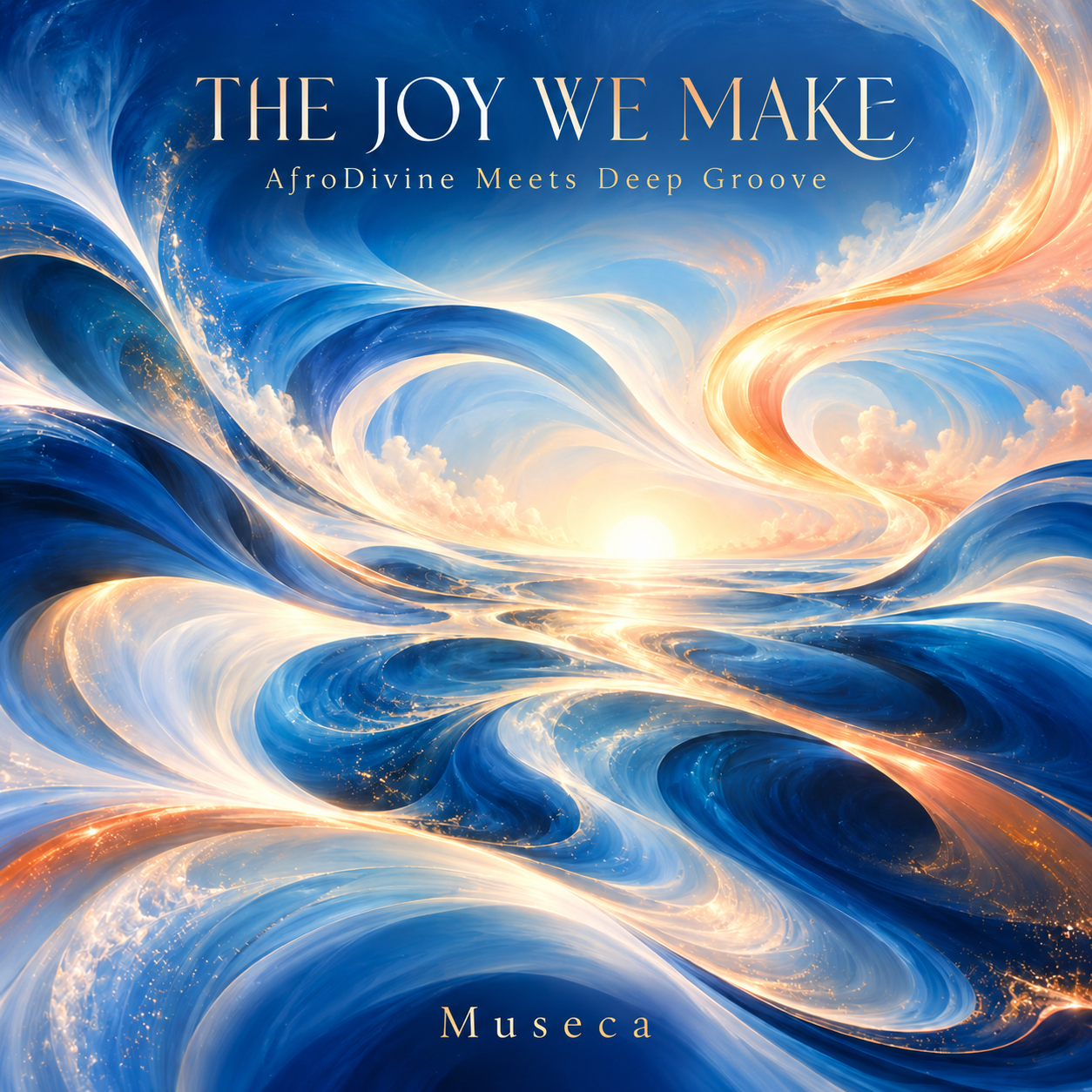
Some music invites us to listen. Other music invites us to move. The Joy We Make invites us to do both—and to discover something profound in the experience of moving together. Across ten original compositions, Museca explores the relationship between rhythm, human connection, emotional vulnerability, and the joy that emerges when individual lives become part of something shared.
At the heart of the album is AfroDivine, an original musical style developed by Museca that brings together the polyrhythmic energy of Afro-house, the harmonic richness and vocal intimacy of neo-soul, and the spiritual resonance of West African and Sahel musical traditions. AfroDivine approaches music as more than entertainment: rhythm becomes a form of expression, the human voice becomes an instrument of emotional and spiritual discovery, and movement becomes a celebration of being alive. Its spiritual character is inclusive rather than doctrinal, finding the sacred in ordinary human experience. It is, in essence, dance music that behaves like a ritual.
With The Joy We Make, AfroDivine encounters deep groove, intensifying the rhythmic sophistication and physical energy already inherent in the style. Warm, rounded house rhythms intertwine with syncopated electric bass lines, conversational congas, shimmering shakers, clipped clavinet figures, and the lush extended harmonies of the Rhodes piano. Rather than relying on repetitive beats or overwhelming electronic production, the music develops its momentum through the intricate relationships between instruments. Rhythmic patterns anticipate, answer, overlap, and occasionally withdraw, creating a constantly evolving musical conversation. Expressive saxophone, flugelhorn, bass clarinet, balafon, mbira, and talking drum introduce distinctive melodic and rhythmic colors, each contributing its own voice to the larger ensemble.
Throughout the album, a soulful female alto and a responsive, gospel-influenced vocal ensemble bring warmth, intimacy, and collective energy to the compositions. Their exchanges are woven into the grooves themselves, allowing vocal melody, percussion, and instrumental counterpoint to become inseparable elements of the music. The result is a richly layered sound that is at once sophisticated and accessible, emotionally expressive and irresistibly danceable.
Yet beneath its exuberant rhythms lies a deeper lyrical journey. The songs explore what it means to belong, to remain open to others, to transform compassion into action, to respect individuality, to carry grief without surrendering joy, and to find courage in vulnerability. Moving from the welcoming invitation of The Circle Opens through the tenderness of What the Silence Holds and The Light We Leave On, the album gradually arrives at a broader understanding of human connection. Its concluding compositions celebrate not a world free of difficulty, but the extraordinary beauty that can emerge when people meet one another with generosity, honesty, and love.
Ultimately, The Joy We Make is a celebration of both individuality and togetherness. Its interlocking rhythms offer a musical reflection of its central philosophy: each instrument retains its own character, each voice contributes something distinct, and the resulting harmony is greater than any single part. The groove moves the body, the melodies touch the heart, and the lyrics invite reflection on the ways we shape one another’s lives.
Joy, the album suggests, is not simply something we find within ourselves. It is also something we create together.
The album begins with an invitation to belong. A simple rhythmic gesture becomes a conversation, and that conversation gradually becomes a community. Through the metaphor of people making music together, The Circle Opens explores the possibility that genuine harmony arises not through domination or conformity, but through the generosity of making room for another person.
The composition establishes the album’s signature AfroDivine deep-groove soul-house sound. A warm four-on-the-floor kick supports cross-rhythmic congas, shimmering shakers, and a deeply elastic, syncopated electric bass. Clipped clavinet figures answer the percussion while the Rhodes piano introduces rich, extended neo-soul harmonies. A soulful female alto exchanges short, joyful phrases with a mixed gospel-influenced chorus, and a featured tenor saxophone contributes expressive melodic improvisation and intimate conversations with the Rhodes. Independent instrumental voices become an exuberant, unified ensemble, giving musical expression to the song’s central philosophy.
Verse 1
Someone tapped against the railing
Three soft notes against the day
Then another hand came answering
And the music found its way
Nobody owned the little rhythm
Nobody had to take the lead
We left a space for one another
And that was all the song would need
Pre-Chorus
A little room, a little kindness
A little courage to begin
And every sound that came to meet us
Made the circle open in
Chorus
One more step!
And the circle grows!
One more voice!
And the music flows!
No one has to carry it alone
Every rhythm finds a home
Verse 2
Some arrived with quiet burdens
Some with laughter in their hands
No one had to tell their story
To be welcomed where we stand
And an older voice grew tender
As it found a second line
What began as one small tapping
Now was many keeping time
Chorus
One more step!
And the circle grows!
One more voice!
And the music flows!
No one has to carry it alone
Every rhythm finds a home
Bridge
Now the drums have fallen silent
Still the pattern doesn’t end
I can feel it in the spaces
Where a stranger turns a friend
And the circle grows
Final Chorus
One more step!
And the circle grows!
One more voice!
And the music flows!
No one has to carry it alone
Every rhythm finds a home
Let the circle open wide!
Let the music come alive!
Life can become a continuous sequence of obligations, plans, and deferred pleasures. In A Little More Alive, a woman recognizes how often she has postponed her own happiness until some imagined future moment when every difficulty will finally be resolved. An unexpected encounter in the rain awakens her to a gentler truth: the world may remain unfinished, and life may remain imperfect, but neither condition prevents us from experiencing its beauty.
The song develops a deep, rolling AfroDivine funk-inflected house groove, distinguished by an expressive electric bass line with occasional fretless-like slides. Crisp clavinet syncopations interlock with the dry offbeat accents of muted electric guitar, creating a lively rhythmic dialogue over warm kick, congas, and fine shakers. The Rhodes provides spacious Dorian harmonies and luminous extended chords. The intimate female alto gradually moves toward greater rhythmic freedom, while the gospel-response chorus transforms personal realization into collective affirmation. The bass becomes a featured melodic voice, demonstrating how a powerful groove can carry both introspection and exuberance.
Verse 1
A chipped blue cup beside the window
The morning turning silver-gray
I had filled my page with errands
Left no room to feel the day
I knew how to keep things moving
How to answer, how to plan
But I kept my heart for later
Like a letter in my hand
Pre-Chorus
I kept saying, when it’s over
When the questions disappear
I will give myself permission
To be fully living here
Chorus
Are the hard days over?
Not yet, not yet!
Can I live before they end?
Yes, yes, yes!
The weight is real, the rhythm too
There’s room for sorrow and for song
The world is still unfinished
And so am I
A little more alive
Verse 2
The wind turned someone’s umbrella
Inside out beside the curb
We both laughed into the weather
Without exchanging any words
No old worry had been settled
No lost hour had come back
But I stayed there in the rainfall
With the whole day on my skin
Pre-Chorus
My troubles hadn’t left me
But they didn’t have to lead
I could carry what was heavy
And still choose where I put my feet
Chorus
Are the hard days over?
Not yet, not yet!
Can I live before they end?
Yes, yes, yes!
The weight is real, the rhythm too
There’s room for sorrow and for song
The world is still unfinished
And so am I
A little more alive
Bridge
I will not call the darkness nothing
I won’t dress it up as light
But I won’t leave the door unopened
To the warmth that’s here tonight
Still alive
Still alive
Final Chorus
Are the hard days over?
Not yet, not yet!
Can I live before they end?
Yes, yes, yes!
The weight is real, the rhythm too
There’s room for sorrow and for song
The world is still unfinished
And so are we
A little more alive
A little more alive
More alive, more alive
Hope does not always arrive as a revelation. Sometimes it appears in the most ordinary human gestures: a neighbor arriving with a bucket, someone lifting a damaged table, or a stranger quietly offering help. The Morning Has Hands tells the story of a community responding to a flooded neighborhood grocery. Its central discovery is that compassion need not promise to repair everything. It becomes meaningful through what people are willing to do for one another.
The music introduces a bright, cross-rhythmic AfroDivine groove with a subtle three-against-two rhythmic character flowing through its steady house pulse. The distinctive voice of the West African balafon brings warm, wooden resonance and agile, repeating melodic figures. Its patterns converse with clipped clavinet accents while deep electric bass, interlocking congas, and shakers maintain irresistible forward motion. The Rhodes adds radiant Mixolydian-inspired harmonies, and the female alto engages a mixed gospel chorus in rhythmic exchanges that echo the coordinated physical activity described in the lyrics. A featured balafon passage celebrates the beauty of independent gestures becoming collective action.
Verse 1
Rain had reached the corner grocery
Left a waterline across the wall
She was standing in the doorway
With her keys, not moving at all
I could not tell her it was nothing
I could not promise she’d be fine
I set my coat beside the counter
And joined the little bucket line
Pre-Chorus
Hope did not arrive as thunder
Or a sudden change of sky
It came in sleeves rolled to the elbows
And the words, “I’ll take this side”
Chorus
Pass the bucket!
Down the line!
Hold the table!
Take your time!
The morning has hands, the morning has hands
It cannot put back what is gone
But hands can hold a weight together
And help a weary day move on
Verse 2
She found a picture of her father
In a drawer the rain had spared
She held it toward the morning
As if he might be standing there
Nobody hurried her to smiling
Nobody told her not to grieve
We left a little space around her
And kept on rolling up our sleeves
Pre-Chorus
She said, “I don’t know what comes after”
No one offered her a plan
But a neighbor took the far end
Of the table in her hands
Chorus
Pass the bucket!
Down the line!
Hold the table!
Take your time!
The morning has hands, the morning has hands
It cannot put back what is gone
But hands can hold a weight together
And help a weary day move on
Bridge
She said, “I may not open Monday”
I had no promise I could make
We let the future stay unanswered
And shared the weight we had today
Take your time
We’re still here
Final Chorus
Pass the bucket!
Down the line!
One more table!
Take your time!
The morning has hands, the morning has hands
It cannot put back what is gone
But hands can hold a weight together
And help a weary day move on
The morning has hands
Hand by hand, hand by hand!
Some of the most meaningful expressions of love occur without explanation, advice, or reassurance. What the Silence Holds portrays two people sitting together late at night, one burdened by feelings she cannot yet articulate, the other learning that genuine compassion sometimes means resisting the urge to repair another person’s experience. The song explores the dignity of listening, the courage of vulnerability, and the quiet consolation of dependable human presence.
Its musical foundation is a spacious, hypnotic AfroDivine deep groove, moving at a relaxed but compelling pace. A rounded house kick, gently displaced conga patterns, delicate shakers, and a syncopated electric bass establish an intimate rhythmic current. Sparse clavinet offbeats preserve forward motion without crowding the arrangement. The Rhodes supplies warm Dorian minor-ninth harmonies and suspended chord colors, creating an atmosphere of emotional openness. The featured bass clarinet brings a dark, woody, breath-shaped melodic voice, offering tender instrumental replies to the singer. Its expressive dialogue with the Rhodes becomes a musical reflection of the understanding that sometimes emerges between words.
Verse 1
Your coat was damp across the shoulders
You stood inside my kitchen door
The words you practiced on the stairway
Would not come out anymore
I put two cups upon the table
The kettle clicked, the rain came down
You drew a circle on the saucer
And listened to the traffic’s sound
Pre-Chorus
I almost reached for easy answers
To mend what I could not yet see
But no one needs a perfect sentence
To know another’s company
Chorus
If the words won’t rise?
Stay awhile, stay awhile!
If the tears come first?
Let them fall, let them fall!
Not every hurt is asking
For an answer or a name
There’s room for what the silence holds
When somebody chooses to stay
Verse 2
The clock went through another hour
Your hands grew quiet on the cup
You watched the shadows on the ceiling
As the night was giving up
At last you said, “I’m tired of telling
Everyone that I am fine”
I didn’t ask you to explain it
Or try to make your silence mine
Pre-Chorus
There was no sudden revelation
No way to turn the hurt aside
But something in that room grew lighter
With nothing left we had to hide
Chorus
If the words won’t rise?
Stay awhile, stay awhile!
If the tears come first?
Let them fall, let them fall!
Not every hurt is asking
For an answer or a name
There’s room for what the silence holds
When somebody chooses to stay
Bridge
You asked, “Will saying it change something?”
I said, “I cannot promise when
But if the words come back tomorrow
I’ll be listening again”
Again, again
Final Chorus
If the words won’t rise?
Stay awhile, stay awhile!
If the tears come first?
Let them fall, let them fall!
Not every hurt is asking
For an answer or a name
There’s room for what the silence holds
When somebody chooses to stay
We cannot mend it all tonight
But we can stay, we can stay
And meet the coming day
Love is easily expressed in words, but the true measure of kindness often lies in what we repeatedly choose to do. Kindness Has a Rhythm follows two sisters confronting the unequal responsibilities of caring for their aging mother. Through an ordinary act of showing up and sharing the work, the singer begins to understand that genuine care involves consistency, accountability, and the willingness to change. The song celebrates not moral perfection, but the courage to turn good intentions into dependable action.
A particularly infectious percussion-driven AfroDivine deep groove supports the narrative. Warm house kick, dry congas, fine shakers, and selectively displaced handclaps form a layered rhythmic foundation beneath an elastic electric bass ostinato. The featured West African talking drum contributes expressive, pitch-bending rhythmic phrases that answer the clavinet and converse with the hand percussion. Rich Rhodes harmonies provide warmth and emotional depth, while the female alto and mixed gospel chorus exchange concise, memorable calls and responses. The instrumental interplay reflects the lyrical message: different responsibilities become sustainable when people learn to share them.
Verse 1
At our mother’s kitchen table
You asked for just one afternoon
I counted all my obligations
While you stared down at your spoon
Then you folded up the calendar
Said, “All right, I’ll see it through”
And I heard how much was hidden
In that small “all right” from you
Pre-Chorus
I could say I cared forever
I could mean it every time
But the hours you were carrying
Were not getting lighter with mine
Chorus
When the work comes round?
Show up, show up!
When the road runs long?
Keep time, keep time!
Kindness has a rhythm
In the hours no one sees
Not in how we speak of loving
But the promises we keep
Verse 2
I came back early on a Thursday
You were reaching for your keys
I said, “I’ll take the afternoon now
Go get some air, and get some sleep”
You looked at me a moment
Like an offer you could doubt
Then you left your coat beside me
And the daylight led you out
Pre-Chorus
It didn’t make me good or blameless
Couldn’t give you back those years
But a habit starts with doing
What we once refused to hear
Chorus
When the work comes round?
Show up, show up!
When the road runs long?
Keep time, keep time!
Kindness has a rhythm
In the hours no one sees
Not in how we speak of loving
But the promises we keep
Bridge
I cannot carry every hour
I cannot make the old days right
But I can take the next one with you
And let our promises keep time
Keep time, keep time
Final Chorus
When the work comes round?
Show up, show up!
When the road runs long?
Keep time, keep time!
Kindness has a rhythm
In the hours no one sees
Not in how we speak of loving
But the promises we keep
When I fall behind?
Come back, come back!
When I lose the time?
Find it again!
Kindness has a rhythm
And the rhythm carries on
In the little things we come back for
Long after words are gone
Each human being carries a distinctive history, a personal rhythm, and a voice shaped by experiences that cannot be entirely known by another. Every Voice a River explores this individuality through the story of two singers attempting to make music together. What begins as an effort to impose a common rhythmic pattern gradually becomes an appreciation of the beauty that emerges when different musical identities are allowed to coexist. The song asks whether genuine unity might depend less on becoming alike than on learning to listen across our differences.
Its interlocking AfroDivine polyrhythmic groove places the Zimbabwean mbira at the center of an intricate musical conversation. The mbira’s plucked metallic tines create a flowing cyclic ostinato, complemented by clipped clavinet accents, deep syncopated electric bass, cross-rhythmic congas, and fine shakers. The Rhodes contributes warm Dorian minor-ninth and 6/9 harmonies. A lyrical tenor saxophone enters as a contrasting melodic voice, developing a conversation with the mbira rather than overwhelming it. The female alto and gospel chorus reinforce the theme through alternating phrases and layered harmonies. The individual instrumental lines retain their recognizable identities even as they form a coherent, deeply danceable whole.
Verse 1
We met above the old rehearsal room
With folding chairs against the wall
You carried music in a paper sleeve
I brought a pencil for us all
Your first phrase leaned across the downbeat
It moved where mine had never gone
I tapped it straight upon the table
And asked you just to sing along
Pre-Chorus
You closed the pages very gently
And said, “That’s how my mother sang”
I heard the quiet after saying
What I’d thought was such a little thing
Chorus
Keep your line!
Keep it true!
I’ll sing mine!
I’ll sing with you!
Every voice a river
Every river has its name
They can meet beneath one bridge
Without becoming all the same
Verse 2
You told me how she sang at evening
With the sewing on her knees
How she’d hold the final syllable
Against the turning of the breeze
I thought about my father’s whistling
On the landing of our stairs
The little tune he never finished
Still comes back when no one’s there
Pre-Chorus
I took the pencil from the table
And let your rhythm find its place
I didn’t need to make it mine
To hear the beauty in its shape
Chorus
Keep your line!
Keep it true!
I’ll sing mine!
I’ll sing with you!
Every voice a river
Every river has its name
They can meet beneath one bridge
Without becoming all the same
Bridge
I cannot know the road that made you
Or every sorrow in your song
But I can listen for the places
Where another voice belongs
Keep your line
Keep it true
And I’ll keep listening to you
Final Chorus
Keep your line!
Keep it true!
I’ll sing mine!
I’ll sing with you!
Every voice a river
Every river has its name
They can meet beneath one bridge
Without becoming all the same
And when our songs come together?
Let them rise, let them rise!
Will we still know where we came from?
Every line, every line!
Every voice a river
Every voice a way back home
Not one melody made smaller
Not one heart left singing alone
The experience of grief can make happiness feel disloyal to the memory of someone we have loved. The Light We Leave On tells of a woman who remembers her mother’s habit of leaving a hallway lamp burning for family members returning home. After her mother’s death, the familiar light becomes a symbol of absence. When children and family return to fill the house with conversation and laughter, the woman discovers that welcoming life again does not diminish the depth of her remembrance. Love, sorrow, gratitude, and joy can occupy the same heart.
The composition explores the expressive possibilities of a restrained, deeply flowing AfroDivine groove. A warm house pulse, delicate cross-rhythmic congas, fine shakers, and a subtly anticipatory electric bass sustain continuous movement beneath sparse clavinet accents. The Rhodes provides richly colored Dorian minor-ninth, minor-eleventh, and suspended harmonies. A single flugelhorn becomes the principal melodic voice, its mellow, rounded tone lending extraordinary tenderness to the instrumental passages. The soulful female alto moves between vulnerability and renewed warmth, supported by a gently responsive gospel chorus. The groove remains alive throughout, suggesting that remembrance and participation in the present are not opposing choices.
Verse 1
You always left the hallway lamp on
For whoever wandered home
A yellow pool across the floorboards
Said no one walked inside alone
Now your coat is gone from the hallway
Your handwriting fills a drawer
I find my hand upon the light switch
And cannot turn it on anymore
Pre-Chorus
I thought the dark was how I kept you
That laughter somehow would be wrong
But every room you made so welcoming
Still remembers how to hold a song
Chorus
Should I leave the light on?
Leave it on, leave it on!
When your footsteps won’t return?
Leave it on, leave it on!
Not to call the past back home
Not to say the hurt is gone
But to welcome those still finding
Their way in from the dark
The light we leave on
Verse 2
One Sunday my sister brought her children
Their small shoes gathered by the door
They filled the room with unfinished stories
And asked if they could stay for more
Without a speech or a decision
I turned the little lamp back on
Its light fell on the empty armchair
And the voices carried on
Pre-Chorus
I could hear the children’s laughter
And still remember how you smiled
The room was neither whole nor empty
As I watched them for a while
Chorus
Should I leave the light on?
Leave it on, leave it on!
When your footsteps won’t return?
Leave it on, leave it on!
Not to call the past back home
Not to say the hurt is gone
But to welcome those still finding
Their way in from the dark
The light we leave on
Bridge
I laughed before I knew I could
And felt the old ache answer too
I do not need to choose between
The life I have and missing you
There’s room for both
There’s room for both
Final Chorus
Shall we leave the light on?
Leave it on, leave it on!
For the ones still coming home?
Leave it on, leave it on!
I cannot bring your footsteps back
I will not call the grieving done
But love can make a room for others
The light we leave on
The light we leave on
Leave it on, leave it on
For the ones still coming home
Moving together does not mean that every disagreement has disappeared or every wound has healed. In When We Move as One, a woman encounters a friend whose confidence she previously betrayed. Surrounded by the energy of a neighborhood celebration, she chooses to acknowledge her wrongdoing without demanding immediate forgiveness. The composition examines reconciliation as an act of honesty, patience, and mutual freedom. Its celebration lies not in pretending the past has been erased, but in allowing the possibility of renewed connection to remain open.
This song introduces an especially energetic vocal-percussive AfroDivine deep groove. A powerful elastic bass line interlocks with clipped clavinet, dry muted electric guitar, cross-rhythmic congas, handclaps, shakers, and a warm house kick. The Rhodes supplies luminous extended neo-soul harmonies. Rather than introducing a conventional instrumental soloist, the composition treats the human voice as an additional component of the rhythm section. Lower and higher gospel-response groups exchange syncopated phrases, sometimes asking the questions normally posed by the female lead. During a reduced instrumental passage, the voices themselves sustain the rhythmic conversation. The result explores the beauty of musical cooperation without requiring every participant to sing or move in precisely the same way.
Verse 1
Lanterns moved above the courtyard
Paper cups beside the door
I saw you by the folding chairs
Where we’d danced the year before
We hadn’t spoken since November
When I gave your private words away
I called it speaking out in anger
But I’d wanted them to take my side that day
Pre-Chorus
The bass was rolling through the courtyard
The floor was full of turning feet
I could follow every rhythm
But not escape what I’d done to you
Chorus
Who will cross the floor?
I will, I will
Will a sorry make it right?
Not all at once
When we move as one
We don’t pretend the hurt is gone
We speak the truth between us
And let tomorrow take its time
No one has to hurry
No one has to run
We find a little courage
When we move as one
Verse 2
I crossed the floor between the tables
Stopped beside the chair you’d found
I said, “I used the words you trusted
To win the people standing round”
I wanted reasons to protect me
But I gave you none of those
You said, “I can’t forgive you quickly”
I said, “I know. I know”
Pre-Chorus
You turned your face toward the bandstand
As a new bass figure came
No grand gesture made us different
But we heard the music just the same
Chorus
Who will cross the floor?
I will, I will
Will a sorry make it right?
Not all at once
When we move as one
We don’t pretend the hurt is gone
We speak the truth between us
And let tomorrow take its time
No one has to hurry
No one has to run
We find a little courage
When we move as one
Rhythmic Refrain
Hold the beat
Hold the beat
Leave some room
Leave some room
Hold the beat
Hold the beat
Leave some room
Leave some room
Bridge
Forgiveness has no metronome
No hand can count it in for you
I have no right to ask you hurry
Or make a song of what I did
But I can stand here without hiding
And let the choice belong to you
You tapped a finger on your paper cup
And listened while the rhythm grew
Final Chorus
Who will cross the floor?
I will, I will
Will a sorry make it right?
Not all at once
When we move as one
We don’t pretend the hurt is gone
We speak the truth between us
And let tomorrow take its time
No one has to hurry
No one has to run
We find a little courage
When we move as one
One step toward the truth
One step, one step
And room enough to choose
Room enough, room enough
When we move as one
There are moments when an unexpected imperfection becomes the source of something beautiful. The Whole Room Sings follows a woman performing at a community gathering who suddenly forgets her words. For an instant, the performance seems to have failed. Then members of the audience begin singing the familiar refrain, and the music becomes a shared experience that transcends the singer’s original intentions. The song celebrates vulnerability, spontaneity, and the extraordinary beauty of moments that cannot be preserved or repeated exactly as they occurred.
The album reaches an exuberant rhythmic summit through a fast, buoyant AfroDivine dancefloor-soul groove. At 124 BPM, deep anticipatory electric bass, clipped clavinet, lively handclaps, dry interlocking congas, and shimmering shakers create a sophisticated, propulsive rhythmic foundation. The Rhodes contributes radiant Mixolydian-inspired 6/9 and dominant-ninth harmonies. A featured baritone saxophone introduces warm, muscular rhythmic riffs and expressive melodic improvisation, its rich lower register providing an engaging contrast to the brighter clavinet. The female alto and mixed gospel ensemble gradually transform individual performance into collective singing, while the instrumental arrangement remains animated by responsive, independent rhythmic figures. The music celebrates the present moment without needing to make it permanent.
Verse 1
Old radiators knocked beneath us
Coats were drying by the wall
Someone pushed the chairs back crooked
Making one more patch of floor
I knew the tune in my own kitchen
Sang it easily alone
But the microphone felt heavy
With a hundred faces turned
Pre-Chorus
I gave them half a line to answer
Such a small thing to begin
From the farthest row a woman
Sent the other half back in
Chorus
Who has the tune?
We do, we do!
And if I lose the line?
Sing it through, sing it through!
The whole room sings, the whole room sings
In every cracked and shining note
We needn’t keep the night forever
To know how much it holds
The whole room sings!
Verse 2
The drummer caught my nervous laughter
Drew a pocket with his hands
By the second verse I trusted
That the groove would help me stand
Then the words I’d held for weeks
Disappeared where they should be
I could hear my breath between the beats
And every eye turned up to me
Refrain
We do, we do!
Sing it through, sing it through!
Verse 2 — Continued
I learned the line from all those voices
Before I found my own again
Chorus
The whole room sings, the whole room sings
In every cracked and shining note
We needn’t keep the night forever
To know how much it holds
The whole room sings!
Rhythmic Refrain
Hear that rhythm!
Here it comes!
Keep it moving!
Everyone!
Bridge
I thought I had to hold the song
Till every note was right
But all the voices in that room
Made room for mine that night
Reflective Bridge
By morning they’ll be stacking chairs
They’ll fold the banners from the wall
And all our voices will be elsewhere
Not one note left in the hall
But what was here was never lesser
Just because it couldn’t stay
We gave the night our whole attention
Then we let it walk away
While we’re here
While we’re here
Final Chorus
Who has the tune?
We do, we do!
And if I lose the line?
Sing it through, sing it through!
The whole room sings, the whole room sings
In every cracked and shining note
We needn’t keep the night forever
To know how much it holds
The whole room sings!
Every beautiful mistake!
Sing it through!
Every voice we dared to make!
Sing it through!
The whole room sings
The whole room sings
And for this moment
It is enough
The album concludes by returning to the question with which it began: what does it mean to belong? Throughout the preceding songs, kindness, responsibility, compassion, courage, and generosity have emerged as essential expressions of human connection. Yet The Joy We Make introduces one final realization. Genuine belonging requires not only the willingness to give, but also the humility and trust to receive. A woman who has spent an evening bringing people together discovers, through a friend’s simple offer of help the following morning, that she too is entitled to support, companionship, and care.
The finale returns to the album’s signature AfroDivine deep-groove soul-house ensemble, uniting warm house percussion, cross-rhythmic congas, fine shakers, selective handclaps, a new elastic electric bass ostinato, clipped clavinet, and the lush extended harmonies of the Rhodes. The expressive tenor saxophone returns as the featured melodic voice, providing a musical connection to The Circle Opens through its lyrical solos and instrumental conversations. The female alto and mixed gospel chorus gradually arrive at a shared refrain, including a passage in which the lead singer withdraws and allows the ensemble to carry the music without her. An extended instrumental conclusion brings saxophone, Rhodes, bass, clavinet, and percussion into one final exchange before a deliberate musical resolution.
The journey ends where it began—with individual voices contributing to something greater than themselves—but with a deeper understanding of what that participation means. Joy is neither an obligation nor a possession. It is not the absence of difficulty, and it cannot be sustained through generosity alone. It grows through the reciprocal experience of giving, receiving, listening, remembering, forgiving, and living together. The joy we make is the life we create in one another’s presence.
Verse 1
By daylight all the chairs were folded
The floor still bore the dancing shoes
A ribbon lay beside the doorway
And someone left a cup or two
I’d sung all night of being carried
Of hands that wouldn’t let us fall
But there I stood alone and sweeping
As though I had to do it all
Pre-Chorus
How easy to say, “Come closer”
How hard to say, “I need you here”
I’d opened up the circle
Yet was standing at its edge
Chorus
Who will carry?
We take our turn!
Who can lean?
We all can!
The joy we make, the joy we make
Is neither yours nor mine to keep
It lives in what we freely offer
And the love we dare receive
The joy we make
The joy we make
Verse 2
You came with coffee from the corner
Two warm rolls inside a sack
You said, “I thought you’d still be working
So I came to help you put things back”
My answer rose before you finished
“I’m fine, there’s hardly more to do”
Then I put the broom against the doorway
And pulled a chair beside me for you
Pre-Chorus
You took the far end of a table
I lifted up the other side
And something in that little moment
Let an old belief subside
Chorus
Who will carry?
We take our turn!
Who can lean?
We all can!
The joy we make, the joy we make
Is neither yours nor mine to keep
It lives in what we freely offer
And the love we dare receive
The joy we make
The joy we make
Bridge
Some days I have a song to offer
Some days I cannot find the key
If joy is something made between us
Let it have room for all of me
Choral Refrain
Take your turn
I’ll take a side
Lay it down
You’re welcome here
You’re welcome here
Final Chorus
Who will carry?
We take our turn!
Who can lean?
We all can!
The joy we make, the joy we make
Is neither yours nor mine to keep
It lives in what we freely offer
And the love we dare receive
The joy we make
The joy we make
Closing Refrain
When the music ends?
We live the song!
And when tomorrow comes?
We carry on!
Not every day will sound like singing
Not every hurt will go away
But we can make some room between us
For the joy we make
The joy we make