Follow the sitar
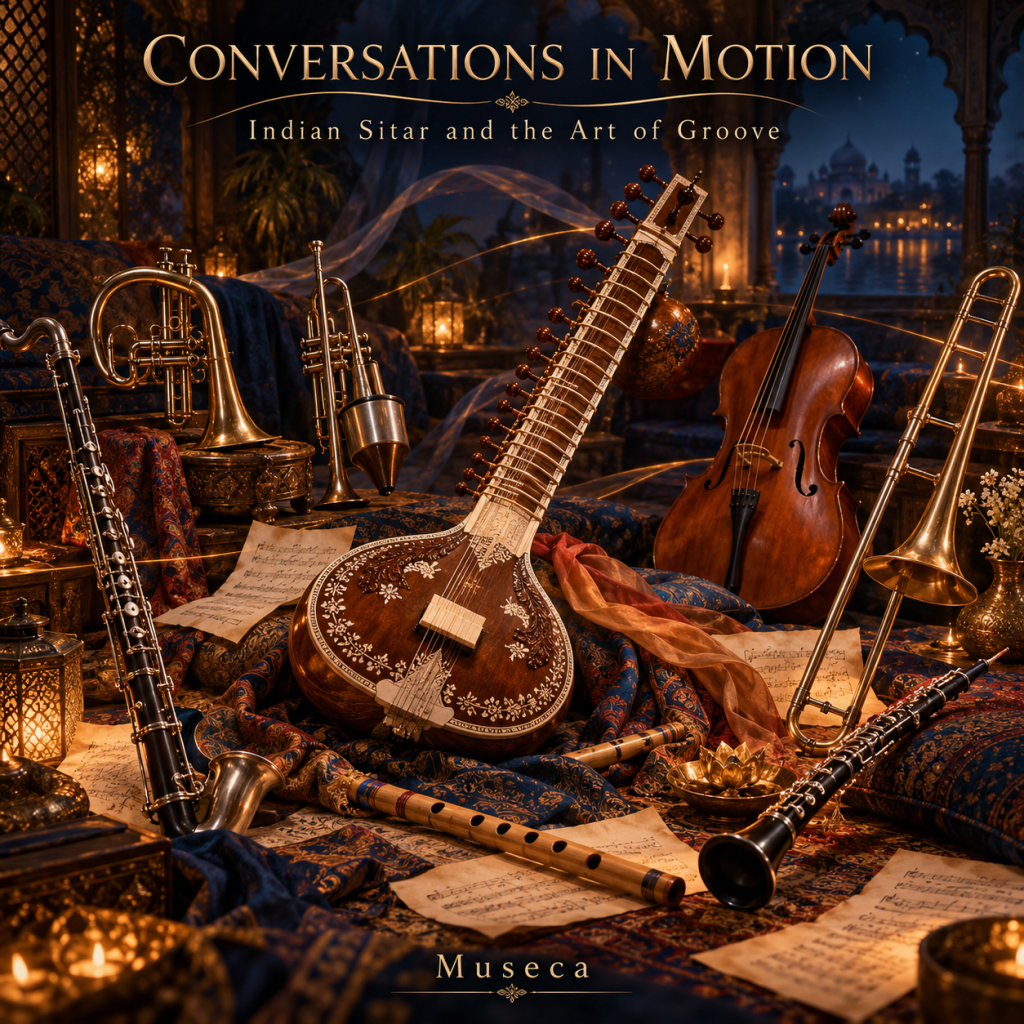
Conversations in Motion
The sitar returns in a wider circle of musical conversations, meeting flugelhorn, bass clarinet, cello, and other partners over varied grooves.
Explore album ↗
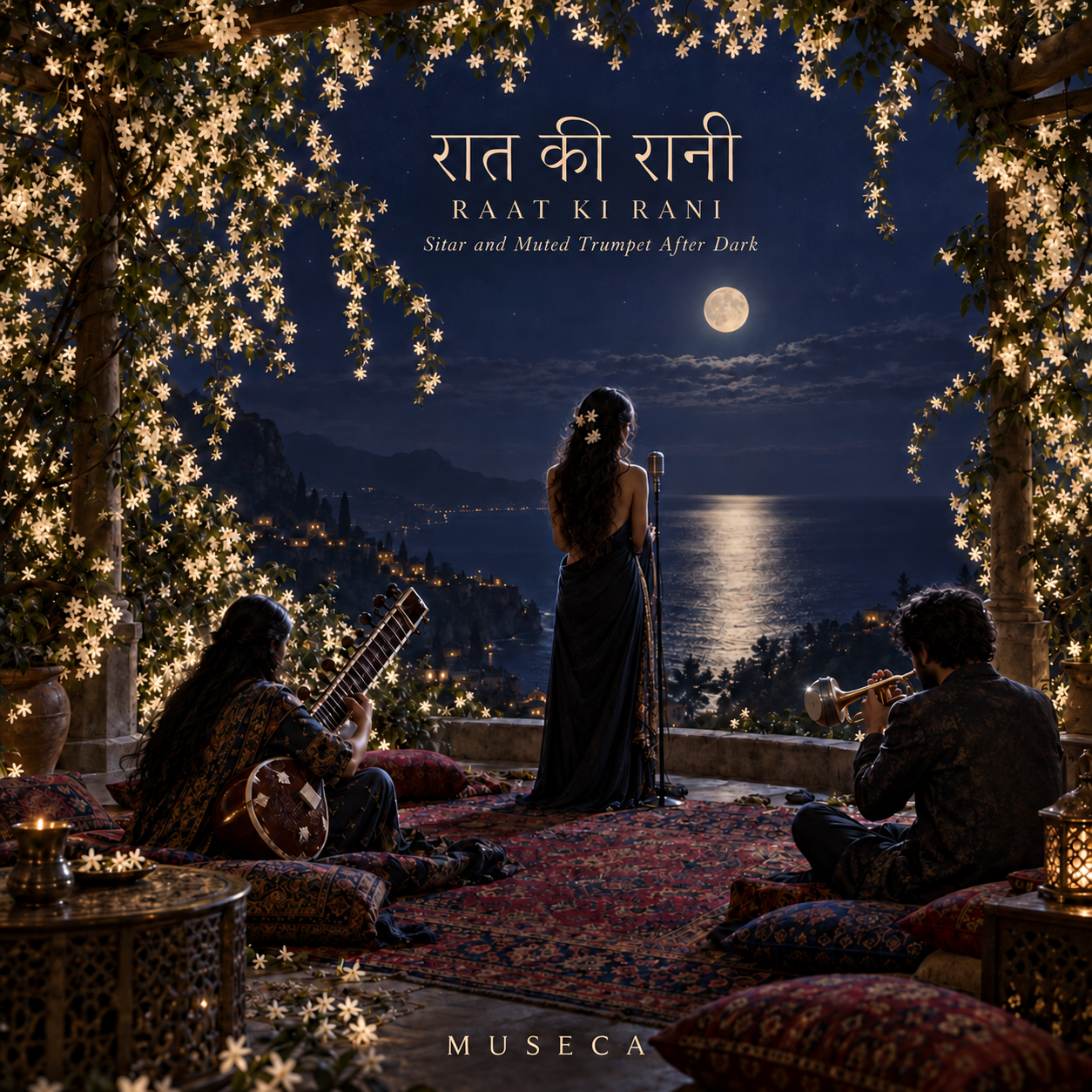
Sitar and Muted Trumpet After Dark
In gardens across India grows a shrub called raat ki rani, the queen of the night. All day its small white flowers stay closed. After sunset they open, and their scent, sweet and heavy and impossible to ignore, drifts across courtyards and terraces until the small hours. By morning the flowers have closed again, and anyone who slept through the night would never know they had opened at all.
This album lives in that interval: the hours when something opens that only opens in the dark.
Two voices. At the heart of every piece are two instruments that, as far as I know, have rarely been asked to sing together as equals: the sitar and the trumpet played with a Harmon mute. They come from opposite ends of the world, yet they are close relatives in sound. The sitar wraps every note in the soft buzz of its curved bridge; the muted trumpet wraps every note in a close, nasal halo of its own. Side by side they sound like two members of the same family, one plucked and one breathed.
What makes them true partners is that both can bend. The sitar’s great expressive gesture is meend, pulling a string sideways so that a note slides toward the next one rather than simply arriving. Most Western instruments cannot follow it: when a sitar bends, a piano or a harp can only let it go. A trumpet can bend with its lips, smear a pitch, half-press a valve and glide. So throughout this album, when the sitar and the muted trumpet play the same melody together, they bend together. The trumpet sustains every note the sitar can only strike, and the sitar gives every note the trumpet holds a shimmering edge. To me they sound like two dancers who have learned each other’s steps.
Where it began. The idea started with a song most people know: “Norwegian Wood,” where a sitar doubles a guitar’s melody note for note. What stayed with me was not the sitar alone but the doubling, two instruments from different worlds speaking one line in two accents. I wanted to find a partner that could follow the sitar further than a guitar can, all the way into its bends. That partner turned out to be the muted trumpet.
Not quite the first meeting. The pairing has a history, and it deserves acknowledging. Miles Davis’s early-1970s sessions included an electric sitar, and the Indo-jazz experiments in 1960s London put sitar and trumpet in the same band. But those were jazz settings, dense or improvised, with the sitar as one color among many. Here the two are the whole conversation: two equal melodic voices, unhurried, over a relaxed groove meant for the late hours.
A night told in ragas. Indian classical music has an old and beautiful idea: every raga belongs to a particular time of day or night. A raga of dusk is not sung at midnight, and the raga that closes a concert carries the feeling of the last hour. This album follows that clock. Its pieces move from sunset to sunrise, each set in a raga traditionally sung at its hour, and each with its own groove and its own small band around the two voices.
The night begins at dusk with a soft nylon guitar and a sunset groove, in Yaman, a raga whose raised fourth gives everything a dreamy glow. Early night brings a lighter, swaying lilt and the warmth of an electric piano. Then a Hammond organ, its speaker turning slowly, moves through the air like a breeze off the water. At nightfall the beat falls away entirely: a felt piano, hushed and close, and the trumpet’s player reaching for the rounder voice of the flugelhorn.
Deeper in, the music opens wide for the only time: strings bloom in full under the harmonic minor of Kirwani, the most cinematic of the night’s ragas. Late night turns smoky and blue in Jog, a raga with both a major and a minor third, where the muted trumpet is most at home and a pedal steel glows far in the background like distant headlights. Midnight belongs to Malkauns, a raga with no fifth at all, its ground strangely far away, and to the surbahar, the sitar’s deep elder sibling. Only after midnight does the tabla arrive. I held it back the whole night so that when it finally comes, softly, in a rocking six-beat cycle, it feels like an arrival rather than a habit. And in the last hour, in Bhairavi, the raga that has closed Indian concerts for generations, the band falls away completely, the melody that opened the dusk returns slowed and changed, and the sitar and trumpet play their final duet alone.
The Queen of the Night. Three times during the night, a voice appears. She is low and close and unhurried, and she is the flower herself. At nightfall she blooms and invites you out into the dark. In the deepest hour she is only fragrance, unseen but everywhere. At first light she folds her petals and says goodbye.
She sings in English, with Hindi woven through like scent: chandni, moonlight; khushboo, fragrance; raat bhar, all night long. In each song the sitar doubles her voice on the Hindi line, bending with her, so for a moment the two voices become three. Her first song turns on the phrase raat ki rani khil gayi, the queen of the night has bloomed. Her last answers it with a single changed word: raat ki rani so gayi, the queen of the night has fallen asleep.
What to listen for. The two voices take turns opening the pieces, the sitar on some, the trumpet on others, so the night is a conversation from the first track to the last. In every piece they come together at least once to play the same melody, bending as one. The strings bloom only once, and return in the last hour as the faintest glow. The album begins with a sitar alone at dusk and ends with a sitar alone at dawn, on the same home note, so the night closes where it began, with the scent of the night still in the air.
Listeners who know my album Maun may notice a small thread between the two. Maun opened with jasmine at dawn, the flower of patient waiting. This album’s jasmine opens at nightfall and gives its scent to whoever is still awake.
How to listen. This is not music for dancing, and not music for a crowded room. It was made for the hours after dark: for a terrace above the sea, a lamp turned low, a book you keep forgetting to read, a conversation that has gone quiet in the best way. Let it play from dusk to dawn, or for as much of the night as you have.
I’ve titled the instrumental pieces by hour and raga, ordered so the night’s clock runs forward, and the three songs by the stage of the flower. Change any of these freely; the notes will adapt.
The night begins with a sitar alone, out of time, sketching the outline of a melody before anything else has arrived. Then the evening settles in around it: a soft nylon guitar, a warm bass, hand percussion as light as footsteps on warm stone.
Yaman is a raga of early evening, and its raised fourth gives everything it touches a slightly dreamy glow, as if the light were lingering longer than it should. This is where the two voices meet for the first time. The sitar offers a simple melody, the muted trumpet answers it, and then, for the first time on the album, they play it together, bending through the same notes as one. That gesture returns in every piece that follows.
Remember this melody. The night will bring it back.
The trumpet speaks first this time. Throughout the album the two voices take turns opening the pieces, so the night unfolds as a conversation.
This is the most buoyant hour, with a light, swaying lilt, an electric piano, and brushes. Khamaj is the raga closest to the Mixolydian mode, the mode of “Norwegian Wood,” the song where this album’s idea first took hold. It’s a quiet nod, carried by the scale alone.
The evening settles. Kafi has the warm, slightly melancholy color of the Dorian mode, and beneath the two voices a Hammond organ holds long chords while its speaker turns slowly, so the sound moves through the air like a breeze coming off the water. It’s the most relaxed groove of the night so far: nothing to do, nowhere to be.
The first song, and the first time the Queen of the Night speaks.
The sun has gone under the water and the stones are still warm. She asks you to leave the lamp inside and come out, because something has opened that only opens in the dark. The nylon guitar from the dusk returns beneath her, and Desh, a romantic raga whose seventh rises on the way up and falls on the way down, gives the melody its longing.
In every refrain the sitar doubles her voice on the Hindi line, raat ki rani khil gayi, the queen of the night has bloomed, bending with her through each note. In the verses the trumpet answers between her lines. The last refrain turns the invitation personal: something opens only after dark, and tonight it opened for you.
[Intro]
[Verse 1]
The sun slipped under the water,
the stones are still warm from the day.
Leave the lamp inside, love,
the night has something to say.
[Refrain]
Raat ki rani khil gayi,
raat ki rani khil gayi —
something opens only after dark,
raat ki rani khil gayi.
[Verse 2]
All day she kept her petals closed,
she let the bright hours pass.
Now chandni on the garden wall,
her scent across the grass.
[Refrain]
Raat ki rani khil gayi,
raat ki rani khil gayi —
something opens only after dark,
raat ki rani khil gayi.
[Instrumental Break]
[Final Refrain]
Raat ki rani khil gayi,
raat ki rani khil gayi —
something opens only after dark,
and tonight it opened for you.
[Outro]
Raat ki rani…
The beat falls away for the first time.
This is the album’s breath, the moment the evening turns fully into night. A felt piano, hushed and close, carries the harmony, and the trumpet’s player reaches for the flugelhorn, rounder and darker, as if speaking more softly now that the light has gone. Bihag is a tender night raga, major in color, with its raised fourth touched only in passing.
Here the music opens wide, for the only time on the album.
Kirwani is the harmonic minor scale, with the yearning raised seventh that has made it the sound of film scores everywhere. A simple piano figure turns beneath the two voices, and a string section waits quietly through most of the piece. Only in the final statement of the melody, when the sitar and trumpet come together once more, do the strings swell fully beneath them. It’s the emotional height of the night, and it’s still unhurried.
The trumpet’s home.
Jog uses both the major and the minor third, which gives it a natural blues color, and both voices can bend between those two notes. When the sitar and trumpet play their melody together here, they bend through the blue note as one. The groove turns slow and smoky, and a pedal steel glows far in the background, gliding between chords like the headlights of a car on a distant road.
The second song: the deepest hour, and the most intimate.
The moon has slipped behind the hill and the garden has lost its shape. The flower can’t be seen anymore, but she is everywhere, because now she is only scent. You won’t see me in the dark; you’ll only know I’m near. Her voice is at its lowest and closest. Charukeshi, major in its lower half and minor above, gives the song its sultry, cinematic color.
The refrain, meri khushboo, raat bhar, means “my fragrance, all night long.” Listeners who know Maun may hear an echo: raat bhar was the refrain of that album’s midnight song, too. Near the end she says, almost speaking, what the night already knows: they say she belongs only to the dark, and morning will take her away. So stay awake a little longer.
[Intro]
[Verse 1]
You won’t see me in the dark,
you’ll only know I’m near —
every breath you take tonight
will bring me here.
[Refrain]
Meri khushboo, raat bhar,
meri khushboo, raat bhar —
close your eyes and breathe me in,
meri khushboo, raat bhar.
[Verse 2]
The moon has slipped behind the hill,
the garden’s lost its shape,
but I am drifting on the air
through every open gate.
[Refrain]
Meri khushboo, raat bhar,
meri khushboo, raat bhar —
close your eyes and breathe me in,
meri khushboo, raat bhar.
[Bridge]
They say I’m only for the night,
that morning takes me away —
so stay awake a little more,
and let the hours stay.
[Instrumental Break]
[Final Refrain]
Meri khushboo, raat bhar,
meri khushboo, raat bhar —
close your eyes and breathe me in,
I’m here until the dawn.
[Outro]
Raat bhar…
The deepest point of the night.
Malkauns is the great midnight raga, and it has no fifth at all. Without that note, the music’s ground feels slightly farther away than it should, dark and suspended. The groove empties out to almost nothing, with long spaces between soft beats. Far below the two voices, the surbahar, the sitar’s deep elder sibling, appears for the first time, sustaining slow, dark glides like the bottom of the night.
Only now does the tabla arrive.
I held it back for the entire night so that when it finally comes, it would feel like an arrival rather than a habit. It takes the whole rhythm by itself, played softly with the fingertips in a rocking six-beat cycle, with no drum kit beside it. Beneath, an oud plays a quiet, repeating pattern. Bageshree is a romantic late-night raga with a Dorian color, and the two voices sound most at home here, swaying, a little wistful, in no hurry for the night to end.
The beat is gone. Bhairavi, with its tender lowered second, is the raga Indian concerts have traditionally closed with, the sound of an evening’s last moments.
The sitar plays almost alone, with only a faint glow of strings far in the distance, the memory of the night’s one great swell. And the melody that opened the dusk returns, slowed and changed, darkened by the hours that have passed. Halfway through, the trumpet enters, and the two speak quietly to each other.
Then the strings fade away completely. For the first and only time on the album, the sitar and the muted trumpet play together with nothing else around them: no band, no rhythm, no harmony beneath. All night they have bent through the same notes inside a groove. Here, at the end of the night, they do it alone. They hold their last note together, and the night is over.
The third song, and the first light.
She opens it alone, singing the first line with no instruments at all, before the morning rises gently around her. The sky is turning pale and the last star is slipping away. She gave every hour she had, and now she folds her petals against the sun. It’s a farewell, but not a sad one: when the evening comes again, I’ll open, one by one.
Ahir Bhairav is the album’s only morning raga, gentle, with a lowered second and a warm major third. The nylon guitar from the dusk returns beneath her, so the flower opens and closes to the same sound. Her first song turned on raat ki rani khil gayi, the queen of the night has bloomed. Her last answers it with a single changed word: raat ki rani so gayi, the queen of the night has fallen asleep.
The final sound is the sitar alone, as the first sound was at dusk, on the same home note. The night closes where it began, and somewhere in a garden a small white flower is already waiting for evening.
[Intro]
The sky is turning pale again,
[Verse 1]
the last star slipping through.
I gave you every hour I had —
the night belonged to you.
[Refrain]
Subah ho gayi,
raat ki rani so gayi —
fold the dark and let me go,
raat ki rani so gayi.
[Verse 2]
Don’t look for me in the light of day,
I’m closed against the sun,
but when the evening comes again,
I’ll open, one by one.
[Refrain]
Subah ho gayi,
raat ki rani so gayi —
fold the dark and let me go,
raat ki rani so gayi.
[Instrumental Break]
[Final Refrain]
Subah ho gayi,
raat ki rani so gayi —
fold the dark and let me go…
[Outro]
So gayi.