
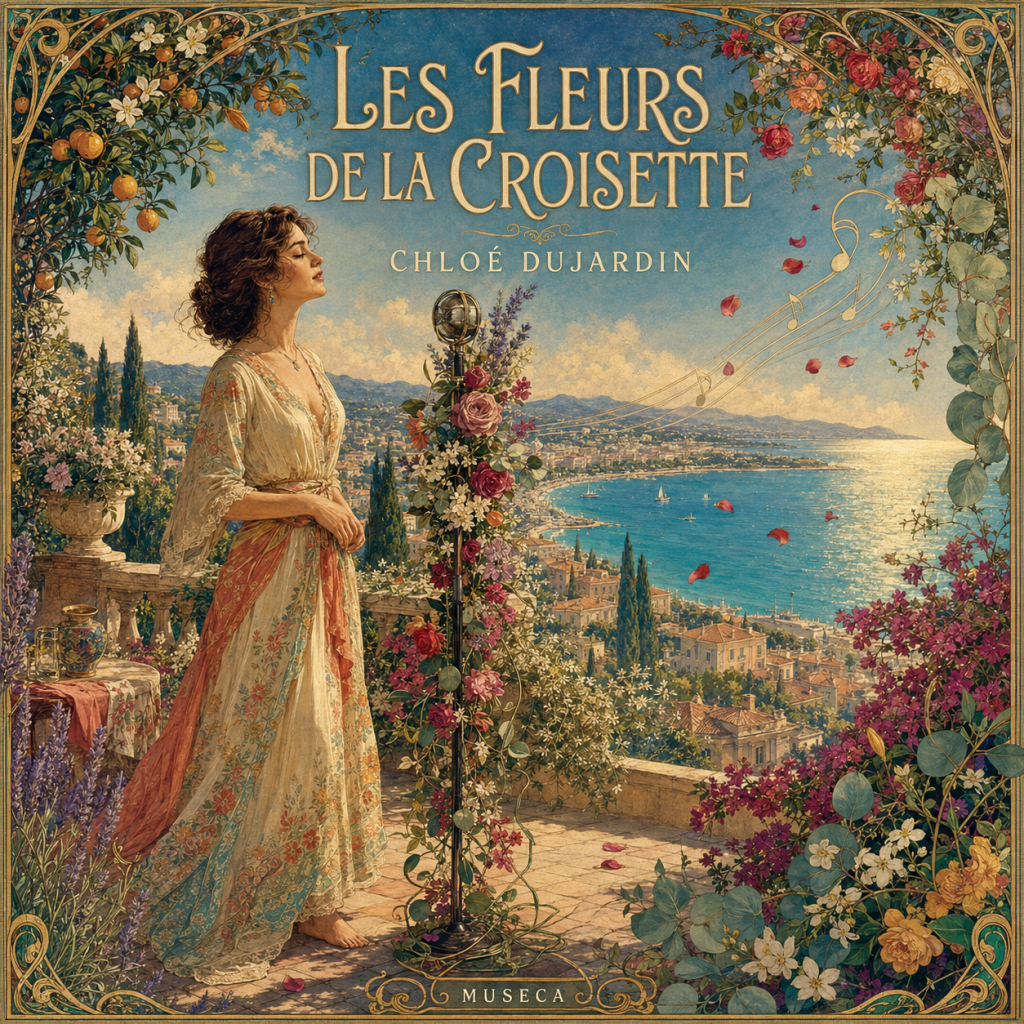
Les Fleurs de la Croisette
The First and Only Album of Chloé Dujardin
Chloé Dujardin is a fictional French mezzo-soprano and vocal persona created by Museca. Her biography, voice and only imagined album form a work of musical fiction.
Between the hillside village of Mougins and the blue distance of the Mediterranean lies the imagined world of Chloé Dujardin.
Chloé grew up on an old estate above Cannes, where her grandfather tended jasmine, lavender, bitter-orange trees, thyme and roses. As a child, she ran barefoot along the garden’s stone paths and sang toward the distant sea. Long before she understood melody or form, the garden became her first conservatory: birds taught her rhythm, leaves taught her breath, and the silences between them taught her that absence could also possess a voice.
Her name seemed to contain her destiny. Chloé carries the ancient suggestion of a young green shoot; Dujardin evokes someone belonging to the garden. Her life would follow the same organic shape as the flowers around her: emergence, opening, fragrance and release.
At nineteen, Chloé waited tables in a small jazz bistro on the Boulevard de la Croisette. One rainy evening in May, after the chairs had been raised and nearly every light extinguished, she sat alone at the piano and began singing an unnamed melody. A stranger entered to escape the rain and listened without interrupting. Nothing visibly dramatic occurred. The rain continued, the glasses remained on the counter, and Chloé finished her song. Yet when she looked up, her private voice had crossed the room and reached another life. A door had quietly opened.
As audiences gradually discovered her, Chloé carried the garden onto every stage. She performed barefoot, with wild roses and eucalyptus wrapped around her microphone stand. This was not theatrical decoration. Beneath unfamiliar lights and before unfamiliar faces, she needed to feel that the earth had accompanied her.
Her music became a form of Riviera neo-chanson: French poetic intimacy meeting Mediterranean air, nocturnal jazz, Balearic rhythm, chamber instrumentation and restrained electronic atmosphere. Felt piano preserved the solitude of the empty bistro. Nylon-string guitar carried the warmth of stone and sunlight. Cello became the voice of memory. Muted trumpet held the reflections of Cannes after rain, while flugelhorn spoke with the tenderness of what could no longer be expressed in words. Vibraphone, bass flute, bowed glass and the distant ondes Martenot allowed flowers, breath, water and light to enter the music without becoming literal scenery.
Les Fleurs de la Croisette is imagined as Chloé’s first and only album. Its nine songs form one continuous season.
Le Jardin avant la mer begins among the roots of childhood. Sel et Lavande follows Chloé down the hillside as the garden’s fragrance meets the salt of the Mediterranean. La Pluie sur la Croisette enters the bistro on the evening her private song is first overheard. In Pieds nus parmi les roses, she steps into public light while protecting the intimacy from which her voice was born.
At the album’s center, Sous les Nuages stops moving. Beneath clouds, sea air and evening light, Chloé recognizes that home is not a place she must reach. It is complete presence within the passing moment.
The final four songs gradually turn inward. In L’Écho du jardin, Chloé discovers that she never truly left Mougins; the garden has continued traveling inside her voice. Une saison seulement considers whether a flower—or a life—must endure for a long time to be complete. Jasmin à minuit allows an entire childhood to return through an open window as fragrance. Finally, Quand la brise m’emportera imagines voice, memory and identity becoming part of the world they once inhabited.
A descending four-note figure moves quietly through the album like a falling petal. It appears in piano, guitar, cello, viola, bass flute, trumpet and Chloé’s wordless humming. In the final song, after her last words have disappeared, the cello reverses the motif and allows it to rise for the first time. The petal falls, but the fragrance continues.
Within this fiction, Chloé’s life is brief. Yet the songs do not portray a woman knowingly composing her farewell. She sings as a young person fully alive to texture, light, scent, touch and sound. Only afterward do her images of passing seasons and open windows seem premonitory.
Her story therefore asks a quieter question than why some lives end early:
Does completeness belong to duration—or to the fullness with which something becomes what it was?
Chloé leaves behind only one album. But a flower is not unfinished because it blooms for a single season. Its life is complete in the flowering.
And somewhere between the garden and the sea, beneath the clouds, her voice continues.
Liner Notes
Le Jardin avant la mer
The album opens before Chloé has encountered stages, audiences or public recognition. Her musical world is still the garden above the Mediterranean, where birds, moving leaves and intervals of silence become her first lessons in rhythm, breath and phrasing. Her grandfather’s patient care of roots and roses provides the song’s underlying understanding: growth cannot be forced, but it can be heard approaching.
Four isolated notes on felt piano introduce the album’s falling-petal motif. The spacious arrangement develops through fingerpicked nylon-string guitar, warm cello responses and the barely audible breath of a harmonium. Delicate bowed-glass resonance gives certain notes a translucent edge, while distant birds and garden air extend the music beyond the instruments. With no drum kit, the pulse comes from Chloé’s language, the movement of the guitar and the natural spacing of the piano.
Paroles françaises — French Lyrics
Avant les vitrines, avant les lumières,
Il y avait le jardin au-dessus de la mer.
Le matin goûtait le sel, la lavande,
Et le vent mettait des chansons dans les branches.
Je courais pieds nus sur les pierres encore froides,
Sous les orangers où le soleil se déploie.
Je ne savais rien des scènes ni des voix,
Mais chaque feuille semblait chanter pour moi.
Mon grand-père parlait peu, connaissait les saisons,
La patience des racines, le secret des boutons.
Il taillait les rosiers comme on accorde une chanson,
Laissant entrer la lumière au cœur de chaque maison.
Ses mains sentaient la terre, le thym et le jasmin,
Il disait : « Toute fleur reconnaît son chemin. »
Puis il écoutait le silence entre deux oiseaux,
Comme si le monde entier respirait dans leur écho.
C’était le jardin avant la mer,
Mon premier ciel, ma première lumière.
Les oiseaux m’ont appris la mesure,
Les feuilles, le souffle et ses murmures.
C’était le jardin avant les chansons,
Avant mon nom, avant les saisons.
J’y ai compris, sans savoir pourquoi,
Que le silence aussi possède une voix.
Plus tard, j’ai cherché des mélodies nouvelles,
Sous d’autres plafonds, sous d’autres étincelles.
Mais chaque note que je laissais partir
Portait un peu de terre et d’oranger en fleur.
Et lorsque ma voix hésitait dans le soir,
Le jardin revenait doucement dans ma mémoire.
Le jasmin tenait la note, le vent ouvrait le chemin,
Et je redevenais l’enfant du premier matin.
C’était le jardin avant la mer,
Mon premier ciel, ma première lumière.
Les oiseaux m’ont appris la mesure,
Les feuilles, le souffle et ses murmures.
C’était le jardin avant les chansons,
Avant mon nom, avant les saisons.
Tout ce que je chante commence encore là,
Dans le silence vivant qui chantait pour moi.
Si ma voix cherche un jour sa maison,
Elle suivra le parfum des saisons.
English Translation
Before the shop windows, before the lights,
There was the garden above the sea.
Morning tasted of salt and lavender,
And the wind placed songs among the branches.
I ran barefoot over stones still cold,
Beneath the orange trees where sunlight unfolded.
I knew nothing of stages or voices,
Yet every leaf seemed to sing for me.
My grandfather spoke little and understood the seasons,
The patience of roots, the secret of buds.
He pruned the roses as one might tune a song,
Letting light enter the heart of every home.
His hands smelled of earth, thyme and jasmine.
He would say, “Every flower recognizes its path.”
Then he listened to the silence between two birds,
As though the whole world breathed within their echo.
It was the garden before the sea,
My first sky, my first light.
The birds taught me rhythm,
The leaves taught me breath and its murmurs.
It was the garden before the songs,
Before my name, before the seasons.
There I understood, without knowing why,
That silence also possesses a voice.
Later, I searched for new melodies,
Beneath other ceilings, beneath other sparks.
But every note I allowed to depart
Carried a little earth and orange blossom.
And whenever my voice faltered in the evening,
The garden returned gently to my memory.
The jasmine held the note, the wind opened the way,
And I became again the child of that first morning.
It was the garden before the sea,
My first sky, my first light.
The birds taught me rhythm,
The leaves taught me breath and its murmurs.
It was the garden before the songs,
Before my name, before the seasons.
Everything I sing still begins there,
In the living silence that sang for me.
If one day my voice goes searching for its home,
It will follow the fragrance of the seasons.
Sel et Lavande
Chloé leaves the protected hillside and begins walking toward the sea. Lavender remains on her hands and clothing while salt gathers in the air around her. The two fragrances become complementary forces: the garden gives her roots, and the Mediterranean invites movement. The song is sensual without being directed toward a lover; it records a young woman awakening to her own physical presence within the world.
The falling-petal motif returns as nylon-guitar harmonics and becomes rhythmic rather than ceremonial. Rhodes electric piano, rounded melodic bass, brushes, cross-stick, shaker and fingertip frame drum create the album’s first flowing groove. A breathy bass flute moves through the arrangement like sea air crossing the hillside, while restrained viola harmonics add small reflections of light. The harmony remains open, favoring major-sixth and add9 colors that allow earth and horizon to coexist.
Paroles françaises — French Lyrics
Le matin descendait le long de la colline,
Dorant les vieux murets, les pierres et les glycines.
J’avais encore aux mains le parfum du jardin,
Mais la mer déposait son appel sur mon chemin.
La lavande accrochée au bord de ma robe
Se mêlait doucement à l’air salé de l’aube.
Chaque pas vers le bleu semblait me révéler
Une part de mon corps que j’avais oubliée.
La terre sous mes pieds,
L’horizon devant moi,
Deux voix si différentes
Qui parlaient à la fois.
Sel et lavande,
Sur mes lèvres, dans le vent.
L’un me garde, l’autre m’emporte,
Et je marche entre les deux courants.
Sel et lavande,
La colline et l’océan.
La terre me donne des racines,
La mer m’apprend le mouvement.
Les pierres étaient tièdes sous mes pieds déchaussés,
Le soleil sur mes épaules commençait à danser.
Je touchais les feuillages en descendant plus bas,
Comme si chaque branche se souvenait de moi.
Puis le goût de la mer est venu jusqu’à ma peau,
Une lumière liquide a traversé les eaux.
Je n’avais rien demandé, rien voulu retenir,
Le monde était si proche qu’il suffisait de sentir.
La terre sous mes pieds,
L’horizon devant moi,
Je n’avais pas à choisir :
Je naissais entre leurs voix.
Sel et lavande,
Sur mes lèvres, dans le vent.
L’un me garde, l’autre m’emporte,
Et je marche entre les deux courants.
Sel et lavande,
La colline et l’océan.
La terre me donne des racines,
La mer m’apprend le mouvement.
Je n’attendais personne
Pour ouvrir le matin.
La lumière avait déjà
Posé sa main dans ma main.
Le vent touchait mes cheveux,
L’eau respirait devant moi.
J’étais aimée par le monde
Sans qu’il prononce pourquoi.
Sel et lavande,
Sur mes lèvres, dans le vent.
L’un me garde, l’autre m’emporte,
Et je danse entre les deux courants.
Sel et lavande,
La colline et l’océan.
Je porte en moi les racines,
Mais mon cœur apprend le mouvement.
English Translation
Morning descended along the hillside,
Gilding the old walls, the stones and wisteria.
The fragrance of the garden still lingered on my hands,
But the sea was laying its call across my path.
The lavender caught along the hem of my dress
Mingled gently with the salty air of dawn.
Each step toward the blue seemed to reveal
A part of my body I had forgotten.
The earth beneath my feet,
The horizon before me—
Two very different voices
Speaking at the same time.
Salt and lavender,
On my lips, within the wind.
One keeps me, the other carries me away,
And I walk between the two currents.
Salt and lavender,
The hillside and the ocean.
The earth gives me roots,
The sea teaches me movement.
The stones were warm beneath my bare feet,
The sunlight on my shoulders began to dance.
I touched the leaves as I descended farther,
As though every branch remembered me.
Then the taste of the sea reached my skin,
And liquid light traveled across the water.
I had asked for nothing and tried to hold nothing back.
The world was so close that all I had to do was feel.
The earth beneath my feet,
The horizon before me—
I did not have to choose:
I was being born between their voices.
Salt and lavender,
On my lips, within the wind.
One keeps me, the other carries me away,
And I walk between the two currents.
Salt and lavender,
The hillside and the ocean.
The earth gives me roots,
The sea teaches me movement.
I was waiting for no one
To open the morning.
The light had already
Placed its hand within mine.
The wind touched my hair,
The water breathed before me.
I was loved by the world
Without its ever saying why.
Salt and lavender,
On my lips, within the wind.
One keeps me, the other carries me away,
And I dance between the two currents.
Salt and lavender,
The hillside and the ocean.
I carry the roots within me,
But my heart is learning movement.
La Pluie sur la Croisette
A rainy May evening transforms Chloé’s private singing into something heard. The bistro has closed, the chairs are raised and Cannes is reduced to reflections across wet glass. Chloé sits at the piano believing herself alone. When someone enters to escape the rain, she continues singing without turning around. Nothing outwardly dramatic happens, yet a private voice crosses the room and a new road quietly begins.
Acoustic piano, upright bass, brushed snare and sparse vibraphone establish a nocturnal jazz-chanson atmosphere over a subtle trip-hop undertow. The falling-petal motif is reharmonized as a rain-darkened piano phrase. Cup-muted trumpet answers Chloé with brief fragments before assuming an eight-bar solo: lyrical, spacious and deliberately unshowy. The trumpet does not announce her future; it represents the unknown listener and the first evidence that her voice has reached beyond herself.
Paroles françaises — French Lyrics
La Croisette brillait sous la pluie de mai,
Les néons se brisaient sur les pavés mouillés.
Les chaises retournées dormaient sur les tables,
La nuit rendait le grand boulevard méconnaissable.
J’avais rangé les verres, éteint presque toutes les lumières,
Gardé près du piano une petite lampe claire.
Je croyais être seule avec l’ombre et la pluie,
Alors j’ai laissé naître une chanson dans la nuit.
La pluie sur la Croisette
Effaçait les pas pressés.
Je chantais pour personne,
Et quelqu’un m’écoutait.
La pluie sur la Croisette
Coulait comme un secret.
Je chantais pour le silence,
Et le silence me répondait.
La porte a respiré dans un courant d’air froid,
Un manteau sombre est entré, puis s’est tenu là.
Je n’ai pas tourné la tête, je n’ai rien demandé,
Ma voix suivait la pluie sans vouloir s’arrêter.
Il s’est assis au fond, dans la dernière lumière,
Sans troubler le piano, sans déplacer l’atmosphère.
Je ne savais de lui ni le nom ni le chemin,
Seulement que mon chant n’était plus tout à fait le mien.
La pluie sur la Croisette
Effaçait les pas pressés.
Je chantais pour personne,
Et quelqu’un m’écoutait.
La pluie sur la Croisette
Coulait comme un secret.
Ma voix traversait l’ombre
Vers un visage que j’ignorais.
Rien n’avait changé dans la salle,
La lampe, les verres, le rideau.
Pourtant l’air semblait moins immobile,
Et la nuit respirait autrement dans ma peau.
Parfois une porte s’entrouvre
Sans bruit, sans promesse, sans éclat.
On continue simplement de chanter,
Sans savoir que la route commence là.
La pluie sur la Croisette
Avait ralenti ses pas.
Je chantais pour personne,
Mais une voix voyage toujours quelque part.
La pluie sur la Croisette
Gardait nos deux secrets.
Je ne savais rien du lendemain,
Seulement que quelqu’un m’avait écoutée.
English Translation
The Croisette shimmered beneath the rain of May,
Neon lights shattered across the wet pavement.
Upturned chairs slept upon the tables,
And night made the great boulevard unrecognizable.
I had put away the glasses and extinguished nearly every light,
Leaving one small lamp glowing beside the piano.
I believed I was alone with the shadows and the rain,
So I allowed a song to be born within the night.
The rain upon the Croisette
Erased the hurried footsteps.
I was singing for no one,
And someone was listening.
The rain upon the Croisette
Flowed like a secret.
I was singing for the silence,
And the silence answered me.
The door breathed open in a current of cold air.
A dark coat entered and then stood there.
I did not turn my head or ask anything.
My voice followed the rain, unwilling to stop.
He sat at the back, within the final pool of light,
Without disturbing the piano or changing the atmosphere.
I knew neither his name nor the road that had brought him,
Only that my song was no longer entirely mine.
The rain upon the Croisette
Erased the hurried footsteps.
I was singing for no one,
And someone was listening.
The rain upon the Croisette
Flowed like a secret.
My voice traveled through the shadows
Toward a face I did not know.
Nothing in the room had changed—
The lamp, the glasses, the curtain.
Yet the air seemed less motionless,
And the night breathed differently against my skin.
Sometimes a door opens slightly
Without sound, promise or brilliance.
We simply continue singing,
Unaware that the road begins there.
The rain upon the Croisette
Had slowed its footsteps.
I was singing for no one,
But a voice is always traveling somewhere.
The rain upon the Croisette
Guarded both our secrets.
I knew nothing of the following day,
Only that someone had listened to me.
Pieds nus parmi les roses
Chloé enters public light without abandoning the garden. She leaves her shoes behind the curtain and performs beside a microphone wrapped in fresh roses and eucalyptus. Bare feet against the stage are not part of a cultivated image; they are a private means of remaining connected to earth while surrounded by lights, fabric and watching faces.
This is the album’s most animated arrangement. Syncopated nylon-string guitar, warm synth bass, Rhodes piano, brushed drums, cross-stick, shaker and frame drum form a supple Mediterranean downtempo groove. Viola pizzicato transforms the falling-petal motif into something playful and physical. Brief open-flugelhorn accents rise between sections like changes in stage light, but never develop into a solo. Even at its brightest, the music refuses spectacle: Chloé has nothing to conquer and nothing to prove. She has only something to offer.
Paroles françaises — French Lyrics
J’avais laissé mes chaussures derrière le rideau,
Pour sentir sous mes pieds le velours du plateau.
On avait noué des roses autour du microphone,
Un peu de mon jardin dans ce lieu qui résonne.
Les lampes s’éveillaient une à une au-dessus,
Des visages attendaient dans une mer inconnue.
J’ai posé mes deux mains sur les fleurs devant moi,
Puis j’ai pris une inspiration comme autrefois.
Sous les lumières,
Je cherchais le vent.
Au milieu des regards,
J’écoutais le silence vivant.
Pieds nus parmi les roses,
Sous les lampes et le bruit,
Je garde un peu de terre
Dans chaque chanson de la nuit.
Pieds nus parmi les roses,
Je n’ai rien à conquérir.
Je viens seulement ouvrir
Ce que le jardin m’a appris.
Les premiers mots sont tombés doucement dans la salle,
Comme des pétales portés au-delà des chandelles.
Je chantais pour chacun comme on chante pour une voix,
Tout près, presque invisible, assise en face de moi.
La scène était immense, mais ma voix restait petite,
Une confidence offerte, une lumière sans limite.
Je ne voulais pas couvrir le murmure des cœurs,
Seulement laisser passer un peu d’air et de couleur.
Sous les lumières,
Je retrouvais le vent.
Au milieu des visages,
Le jardin respirait lentement.
Pieds nus parmi les roses,
Sous les lampes et le bruit,
Je garde un peu de terre
Dans chaque chanson de la nuit.
Pieds nus parmi les roses,
Je n’ai rien à conquérir.
Je viens seulement ouvrir
Ce que le jardin m’a appris.
Puis les murs se sont éloignés,
Les lampes ont perdu leur nom.
Sous mes pieds, le velours devenait
Le vieux chemin de la maison.
Je sentais le thym, le jasmin,
La terre fraîche après l’été.
Et toutes ces mains dans l’ombre
Étaient des feuilles venues m’écouter.
Pieds nus parmi les roses,
Sous les lampes et le bruit,
Je porte un peu de terre
Dans chaque chanson de la nuit.
Pieds nus parmi les roses,
Je n’ai rien à conquérir.
Je viens seulement offrir
Ce que le jardin m’a appris.
English Translation
I had left my shoes behind the curtain
So I could feel the velvet of the stage beneath my feet.
Roses had been tied around the microphone—
A little of my garden within this resonant place.
The lights awakened one by one above me.
Faces waited within an unfamiliar sea.
I placed both hands upon the flowers before me,
Then drew a breath as I had long ago.
Beneath the lights,
I searched for the wind.
Surrounded by watchful eyes,
I listened to the living silence.
Barefoot among the roses,
Beneath the lights and noise,
I keep a little earth
Within every song of the night.
Barefoot among the roses,
I have nothing to conquer.
I have come only to open
What the garden taught me.
The first words fell gently into the room
Like petals carried beyond the candlelight.
I sang for everyone as one might sing for a single voice,
Very near, almost invisible, seated before me.
The stage was immense, but my voice remained small—
A confidence offered, a light without boundaries.
I did not want to overpower the murmuring of hearts,
Only to let a little air and color pass through.
Beneath the lights,
I found the wind again.
Among all those faces,
The garden breathed slowly.
Barefoot among the roses,
Beneath the lights and noise,
I keep a little earth
Within every song of the night.
Barefoot among the roses,
I have nothing to conquer.
I have come only to open
What the garden taught me.
Then the walls receded,
And the lights lost their names.
Beneath my feet, the velvet became
The old path leading home.
I could smell the thyme and jasmine,
The cool earth after summer.
And all those hands within the darkness
Were leaves that had come to listen to me.
Barefoot among the roses,
Beneath the lights and noise,
I carry a little earth
Within every song of the night.
Barefoot among the roses,
I have nothing to conquer.
I have come only to offer
What the garden taught me.
Sous les Nuages
At the center of the album, movement stops. Chloé stands beneath clouds, feeling sea breath, evening wind and light across her skin. Time appears to pause long enough for a simple recognition: home is not necessarily the garden, the stage or any destination still ahead. Home can be the moment in which nothing is missing.
The song inhabits the chill-ambient territory of Mediterranean and Balearic music. Soft piano layers, ambient pads, mellow bass and an understated downtempo beat create a wide horizon around Chloé’s voice. During the instrumental passage, language dissolves into humming; the vocalist continues without words, becoming part of the air surrounding her. The arrangement’s restraint makes Sous les Nuages the album’s point of stillness and Chloé’s defining expression of presence.
Paroles françaises — French Lyrics
Sous les nuages, je me perds,
Dans le souffle doux de la mer.
Mon cœur s’ouvre au vent du soir,
Comme un secret, comme un espoir.
La lumière danse sur ma peau,
Un monde calme, un tempo nouveau.
Je ferme les yeux, je ressens tout,
La paix m’appelle, tout devient doux.
Chuchotements dans l’air doré,
Le temps s’arrête pour respirer.
Sous les nuages, je suis chez moi,
Ici, maintenant, juste toi et moi.
English Translation
Under the clouds, I lose myself
Within the gentle breath of the sea.
My heart opens to the evening wind
Like a secret, like a hope.
Light dances upon my skin—
A peaceful world, a new rhythm.
I close my eyes and feel everything.
Peace is calling me, and everything grows soft.
Whispers within the golden air,
Time stops for a moment to breathe.
Under the clouds, I am home—
Here, now, just you and me.
L’Écho du jardin
Now traveling and performing away from Mougins, Chloé discovers that the garden has not remained behind. It continues within her breathing, melodic instincts and use of silence. What she once regarded as memory reveals itself as something alive: her roots do not pull her backward but nourish everything she is becoming.
Flowing in a gentle 6/8, the song expands from felt piano and cello into the album’s broadest chamber landscape. Viola, translucent violins and soft analog atmosphere widen the space without overwhelming Chloé’s intimate voice. Bowed-glass sonorities introduce a fragile shimmer, while distant ondes Martenot lines suggest a horizon beyond the visible room. In the instrumental interlude, cello begins with the descending falling-petal motif and gradually lengthens it into a rising phrase—the first suggestion that the motif contains another possible direction.
Paroles françaises — French Lyrics
Dans une chambre blanche au-dessus d’une autre ville,
J’écoutais les rideaux respirer, immobiles.
Les lumières de la scène dormaient encore dans mes yeux,
Comme des étoiles étrangères suspendues dans le bleu.
J’ai ouvert la fenêtre à l’air de la nuit,
Une odeur de jasmin est entrée sans bruit.
Il n’y avait aucun jardin dans la rue au-dessous,
Pourtant j’ai entendu les feuilles parler tout près de nous.
J’avais traversé tant de routes,
Laissant la colline au matin.
Mais quelque chose chantait encore
Sous ma voix, au creux de mes mains.
Je croyais avoir quitté le jardin,
Mais le jardin ne m’a jamais quittée.
Il pousse en silence entre mes refrains,
Dans chaque souffle que je laisse passer.
Je croyais avoir quitté le jardin,
Pour suivre les lumières et les chemins.
Mais lorsque ma voix cherche où se poser,
C’est toujours une branche qui vient la porter.
Les oiseaux m’avaient donné le rythme autrefois,
Les feuilles avaient appris la patience à ma voix.
Le vent entre les branches avait ouvert mes phrases,
Et la terre avait gardé le silence entre leurs traces.
Même loin des pierres tièdes et des orangers,
Je retrouvais leur lumière dans une note prolongée.
Chaque salle inconnue devenait un peu moins grande
Quand ma voix y déposait du jasmin et de la lavande.
Je n’avais rien emporté
Que personne aurait pu voir.
Pourtant mes racines voyageaient
Sous ma peau, jusque dans le soir.
Je croyais avoir quitté le jardin,
Mais le jardin ne m’a jamais quittée.
Il pousse en silence entre mes refrains,
Dans chaque souffle que je laisse passer.
Je croyais avoir quitté le jardin,
Pour suivre les lumières et les chemins.
Mais lorsque ma voix cherche où se poser,
C’est toujours une branche qui vient la porter.
J’avais pris la mémoire
Pour un chemin retournant en arrière.
Mais les racines ne retiennent pas :
Elles nourrissent ce qui monte vers la lumière.
Je ne revenais pas à l’enfant
Qui courait sous les orangers.
C’était elle qui continuait d’avancer,
Invisible, dans tout ce que je devenais.
Je croyais avoir quitté le jardin,
Mais le jardin ne m’a jamais quittée.
Il fleurit maintenant dans mes refrains,
Dans chaque silence que ma voix vient toucher.
Je croyais chanter seule sur le chemin,
Sous les lumières des villes traversées.
Mais ce n’est jamais ma voix seulement :
C’est tout le jardin qui chante à travers moi.
English Translation
Within a white room above another city,
I listened to the motionless curtains breathe.
The stage lights still slept within my eyes
Like foreign stars suspended in the blue.
I opened the window to the night air,
And the scent of jasmine entered without a sound.
There was no garden in the street below,
Yet I heard the leaves speaking close beside me.
I had traveled across so many roads,
Leaving the hillside behind in the morning.
But something was still singing
Beneath my voice, within the hollow of my hands.
I thought I had left the garden,
But the garden never left me.
It grows silently between my refrains,
Within every breath I allow to pass.
I thought I had left the garden
To follow the lights and the roads.
But whenever my voice searches for somewhere to rest,
A branch always comes to carry it.
The birds had given me rhythm long ago,
And the leaves had taught my voice patience.
The wind among the branches had opened my phrases,
While the earth preserved the silence between their traces.
Even far from the warm stones and orange trees,
I found their light again within a lingering note.
Every unfamiliar hall became a little less immense
When my voice placed jasmine and lavender inside it.
I had taken nothing with me
That anyone else could see.
Yet my roots traveled
Beneath my skin and into the evening.
I thought I had left the garden,
But the garden never left me.
It grows silently between my refrains,
Within every breath I allow to pass.
I thought I had left the garden
To follow the lights and the roads.
But whenever my voice searches for somewhere to rest,
A branch always comes to carry it.
I had mistaken memory
For a road leading backward.
But roots do not hold us back:
They nourish what rises toward the light.
I was not returning to the child
Who ran beneath the orange trees.
She was the one who continued moving forward,
Invisible within everything I was becoming.
I thought I had left the garden,
But the garden never left me.
Now it blossoms within my refrains,
Within every silence my voice comes to touch.
I thought I was singing alone along the road,
Beneath the lights of all the cities I had crossed.
But it is never only my voice:
It is the entire garden singing through me.
Une saison seulement
Late-summer flowers reach their fullest color just as their first petals begin to loosen. Chloé observes this without interpreting it as tragedy. Instead, she wonders whether completeness belongs to duration or to the fullness with which something becomes itself. A passing light has not failed because it passed; a flower is not incomplete because it opened for only one season.
The track begins as a slow French bossa-chanson, led by fingerpicked nylon guitar, rounded bass, brushes, cross-stick and a delicate shaker. Motor-off vibraphone creates suspended points of late-afternoon light, while bass flute carries the falling-petal motif like warm air moving through flowers. As the song progresses, its bossa pulse gradually dissolves into dream-pop suspension. Rhythm gives way to resonance, anticipating the increasing weightlessness of the album’s final songs.
Paroles françaises — French Lyrics
Sur une terrasse à la fin de l’été,
Les roses trop ouvertes commençaient à tomber.
Le soleil traversait leurs couleurs fatiguées,
Déposant sur la pierre des ombres parfumées.
Les bougainvilliers penchaient au-dessus du chemin,
Encore pleins de lumière, déjà plus incertains.
Chaque fleur donnait tout dans son dernier éclat,
Sans demander au jour de ralentir pour elle.
Je regardais les pétales
Descendre dans le vent,
Si légers, si tranquilles,
Comme s’ils savaient depuis longtemps.
Une saison seulement,
Est-ce trop peu pour une fleur ?
Elle donne au soleil tout son présent,
Sans compter les heures.
Une saison seulement,
Est-ce trop peu pour une vie ?
Ce n’est peut-être pas le temps
Qui donne sa mesure au cœur qui fleurit.
La mer changeait de bleu à chaque heure du soir,
Gardant quelques secondes le soleil dans son miroir.
Puis la lumière glissait sans chercher à rester,
Et personne ne disait qu’elle avait moins brillé.
J’ai pensé aux chansons qui s’effacent après nous,
Aux parfums qui reviennent quand on ne les cherche plus.
Ce qui passe entre nos mains n’est pas toujours perdu :
Parfois cela demeure précisément parce que ce n’est plus.
Je regardais la lumière
Se retirer lentement,
Sans regret, sans promesse,
En achevant simplement son présent.
Une saison seulement,
Est-ce trop peu pour une fleur ?
Elle donne au soleil tout son présent,
Sans compter les heures.
Une saison seulement,
Est-ce trop peu pour une vie ?
Ce n’est peut-être pas le temps
Qui donne sa mesure au cœur qui fleurit.
Je ne demande pas à midi
De durer jusqu’au soir.
Je ne demande pas à la rose
De retenir son histoire.
Que chaque chose reste assez longtemps
Pour devenir pleinement ce qu’elle est :
Une couleur ouverte dans la lumière,
Un parfum confié au vent qui passait.
Une saison seulement
Peut contenir le monde entier,
Si chaque matin s’ouvre vraiment
Et si chaque soir peut s’achever.
Une saison seulement,
Puis la lumière change de lieu.
Ce n’est pas parce qu’elle passe
Qu’elle a moins illuminé nos yeux.
English Translation
Upon a terrace at the end of summer,
The roses, opened too widely, had begun to fall.
Sunlight passed through their fading colors,
Casting fragrant shadows upon the stone.
The bougainvillea leaned above the path,
Still filled with light, already less certain.
Every flower gave everything in its final radiance
Without asking the day to slow down for it.
I watched the petals
Descending upon the wind,
So weightless and peaceful,
As though they had always known.
Only one season—
Is that too little for a flower?
It gives the sunlight all of its present,
Without counting the hours.
Only one season—
Is that too little for a life?
Perhaps it is not time
That measures the heart in bloom.
The sea changed its shade of blue with every evening hour,
Holding the sun within its mirror for a few seconds.
Then the light slipped away without trying to remain,
And no one said that it had shone any less brightly.
I thought of songs that fade after we are gone,
Of fragrances that return when we no longer seek them.
What passes through our hands is not always lost:
Sometimes it endures precisely because it is no longer here.
I watched the light
Slowly withdraw,
Without regret or promise,
Simply completing its present moment.
Only one season—
Is that too little for a flower?
It gives the sunlight all of its present,
Without counting the hours.
Only one season—
Is that too little for a life?
Perhaps it is not time
That measures the heart in bloom.
I do not ask the noonday
To endure until evening.
I do not ask the rose
To hold on to its story.
May everything remain long enough
To become completely what it is:
A color opening within the light,
A fragrance entrusted to the passing wind.
Only one season
Can contain the entire world,
If every morning truly opens
And every evening is allowed to end.
Only one season,
And then the light moves elsewhere.
Its passing does not mean
That it illuminated our eyes any less.
Jasmin à minuit
Unable to sleep in an unfamiliar room, Chloé leaves a window open to the night. Jasmine enters without announcement and restores an entire sensory world: her grandfather’s hands in the soil, cold stones beneath her childhood feet and the small voice she once offered to branches and birds. The past does not return literally. It begins breathing within the present.
Felt piano, warm cello, cello harmonics, bass-flute breath and minimal analog atmosphere create the album’s most private nocturne. A nearly imperceptible pulse suggests wakefulness rather than rhythm. The central instrumental passage belongs to flugelhorn, whose long, patient phrases become the unspoken voice of Chloé’s grandfather and the garden he tended. Chloé answers its final phrase with a closed-mouth hum, creating a wordless exchange between memory and the person she has become.
Paroles françaises — French Lyrics
La ville avait fermé ses fenêtres une à une,
Je gardais la mienne entrouverte sous la lune.
Je ne dormais pas, mais je n’attendais rien,
J’écoutais simplement la nuit retenir le matin.
Puis un parfum léger a traversé la chambre,
Plus doux qu’une parole, plus ancien que septembre.
Il s’est posé sur l’oreiller près de moi,
Et tout un jardin s’est réveillé dans le noir.
Je n’ai pas fermé les yeux,
Je n’ai pas prononcé ton nom.
Je t’ai reconnu dans l’air
Avant même de savoir pourquoi.
Jasmin à minuit,
Tu entres sans frapper.
Tu portes dans la nuit
Ce que je croyais oublié.
Jasmin à minuit,
Parfum de mes premiers jours,
Tu ne ramènes pas le passé :
Tu le fais respirer autour.
J’ai revu les mains de mon grand-père dans la terre,
Ses doigts suivant les racines avec patience et lumière.
Il connaissait chaque fleur avant qu’elle ne s’ouvre,
Et laissait le vent choisir ce que le jardin découvre.
J’ai retrouvé mes pas dans les allées du matin,
Les pierres encore froides, le thym contre mes mains.
La petite voix que j’offrais aux branches et aux oiseaux
Dormait encore en moi, intacte sous ma peau.
Je n’avais rien appelé,
Pourtant tout revenait.
Une seule fleur dans l’air,
Et la chambre disparaissait.
Jasmin à minuit,
Tu entres sans frapper.
Tu portes dans la nuit
Ce que je croyais oublié.
Jasmin à minuit,
Parfum de mes premiers jours,
Tu ne ramènes pas le passé :
Tu le fais respirer autour.
La mémoire ne frappe pas
Et ne demande pas d’entrer.
Elle choisit parfois un parfum
Pour rendre un monde à la clarté.
Elle ne replace pas les heures
Dans l’ordre où nous les avons vécues.
Elle ouvre simplement une fenêtre,
Et ce qui semblait loin respire à nouveau.
Jasmin à minuit,
Tu entres sans frapper.
Tu poses dans la nuit
Tout ce que le temps n’a pas effacé.
Jasmin à minuit,
Reste encore un instant.
Non pour retenir le passé,
Mais pour l’entendre respirer dans le présent.
English Translation
The city had closed its windows one by one.
I kept mine partly open beneath the moon.
I was not sleeping, but I was waiting for nothing.
I simply listened as the night held back the morning.
Then a delicate fragrance crossed the room,
Softer than a word, older than September.
It settled upon the pillow beside me,
And an entire garden awakened in the darkness.
I did not close my eyes.
I did not speak your name.
I recognized you within the air
Before I even understood why.
Jasmine at midnight,
You enter without knocking.
You carry into the night
What I believed I had forgotten.
Jasmine at midnight,
Fragrance of my earliest days,
You do not bring the past back:
You make it breathe around me.
I saw my grandfather’s hands within the earth again,
His fingers following the roots with patience and light.
He knew every flower before it opened
And allowed the wind to choose what the garden revealed.
I rediscovered my footsteps along the morning paths,
The stones still cold, the thyme brushing my hands.
The little voice I once offered to the branches and birds
Still slept within me, untouched beneath my skin.
I had summoned nothing,
Yet everything returned.
A single flower upon the air,
And the room disappeared.
Jasmine at midnight,
You enter without knocking.
You carry into the night
What I believed I had forgotten.
Jasmine at midnight,
Fragrance of my earliest days,
You do not bring the past back:
You make it breathe around me.
Memory does not knock
Or ask permission to enter.
Sometimes it chooses a fragrance
To bring an entire world back into the light.
It does not arrange the hours
In the order in which we lived them.
It simply opens a window,
And what seemed distant begins to breathe again.
Jasmine at midnight,
You enter without knocking.
You place within the night
Everything that time has not erased.
Jasmine at midnight,
Remain a moment longer—
Not so that I may hold on to the past,
But so I may hear it breathing in the present.
Quand la brise m’emportera
The final song considers disappearance without staging a death scene. Wind carries petals beyond the garden, songs travel into unfamiliar memories, and identity ceases to depend upon remaining physically present in one place. Chloé’s farewell is therefore not an announcement of departure but a change of form: she imagines herself continuing as salt, lavender, jasmine, silence and song.
The music begins with voice, felt piano and cello before opening into a slow, floating 6/8. Warm viola, translucent violins, bowed-glass resonance and distant ondes Martenot create luminosity without a conventional orchestral climax. After Chloé’s final words—Je ne partirai pas vraiment, je changerai seulement de parfum—the instruments gradually withdraw.
Chloé hums the familiar descending falling-petal motif one final time. The cello answers by reversing it into a complete rising phrase, and the piano repeats that transformation. Garden air and distant Mediterranean sea air merge until their origins can no longer be distinguished. The album does not end with a closed cadence. It releases Chloé’s voice into the atmosphere from which it first emerged.
Paroles françaises — French Lyrics
Un jour, le vent défait les roses du jardin,
Il détache leurs couleurs sans leur faire de chagrin.
Les pétales prennent l’air, traversent le chemin,
Et leur parfum voyage bien plus loin que nos mains.
Rien ne demande au vent où commence son voyage,
Ni quel ciel gardera la mémoire de son passage.
Une fleur quitte la branche, mais quelque chose demeure :
Une trace dans la lumière, une douceur dans le cœur.
Je ne demanderai pas au vent
De me laisser toujours ici.
Je lui confierai simplement
Ce que j’aurai aimé de cette vie.
Quand la brise m’emportera,
Ne ferme pas toutes les fenêtres.
Tu m’entendras peut-être encore
Dans l’air léger qui les traverse.
Quand la brise m’emportera,
Ne cherche pas où je serai.
Je serai dans le sel, la lavande
Et dans les chansons que j’aurai laissées.
Une chanson, lorsqu’elle s’envole,
Ne sait plus qui l’a fait naître.
Elle entre dans une autre mémoire,
Elle ouvre une autre fenêtre.
Elle attend parfois des années
Avant de toucher un nouveau matin.
Puis quelqu’un la chante sans savoir
Qu’elle portait autrefois mon jardin.
Je n’aurai pas besoin de savoir
Dans quelles mains elle continuera.
Une voix n’est jamais vraiment perdue
Quand une autre voix la reconnaît déjà.
Quand la brise m’emportera,
Ne ferme pas toutes les fenêtres.
Tu m’entendras peut-être encore
Dans l’air léger qui les traverse.
Quand la brise m’emportera,
Ne cherche pas où je serai.
Je serai dans le sel, la lavande
Et dans les chansons que j’aurai laissées.
Je ne partirai pas vraiment,
Je changerai seulement de parfum.
Un peu de jasmin dans une chambre,
Un peu de soleil sur tes mains.
Je ne quitterai pas le monde,
Je changerai seulement de voix :
Le silence entre deux notes,
Le souffle qui passe près de toi.
Quand la brise m’emportera,
Laisse ouvertes toutes les fenêtres.
Je reviendrai peut-être encore
Dans chaque lumière qui les traverse.
Quand la brise m’emportera,
Je ne serai ni loin ni là.
Je serai le jardin dans la chanson,
Et la chanson qui continue après moi.
Je ne partirai pas vraiment,
Je changerai seulement de parfum.
English Translation
One day, the wind loosens the garden roses,
Releasing their colors without causing them sorrow.
The petals take to the air and cross the path,
And their fragrance travels far beyond our hands.
No one asks the wind where its journey begins
Or which sky will preserve the memory of its passing.
A flower leaves its branch, but something remains:
A trace within the light, a tenderness within the heart.
I will not ask the wind
To leave me here forever.
I will simply entrust to it
Everything I will have loved in this life.
When the breeze carries me away,
Do not close all the windows.
Perhaps you will still hear me
Within the gentle air that passes through them.
When the breeze carries me away,
Do not search for where I will be.
I will be within the salt and lavender
And within the songs I will have left behind.
Once a song takes flight,
It no longer knows who gave it birth.
It enters another memory
And opens another window.
Sometimes it waits for years
Before touching a new morning.
Then someone sings it without knowing
That it once carried my garden.
I will not need to know
In whose hands it will continue.
A voice is never truly lost
When another voice already recognizes it.
When the breeze carries me away,
Do not close all the windows.
Perhaps you will still hear me
Within the gentle air that passes through them.
When the breeze carries me away,
Do not search for where I will be.
I will be within the salt and lavender
And within the songs I will have left behind.
I will not truly depart;
I will only change my fragrance:
A little jasmine within a room,
A little sunlight upon your hands.
I will not leave the world;
I will only change my voice:
The silence between two notes,
The breath that passes close beside you.
When the breeze carries me away,
Leave all the windows open.
Perhaps I will return once more
Within every light that passes through them.
When the breeze carries me away,
I will be neither far away nor there.
I will be the garden within the song,
And the song that continues after me.
I will not truly depart;
I will only change my fragrance.
Playlist
- Track 1 - Le Jardin avant la mer Museca 4:46
- Track 2 - Sel et Lavande Museca 5:20
- Track 3 - La Pluie sur la Croisette Museca 5:12
- Track 4 - Pieds nus parmi les roses Museca 5:19
- Track 5 - Sous les Nuages Museca 2:40
- Track 6 - L’Écho du jardin Museca 5:58
- Track 7- Une saison seulement Museca 4:55
- Track 8 - Jasmin à minuit Museca 5:54
- Track 9 - Quand la brise m’emportera Museca 5:28