
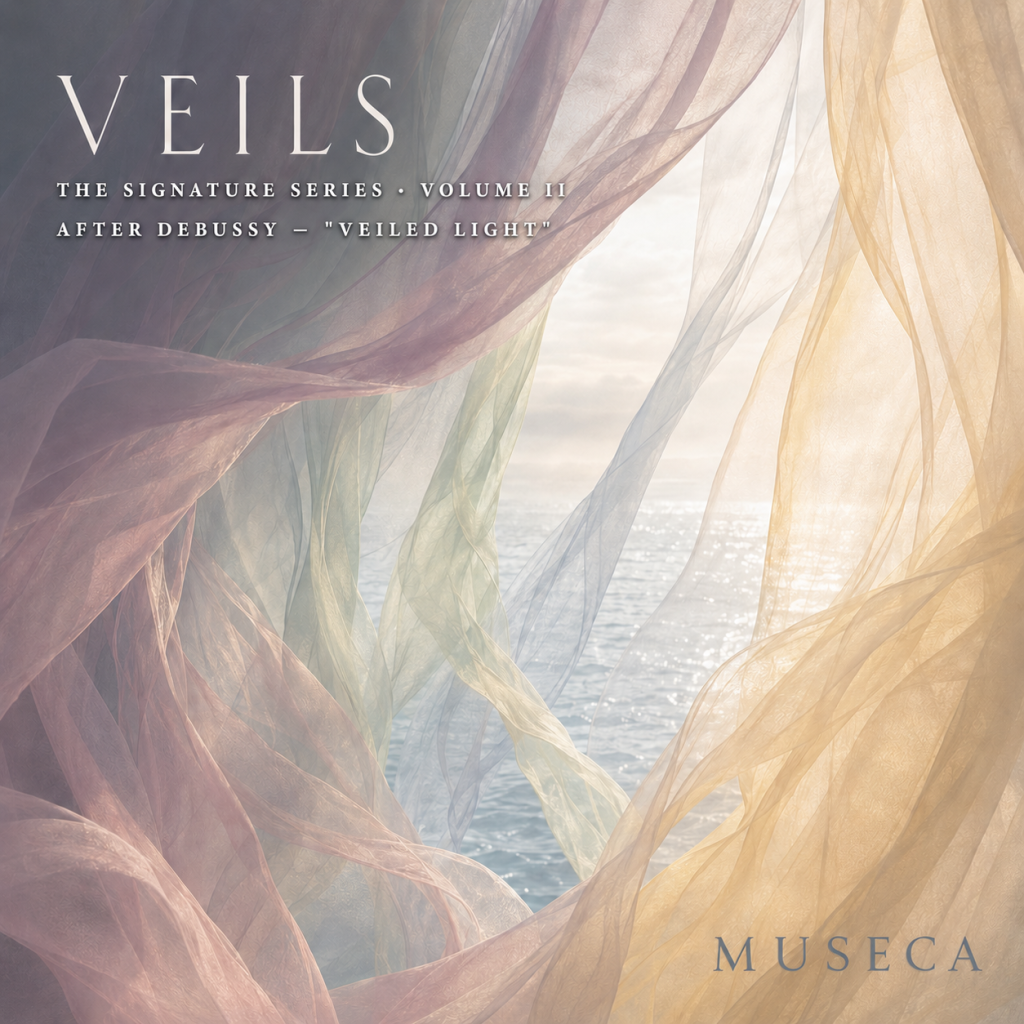
VEILS
The Signature Series · Volume II
after Debussy — “Veiled Light”
Nothing on this album resolves. Nothing arrives.
That is not a mood. It is a rule, applied to every one of the six tracks, and it comes directly from the composer the record is built from.
Genre, style, signature
A composer’s genre is the container they worked in — the symphony, the prélude, the song. Their style is the shared language of their time and place, an accent everyone in the period carries. Neither belongs to one person.
Signature is the third layer, and the only one that does. It is the set of behaviors a composer performs that no one else performs in quite that combination — how they treat a melody, what they do with time, where they place weight, what they refuse to do. It is not a sound. It is a set of decisions that produce sounds, and because it is made of decisions rather than timbres, it survives being moved.
The Signature Series extracts one composer’s signature and builds an entire album from it in a modern genre far from their own. Each volume is a proof: the engine, without the costume.
What Debussy actually does
His signature is veiled light, and underneath it sit six behaviors.
He treats chords as colors rather than as verbs. In common-practice harmony a chord does something — it pulls, it strains, it discharges into the next one. Debussy chose chords for how they sound standing still. That single reversal is the deepest thing about him.
He planes: whole blocks of harmony sliding in parallel, keeping their shape as they move. It is the first thing a harmony student is taught not to do, because parallel motion dissolves the independence of the voices and leaves a single colored object moving through space. He did it constantly.
He writes time without a pulse — no downbeat to count against, no moment weighted more than the one beside it. Duration felt rather than measured.
He uses scales that have no home. Whole-tone and pentatonic collections contain no leading tone, no note that leans toward a tonic. Remove the leading tone and you remove the machinery of arrival. The music cannot cadence because the raw material will not permit it.
He makes register do the work of form. Where a passage sits — high and thin, low and clustered, spread across an enormous empty middle — carries the architectural weight that development and modulation carry for other composers.
And he keeps everything half-said. He came out of Symbolist poetry, where naming the thing kills it. The veil is not concealment for its own sake; it is the conviction that the half-glimpsed is more alive than the fully lit.
Not one of those requires a piano.
Why dream pop
Because it is the one genre in this series that Debussy can be said to have caused.
Ambient music’s lineage runs back through Eno and Satie to him. Planing chords, whole-tone haze, and pulseless time already sound like the destination. So unlike the other volumes, this album cannot prove the method by surviving a hostile genre — the engine was never asked to survive anything.
What it can demonstrate instead is fidelity. Ambient music drifts because drifting is easy. Veils drifts because six specific behaviors make resolution structurally impossible. The difference is audible if the constraints are real and inaudible if they are decorative, and that is the only claim this record makes.
The six
Each track isolates one behavior and asks nothing else of itself.
Planing — parallel chords alone, blocks of color sliding without voice-leading.
Voiles — the namesake, taken from Debussy’s own whole-tone prélude, whose title means both sails and veils. The first human presence on the record, and the voice is treated as a color rather than as a lead. If you find yourself waiting for a chorus, the track has failed.
Pentatonic Water — five notes, no semitones, nothing that pulls anywhere. Debussy returned to water obsessively because it moves constantly and goes nowhere, takes the shape of whatever holds it, and has no edges. Pentatonic harmony behaves the same way.
No Downbeat — events arriving at unpredictable intervals with long silences between them. Not a drone: things happen, they simply are not counted.
Register as Form — the voice climbs to its highest, thinnest register and stays there while everything else sinks away, leaving an enormous empty middle. The distance between them is the architecture.
Dissolve — the record does not fade. It loses definition. Attacks soften, reverb overtakes the direct sound, the instruments stop being separable, and the music becomes indistinguishable from the silence around it. Debussy’s drowned cathedral rises, sounds, and sinks without anything having been resolved.
The law
Nothing resolves. Nothing arrives.
Volume I of this series rationed arrival to a single moment. This record refuses it entirely — six tracks with no cadence, no climax, and no landing at any point. Heard against Unguarded, that is the clearest thing the Signature Series has to say: two composers, two engines, two entirely different relationships to arrival, both audible without a word of explanation.
The books
The framework behind this album is documented in full, and both volumes are free to download and read.
Volume I — The Signature Method sets out the theory: the distinction between genre, style, and signature; how to isolate a composer’s transferable engine from their period surface; and how to translate that engine into contemporary music without imitation.
Volume II — The Signature Cards applies it to fifty-one composers from Hildegard of Bingen to Philip Glass. Each entry gives a signature formula, a core statement, the primary elements at a glance, essential listening, and a map of the modern genres that composer’s engine translates into.
Debussy’s entry in Volume II is the source of everything here. You can read it, disagree with it, and make a completely different record from the same page. That is the intended use.
Download both volumes:
Volume I – The Signature Method
Volume II – The Signature Cards
Liner Notes
Planing
The first thing a harmony student is taught not to do.
Move two voices in parallel and they stop being two voices — they collapse into one thickened line, and the independence that makes counterpoint work disappears. Every treatise since the fifteenth century forbids it. Debussy did it constantly, deliberately, and it is the most immediately recognizable thing about his music.
What you get when you break the rule is a chord that has stopped being a verb. In common-practice harmony a chord is an action: it pulls somewhere, it strains, it discharges into the next one. Plane it — slide the whole shape up or down intact — and it becomes an object instead. A block of color moving through space, going nowhere, because it has no tendency to go anywhere.
That is the album’s entire premise stated once, plainly, before anything else is asked of it. Nothing here develops. Nothing arrives. Blocks of color slide past, and the record has told you what it is.
Voiles
The title is Debussy’s, from his own whole-tone prélude, and it means both sails and veils. He never said which. That refusal is the point, and it is why this album is called what it is.
He came out of Symbolist poetry, where the governing conviction was that naming a thing kills it — that the half-glimpsed is more alive than the fully lit. Not concealment for the sake of mystery, but a belief that suggestion carries more than statement.
So the first human presence on this record is not a lead vocal. It is a color among colors. The voice sits back, drenched, breathy, mostly wordless, blurred into the pads until you are not always certain where the instruments end and she begins. A few words surface and none of them complete a sentence.
If you find yourself waiting for a chorus, that is the track working. Waiting is what it is for.
Pentatonic Water
Five notes, no semitones, and nothing that wants anything.
In a major scale, the seventh degree strains upward toward the tonic and the fourth leans down toward the third. The scale is full of notes with tendencies — that is the machinery arrival is built from. Remove the semitones and the machinery is gone. Every note is equally at rest. Cadence becomes impossible rather than merely avoided.
Debussy heard Javanese gamelan at the Paris Exposition in 1889 and it changed what he thought music could be. What he took was not the instruments but the collection.
And he returned to water his whole life — reflections, rain, a drowned cathedral, the sea. Water was his image for a substance that moves constantly and goes nowhere, takes the shape of whatever holds it, and has no edges. Pentatonic harmony behaves identically. There are no water sounds on this track. There did not need to be.
No Downbeat
Time with nothing to count against.
Western music organizes duration by recurring accent — a downbeat, and a hierarchy in which some moments carry more weight than the ones beside them. Debussy dismantled that. Not with unusual meters, which only substitute one grid for another, but by removing the sense that any moment matters more than its neighbor. Events happen when they happen.
This is not a drone. Things occur here — a single bell, a phrase on the flute that enters and stops, a piano gesture that is never repeated — and the silences between them are as composed as the sounds. If nothing happened it would be a wash. If things happened on a schedule it would be a pulse. It is neither, and the space between those two failures is very narrow.
What remains is music that is unmistakably happening and cannot be counted.
Register as Form
The deepest thing on the record and the hardest to point at.
Most music organizes itself by argument. A theme is stated, taken apart, moved through keys, and returned changed. Debussy largely abandoned the whole apparatus. What replaced it was placement — where a sound sits carrying the structural weight that development carries elsewhere. Move the same material an octave and it becomes a different event.
Here the voice climbs to the top of its range and stays, thin and unsupported, while everything else sinks away beneath it. The middle of the register empties out and nothing fills it. What the music is about, structurally, is the distance between the voice and the floor.
That gap is not an absence in the track. It is the track. Which is the Symbolist position carried into architecture — the thing suggested by what surrounds it, never stated directly, and more alive for it.
Dissolve
Not an ending. A loss of definition.
Volume I of this series closed with a lament — the Pathétique principle, music that tries to rise and cannot, sinking into a silence you notice. That is a statement. Something is being mourned and the music knows it.
Nothing is mourned here. Nothing gives out. The music simply stops being distinguishable from what surrounds it. Attacks soften, reverb overtakes the direct sound, the instruments stop being separable from one another, and pitch blurs toward noise until nothing in the frame has an edge.
Debussy’s drowned cathedral rises out of the water, sounds, and sinks back, and nothing has been resolved by its having appeared. This is that. There is no final chord — nothing you could identify as the last event — because a record whose law is that nothing arrives cannot be permitted to conclude.
It ends by ceasing to be there.
Playlist
- Track 1 — "Planing" Museca 3:13
- Track 2 — "Voiles" Museca 1:49
- Track 3 — "Pentatonic Water" Museca 2:45
- Track 4 — "No Downbeat" Museca 3:14
- Track 5 — "Register as Form" Museca 1:37
- Track 6 — "Dissolve" Museca 2:55