
The first time I heard Abraham-Hicks say, “You are so free that you can choose bondage,” I stopped.
There was something almost impossible contained in those few words. Freedom and bondage seemed to belong at opposite ends of human experience. One meant possibility; the other, limitation. One suggested an open horizon; the other, a locked room. Yet the statement placed them beside one another and proposed a paradox: perhaps our freedom is so fundamental that we can even use it to construct the experience of being unfree.
I began thinking about what that might mean in ordinary human life.
Most of us do not consciously choose confinement. We do not wake in the morning and decide to become afraid, restricted, resentful, or trapped. The process is usually much quieter than that. We make choices intended to protect ourselves. We avoid something that once hurt us. We remain where life feels predictable. We repeat an explanation because it has helped us make sense of the past. We decline a possibility because uncertainty feels more dangerous than familiarity.
And often, those decisions are perfectly understandable.
A wall may have been built because, at one time, we needed a wall.
A door may have been closed because something outside it frightened us.
A room may have become familiar because familiarity offered shelter during a difficult season.
But something curious can happen with time. What began as protection can become habit. Habit can become belief. Belief can become identity. Eventually, we may forget that the structure surrounding us was ever constructed at all.
We begin to experience it simply as reality.
This is who I am.
This is the way things are.
There is nowhere else to go.
I cannot change this.
The architecture becomes invisible.
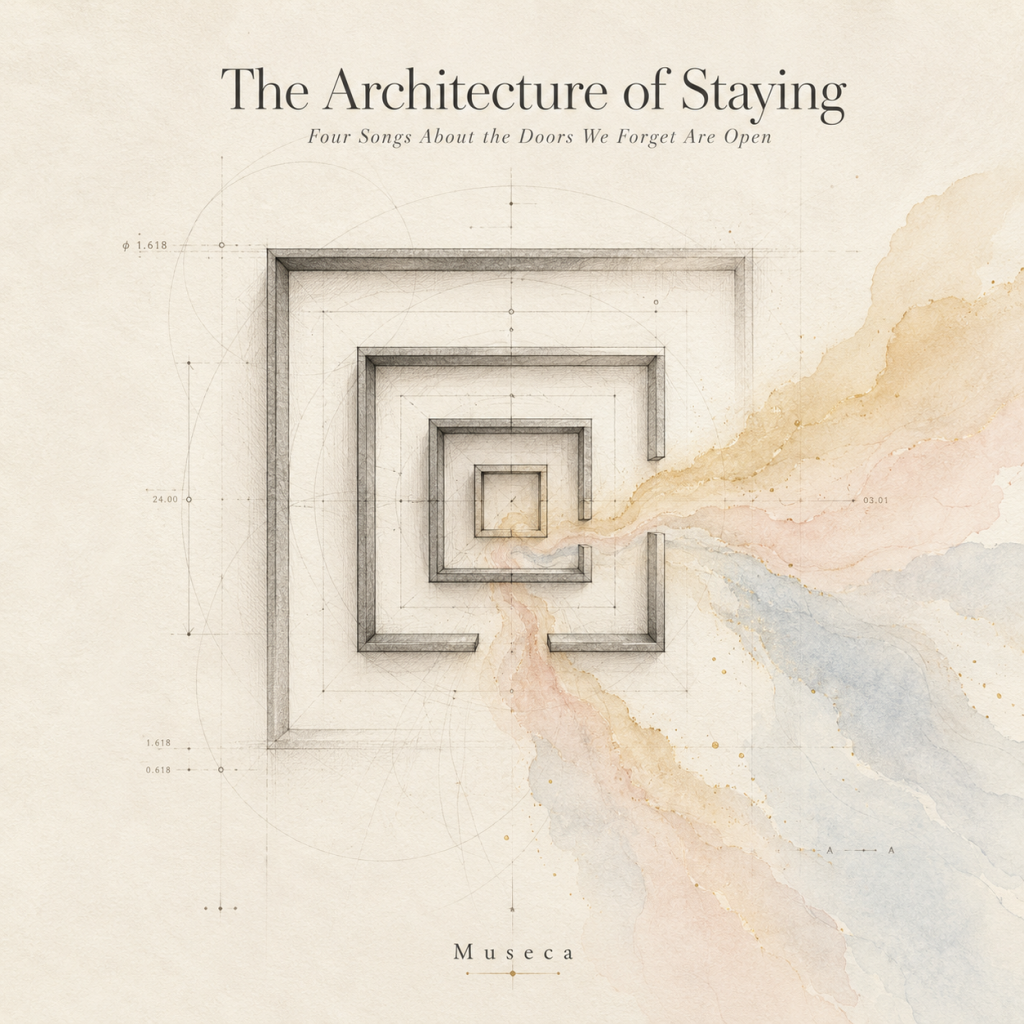
That was the idea that led me to The Architecture of Staying — Four Songs About the Doors We Forget Are Open.
I did not want to write a song that explained the philosophy. I wanted to build a small musical world in which a listener could experience it.
So the album became four songs describing four stages of an interior journey.
The Shelter begins with protection. Its narrator has carefully constructed a place where nothing unexpected can reach her. The room is warm, intimate, and safe. There is no villain and no mistake. The walls exist for a reason. But gradually she notices that the same structure keeping the weather outside is also keeping some of the morning away.
The Familiar Room explores what happens when protection becomes repetition. The narrator rearranges the furniture, changes the pictures, moves the flowers, and modifies everything she can without ever questioning the room itself. Life appears to change while its underlying boundaries remain intact. Familiarity has quietly begun impersonating necessity.
Then comes The Door Was Never Locked.
This is the turning point of the album. Almost accidentally, the narrator touches the boundary she has spent years assuming could not be crossed. The door moves.
There is no chain.
There is no guard.
There is no dramatic act of liberation.
There is simply the unsettling discovery that the obstacle she regarded as permanent was not what she believed it to be.
And that realization is not immediately joyous.
Freedom can be frightening when we have built an identity around the belief that we have no choice. An open door does more than reveal possibility. It asks us to reconsider all the reasons we have given ourselves for remaining where we are.
The final song, Nothing Held Me, takes the journey one step further.
The narrator does not destroy the room.
She does not condemn the person who built it.
She does not need to hate the past in order to leave it.
Instead, she understands something gentler: what once protected us does not have to imprison us forever. We can be grateful for an old shelter and still recognize when it has become too small.
This became one of the central ideas of the album:
I can bless what once protected me and still keep walking through.
Musically, the four songs follow the same transformation. They share an intimate cinematic chamber-folk language—female voice, acoustic guitar, piano, cello, viola, strings, bass, brushed percussion, and a recurring melodic motif—but the musical space gradually changes.
The first song feels warm and enclosed.
The second becomes more circular and repetitive.
The third begins to open.
And by the fourth, the same musical materials are breathing more freely, moving farther, occupying a wider harmonic space.
The architecture of the music changes as the architecture of the narrator’s thinking changes.
At its deepest level, The Architecture of Staying is not an album about blaming ourselves for the circumstances of our lives. There are real circumstances, real losses, real obligations, and real barriers that cannot simply be wished away. The album is interested in something subtler: the additional walls human beings sometimes construct inside those circumstances—the assumptions, habits, fears, inherited stories, and familiar explanations that can remain long after their original purpose has passed.
Perhaps that is what makes the Abraham-Hicks statement so provocative.
If freedom merely meant having no limitations, it would be easy to recognize.
But a deeper kind of freedom may include the ability to choose, to repeat, to resist, to remain, even to forget for a while that another possibility exists.
And perhaps the most extraordinary moment is not when someone finally gives us our freedom.
It is when we reach for the door we were certain was locked—
and discover that it moves.
Liner Notes
The Architecture of Staying is a four-song meditation on the structures we build inside ourselves: shelters, habits, explanations, boundaries, and the quiet assumptions that can slowly harden into walls.
The album begins with protection.
In The Shelter, safety is not portrayed as weakness or failure. The room is warm for a reason. Its walls were built against weather that once felt real and threatening. The music reflects that intimacy through close-miked vocals, fingerpicked acoustic guitar, felt piano, cello, and a gentle 6/8 pulse. The harmony remains contained, the melodic range narrow, and the recurring motif first appears almost like a lullaby. The song asks a simple question: what happens when something that once kept us safe begins keeping too much of the world outside?
Lyrics
[Verse 1]
I laid the first stone when the weather turned
A little wall for every lesson learned
Closed one window when the cold came through
Pulled the curtains when the night wind blew
I made a room where nothing could surprise me
Kept every sharp and sudden thing outside me
Softened every corner, lowered every light
Built myself a quiet place to sleep at night
[Pre-Chorus]
And for a while
It felt like peace
Nothing entered
Nothing reached me
[Chorus]
I built it strong enough to keep the weather out
Never noticed what was missing from the house
I kept the rain from falling where I lay
And somehow kept a little of the morning away
Still, I called it shelter
Still, I called it home
Safe beneath the ceiling
Safe enough alone
[Instrumental — 4-note piano/cello motif]
[Verse 2]
I learned the sound of every wooden floor
Knew every shadow moving past the door
Moved the table closer to the wall
Made the room feel bigger when it started feeling small
I told myself the narrow view was plenty
One familiar road was better than too many
Every little boundary had a reason at the start
Every careful lock was made to guard a tender heart
[Pre-Chorus]
And for a while
It felt like peace
Nothing entered
Nothing reached me
[Chorus]
I built it strong enough to keep the weather out
Never noticed what was missing from the house
I kept the rain from falling where I lay
And somehow kept a little of the morning away
Still, I called it shelter
Still, I called it home
Safe beneath the ceiling
Safe enough alone
[Bridge — arrangement opens slightly, viola enters]
Then one afternoon
A line of gold
Slipped beneath the curtain
Onto the floor
I watched it move
Across the room
And wondered when
The room had grown so small
[Final Chorus — slightly wider, still restrained]
I built it strong enough to keep the weather out
Now I’m starting to see what else I shut out
I kept the rain from falling where I lay
And maybe kept a little too much morning away
Still, I call it shelter
Still, I call it home
But somewhere past the curtains
Something warm is growing
[Outro — voice softens, instruments fall away]
There’s a little light
Around the edges now
The Familiar Room turns protection into repetition. Its circular groove, recurring figures, and quietly insistent rhythmic patterns mirror a life organized around the known. The narrator changes the furniture, moves the flowers, rearranges the details, yet the view from the window remains the same. The musical language is intentionally more active than in the opening track, but its movement is cyclical rather than directional. It is motion without departure.
Lyrics
[Verse 1]
Every morning, seven twenty
Kettle singing, curtains drawn
Same two cups upon the counter
Though there’s only ever one
Chair beside the eastern window
Table turned the way I like
Three small steps into the hallway
Four more steps to reach the light
I know which board complains beneath me
Which old hinge will softly sigh
I could cross this room with closed eyes
I have done it all my life
[Pre-Chorus — bass begins anticipating the changes]
There’s a comfort in returning
To the places that we know
There’s a mercy in a circle
Till you wonder where it goes
[Chorus — stronger groove, still restrained]
I keep moving things around
In the familiar room
Turn the chair toward another wall
Put the flowers somewhere new
I change everything I can
Without changing where I am
Then I wonder why the window
Shows the same old view again
[Instrumental — repeating 4-note motif, cello answering piano]
[Verse 2]
I have names for every reason
I have reasons not to leave
One for caution, one for timing
One for things I once believed
I have polished every answer
Till they shine like something true
“This is safer.”
“This is wiser.”
“This is simply what I do.”
Somewhere years became a pattern
Patterns learned to speak for me
And the road I never traveled
Slowly disappeared from memory
[Pre-Chorus — slightly more rhythmic tension]
There’s a comfort in returning
To the places that we know
But a circle drawn too carefully
Leaves nowhere else to go
[Chorus — fuller bass and brushed percussion]
I keep moving things around
In the familiar room
Turn the chair toward another wall
Put the flowers somewhere new
I change everything I can
Without changing where I am
Then I wonder why the window
Shows the same old view again
[Post-Chorus — quiet vocal layering]
Same window
Same sky
Same question
Passing by
[Bridge — percussion thins; guitar ostinato continues underneath]
Yesterday I moved the table
To the other side
For a moment
Something opened
In the corner of my eye
A strip of hallway
Past the doorway
A place I rarely see
And I couldn’t quite remember
Who had told me not to leave
[Brief instrumental pause]
[Do not make this revelation triumphant — it should feel unsettling and intimate]
[Final Chorus — groove returns with greater movement; strings widen slightly]
I’ve been moving things around
In the familiar room
Changing pictures, changing colors
Making old things look brand new
Changing everything I can
Without changing where I am
And tonight the same old window
Doesn’t look the same somehow
[Outro — percussion gradually disappears]
Maybe it was never
The only view
With The Door Was Never Locked, the architecture begins to change. The same chamber-folk vocabulary remains, but the harmony gradually widens, the bass moves more freely, and the strings begin to occupy a larger emotional space. The revelation at the center of the song is deliberately understated. There is no dramatic escape, no broken chain, no heroic declaration. There is only a hand on a handle and the discovery that an assumed boundary can move. The realization is initially unsettling because an open door does more than offer freedom; it calls old explanations into question.
Lyrics
[Verse 1]
I knew the grain beneath my fingers
On the frame beside the hall
Knew the hour light would gather
On the faded painted wall
Knew the silence of the handle
Never tested, always near
Like a word I’d stopped pronouncing
But had learned enough to fear
I walked past it every evening
With my arms and eyes full
I had made a life of passing
What I never chose to pull
[Pre-Chorus]
Some doors become a story
Long before they ever move
And we learn to call it caution
When it’s only what we’ve assumed
[Chorus]
I thought the door was there to keep me
Thought it meant “Do not begin”
Thought the stillness of the threshold
Was the shape the world was in
I had given all my power
To a boundary in my mind
Till one night my hand just found it
And the whole thing moved aside
[Verse 2]
Not with thunder
Not with warning
Not with some dramatic sign
Just a small and ordinary turning
Of a thing I’d left alone for years and years of mine
And the hallway opened softly
Like it had been waiting there
No commandment written on it
No one standing guard anywhere
Only dust along the baseboards
Only quiet, only air
Only all the time I’d spent
Imagining a lock was there
[Pre-Chorus]
Some fears become a structure
When we feed them with our names
And the rooms we keep repeating
Start to feel like they were fate
[Chorus]
I thought the door was there to keep me
Thought it meant “Do not begin”
Thought the stillness of the threshold
Was the shape the world was in
I had given all my power
To a boundary in my mind
Till one night my hand just found it
And the whole thing moved aside
[Post-Chorus]
No chain
No guard
No key left out of reach
Only all the words
I had taught myself to believe
[Bridge — percussion thins slightly, strings open wider, vocal more exposed]
I stood there with the hallway breathing
Like a shore I’d never seen
And I didn’t feel triumphant
I felt fragile
I felt seen
Because if nothing truly held me
Then what had all those years been for?
All the careful explanations
All the polished reasons
All the rituals by the door
Then a wind moved through the opening
And touched the room behind my back
And something in me understood
I did not have to hate the room
To know I wasn’t trapped
[Final Chorus — broader harmony, slightly wider strings, groove more open but still intimate]
I thought the door was there to keep me
Now I know it only stood
As a place where fear and habit
Learned to masquerade as good
I had given all my power
To a boundary in my mind
Till one night my hand just found it
And the whole world changed its size
[Outro — very intimate, instruments slowly fall away]
There was never any lock
Only all the years
I never tried
The final track, Nothing Held Me, does not reject the earlier rooms. It looks back on them with compassion. The narrator recognizes that a shelter can be useful without being permanent, and that leaving does not require anger toward the self who once needed protection. The groove becomes more fluid, the harmony more spacious, and the recurring melodic motif is finally allowed to expand beyond its earlier shape. What had once repeated now continues forward.
Lyrics
[Verse 1]
I stood beyond the doorway
With the room still at my back
Nothing shattered when I left it
Nothing called to pull me back
The chair remained beside the window
The curtains moved the way they knew
Morning rested on the floorboards
Like it always used to do
And I could almost hear the person
Who had needed all those walls
She was never weak for building them
She was frightened, that was all
[Pre-Chorus]
So I won’t curse the shelter
I won’t tear it stone from stone
Some things save us for a season
That were never meant for home
[Chorus]
Nothing held me
But what I held onto
Every rope around my heart
Was running through my hands
Nothing stopped me
Like believing that it could
And the moment I stopped pulling
I could finally understand
I didn’t need permission
I didn’t need a sign
I only had to open
What I’d kept closed inside
[Verse 2]
At first I walked a little slowly
Just beyond the garden wall
Half expecting some invisible hand
To tell me I’d gone too far
But the road did not accuse me
And the sky asked nothing back
Every step became another
Until footsteps made a path
I turned once toward the window
Saw the room where I had stayed
It looked smaller from the distance
But I loved it anyway
[Pre-Chorus]
I don’t have to hate the doorway
Or the years before I knew
I can bless what once protected me
And still keep walking through
[Chorus — arrangement broadens]
Nothing held me
But what I held onto
Every rope around my heart
Was running through my hands
Nothing stopped me
Like believing that it could
And the moment I stopped pulling
I could finally understand
I didn’t need permission
I didn’t need a sign
There was always more horizon
Than the window let me find
[Bridge — percussion becomes very light; vocal exposed]
Maybe freedom isn’t thunder
Maybe no walls have to fall
Maybe freedom is the moment
You no longer need the wall
Maybe leaving isn’t anger
Maybe letting go is kind
Maybe some doors only open
When we stop asking them why
[Pause]
I opened up my hand
And nothing disappeared
Except the weight
I’d gotten used to carrying
[Final Chorus — spacious, flowing, restrained emotional peak]
Nothing held me
But what I held onto
And I held so tightly
I mistook the holding for a chain
Nothing freed me
Like releasing what I knew
And discovering the open road
Had always known my name
I don’t need permission
I don’t need a sign
There’s more morning past the doorway
There’s more road beyond the light
[Outro — drums and percussion disappear]
The room is still behind me
The door is open wide
I don’t have to close it
I just don’t have to stay
[Final vocal, nearly whispered]
Nothing held me
But what I held onto
This transformation in the motif is central to the album’s musical design. Across the four tracks, the same basic musical DNA is gradually released from confinement. The early songs favor closed voicings, suspended harmony, repeated figures, and contained phrasing. By the end, those same elements are stretched into wider intervals, longer melodic lines, and more open harmonic space.
The album therefore moves not from darkness to light, but from enclosure to possibility.
Its central concern is not whether every limitation is self-created. Many are not. Life contains circumstances, losses, obligations, and external realities that cannot be reduced to personal choice. The songs focus instead on the quieter structures that can form around those realities: the habits we no longer examine, the stories we keep repeating, the fears that continue long after the original danger has passed.
The question running beneath all four tracks is not, “Why did I stay?”
It is more compassionate than that.
It is: “Do I still need to?”
And perhaps freedom begins there—not in destroying every wall, but in noticing which ones have become unnecessary.
The room may remain.
The door may remain.
The past may remain.
But staying is no longer the only possible movement.
Playlist
- The Shelter Museca 5:14
- The Familiar Room Museca 5:20
- The Door Was Never Locked Museca 5:19
- Nothing Held Me Museca 5:55