
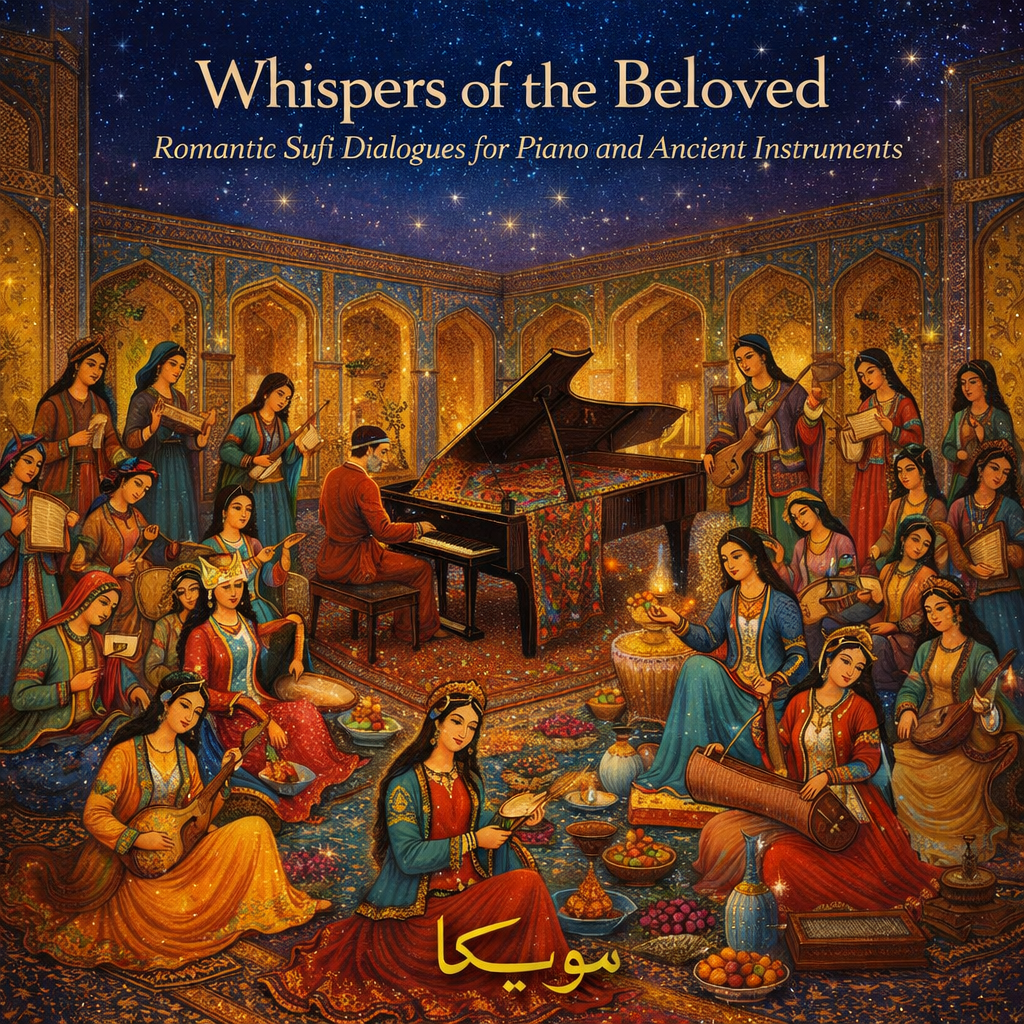
Introduction
Whispers of the Beloved is conceived as a single inward journey, shaped less by narrative than by states of awareness. The album does not aim to tell a story in the conventional sense, nor to present virtuosity or spectacle. Instead, it listens for what emerges when devotion, memory, and presence are allowed to unfold slowly. Each track is a movement of attention: closeness, distance, surrender, acceptance, warmth, remembrance, and finally stillness. Together, they form a continuous arc that mirrors the inner logic of Sufi contemplation—return rather than arrival, dissolution rather than resolution.
At its core, the album explores dialogue: between sound and silence, between personal feeling and collective ritual, and between Western piano language and the ancient musical vocabulary of Persia. The piano does not dominate this world; it enters as a guest, responding to a musical tradition that predates it by centuries. The result is not fusion for novelty’s sake, but a conversation grounded in respect, restraint, and shared emotional intent.
Background of Persian Music
Persian classical music is one of the world’s oldest continuously evolving musical traditions. It is deeply connected to poetry, spirituality, and oral transmission, emphasizing nuance, ornamentation, and emotional subtlety over harmonic progression or large-scale form. Rather than being built around fixed compositions, Persian music is traditionally organized around modal systems known as dastgah and avaz. These modes provide melodic frameworks that guide improvisation, phrasing, and emotional color.
Time in Persian music is often flexible. While rhythmic cycles do exist—especially in dance or ritual contexts—many forms privilege free rhythm, allowing melodies to breathe and unfold according to feeling rather than meter. Silence is treated as an active element, and repetition is used not to build tension, but to deepen presence. This makes Persian music especially suited to spiritual and contemplative expression, where subtle shifts carry more meaning than dramatic gestures.
Typical Instruments in Persian Music
Persian music relies on a small but highly expressive family of instruments, each chosen for its ability to mirror the human voice and breath.
The ney, an end-blown reed flute, is one of the most spiritually charged instruments in Persian and Sufi music. Its sound is intimate, fragile, and breath-centered, often associated with longing, separation, and remembrance. In many traditions, the ney is considered a metaphor for the soul itself.
The setar is a small, delicate plucked lute known for its intimacy and subtlety. Traditionally used in private or contemplative settings, it favors nuance over volume and is closely associated with inward listening and poetic expression.
The kamancheh, a bowed spike fiddle, produces a vocal, resonant tone capable of deep emotional shading. It is often used to sustain feeling across time, carrying lament, warmth, and reflection.
The santur, a hammered dulcimer, adds shimmer and light through its cascading tones. In restrained use, it evokes movement, illumination, and fleeting brilliance rather than rhythmic drive.
Percussion in Persian and Sufi contexts is typically ceremonial rather than decorative. The daf and bendir (frame drums) are central to devotional and communal music, especially in Sufi practice. Their rhythms are circular and grounding, designed to support trance, breath alignment, and collective motion rather than to mark beats in a modern sense.
Instrumentation in This Album
Whispers of the Beloved draws from this traditional palette with careful discipline. Persian instruments are not used as accents or color, but as primary narrative voices. The ney and setar frequently lead melodic development, shaping the emotional and modal direction of each piece. The kamancheh appears where sustained emotional depth is required, particularly in moments of remembrance and vulnerability. The santur is introduced sparingly, reserved for passages that call for shimmer rather than weight.
Frame drums—daf and bendir—are employed only when rhythm serves a ritual or communal purpose. Their presence signals embodied movement or shared breath, never stylistic groove or propulsion. In several tracks, rhythm is deliberately absent, allowing stillness to take precedence.
The piano functions throughout the album as a companion rather than a protagonist. Its role shifts depending on the emotional need of each piece: sometimes reflective, sometimes supportive, sometimes nearly silent. Harmonic language is kept open and modal, avoiding Western cadential logic in favor of resonance and space. The piano listens, responds, and occasionally withdraws entirely.
Together, these instruments form a sound world that is intimate, ancient, and unhurried. The album does not attempt to modernize Persian music, nor to dress it in contemporary production language. Instead, it invites the listener into a shared space where breath, memory, and devotion coexist—where sound arises, moves, and finally gives way to stillness.
Liner Notes
Whispers of the Beloved
The album opens in intimacy. This piece feels less like a beginning than an overheard confession, as if the music has already been speaking before we arrived. The piano offers a quiet admission, while the surrounding breath of sound suggests a presence that is already known. Nothing is sought or explained; the beloved is simply felt, close enough to whisper.
Garden of the Nightingale
Here, presence becomes place. The music steps into a Persian garden at night, where sound drifts naturally among leaves and stone. The nightingale’s voice is not performative but inevitable, singing because it exists. Melody unfolds gently, grounded in tradition, as if the piano itself is listening and learning the language of the garden.
Letters Written in Breath
Distance enters softly. This piece carries the ache that follows closeness, when words can no longer be spoken and must instead be breathed. Phrases feel suspended, incomplete, as if written in air rather than ink. Silence plays as large a role as sound, holding the tenderness of what remains unsaid.
Dance of the Veil
Movement arrives not as celebration, but as surrender. Rhythm emerges ritually, drawing the body into a slow, circular turning. This is devotion expressed through motion, ancient and inward, where the dance is not meant to be seen. The veil lifts and falls in the same gesture, revealing nothing new yet changing everything.
The Rose Does Not Ask
After motion comes rest. This piece embodies acceptance without effort, beauty without explanation. The music does not reach outward; it opens quietly, the way a rose opens because it is its nature. There is no longing here, only calm presence and a sense of having arrived without traveling.
Moon Over Shiraz
Warmth returns under moonlight. The city breathes softly, and the music walks alongside it. Persian instruments lead the way, carrying the nocturnal character of place, while the piano offers gentle accompaniment. Romance here is subtle and unforced, shaped by atmosphere rather than desire, as if the night itself were listening.
When the Heart Remembers
This is the emotional center of the journey. Memory surfaces not as story, but as feeling. The heart recalls what it once knew without needing proof. The music allows vulnerability without drama, letting emotion rise and fall naturally, held by restraint and honesty rather than release.
Steps Around the Fire
The personal dissolves into the communal. Rhythm gathers breath and body into a shared circle, where no single voice dominates. This is collective devotion, grounded and ancient, expressed through repetition and presence. The fire at the center is not spectacle, but warmth—something everyone feels together.
You Were Never Separate
Reassurance arrives quietly. This piece speaks a truth that does not argue or persuade; it simply recognizes. The sense of division softens, and what once felt distant is revealed as always near. The music offers unity as comfort, not as revelation, settling gently into the listener.
Stillness After the Name
The journey ends by letting go of endings. Sound thins into space, and silence becomes the final expression. Names dissolve, distinctions fade, and what remains is awareness without form. The music does not conclude so much as step aside, leaving the listener alone with presence, as the night continues beyond hearing.
Playlist
- Whispers of the Beloved Museca 5:50
- Garden of the Nightingale Museca 3:55
- Letters Written in Breath Museca 3:27
- Dance of the Veil Museca 4:00
- The Rose Does Not Ask Museca 2:22
- Moon Over Shiraz Museca 2:56
- When the Heart Remembers Museca 2:53
- Steps Around the Fire Museca 4:51
- You Were Never Separate Museca 3:30
- Stillness After the Name Museca 5:02