Bossa nova was born from a simple but profound idea: that music can be intimate. In the late 1950s along the beaches and apartments of Rio de Janeiro, musicians began to soften the pulse of samba, blending its rhythmic sway with the harmonic elegance of jazz and the quiet poetry of everyday life. The result was a sound that felt both modern and timeless—music that did not demand attention but gently invited it. Bossa nova became the soundtrack of open windows, warm evenings, and conversations that lingered long after sunset.
Veludo e Mar lives in that same atmosphere. These six songs explore the emotional landscape that bossa nova has always inhabited: the meeting of sea and sky, the quiet beauty of twilight, the subtle ache of memory, and the calm warmth of a new morning. The album moves through a natural arc of time and feeling—from the velvet glow of sunset, through moonlit streets and drifting mist, and finally into the soft renewal of dawn.
Some of the pieces lean toward the traditional language of bossa nova, built around the gentle conversation between nylon-string guitar, voice, and rhythm. Others allow the sound to drift slightly outward, touching modern textures and lounge atmospheres while still keeping the heartbeat of the Brazilian groove. Throughout the album, the intention remains the same: music that breathes, sways, and leaves space for the listener.
The title reflects the two elements that shape the record’s mood. Veludo suggests softness—the quiet intimacy of a whispered melody, the smooth flow of chords under a voice. Mar evokes the horizon and the breeze that carries both memory and hope. Together they capture the essence of bossa nova: music that moves like water and settles like evening light.
These songs are meant to be heard as one gentle journey—from sunset to night to morning—where rhythm is never hurried and emotion is never forced. In that calm space between longing and light, the sea keeps its slow rhythm, and the music simply follows.
Liner Notes
Veludo Azul opens the album in a haze of color and atmosphere. It is the most modern of the six songs, yet its heart remains unmistakably bossa nova: nylon-string guitar, gentle syncopation, and a voice that never pushes harder than the breeze behind it. The added chill textures and ambient glow give the song a sunset-lounge aura, as though the classic Rio shoreline had drifted into a dream. Its mood is intimate, warm, and suspended between memory and desire.
Lyrics
[Intro: Whispered with ambient reverb] Blue velvet sky, the ocean sighs, And time slows down with you.
[Verse 1] You trace a rhythm on my skin, Like waves that never crash too loud. The world dissolves in cobalt light, And all I feel is now.
[Chorus] Veludo azul, no som da luz, Seu tom me guia, como o azul. Suave brisa, noite comum, Veludo azul — volta algum.
[Verse 2] You brew a melody in air, Each note a hush, a half-closed eye. Even the stars forget to shine, When you’re this close, this nigh.
[Chorus repeat] Veludo azul, no som da luz, Seu tom me guia, como o azul. Suave brisa, noite comum, Veludo azul — volta algum.
[Outro] And when the morning paints the sea, You’ll still be here, inside of me.
Areia e Névoa deepens that twilight world. Where Veludo Azul glows, this song shimmers more softly, with sand, mist, and distance shaping the emotional landscape. The flugelhorn adds a smoky, lyrical color that broadens the album’s palette while preserving the understated sensuality of the style. This is a song of traces rather than declarations: fading footsteps, sea air, and the ache of someone felt more in atmosphere than in presence.
Lyrics
[Intro – whispered with ocean ambiance] Between the tide and time… you disappeared.
[Verse 1] The sand remembers what the sun forgot, Your voice, a wave that fades, then not. The mist arrives without a name, And nothing here will feel the same.
[Chorus] Areia e névoa — you drifted away, Like dreams we keep from light of day. Your touch, your tone, the things you’d say… Still echo in the bay.
[Verse 2] I walk the beach you left behind, With footsteps softer than the wind. Each shell a secret we once knew, Each shadow shaped like you.
[Chorus repeat] Areia e névoa — you drifted away, Like dreams we keep from light of day. Your touch, your tone, the things you’d say… Still echo in the bay.
[Bridge – Flugelhorn Solo] [Soft solo over chilled groove and ambient pad]
[Outro] Your breath is in the breeze… Still whispering to me.
Saudade do Sol turns toward the traditional soul of bossa nova. Its language is simple, but its feeling is deep: longing carried by light, warmth remembered after the day has passed. The song rests in the emotional center of the album, where saudade—that uniquely Brazilian blend of tenderness, loss, and sweetness—comes fully into view. The arrangement is deliberately restrained, allowing the melody and lyric to breathe with the quiet dignity that defines the classic style.
Lyrics
[Verse 1] Nas ondas do vento Ouço teu nome chegar No cheiro da tarde Sinto o sol me deixar
[Chorus] Saudade do sol, Do teu olhar, do teu farol O dia se foi, Mas teu calor ficou em mim
[Verse 2] O tempo é tão lento Sem teu passo no chão O céu perde a cor Na sombra da solidão
[Chorus repeat] Saudade do sol, Do teu olhar, do teu farol O dia se foi, Mas teu calor ficou em mim
[Outro] Ficou em mim… Ficou em mim…
Mar de Janela brings the sea indoors. This song feels like an open window at the edge of evening, where the outer world enters not with drama, but with stillness. The ocean is not presented as spectacle here, but as companion: a keeper of memory, a witness to solitude, and a gentle force moving through the room. Its bossa nova setting is intimate and domestic, making it one of the album’s most inward and reflective moments.
Lyrics
[Verse 1] Na janela, o mar entrou Fez silêncio e me chamou Trouxe espuma, trouxe cor Trouxe o nome do meu amor
[Verse 2] No café que já esfriou Teu retrato ainda ficou Sobre a mesa, a luz do fim Fez o vento falar de mim
[Chorus] Mar de janela Brisa tão bela Toca meu peito devagar Leva a saudade Da tarde à cidade E faz meu sonho navegar
[Verse 3] Cada barco que passou Uma lembrança me deixou E no azul do entardecer Quase ouvi você dizer
[Chorus] Mar de janela Brisa tão bela Toca meu peito devagar Leva a saudade Da tarde à cidade E faz meu sonho navegar
[Outro] Fica a onda Fica a luz Fica o mar Dentro de mim
Rua do Luar shifts the scene from shoreline to city street. Moonlight, pavement, silence, and distant music all meet in a portrait of nocturnal longing. There is romance here, but also a certain elegant loneliness, as if the song were walking beside its own memory. The muted trumpet coloring adds a faint jazz glow without disturbing the classic bossa atmosphere. This track gives the album its midnight hour: graceful, suspended, and quietly cinematic.
Lyrics
[Verse 1] Rua de luar, passo sem som Noite tão clara, céu de bombom Teu perfume ficou no ar Feito segredo a me chamar
[Verse 2] Porta entreaberta, luz no chão Sombra comprida na estação Cada janela, um coração Cada silêncio, uma canção
[Chorus] Rua do luar Me faz lembrar Teu riso manso no portão Noite vazia Doce maresia Dançando em minha solidão
[Verse 3] Um violão em algum lugar Faz a calçada respirar E eu vou sozinho sem saber Se a lua guarda o teu querer
[Chorus] Rua do luar Me faz lembrar Teu riso manso no portão Noite vazia Doce maresia Dançando em minha solidão
[Bridge] [Muted trumpet solo]
[Outro] Rua do luar Se eu te encontrar Não digo nada Só vou sorrir
Flor da Manhã closes the journey with renewal. After dusk, mist, longing, and moonlight, this final piece opens the windows to morning. Its brightness is gentle rather than triumphant, true to the album’s understated emotional world. The song suggests that light does not return all at once; it arrives softly, through air, color, and the slow reawakening of the heart. As the final track, it completes the album’s arc beautifully, leaving the listener not in sorrow, but in calm and luminous repose.
Lyrics
[Verse 1] Flor da manhã Abre no quintal Bebe do sol Brisa de cristal
[Verse 2] O dia vem Sem me apressar No teu clarão Aprendo a olhar
[Chorus] Flor da manhã Vem me dizer Que a luz também Sabe renascer Depois da noite Do céu sem cor Volta o caminho Volta o calor
[Verse 3] Passa um pardal Canta no fio Tudo outra vez Claro e macio
[Chorus] Flor da manhã Vem me dizer Que a luz também Sabe renascer Depois da noite Do céu sem cor Volta o caminho Volta o calor
[Outro] Manhã tão mansa Fica assim Teu ouro leve Sobre mim
Playlist
Track 1 - Veludo AzulMuseca3:06
Track 2 - Areia e Névoa (Sand and Mist)Museca4:30
Track 3 - Saudade do SolMuseca2:44
Track 4 - Mar de JanelaMuseca2:42
Track 5 - Rua do LuarMuseca3:01
Track 6 - Flor da ManhãMuseca2:30
Continue exploring
Follow the bossa beyond the morning light
Hear another journey through Latin settings, an intimate multilingual song world, and a continuous coastal lounge.
Sombra y Fuego takes a recurring idea through bossa, bolero, salsa, jazz, and tango. The bossa’s intimate sway becomes one point in a wider sequence of transformations.
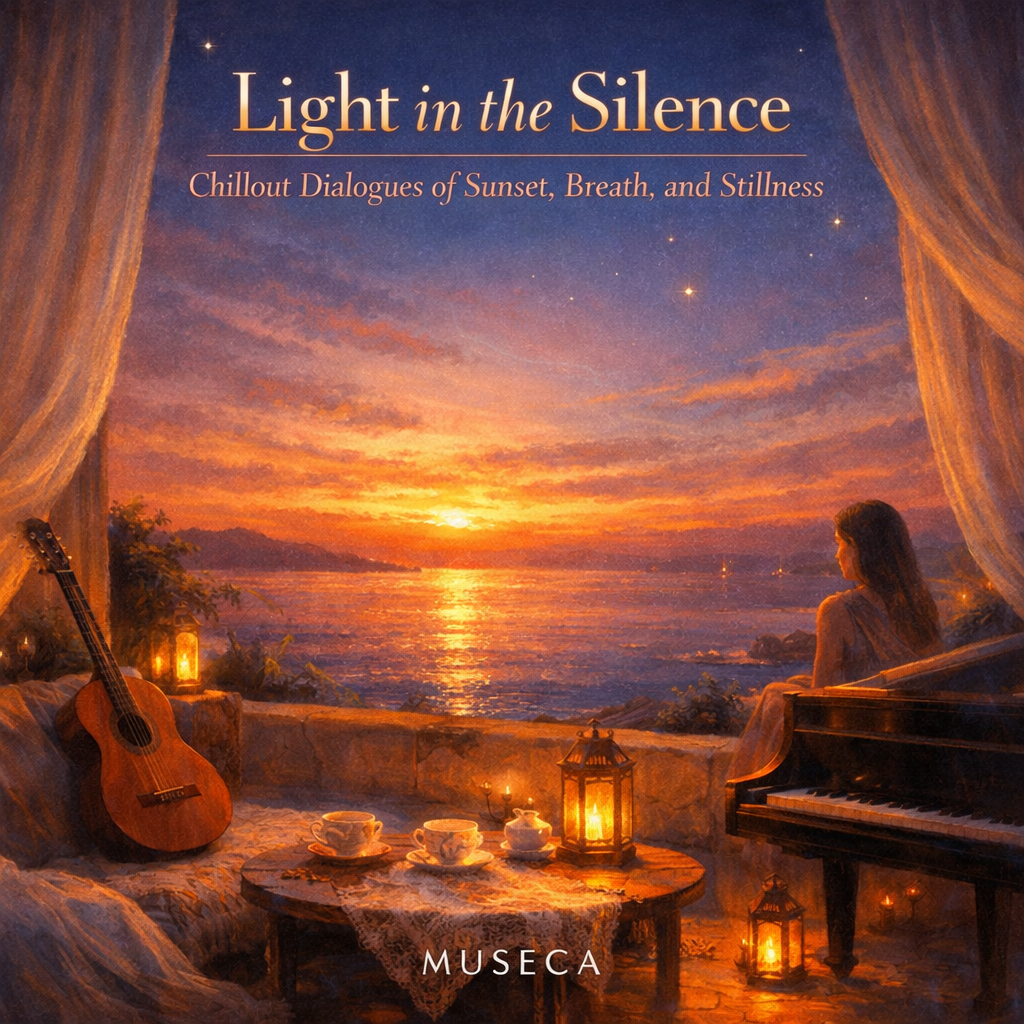
Light in the Silence joins bossa-inflected warmth, nylon guitar, flute, and breathy vocals. Its changing atmosphere offers a close companion to the velvet sunset and sea.
Chillout Vibes offers a continuous Café del Mar-inspired setting of warm textures and slow rhythms. Extend the evening atmosphere into a broader lounge palette.