
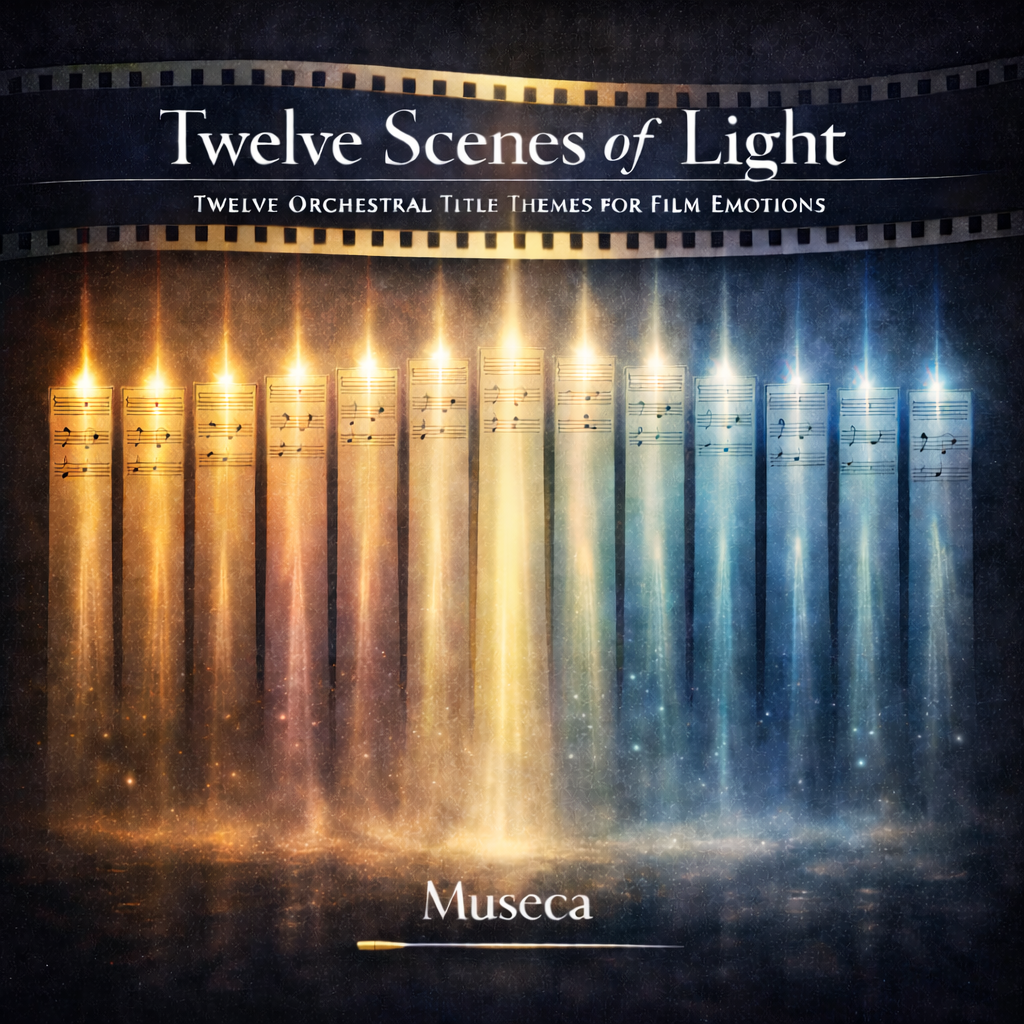
This album is a set of twelve original, purely orchestral film themes—each written as a complete, hummable “title-theme statement,” built from an 8-bar kernel expanded into a 16-bar main theme. The intention is simple: to recreate the emotional clarity of classic cinema themes without imitation, using the same structural discipline that makes the best film music instantly memorable. Each track begins with a compact musical idea—clear enough to be recognized in a few seconds—then unfolds into a fuller statement where orchestration, register lift, and cadential weight turn the melody into a narrative event.
The twelve theme emotions were chosen because they function as the most common “emotional jobs” that music performs in storytelling. Across genres—romance, adventure, mystery, drama, thriller—films repeatedly return to a small set of archetypal states: awe at a new world, the forward pull of motion, the inner spine of resolve, unanswered curiosity, tightening dread, the shadow of power, the intimacy of love, the ache of memory, the reality of loss, the turning of renewal, the release of victory, and the final perspective of transcendence. These are not merely moods; they are structural pivots in narrative. Each one tends to appear at predictable story moments (opening, departure, investigation, threat, bond, rupture, recovery, climax, and aftermath), which is why audiences recognize them so quickly—and why composers can shape them into themes that feel inevitable.
To keep the album coherent while preserving variety, the instrumentation follows an “orchestral spine plus signature color” approach. Strings provide the continuous identity of the record, while each emotion is given a featured color—celesta for wonder, horns for motion, bass clarinet for mystery, low brass for menace, solo cello for mourning, harp for the sacred—so the listener hears a unified world with distinct emotional rooms inside it. The result is a practical theme library: twelve original melodic identities, each engineered to be quotable at 8 bars, fully declarative at 16, and adaptable to scenes through orchestration and variation—exactly as film music must behave when it is doing its job.
Liner Notes
Track 1 — Wonder / Discovery
Mode: C Lydian • 4/4 • ♩=76 • Color: celesta + high strings harmonics
Form: 8-bar sentence (2+2+4) → 16 bars = A + A′ (higher + fuller)
Harmony: Imaj9(#11) → II(add6) → Imaj9(#11) → V(add4)/I (floating, no “hard” cadence)
Melody contour: 1–2–3–#4 | 5–#4–3–2 | 1–2–#4–5 | 6–5–3–1
A first-light cue: the melody behaves like curiosity itself—reaching toward the raised fourth, then returning home without finality. The celesta and harmonics create an “open sky” acoustic where wonder is felt as gentle expansion rather than spectacle.
Track 2 — Adventure / Motion
Mode: G Mixolydian • 4/4 • ♩=112 • Color: horns + low-string ostinato
Form: 8-bar period (4+4) → 16 bars = A + B (new answer strain)
Harmony: I → ♭VII → IV → I | ii → IV → ♭VII → I (open, driving)
Melody contour: 5–6–5–3 | 2–3–4–5 | 6–5–4–3 | 2–1 (tag)
This is forward motion without anxiety: a mixolydian road theme where the lowered seventh keeps the horizon wide and unpretentious. The ostinato is propulsion, but the horns carry the smile—the sense that the journey itself is the reward.
Track 3 — Heroic Resolve
Mode: A Dorian • 4/4 • ♩=96 • Color: solo viola/violin unison → full strings (horns optional later)
Form: 8-bar sentence (2+2+4) → 16 bars = A′ with wider intervals + stronger cadence
Harmony: i → IV | VII → i | ii → IV → VII → i(6/9)
Melody contour: 1–♭3–4 | 5–4–3 | 2–4–5 | 6–5–1 (resolved)
Resolve is courage with restraint, and Dorian is its natural language—minor with a lifted spine. The expansion widens the intervallic reach in the second half, as if the character’s internal “yes” becomes audible to the world.
Track 4 — Mystery / Curiosity
Mode: D Dorian ♭2 (D–E♭–F–G–A–B–C) • 4/4 • ♩=78 • Color: bass clarinet + muted strings
Form: 8-bar period (4+4) → 16 bars = A + A′ (deeper + clearer hint of answer)
Harmony: i(add♭2) → ♭IImaj7 → iv → v | i → ♭II → iv → i (cadence withheld)
Melody contour: ♭2→1 “sigh” | ♭3–4–♭2 | 5–4–♭3 | ♭2–1 (returns)
The flat second is the question mark: it brushes the tonic and refuses to explain itself. With bass clarinet leading and strings muted, the music feels like a corridor of half-seen doors—curiosity pulling forward, certainty held back.
Track 5 — Suspense / Dread
Mode: ambiguous modal pedal (center on C) • 4/4 • ♩=72 • Color: low strings tremolo + timpani/taiko pulses (orchestral only)
Form: kernel 2-bar cell presented as an 8-bar sentence → 16 bars = layer escalation + cadence denied
Harmony: pedal 1 with chromatic upper neighbors; occasional ♭2/♭6 color (never “home”)
Melody contour: 1–♭2–1 | 5–♭6–5 (fragmented, then inverted)
Here the “theme” is behavior, not tune: a cell that tightens like breath held too long. The 16-bar expansion is pure orchestration strategy—layers accumulating, range widening, time compressing—yet the harmony refuses catharsis by design.
Track 6 — Menace / Villainous Power
Mode: F Phrygian • 4/4 • ♩=88 • Color: low brass + contrabassoon + bass strings
Form: 8-bar period (4+4) → 16 bars = A′ heavier + “iron” cadence
Harmony: i → ♭II → i → ♭VI | iv → ♭II → i → i (weighty closure)
Melody contour: ♭2–1 (brand) | 4–♭2–1 | 5–♭6–5 | ♭2–1 (final stamp)
Phrygian menace is power with proximity—the threat is already in the room. The low brass and contrabassoon anchor a theme that doesn’t chase; it advances slowly, certain of outcome, sealing its presence with the flat-second “stamp.”
Track 7 — Love / Devotion
Mode: D Dorian • 4/4 • ♩=84 • Color: strings (solo violin → full strings)
Form: 8-bar period (4+4) → 16 bars = A + A′ lift (yearning → fulfillment → lasting)
Harmony: i → IV → VII → v | i → IV → VII → i(6/9) (warm modal close)
Melody contour: 5–6 pickup; appoggiatura 2→♭3; period answer with octave-lifted climax
This love theme is built on tenderness that does not collapse into sadness—Dorian warmth, long-breathed line, and cadences that feel like staying rather than arriving. The second statement rises in register and density, turning yearning into fulfillment without changing the emotional truth.
Track 8 — Nostalgia / Memory
Mode: E major with modal borrowing (touches of ♭VII / iv) • 4/4 • ♩=72 • Color: piano + soft strings
Form: 8-bar sentence (2+2+4) → 16 bars = B strain as “memory returns,” then calm cadence
Harmony: I → vi | IV → I | iv (borrowed) → I | ♭VII → I (gentle time-warp)
Melody contour: 3→2 “sigh” | 1–2–3 | 5–4–3 | 2–1 (soft landing)
Nostalgia lives in harmonic “weather”—a bright key with brief shadows passing through. The piano carries the intimacy of recollection, while the borrowed iv and ♭VII feel like an old photograph: slightly faded, emotionally sharper than expected.
Track 9 — Loss / Mourning
Mode: C Aeolian (C minor natural) • 4/4 • ♩=60 • Color: solo cello + divisi violas
Form: 8-bar period (4+4) → 16 bars = A′ deeper, cadence softened (no triumph)
Harmony: i → VI → iv → v | i → ♭VII → VI → i(add2) (suspensions)
Melody contour: 5–4–♭3 | 2–♭3–4 | ♭6–5–4 | 2–1 (quiet acceptance)
This is grief without theatrics: slow harmonic rhythm, suspended resolutions, and a cello line that speaks like a human voice trying not to break. The final cadence is deliberately softened, suggesting endurance rather than closure.
Track 10 — Hope / Renewal
Mode: D Dorian brightening toward Lydian color (raised 4 appears late) • 4/4 • ♩=84 • Color: flute/oboe halo + strings
Form: 8-bar sentence (2+2+4) → 16 bars = A′ with higher register + clearer cadence
Harmony: i → IV | VII → i | II (Lydian lift) → IV → i(6/9)
Melody contour: 1–2–♭3 | 4–5–4 | 6–5–4 | 2–1 (then octave-lift in bars 9–16)
Hope is not a switch—it’s a gradual brightening. The late Lydian lift is the key gesture: a single raised fourth that feels like sunlight entering a room, after which the theme can finally cadence with confidence.
Track 11 — Triumph / Victory
Mode: B♭ major (or Mixolydian tint) • 4/4 • ♩=120 • Color: brass choir + full strings + cymbal swells (orchestral)
Form: 8-bar period (4+4) → 16 bars = A + B (answer strain + final seal)
Harmony: I → V → vi → IV | ii → V → I → I(add6) (clean, earned cadence)
Melody contour: 1–3–5 | 6–5–3 | 2–4–5 | 1 (big cadence)
Triumph must feel earned, so the harmony is clear and the cadence is unambiguous. The second strain doesn’t merely repeat—it “confirms,” widening the orchestration and sealing the final tonic like a banner held aloft.
Track 12 — Transcendence / Sacred
Mode: D Mixolydian (hymn-like, open) • 4/4 • ♩=56 • Color: strings + harp + celesta (no choir)
Form: 8-bar period (4+4) → 16 bars = A′ with longer tail + “amen” cadence
Harmony: I(add9) → ♭VII → IV → I | IV → I → ♭VII → I(6/9) (plagal emphasis)
Melody contour: 1–2–3 | 5–4–3 | 2–1–2 | 1 (slow, inevitable)
The final track steps outside narrative tension and into perspective. Mixolydian openness, plagal gravity, and a lengthened tail create the sensation of looking back at the whole story from above—quietly affirmed, gently released.
Playlist
- Track 1 — Wonder / Discovery Museca 2:50
- Track 2 — Adventure / Motion Museca 2:54
- Track 3 — Heroic Resolve Museca 2:55
- Track 4 — Mystery / Curiosity Museca 2:12
- Track 5 — Suspense / Dread Museca 2:56
- Track 6 — Menace / Villainous Power Museca 4:20
- Track 7 — Love / Devotion (Theme #1) Museca 3:23
- Track 8 — Nostalgia / Memory Museca 1:57
- Track 9 — Loss / Mourning Museca 4:00
- Track 10 — Hope / Renewal Museca 3:25
- Track 11 — Triumph / Victory Museca 2:03
- Track 12 — Transcendence / Sacred Museca 2:48