
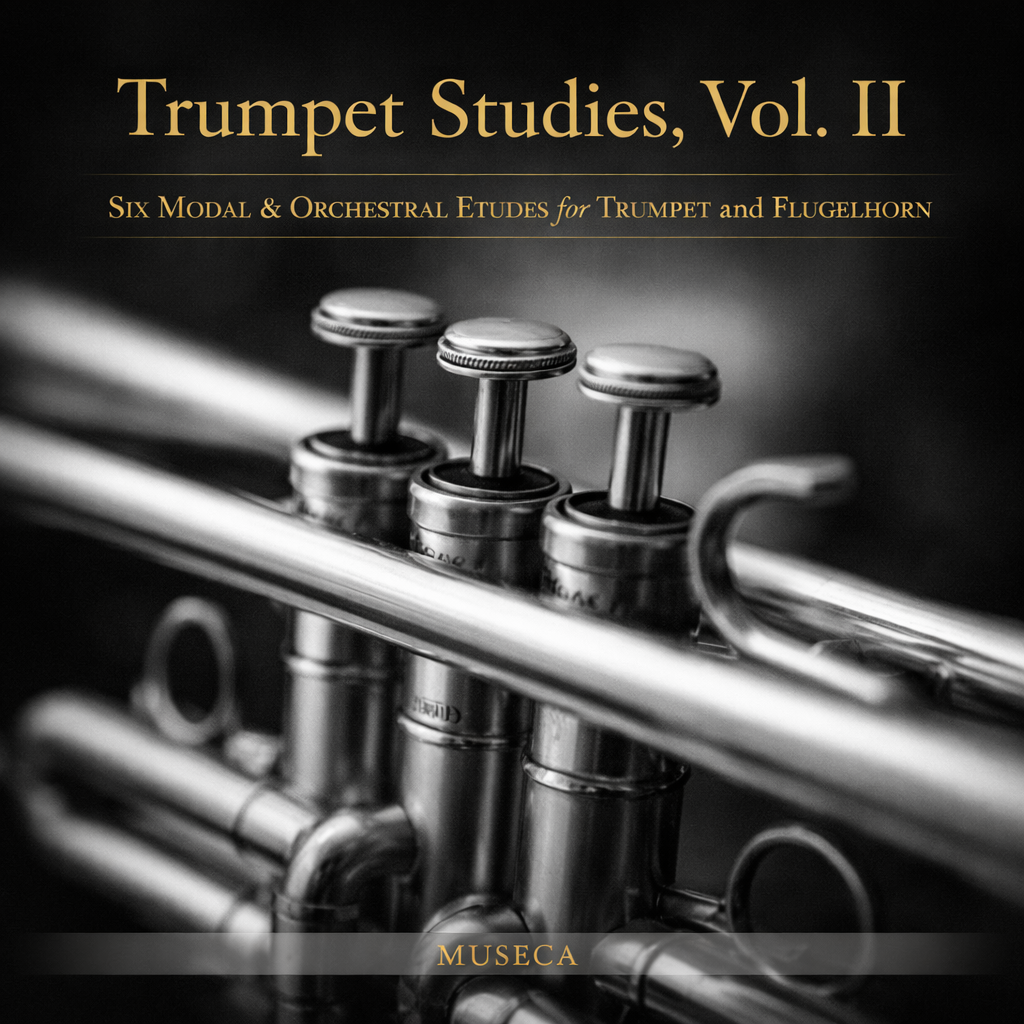
Trumpet Studies, Vol. II is constructed as a disciplined set of six etudes—less a collection of “songs” than a coherent laboratory for trumpet and flugelhorn technique. The guiding premise is simple: treat the horn as a thinking voice. Not a vehicle for display, but an instrument that can shape meaning through economy, timing, and timbre. Each track is therefore built on explicit constraints—limited pitch materials, controlled phrase counts, and deliberate orchestration—so that expression arises from choices rather than density.
The album’s first structural pillar is a trumpet/flugelhorn technique set drawn from the modal small-group logic associated with Kind of Blue. Here, the melodic language is motif-first: phrases are constructed from 2–5 note cells and developed by variation rather than by adding notes. Cells are repeated three to five times while altering a single variable—rhythm, ending pitch, articulation—or by using register as a second voice, re-stating the same idea up or down an octave to create narrative without “new material.” Silence is treated as structure, not absence: rests and held tones are melodic events, with an intentional silence ratio and phrases that end early so the harmony and texture can answer. Modal centers remain stable while tension is generated through color tones—9ths, 11ths, 13ths—and through subtle modal mixture (the expressive friction of 6 vs ♭6, or natural 3 vs ♭3) against a pedal foundation. Time, too, becomes a compositional parameter: the groove stays steady while the horn creates an illusion of rubato through behind-the-beat entrances, tie-overs across barlines, and phrase peaks placed in weak parts of the bar. Finally, tone concept functions as narrative logic: changes of color—open horn, Harmon-muted, cup-muted—replace virtuosity, allowing the same melodic material to read as confession, distance, or intimacy purely through timbral recontextualization.
The second pillar is a complementary technique set drawn from the orchestral lyricism logic associated with Sketches of Spain. In these studies, trumpet and flugelhorn behave less like soloists and more like singers inside a large acoustic space. The horn does not dominate; it enters from within the orchestral fabric and emerges briefly, often beginning phrases doubled in timbre—unison or octave pairings with clarinet, oboe, or horn—before separating into a short spotlight and returning to blend. The phrasing is governed by long-breath melodic arcs: fewer phrases, longer phrases—“breath sentences” in the 8–14 second range—shaped primarily by stepwise motion and small intervals, with leaps reserved for a single decisive emotional gesture. Ornamentation is rationed and purposeful: scoops, falls, grace-notes, and half-valve smears appear sparingly, limited to roughly one ornament per two phrases, and placed on arrivals rather than passing tones so they function as meaning rather than decoration. Harmony is treated as inevitability—slow shifts like light moving across a wall—favoring pedal points, planed color blocks, and restrained cadence behavior over busy functional change. Rhythm becomes ceremonial: processional ostinati and sparse percussion punctuation create a sense of ritual, with low repeating patterns and selective strikes (timpani or hand percussion) replacing ride-cymbal propulsion.
Taken together, the six etudes form a single arc: from modal economy and negative space, toward orchestral breath and ritual color—always original in material, yet unified by a consistent technical philosophy. The result is a Volume II that reads like a method book written in sound: a set of playable concepts, each engineered to make the trumpet and flugelhorn speak with clarity, patience, and authority.
Liner Notes
Pedal of Smoke
Study Objective: Develop intensity from a limited pitch set by repeating a 3-note cell and varying only placement (displacement), not density.
The cycle opens with authority under constraint: a narrow pitch field, a pedal foundation, and a trumpet line that advances through small, deliberate mutations—rhythmic shifts, altered endings, octave re-voicings. The accompaniment stays intentionally thin so the “answers” are often delivered by space itself.
Blue Geometry
Study Objective: Treat silence as primary material—shape phrases that resolve by withholding closure, using rests and held tones to complete the form.
Muted tone turns minimalism into structure. Motifs appear, retreat, and return with changed weight, as if the melody is being revised mid-thought. The groove remains steady while the horn creates time elasticity through delayed entrances and tie-overs, letting absence become the track’s strongest cadence.
Dorian Lantern
Study Objective: Create lyric heat through sustained color tones (9/11/13) and small-interval melody, reserving one strategic leap as the single “reveal.”
Flugelhorn warmth becomes the primary paint, hovering near the modal center while tension blooms through color. The line favors stepwise motion and close intervals so that the rare leap reads as meaning—an intentional widening of the frame—before the voice returns to intimacy.
Procession in 12
Study Objective: Build a ceremonial 12/8 through one chant-like 4-note cell; generate variation via articulation, register, and shading rather than new notes.
A ritual ostinato sets the ground: low patterns and sparse percussion punctuation replace swing propulsion. The trumpet’s chant cell is never replaced—only transformed—so the track feels processional and inevitable, with brief emergences into spotlight before dissolving back into the ensemble fabric.
Arches of Ochre
Study Objective: Write the flugelhorn as an inner voice of the ensemble—enter in unison blends, separate briefly into spotlight, then return to the fabric.
This etude treats the solo voice as orchestral material. Phrases often begin doubled with winds or horns, then separate for a moment of clarity before rejoining the texture. Long-breath lines and slow swells make the harmony feel like shifting light—experienced as color rather than counted as changes.
Saeta Without Words
Study Objective: Use ornament as meaning (rare, intentional inflection) and avoid cadential punctuation; let a recurring “cry-note” act as the emotional axis.
The closing study is meaning-per-gesture: muted trumpet in sparse orchestral space, a steady pedal, and carefully rationed micro-inflection—placed on arrivals, never as decoration. The piece refuses “finality” in cadence; instead, the returning cry-note functions as a wordless refrain, resolving by deepening rather than arriving.
Playlist
- Track 1 — Pedal of Smoke Museca 3:09
- Track 2 — Blue Geometry Museca 2:00
- Track 3 — Dorian Lantern Museca 3:13
- Track 4 — Procession in 12 Museca 4:20
- Track 5 — Arches of Ochre Museca 4:25
- Track 6 — Saeta Without Words Museca 2:22