
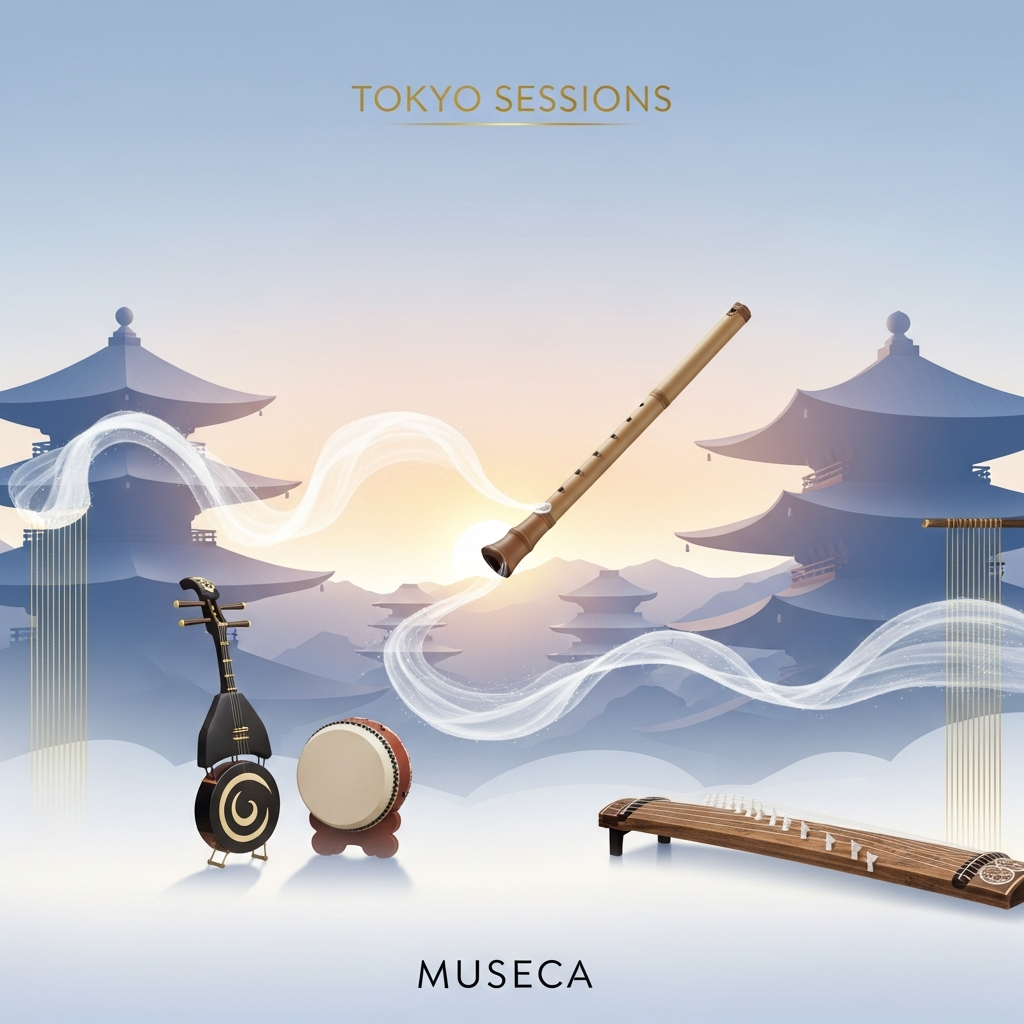
Tokyo Sessions — Album Introduction
Tokyo Sessions is a meeting point: the living grain of Japanese instruments placed inside modern rooms of sound. Rather than recreating historical repertoires, these pieces invite the instruments themselves—koto, shamisen, shakuhachi, shinobue, taiko, biwa, and kokyū—to speak their native articulations inside contemporary forms: Café del Mar chill, modern jazz, lo-fi, deep house, nu-disco, neo-soul, trip-hop, liquid drum & bass, and ambient/neo-classical.
Each track is built on a simple covenant: the genre provides structure and pulse; the instruments carry breath, wood, skin, and string. Slides, tremoli, ma (intentional space), and unforced intonation are preserved, not corrected. You’ll hear bamboo over a soft four-on-the-floor, tsugaru bite inside a swing chorus, taiko as the engine of a dance groove, and koto harmonics floating over late-night pads. The result is neither fusion for its own sake nor pastiche—it is a dialogue where both sides remain themselves.
Production is deliberately transparent: intimate microphones, plate and room reverbs, restrained compression, and careful low-end governance let transients and decay tell the story. Across the sequence, the city is a silent collaborator—neon distance, rooftop wind, quiet alleys after rain—framing an album that is at once refined, nocturnal, and deeply human.
Tokyo Sessions honors tradition by trusting timbre and touch while exploring new contexts. It is contemporary music shaped by centuries of craft, and a reminder that instruments don’t belong to eras—they belong to the hands that play them.
Museca (Tokyo November 2025)
Tokyo Sessions — Liner Notes
1) Neon Koto — Café del Mar (≈92 BPM, A Aeolian with add9/11 colors)
A sunset prelude: rolling koto arpeggios voice open fifths (A–E) with natural harmonics on section ends. Shakuhachi replies in short, breath-led motifs; Rhodes pads blur the harmony with suspended 9ths to avoid cadential gravity. Side-chain swells give the pads a tide-like motion while a soft kick and brushed percussion outline a relaxed 4/4. Plate reverb on koto is short to preserve attack; the flute uses eighth-note tape delay for depth without haze.
2) Shamisen Blue — Modern Jazz Quartet (≈120 BPM, D Dorian with blues inflection)
Tsugaru shamisen takes the “horn chair,” exploiting sawari buzz for growl on blue notes (♭5 approach tones). The head is AABA; piano comps with rootless voicings and shell tones to leave overtone space for the shamisen. Walking bass outlines modal pedals; brush kit keeps a dry ride pattern. Solos lean on string snaps and glissandi rather than bebop chromaticism—an assertive timbral statement inside a classic small-combo frame.
3) Shibuya Mist — Lo-Fi Chillhop (≈80 BPM, G minor with borrowed IVmaj7)
A nocturne on vinyl. Koto block chords carry the harmony while shakuhachi sings a two-bar hook; low-passed rain foley sits in the mid-side field. The IVmaj7 borrowing (Cmaj7) softens the minor center, creating that “streetlight lift.” Drums are behind the beat with lightly swung hats; a sub counterline arrives in the B section to thicken the late-night drift.
4) Taiko Meridian — Downtempo Deep House (≈104 BPM, E Aeolian with Phrygian touch)
Taiko functions as both tom and drone: mid-sized barrels give a woody thud that anchors the four-on-the-floor. Cross-accents in bars 3–4 create a gentle hemiola, answered by shinobue riffs that skate above the grid. The breakdown exposes airy drones and breath tones; the drop returns with trimmed low-end (HPF ≈45 Hz) to keep the sub clean. Pads are side-chained to kick only—taiko remains unpumped to retain physicality.
5) Ginza Bossa — Bossa Nova with Shakuhachi (≈96 BPM, A minor with 6/9 and add13) — vocal
A candlelit pocket. Nylon guitar patterns the classic bossa clave; upright bass walks minimally to protect the singer’s phrasing. Shakuhachi acts as an obbligato—never doubling the melody, always answering it—using meri/kari (pitch shading) on cadences. The bridge pivots through secondary dominants to momentarily “warm” the minor tonality. Vocal is close-mic’d with a small room verb; flute rides 1–3 dB under the lead during verses, then blossoms on the outro tags.
Lyrics
[Verse 1]
City lights whisper low, crossing lines of gold
Footsteps find a sway, stories softly told
[Chorus]
Under the yozora tonight, we breathe in slow
Ginza no kaze, where quiet rivers flow
[Verse 2]
Lazy chords of rain trace the window’s seam
Your hand keeps the time, samba in a dream
[Bridge]
Kokoro wa, kokoro e—follow where it goes
[Chorus]
Under the yozora tonight, we breathe in slow
Ginza no kaze, where quiet rivers flow
[Outro]
[Shakuhachi ad-lib; whisper “oyasumi”]
6) Taiko Satellite — Nu-Disco (≈118 BPM, B minor pentatonic + dominant lifts)
A midnight rooftop mover. Juno bass locks octaves with a tight four; muted guitar comps on the off-beats. Taiko appears as disciplined fills at phrase ends—short, tuned, and compressed in parallel for punch—so the groove remains disco-clear. Harmony lives mostly in pentatonic hooks; pre-chorus lifts hit V/VI for sparkle before snapping back into the dance pocket.
7) Velvet Lantern — Neo-Soul (≈84 BPM, F minor with min9/11 extensions) — vocal
Koto and Rhodes trade call-and-response, the koto voicing quartal shapes that sit beautifully against min9/11 chords. Pocket drums place ghost notes between the singer’s syllables; a round P-bass leans slightly late for melt. The bridge chromatically “slides” via tritone subs while the vocal stays conversational, creating elegant harmonic motion without vocal gymnastics. Stereo koto miking supplies width; the center stays reserved for the voice.
Lyrics
[Verse 1]
Low light on the street, velvet in the air
Koto finds the beat, pulling up a chair
[Chorus]
Say you’ll stay just a little more—
Tokyo night behind a hidden door
[Verse 2]
Teacups ringing time, hush between the notes
Breathing with the chime, secrets in our coats
[Bridge]
I follow where your rhythm goes
[Chorus]
Say you’ll stay just a little more—
Tokyo night behind a hidden door
[Outro]
[Soft ad-libs; koto riff to fade]
8) Biwa Noir — Cinematic Trip-Hop (≈78 BPM, D minor with modal mixture)
The biwa’s nail attack becomes a noir heartbeat: an ostinato built from 1–♭7–♭6 outlines a shadowy descent. Dusty drums and chamber-string swells create long arcs; granular delay on select plucks smears into raindrop echoes. A sub-only interlude drops the drums out, letting biwa harmonics flicker like alley reflections before the full kit returns half-time and heavier.
9) Blade Garden — Liquid Drum & Bass (≈172 BPM, E minor; I–VI–VII pad cycle)
A glide through city air. Rolling breaks (two-layer chop: crisp top, warm room bottom) lift a sine-leaning sub; shakuhachi leads sing long-line melodies while koto stabs provide syncopated chord punctuations on the “and” of 2 and 4. Amen fragments appear only as excitement devices late in phrases. Mid-break, the flute solos over pads alone, then the drums bloom back under a widened pad stack.
10) Sky Shrine — Ambient / Neo-Classical (≈64 BPM or rubato, C major / A minor ambiguity)
A breath-based coda. Shinobue sustains trace micro-vibrato; kokyū drones anchor pedal points while felt-piano motifs sketch quartal figures that never fully resolve. Choir pads are filtered to avoid intelligible “words,” keeping the texture human yet abstract. The form arrives in three waves—dawn hush, first light, still return—ending with a long decay that invites silence rather than applause.
Playlist
- Neon Koto (Café del Mar) Museca 4:45
- Shamisen Blue (Modern Jazz Quartet) Museca 2:41
- Shibuya Mist (Lo-Fi Chillhop) Museca 2:20
- Taiko Meridian — Downtempo Deep House Museca 3:52
- Ginza Bossa — Bossa Nova with Shakuhachi Museca 2:35
- Taiko Satellite — Nu-Disco Museca 4:35
- Velvet Lantern — Neo-Soul Museca 2:08
- Biwa Noir — Cinematic Trip-Hop Museca 2:42
- Blade Garden — Liquid Drum & Bass Museca 4:08
- Sky Shrine — Ambient / Neo-Classical Museca 3:49