
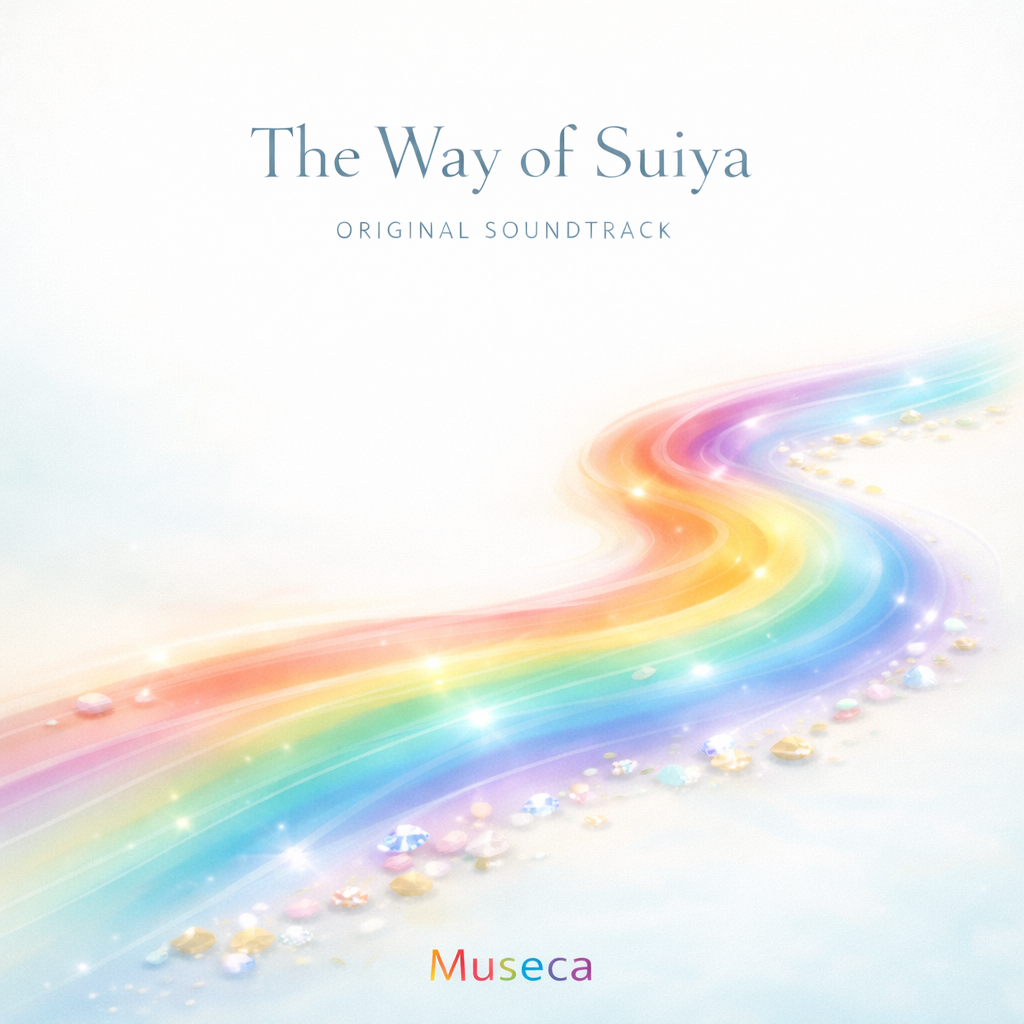
The Way of Suiya — Original Soundtrack
Music Inspired by the Novella by P. A. Rallax
The Way of Suiya is not a story about building a better world.
It is a story about what remains when the need to control the world dissolves.
In the novella by P. A. Rallax, we follow Ilan — a man formed by maps, systems, and certainty — as he walks away from collapse and toward something he does not understand. What he finds is Suiya: a small riverside village with no gates, no leaders, no political structures, and no visible authority. Decisions arise without debate. Problems resolve without command. The current of the stream becomes both metaphor and method.
At first, Ilan attempts to interpret Suiya through the logic he has always known. He looks for hierarchy. He looks for hidden governance. He tries to fix what does not appear broken. Yet Suiya does not resist him. It simply flows around him — patiently, quietly — until he begins to see that the very instinct to control is what has kept him separate from harmony.
The story unfolds not as drama, but as gradual recalibration.
Moments such as The Council of None, The Listening Pool, Drought of Control, and The Naming of the Water reveal a way of living rooted in trust rather than enforcement. The villagers do not surrender responsibility; they surrender domination. Their society functions not because no one leads, but because no one insists.
By the final pages, Ilan does not conquer Suiya, nor does he master its philosophy. He lets go of the need to define himself against it. In doing so, he discovers what the book calls the “First Harmonic” — a resonance beneath effort, a tone that emerges when tension ceases.
The soundtrack mirrors this arc.
The music begins from a place of distance — hesitant, searching, and inward. As the album unfolds, themes flow more freely. Motifs that once felt uncertain begin to breathe. The harmonic language avoids sharp cadences and grand resolutions, favoring spacious textures, suspended chords, and gentle melodic currents. The instrumentation — piano, strings, flute, harp — is intentionally restrained. Nothing dominates. Nothing shouts. Each voice enters, yields, and recedes like water meeting stone.
The Overture frames the entire journey: not as a beginning, but as the river itself — present before Ilan arrives and continuing long after he stops naming himself.
This soundtrack does not attempt to dramatize the novella. It inhabits it.
Like the story, it does not seek climax.
It seeks alignment.
Like Suiya, it does not impose structure.
It listens.
And in listening, it finds its form.
You may download a PDF copy of the current edition of The Way of Suiya by P. A. Rallax below. Reading the novella alongside the soundtrack will deepen the experience, allowing you to follow the emotional arc of the story as the music unfolds—chapter by chapter, current by current.
Liner Notes
Overture — The Way of Suiya
The overture stands outside the journey, just as the river stands outside any single chapter of the story. Sweeping strings and gentle harp evoke a current that has always been flowing, long before Ilan appears on its banks. Hints of tension surface in the harmony and then dissolve again into spaciousness, echoing the central movement of the novella: from control to surrender, from collapse to quiet resonance. This piece is not an arrival; it is the field in which every arrival takes place.
The Map That Led to Nothing
This opening cue follows Ilan before he reaches Suiya, with solo piano capturing the weight of his old world and the hollowness of its promises. Hesitant motifs wander without clear direction, reflecting the loss of trust in maps, systems, and institutions that once claimed to offer certainty. The pauses and unresolved phrases suggest that the true path is not being drawn; it is slowly being discovered underfoot.
A Village with No Gates
Here the music steps into Suiya for the first time. Piano and soft flute introduce a simple, hopeful motif that feels quieter than expectation and gentler than welcome. The strings do not swell; instead, they breathe. This piece reflects the shock of finding a place with no walls, no guards, and no visible authority—a village organized not by force, but by mutual ease. The music does not proclaim safety; it quietly assumes it.
The Council of None
In this track, piano, flute, and cello trace the subtle choreography of a community that governs without formal councils or decrees. The lines move around each other in calm conversation, never competing for space. There is no grand theme, only a shared pattern of small adjustments, like villagers placing stones in a channel until the water finds its way. The absence of dramatic climax is the point: nothing needs to be imposed for harmony to emerge.
The Listening Pool
The music grows more sparse as Ilan encounters the Listening Pool—a place where questions are floated on bark boats and allowed to drift. Solo piano, nearly alone, lingers on open chords and gentle dissonances that never fully resolve. Long silences between phrases mirror the pool’s quiet invitation: not to demand answers, but to release the need for them. This piece is less a statement than a held breath.
Drought of Control
This cue explores the tension of Ilan’s attempt to “fix” the stream wall and impose order on what does not ask for it. The piano begins with a tighter, more repetitive figure, suggesting the mindset of control: focused, anxious, convinced it knows better. Gradually, the harmony softens and the motif loosens, mirroring the moment when the water, rain, and the villagers’ response reveal that control is the true drought. The music moves from insistence to acceptance.
The Upstream Walk
Piano and cello walk together in this piece, tracing the ritual of the Upstream Walk—a silent journey taken when something must be released. The tempo feels like a slow stride, but without a strict pulse, as if the path adjusts itself around the walkers. The two instruments move in a quiet dialogue, sometimes aligning, sometimes separating, just as the characters part at the fork in the stream. This track embodies reflection without confession, reconciliation without words.
The Naming of the Water
One of the emotional centers of the album, this piece marks the annual ritual in which villagers pour water from their own lives back into the stream. The ensemble opens gently and then blooms into a luminous, sustained harmony, suggesting something sacred yet entirely unceremonious. Themes from earlier tracks return in softened, more complete forms, like memories whispered into the current. This is less a hymn to water than an acknowledgment that water has always been listening.
The Word That Cannot Be Translated
This track occupies the space where language fails. Solo piano, shifting between modes and blurred tonal centers, expresses what the villagers mean when they say that “Suiya” is not a word, but something that happens. Phrases begin but do not quite land; cadences defer themselves, hovering over unexpected tones. The music feels clear and elusive at once, echoing the idea that some truths are not defined, but lived.
A Name Left Unspoken
Here the score turns inward as Ilan releases his own name into the stream. The piano plays a simple motif that returns again and again, each time slightly quieter or more transparent, as though it is being carried downstream. The intimacy of the piece reflects a shedding of identity as possession. It is not a tragic letting go, but a delicate relinquishing—like setting down something that has been held too tightly for too long.
The First Harmonic (The Way of Suiya)
The closing track gathers the album’s themes into a single, gentle resonance. Piano, flute, and cello share an unhurried melodic line, not as a grand finale but as an open chord—what the story calls the “first harmonic.” The music does not resolve everything; it allows everything to rest together. Control has softened into trust, tension into spaciousness. As the final notes fade, what remains is the feeling at the heart of both novella and soundtrack: that there is a way of living, like water, that does not need to be forced to be true.
Playlist
- Overture — The Way of Suiya Museca 3:25
- The Map That Led to Nothing Museca 3:11
- A Village with No Gates Museca 3:25
- The Council of None Museca 3:45
- The Listening Pool Museca 2:40
- Drought of Control Museca 2:05
- The Upstream Walk Museca 2:55
- The Naming of the Water Museca 3:03
- The Word That Cannot Be Translated Museca 3:28
- A Name Left Unspoken Museca 3:05
- The First Harmonic (The Way of Suiya) Museca 3:20