
Introduction — The Threshold Continuum
Subtitle: Twelve Phrygian Variations on the 1–Flat 2 Threshold
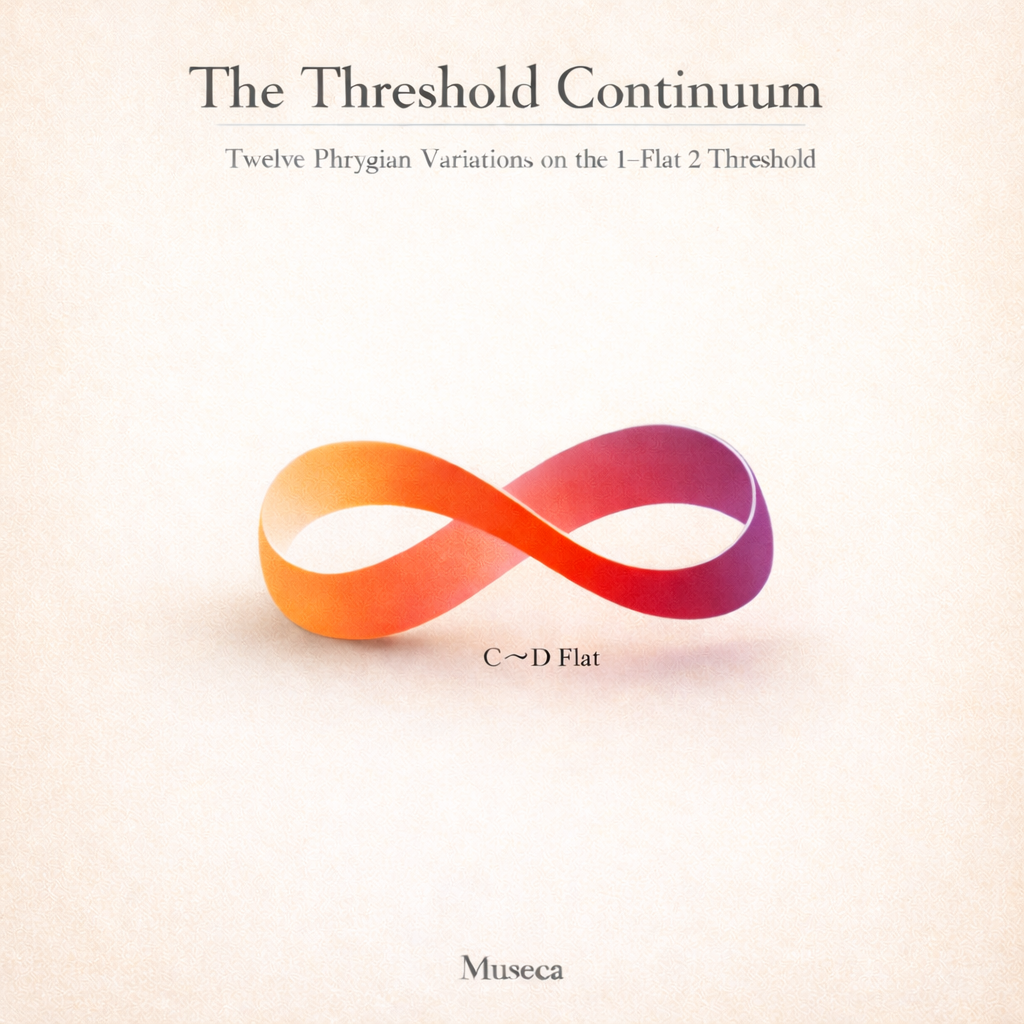
The Threshold Continuum is built on a single idea expressed two ways—one visual, one musical. Visually, the album is symbolized by a Möbius strip: a form that appears to have two sides, yet is revealed to be one continuous surface. Its meaning is direct: the “physical” and the “spiritual” are not separate rooms divided by a door. They are the same reality experienced from different orientation. The veil is not a wall. It is a twist in perspective.
Musically, that same truth is enacted through the Phrygian mode’s defining pressure point: the 1–Flat 2 relationship. In C Phrygian, the home tone (C) sits inches from its shadow (D♭). These two notes do not behave like distant opposites; they behave like neighboring realities occupying the same space. The album treats this half-step as a Möbius twist in sound—an intimate friction that can feel ominous, tender, luminous, or romantically unresolved, depending on how the listener is turned toward it.
The techniques behind the concept are intentionally disciplined. A persistent C pedal functions as the album’s continuous surface—always present, always returning, never relinquishing the floor. Above it, harmony circulates primarily between i and ♭II, allowing the 1–Flat 2 tension to remain audible not as a passing color, but as the core condition of the music. Motifs recur like a single thought heard from different angles: sometimes whispered by piano, sometimes carried by violin in long cantabile lines, sometimes expanded into divisi strings where the spectrum opens without granting closure. “Light pulses” appear as a quiet heartbeat—supporting the arc, never overpowering it.
The album’s emotional peaks are not cadences; they are perspective shifts. In key moments, orchestration brightens and swells—strings rising, harmonics blooming, the room widening—so the same unresolved interval momentarily glows. Nothing “solves.” Instead, the listener experiences what the Möbius strip implies: you can return to the same place and yet feel as though you have crossed into something new, simply because your orientation has changed.
For that reason, the endings are engineered as part of the philosophy. These pieces do not conclude with punctuation; they dissolve. Each track is designed to fade gradually—an exit without cadence—leaving the threshold intact. The Threshold Continuum does not promise a doorway to another world. It offers something quieter and more radical: the suggestion that the threshold is already here, and that beauty is what happens when tension is held long enough to become light.
Liner Notes
Continuum Theme — C Phrygian 1
The album opens by establishing its physical law: a steady C pedal that never relinquishes the floor, while the harmony rocks between i and ♭II like a slow pendulum. The motif is introduced in restrained form—piano and strings circling the 1–♭2 tension (C against D♭) without letting it resolve. The pulses are light, more like breath than beat, and the track’s role is to define the world: suspense as a constant state rather than a momentary effect.
Aperture on C
This is the first “threshold close-up.” The C pedal is nearly tactile, and everything else is sparse enough to feel like negative space. Muted strings and airy pads suggest i–♭II more than they state it, with small motif fragments appearing like distant reflections. The music’s motion is mostly dynamic—tiny crescendos and gentle retreats—so the tension feels intimate, like listening for something just beyond the door.
Upper-Neighbor Threshold
Here the album leans into the friction. The 1–♭2 grind is foregrounded through tighter voicings and more insistent repetition, often in the violins against the harmonic bed. The i–♭II motion becomes more explicit and rhythmic, and the piano behaves more like an engine—short figures that keep the pressure constant. Even when the texture thickens, the harmony remains trapped by design, creating an energized, controlled intensity rather than a release.
Piano Under Glass
The piano takes the lead in a more Romantic posture—cantabile phrasing, soft arpeggiation, and a fragile clarity that feels close-miked and intimate. Strings respond in long, warm bows that widen the harmony without changing its destination, letting the i–♭II cycle feel like yearning rather than menace. The motif becomes less percussive and more lyrical, as if the same idea is being sung instead of stated.
Pulse Lattice
This track turns “light pulses” into architecture. A delicate rhythmic lattice—subtle, shimmering, never club-like—threads through the strings and pads, giving the motif a sense of suspended motion. The harmony stays faithful to the C pedal and Phrygian i–♭II, but the feeling shifts: less weight, more glimmer, like tension viewed through glass. The result is propulsion without aggression—movement that never breaks the album’s vow of restraint.
Harmonics at the Rim
Texture becomes the subject. High-string harmonics, tremolo veils, and near-bridge shimmer create a luminous edge where the pitch content feels half-material, half-light. The i–♭II relationship remains present but is translated into color—clustered overtones and spectral voicings that keep the 1–♭2 tension alive without always spelling it out. The piano appears in sparse, delicate traces, while the pads provide a faint atmosphere of suspended air.
Swell Architecture I
This is the album’s first purpose-built “event track,” engineered around a violin-led swell: a long crescendo that opens the register and brightens the spectrum, followed by a controlled hush. The motif is present throughout, but it becomes emotionally legible through dynamics and orchestration—divisi strings widening, pads blooming, pulses thinning as the swell peaks. The key musical trick is that the intensity increases while the harmony refuses to “solve itself,” so the listener experiences arrival as radiance, not resolution.
Continuum Theme — C Phrygian 2
The expanded statement deepens the album’s language. The pacing is broader, the sections breathe longer, and the orchestration becomes more cinematic—strings rising higher, piano supporting with more space, the pulse acting like a distant signal. The signature moment arrives in the late swell: a violin introduction and lift that turns the Phrygian tension into something openly beautiful, as if the threshold briefly becomes light. The track still avoids closure, but it proves the concept: the same unresolved interval can carry tenderness, awe, and uplift.
Counterpoint Through the Door
Two voices—typically violin and piano—begin to chase the motif in imitation, creating tension through overlap rather than harmonic change. The counterpoint is simple but emotionally effective: when one line reaches toward D♭, the other answers or shadows it, intensifying the sense of a door approached from two angles. Strings swell around the duet like a surrounding memory, while the pulses remain understated so the phrasing can feel rubato and human. The ending refuses cadence, letting the intertwined lines dissolve instead of conclude.
D♭ Mirage
This track treats ♭II as a mirage: it appears vivid in lush string voicings, then evaporates as the texture thins and the harmony slips back under the C pedal’s gravity. Piano arpeggios and fragments create the sensation of reaching—forward motion that never arrives—while the pads smear the edges of the chord changes so the listener feels the threshold more than they “count” it. The 1–♭2 tension becomes romantic here: less bite, more longing, like an image that stays just out of focus.
Gravity Return (Low-String Floor)
The register drops and the album’s weight returns. Low strings—cellos and basses—carry the narrative, making the C pedal feel like ground you can feel in your chest. The i–♭II motion becomes slower and more ceremonial, with the piano reduced to echoes and shadows. The emotional effect is inevitability: the same threshold, now approached with patience and depth, as if the music is accepting the unresolved state rather than fighting it.
Exit Without Cadence
The finale is designed as a controlled disappearance. The motif thins into high strings and vaporous pads, with the Phrygian motion hinted rather than declared. Pulses become minimal—more like a fading heartbeat—and the C pedal remains as a final horizon line. Instead of a closing chord, the track offers a long dissolve: the listener is not given a door slam or a full stop, only an exit made of air, leaving the threshold behind them still open, still unresolved.
Playlist
- Continuum Theme — C Phrygian 1 Museca 3:54
- Aperture on C Museca 3:49
- Upper-Neighbor Threshold Museca 4:56
- Piano Under Glass Museca 4:32
- Pulse Lattice Museca 3:47
- Harmonics at the Rim Museca 4:39
- Swell Architecture I souledout 5:22
- Continuum Theme — C Phrygian 2 Museca 6:40
- Counterpoint Through the Door souledout 4:20
- D♭ Mirage Museca 5:03
- Gravity Return (Low-String Floor) Museca 3:47
- Exit Without Cadence Museca 4:13