
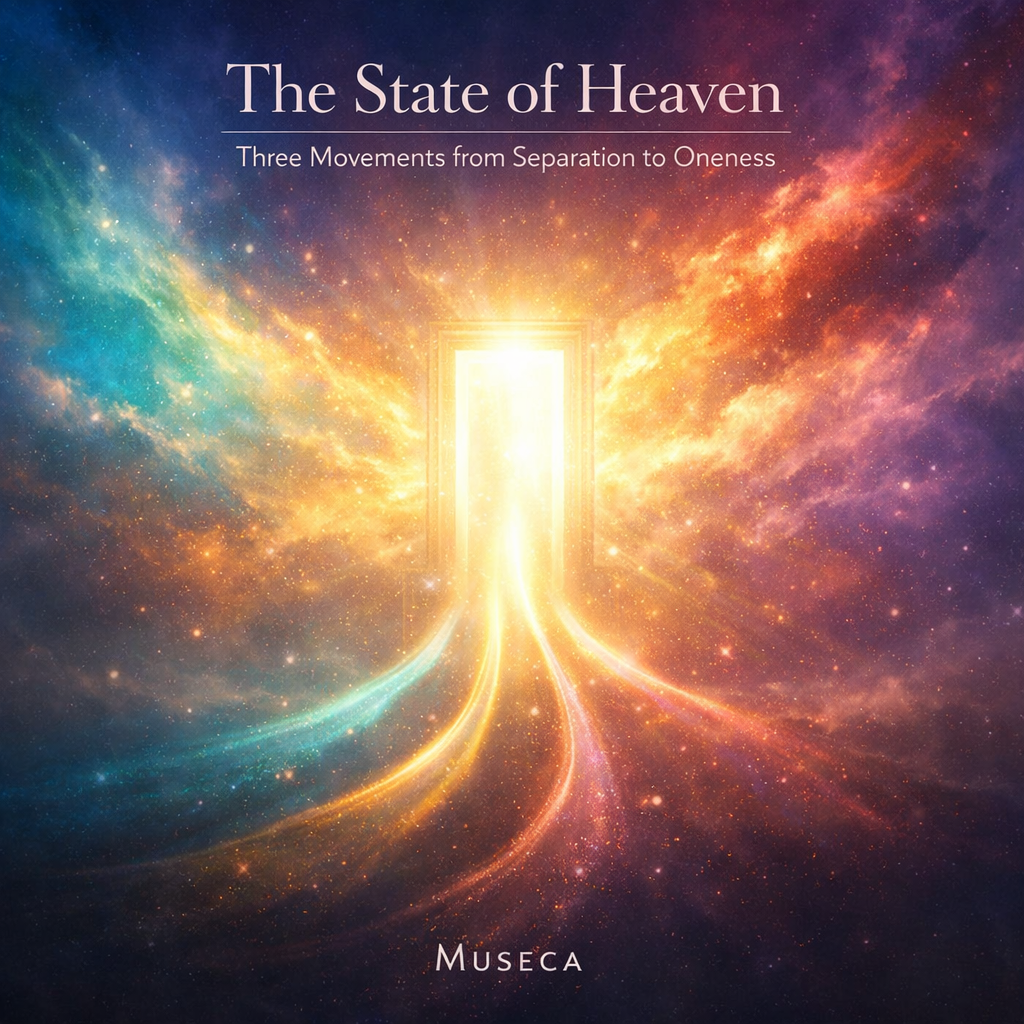
The State of Heaven — Three Movements from Separation to Oneness is built on a simple, radical premise shared by both Neale Donald Walsch and Abraham-Hicks: heaven is not primarily a destination in space, but a condition of consciousness—a lived inner state. In this view, what changes our reality is not where we go, but what we become while we are here: the shift from fear to love, from resistance to allowing, from the story of separation to the experience of union.
Walsch frames heaven as a “remembering” of our true nature—an identity deeper than the anxious self that believes it must earn belonging. Abraham-Hicks describes a similar movement using different language: alignment with well-being, where emotional guidance becomes a compass. When we are out of alignment, we experience life as distance—grasping, striving, proving, searching for a door “somewhere else.” When we return to alignment, the same world feels different because we are different. The heart softens, the mind quiets, and what once seemed withheld begins to feel available—not as a reward, but as a natural state.
The album unfolds as a suite in three movements. Separation (The Myth of Elsewhere) gives voice to the ache of looking outward for what can only be found inward. Alignment (The Turning) marks the pivot: the moment we stop forcing life and begin to receive it, breath by breath, thought by thought. Oneness (The Kingdom Within) is the arrival—not a dramatic conquest, but a steady embodiment of wholeness, where love is no longer an aspiration but a way of standing in the present. The bonus track, Epilogue: The Open Door (Instrumental), completes the arc by letting the listener inhabit the message without words—an afterglow of integration, where the music itself becomes the state the album describes.
This is not an argument about theology, nor a promise of escape. It is a musical meditation on the practical spirituality of “heaven-now”: the recognition that the door is real, the door is near, and the door opens inward.
Liner Notes
Movement I — Separation (The Myth of Elsewhere)
This movement begins in the most human place: the ache of “not yet.” The music inhabits the old reflex to look outward for relief—toward distance, destiny, proof, and permission. Suspended harmonies and restrained motion reflect a mind reaching for certainty and a heart trying to earn its way into peace. In this world, heaven feels like a location—somewhere above, ahead, or beyond—while the present moment feels like exile. The emotional truth is not judged here; it is simply witnessed. The movement ends with a soft crack in the premise: the first hint that what is being sought may not be far away at all.
Lyrics
[Verse 1]
I chased a silver skyline
Past every quiet sign
I tried to buy tomorrow
With yesterday’s design
I called the stars my witnesses
And begged them to be kind—
But every answer echoed back
From somewhere in my mind
[Pre-Chorus]
If heaven is a doorway
Why can’t I find the frame?
I’ve memorized the distance
And I’ve forgotten my name
[Chorus]
I searched the sky for a door
I begged the light for proof
I built a thousand ladders
To reach an empty truth
And every step kept saying
“You’re almost there… almost there…”
As if the holy were a place
And not the way I’m here
[Verse 2]
I watched the world in motion
Like glass behind a pane
Smiling like a statue
While storms rehearsed my pain
I learned the art of leaving
Before I could be left—
I called it independence
But it was only theft
[Bridge]
Somewhere, a candle trembles
Inside a hidden room
A breath I did not listen to
Still waiting to resume
What if the gate is nearer
Than my sorrow can admit?
[Final Chorus]
I searched the sky for a door
And missed the one in me
I turned my eyes to elsewhere
And called that “reality”
Yet something underneath me
Keeps whispering, “Come near… come near…”
As if the holy were a state
And I am standing here
[Outro]
[Wordless hum / “ah” over an unresolved chord, fade.]
Movement II — Alignment (The Turning)
Here the album pivots from pursuit to practice. Alignment is portrayed not as a dramatic revelation, but as a quiet recalibration—an inner turning that happens in breath, attention, and the willingness to stop fighting the moment. The rhythm becomes more fluid and supportive, like a body remembering how to trust. Harmonies warm and open; the melodic line steadies, as though the voice is no longer pleading for entry but discovering it already belongs. This movement reflects the shared insight of Walsch and Abraham-Hicks: the “door” is not found by traveling—it is found by shifting state. The turning is subtle, but everything changes once it begins.
Lyrics
[Verse 1]
I stopped rehearsing endings
I let the noise grow thin
I heard the hush behind my thoughts
And let it pull me in
Not rescue—just a simple choice
A softer way to steer
A yes that didn’t shout at life
But made the moment clear
[Pre-Chorus]
I cannot force the river
But I can stop the fight
I can unclench the questions
And open to the light
[Chorus]
I found the door in my breath
In the pause between the words
In the place my fear can’t enter
In the stillness I preferred
And I felt my body listening
Like it finally understood—
Not a ladder toward the heavens
But a turning toward the good
[Verse 2]
I named the old illusions
Then let them drift away
Like paper boats I used to float
And watch dissolve to gray
I asked for what I wanted
Without defending why
And something like permission
Returned into my eyes
[Bridge]
[Choir enters softly on “ah”]
So I reach for better gently
Not perfect—only true
One thought that feels like open hands
One note that carries through
We are closer than we knew…
[Final Chorus]
I found the door in my breath
And the room behind my ribs
Where the heart becomes a compass
And the future loosens its grip
And I felt a quiet radiance
Like morning learning to be—
Not a place I have to travel
But a state remembering me
[Outro]
I found the door in my breath.
Movement III — Oneness (The Kingdom Within)
The final movement is arrival through embodiment. Oneness is not treated as an abstract ideal, but as a lived posture—presence without bracing, love without bargaining, clarity without strain. Orchestration expands into full radiance, not for spectacle, but to express a consciousness that has stopped dividing the world into inside and outside. The kingdom is revealed as inward, immediate, and quietly inevitable when resistance dissolves. The music resolves cleanly because the narrative has resolved: heaven is not withheld, not earned, not elsewhere. It is the state that emerges when separation is released.
Lyrics
[Verse 1]
Now every face is a window
Not stranger, not apart
Each moment holds a doorway
To the same unbroken heart
I do not chase the shining
I do not bargain to belong—
I carry what I asked for
And it carries me along
[Pre-Chorus]
The thread was never missing
I only lost the feel
Now love is not a promise—
It is the way I kneel
[Chorus]
The kingdom is within
And it’s opening again
Like light through a curtain
Like grace without an end
And what I called “heaven”
Is the clearness where I stand—
A state of being present
A home I understand
[Verse 2]
I bless the days of hunger
They taught me how to see
The ache was only pointing
To what was always me
No exile, no exclusion
No final, sealed decree—
Only the great returning
To what we already are
[Bridge]
[Big operatic lift + choir harmonies]
I am not separate
I am not left outside
I am the breath of life itself
And life is on my side
We are the door…
We are the flame…
We are the name behind the name…
[Final Chorus]
[Choir strong; harmonize the last two lines]
The kingdom is within
And it’s opening again
Not later—now, not elsewhere—
Here, and here, and here again
And what I called “heaven”
Is the love that has no seam—
A state of being human
In the widest kind of peace
[Outro]
Here is heaven.
[Hold final chord, resolved.]
Epilogue: The Open Door (Instrumental) (Bonus Track)
After the words have done their work, the epilogue lets the listener inhabit the conclusion without explanation. This is the integration space—the felt experience of “heaven as a state of being.” Piano and harp introduce the doorway as something simple and intimate; strings widen the room until it feels less like reaching and more like resting. Motifs from the second and third movements return as gentle echoes, as if the body is learning a new default. The final cadence lands with deliberate warmth and certainty, not as an ending, but as an open threshold: the door remains, quietly available, because it was never external in the first place.
Playlist
- Movement I — Separation (The Myth of Elsewhere) Museca 4:20
- Movement II — Alignment (The Turning) Museca 3:56
- Movement III — Oneness (The Kingdom Within) Museca 3:26
- Epilogue: The Open Door (Instrumental) Museca 2:48