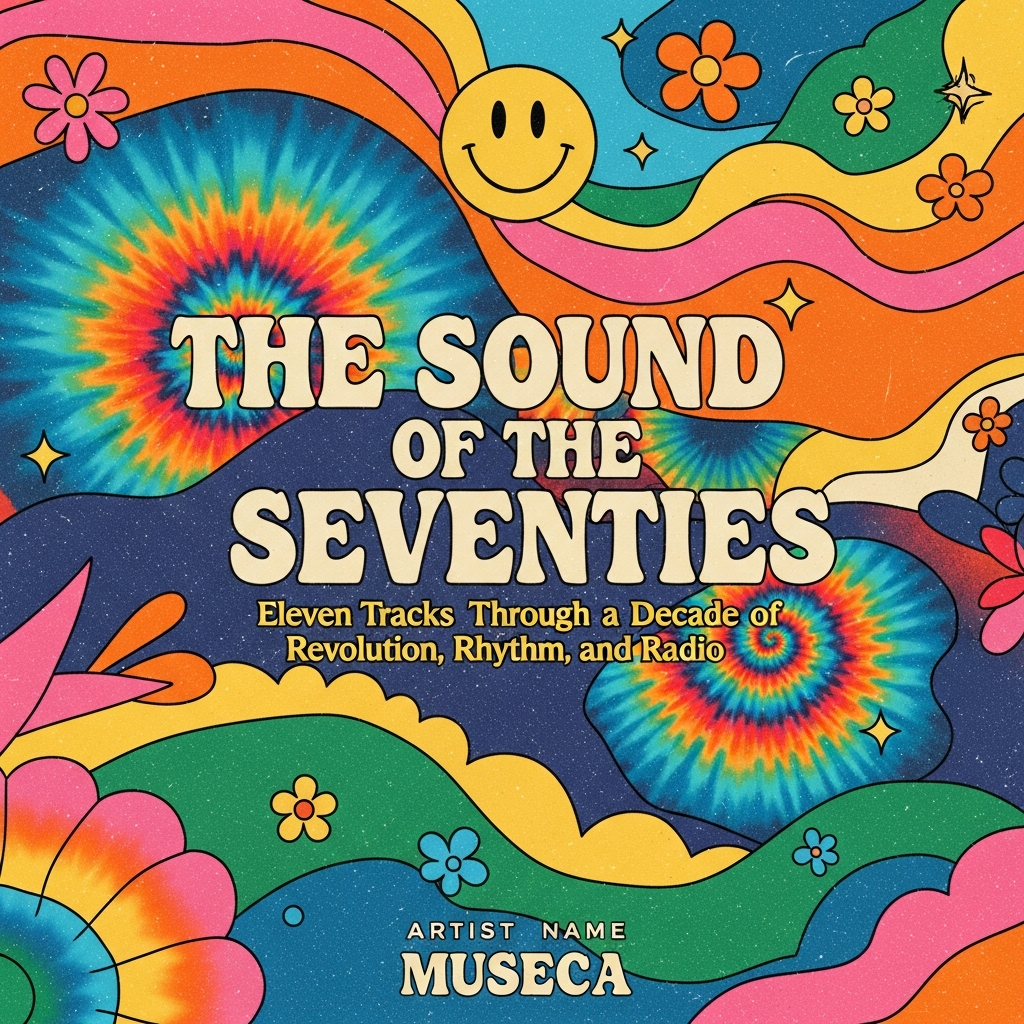
The Sound of the Seventies
Eleven Tracks Through a Decade of Revolution, Rhythm, and Radio
The 1970s didn’t just reshape music — they redefined what music was allowed to be.
This was the decade when vinyl became sacred, when the studio became a temple, when the streets, clubs, and corners of America pulsed with new voices and unfiltered truths. It was a time of beautiful contradictions: soul and protest, glitter and grit, peace and fury. One decade, many revolutions — all of them audible.
The Sound of the Seventies is not a greatest-hits tribute or a nostalgic mixtape. It is a reimagined journey through the sounds, textures, and emotions that shaped the era. Across eleven original tracks, Museca traces the seismic shifts in American music — from soft rock sanctuaries to disco cathedrals, from country dives to punk basements, from the Rhodes piano to the plastic microphone.
This is the music of a generation that refused to be silent, that danced through fire, that made art out of static.
And now, with the needle on the groove once again…
The story begins.
Liner Notes
1970 – The Album Age Begins
Needle on the Groove
An analog ode to the vinyl ritual — where every revolution spins a memory. The LP becomes more than a format: it’s a compass, a confession, a ceremony. You don’t just hear it — you live inside it.
1971 – Soul Power Rising
Funk Is My Name
Brass like fire, bass like prophecy. This is groove as identity — defiant, rhythmic, proud. Funk doesn’t ask for permission. It announces itself, then dares the world to catch up.
1972 – Post-Vietnam Despair
Star-Spangled Stranger
A haunting folk-rock ballad set in the quiet that followed the storm. Not every uniform comes home whole. Some carry medals; others, ghosts. This is the song they never played at the parade.
1973 – Singer-Songwriter Peak
Moonlight on Laurel Canyon
Up in the hills, artists traded verses like secrets. This acoustic tribute captures the intimacy of an era when pain and poetry shared a room, and every heartbreak became a harmony.
1974 – Jazz Fusion Awakens
Electric Pharaoh
An instrumental ritual in polyrhythm and prophecy. Synths swirl, brass chants, and the groove rides eastward. Jazz unshackled from its past, reborn with circuits and cosmic breath.
1974 – The Mythic Edge of Rock
Hammer of the Valley
Electric guitars roar like distant thunder. This is hard rock as mythology — ancient power in modern hands. In the canyon of distortion and echo, the gods still tune their amps.
1975 – Glam Rock Reigns
Mascara and Stardust
The stage becomes a sanctuary. Eyeliner, platform boots, and glitter veil a raw, radiant truth: you can be anything, and everything, under the light. This is self-expression turned all the way up.
1975–76 – California Country Rock
Copper Dawn
A gentle departure soaked in golden hour melancholy. Echoes of The Eagles roll across dusty harmonies. A love story ends not in fire, but in the long shadow of morning.
1976 – Disco’s Golden Hour
Saturday Saints
The dance floor becomes divine. In polyester robes and four-on-the-floor salvation, disco delivers joy, release, and rhythm as sacrament. Here, the groove redeems all.
1977 – Outlaw Country Meets Rock
Bourbon and Barbed Wire
A grizzled confession from the edge of a neon-lit dive. Southern rock meets outlaw balladry in this tale of love, regret, and pedal steel redemption.
1978 – Punk’s Rebellion
No Future on Bleeker Street
Three chords and no apologies. This is raw nerve in leather and spit, a scream for truth in a world selling silence. The revolution didn’t wait for permission — it just showed up.
1979 – Birth of Hip-Hop
Plastic Microphone
A Bronx sidewalk becomes a stage. One rhyme, one beat, one defiant voice transforms nothing into everything. Hip-hop begins with no gold, no fame — just a rhythm and the will to speak.
Epilogue – The End of the Decade
Fade into FM
The signal weakens, the lights dim. This is the long goodbye to a decade of sound. The radio hums with memory, the tape unspools. But somewhere, the groove still turns.
Postscript: The Sound Beneath the Surface
The 1970s were more than a soundtrack — they were a seismic shift in sound, spirit, and self.
Across its ten wild years, American music fractured and flourished. Rock split into cathedrals and back alleys — from arena-sized solos to garage-born rage. Soul and funk carried the voices of the streets and sanctuaries alike, while disco danced into the night with mirrorball salvation. Punk tore it all down with three chords and no apologies. And in the shadows of city blocks, something new crackled into life — hip-hop, raw and revolutionary.
Technology expanded the canvas: FM radio stretched songs past three minutes. Synthesizers and multi-tracking opened new dimensions of sound. The studio became an instrument, and the album became a novel. Meanwhile, the culture spun — war, resistance, freedom, glitter, denim, protest, polyester. Music mirrored every shift.
Artists no longer asked permission to be heard. They became prophets, punks, poets, outlaws, and saints. From the jazz fusion visions of Miles and Herbie to the raw declarations of Grandmaster Flash and Patti Smith — everyone was breaking ground, breaking rules, and breaking silence.
The Sound of the Seventies was never one sound.
It was many voices — all turning the same revolution.
And in that spin — of records, bodies, turntables, and time — a generation found itself.
Let the groove live on.
— Museca
Playlist
- Needle on the Groove Museca 3:28
- Funk Is My Name Museca 4:49
- Star-Spangled Stranger Museca 3:20
- Moonlight on Laurel Canyon Museca 4:36
- Electric Pharaoh Museca 3:37
- Hammer of the Valley Museca 3:50
- Mascara and Stardust Museca 2:44
- Copper Dawn Museca 3:22
- Saturday Saints Museca 3:19
- Bourbon and Barbed Wire Museca 3:23
- No Future on Bleeker Street Museca 2:29
- Plastic Microphone Museca 2:22
- Fade into FM Museca 3:35