
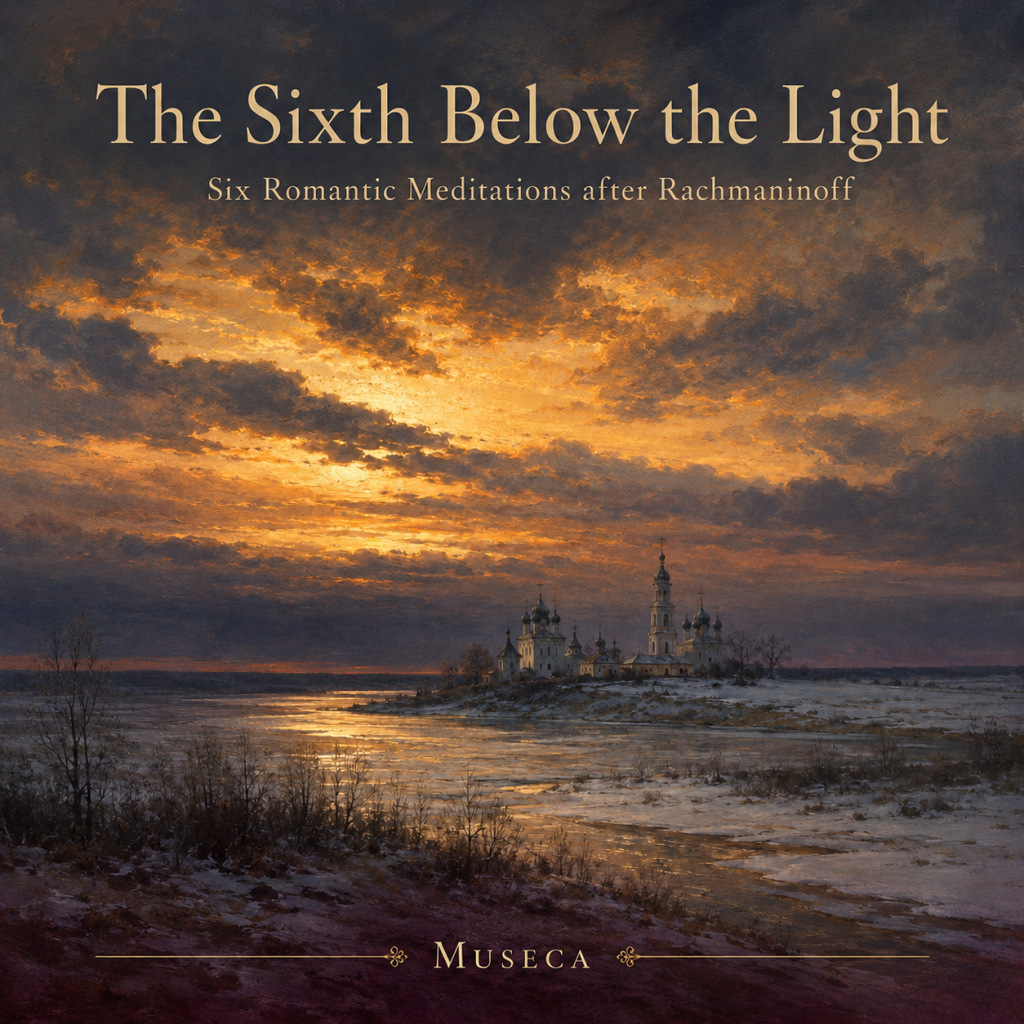
The Sixth Below the Light
Six Romantic Meditations after Rachmaninoff
The Sixth Below the Light is a piano-orchestral homage to one of the most affecting emotional signatures in Rachmaninoff’s music: the strange ache that occurs when major-key radiance is touched by its own minor shadow. This album is built around a single musical idea—the lowered sixth, or ♭6—and treats it not merely as a harmonic device, but as an emotional symbol. It is the note beneath the light, the shadow inside the victory, the memory of sorrow that remains audible even when the music rises toward triumph.
Rachmaninoff’s most powerful moments rarely feel like simple happiness or simple grief. His music often reaches a blazing major-key arrival, yet that arrival still feels wounded. The listener hears grandeur, but also cost. The harmony may open into light, but somewhere inside the chord or melody there is a darker note, a borrowed color, a remembrance of struggle. This is why his climaxes can feel so human. They do not deny suffering; they carry it upward.
The central principle behind this album is modal mixture: the borrowing of notes and chords from a parallel mode. A piece may be rooted in a major key, but for a moment it borrows from the parallel minor. In D major, for example, the sixth note of the scale is B natural. But if the music borrows from D minor, that B becomes B-flat. This lowered sixth does not destroy the major key. It deepens it. It turns brightness into tenderness. It makes triumph feel remembered rather than naïve.
That is the sound world of The Sixth Below the Light: not darkness replacing light, but darkness within light.
Musically, the album explores several related forms of this idea. Sometimes the lowered sixth appears as a single melodic note, held briefly at the emotional peak of a phrase. Sometimes it is hidden inside a borrowed minor iv chord—the haunting moment when a major-key subdominant turns minor. Sometimes it appears inside the ♭VI chord, a broad Romantic color that gives the music depth, nobility, and ache. At other moments, the music moves toward the darker territory of the Neapolitan chord, the lowered supertonic harmony, or ♭II, traditionally one of the most solemn and fateful sonorities in tonal music.
These devices are not used here as academic ornaments. They are the emotional grammar of the album. The borrowed minor iv becomes private tenderness. The ♭VI becomes memory. The Neapolitan becomes a gate into sacred darkness. The flat sixth becomes the wound that allows the major key to speak truthfully.
In practical terms, the album is conceived as six piano-orchestral meditations, each approaching this harmonic principle from a different angle. The piano serves as the central voice: sometimes confessional, sometimes bell-like, sometimes virtuosic and storm-driven. Around it, the orchestra acts as memory and atmosphere—strings, horns, low winds, bells, and occasional wordless choral color forming a resonant space where each harmonic shadow can unfold.
The first meditation introduces the album’s governing sound: major light touched by the lowered sixth. The second enters a Russian bell-world of snow, fate, and tolling resonance. The third turns inward, focusing on the borrowed minor iv chord as a gesture of intimate sorrow. The fourth opens the darker architecture of Neapolitan harmony, solemn and cathedral-like. The fifth becomes a cadenza of struggle, where the pianist’s hands seem to fight their way toward radiance. The final meditation gathers the album’s materials into a last act of wounded peace: a major-key resolution that has not escaped sorrow, but absorbed it.
This is the essence of Rachmaninoff’s “wounded triumph.” His music often sounds victorious because it moves toward light; it sounds wounded because the light remembers what preceded it. A purely major cadence can sound complete, but in Rachmaninoff’s emotional language, completion is rarely innocent. The final chord may shine, but the path to it has passed through minor shadows, chromatic descents, tolling bells, and harmonies that seem to carry grief in their inner voices.
The Sixth Below the Light follows that path. It does not attempt to imitate Rachmaninoff’s melodies or reproduce his works. Instead, it builds an original Museca meditation around one of the deep principles that gives his music its emotional force: the way a single altered note can transform victory into remembrance, beauty into longing, and light into something far more profound.
The album’s guiding idea may be stated simply:
A major chord becomes more human when it remembers the minor.
Or, more poetically:
Every light has a sixth below it.
Liner Notes
The Sixth Below the Light
The opening meditation introduces the harmonic premise of the entire album: a major key made more human by the presence of its lowered sixth. The music begins in a world of apparent radiance, centered around the clarity of D major, but that brightness is quickly altered by the appearance of B-flat — the ♭6. This note does not fully pull the music into minor; instead, it shadows the major key from within.
The essential emotional device is modal mixture, especially the borrowing of the minor iv chord from the parallel minor. In D major, the expected subdominant would be G major, but when it becomes G minor, the borrowed B-flat enters the harmony. That single change transforms the chord from open and noble into tender, wounded, and reflective.
The track’s harmonic world can be heard as a gradual oscillation between light and memory:
D major → G minor → D major → B-flat major → A7 → D major
The B-flat major chord, functioning as ♭VI, expands the emotional field. It is not merely a dark color; it feels like a door opening behind the major key. This is the first statement of the album’s central thesis: major-key beauty becomes more profound when it carries the trace of sorrow.
The piano serves as the primary narrator. Its opening phrases should feel private and almost improvisatory, while the strings and horns slowly enter as if the inner emotion has become too large to remain solitary. The track should not end with complete certainty. Its purpose is not resolution, but revelation: the listener discovers that the light has a hidden lower shadow.
Bells Under Snow
This meditation draws on one of the most recognizable aspects of Rachmaninoff’s sound world: the tolling resonance of bells. But the bells here are not decorative. They function harmonically and psychologically. They create a sense of distance, ritual, memory, and fate.
The piano is treated almost as a bell instrument, using low octaves, open fifths, and repeated sonorities that ring beyond their attack. The harmony begins in a darker minor atmosphere, then allows occasional major-key openings to appear through the texture. These major glimpses should feel like light seen through falling snow — beautiful, but veiled.
The technique here is less about a single exposed ♭6 and more about minor-major permeability. The tonal center moves between darkness and warmth, allowing the listener to feel how a minor landscape can contain brief flashes of major consolation. This is an important part of the Rachmaninoff emotional vocabulary: the music often does not remain fixed in sadness, but neither does it escape sadness cleanly.
The orchestration should emphasize depth and resonance: low strings, bass clarinet, contrabassoon, French horns, tubular bells, and spacious piano writing. The bell sonorities create a slow harmonic gravity. Each chord seems to have weight. Each resonance suggests something remembered rather than something newly discovered.
Where the first track reveals the lowered sixth as a wound inside major light, this track broadens the album into a Russian-Romantic atmosphere: snow, bells, distance, and the solemn beauty of sound disappearing into silence.
The Borrowed Chord
This is the album’s most intimate meditation, built around one of the simplest and most devastating gestures in Romantic harmony: the borrowed minor iv chord.
In A major, the expected subdominant is D major:
D–F-sharp–A
But when the chord is borrowed from A minor, it becomes D minor:
D–F–A
That F natural is the lowered sixth of A major. The entire emotional effect of the track can be understood through that single transformation. The major world does not collapse; it softens. It becomes vulnerable.
The core progression is deliberately spare:
A major → D minor → A major
This is a small harmonic movement, but it contains an enormous emotional charge. The borrowed minor iv chord has a sighing quality because it changes only one note, yet that one note alters the entire atmosphere. The listener feels the major key briefly remember its minor self.
This track should be approached almost as a romance or nocturne without words. The piano provides the harmonic bed, while a solo cello or violin carries the vocal line. The technique should be transparent enough for the listener to feel the chord change directly. Overcomplication would weaken the effect. The beauty is in restraint.
The borrowed chord represents private sorrow rather than public tragedy. It is not the grand suffering of a concerto climax; it is the quiet moment when memory enters a room. In the structure of the album, this meditation turns the flat-sixth principle inward. The wound is no longer architectural or symphonic. It is personal.
Neapolitan Gate
This meditation explores the darkest harmonic region of the album: the Neapolitan chord, or ♭II. In tonal harmony, the Neapolitan is a chord built on the lowered second scale degree. In D, that chord is E-flat major. It is often used in first inversion, creating the traditional Neapolitan sixth:
E-flat/G → A7 → D
This movement has a powerful sense of fate. The E-flat chord feels foreign, monumental, almost stone-like. It stands just outside the home key, yet it has a strong gravitational pull toward the dominant. When it moves to A7 and then to D, the resolution feels not merely harmonic, but dramatic.
The Neapolitan chord is especially potent here because it contains B-flat, the same lowered sixth that governs the album. In D, E-flat major contains:
E-flat – G – B-flat
So within the Neapolitan color, the album’s central wound is still present. But now it is embedded in a darker, more ceremonial sonority. The ♭6 is no longer just tender or nostalgic; it becomes solemn and almost sacred.
The orchestration should feel architectural: low brass, tremolo strings, dark piano, deep bells, and restrained wordless choir. This track should not become cinematic bombast. Its power comes from gravity, not volume. The harmony should feel like a gate opening slowly, revealing a space that is both frightening and holy.
If the borrowed minor iv is the sound of private memory, the Neapolitan is the sound of destiny. It places the listener before something larger than personal emotion: judgment, surrender, night, and the grandeur of the unknown.
Cadenza of the Wounded Hand
This meditation brings the album’s harmonic idea into the world of pianistic struggle. It is conceived as a concerto-cadenza fantasy: virtuosic, storm-driven, physically demanding, and emotionally exposed.
The home key is E major, a bright and resonant key for the piano. But the central wound note is C natural, the lowered sixth of E major. In this context, C natural cuts through the brilliance of the key with unusual poignancy. Against E major’s radiance, it feels almost impossible — a foreign sorrow embedded in a field of light.
The motto idea can be transformed into E major as:
E – G-sharp – C natural – B
Scale degrees:
1 – 3 – ♭6 – 5
This shape contains the entire album in miniature: home, major brightness, the wound, and stabilization. In this track, however, the motif is not simply sung. It is fought for. It may appear in octave passages, arpeggiated surges, thick chordal writing, and storm-like piano figures.
The technique here is about placing the ♭6 at moments of maximum physical and emotional pressure. The lowered sixth should often appear near a melodic peak, or as an unexpected color inside a climactic chord. This makes the virtuosity feel meaningful. The difficulty is not merely technical display; it becomes a metaphor for struggle.
The orchestra should enter gradually, almost as if the piano’s internal conflict has expanded beyond the instrument. Strings, horns, and low brass can intensify the ascent, but the piano must remain the central protagonist. The final emergence into E major should feel hard-won, not cleanly victorious. This is Rachmaninoff’s essential dramatic paradox: triumph is most moving when it still bears the marks of the hand that suffered to reach it.
After the Last Bell
The final meditation gathers the album’s harmonic materials into a closing act of acceptance. It returns to D major, the spiritual home of the album, and revisits the B-flat lowered sixth that first appeared in the opening track. But now the meaning of the note has changed.
At the beginning of the album, the ♭6 felt like a wound entering the light. Here, it feels integrated. The B-flat no longer threatens the major key; it deepens it. The album’s final task is to show that sorrow has not been erased, but absorbed into a larger radiance.
The closing harmonic language may recall the album’s major devices:
D major → B-flat major → G minor → E-flat/G → A7 → D major
This progression brings together the central colors:
B-flat major as ♭VI
G minor as borrowed minor iv
E-flat/G as the Neapolitan sixth
A7 as the dominant returning home
D major as the final light
The track should begin quietly, almost as an echo of the first meditation. The piano recalls the original motif, but more slowly, with more space between phrases. Bells return from the second track, but distantly. The Neapolitan shadow from the fourth track appears again, though less terrifying now. The struggle of the fifth track is remembered, but no longer enacted.
The climax, if present, should feel like transfiguration rather than conquest. This is not victory over sorrow. It is the discovery that sorrow has become part of the music’s truth.
The final D major should be spacious, resonant, and restrained. Ideally, the B-flat appears one last time before resolving downward or inward, as if the wound has found its place inside the chord of peace.
The album ends where Rachmaninoff’s deepest emotional language often seems to lead: not to happiness untouched by pain, but to light made more beautiful because it remembers the darkness below it.
Playlist
- Track 1 — The Sixth Below the Light Museca 2:30
- Track 2 — Bells Under Snow Museca 2:24
- Track 3 — The Borrowed Chord Museca 2:38
- Track 4 — Neapolitan Gate Museca 2:34
- Track 5 — Cadenza of the Wounded Hand Museca 2:39
- Track 6 — After the Last Bell Museca 2:50