
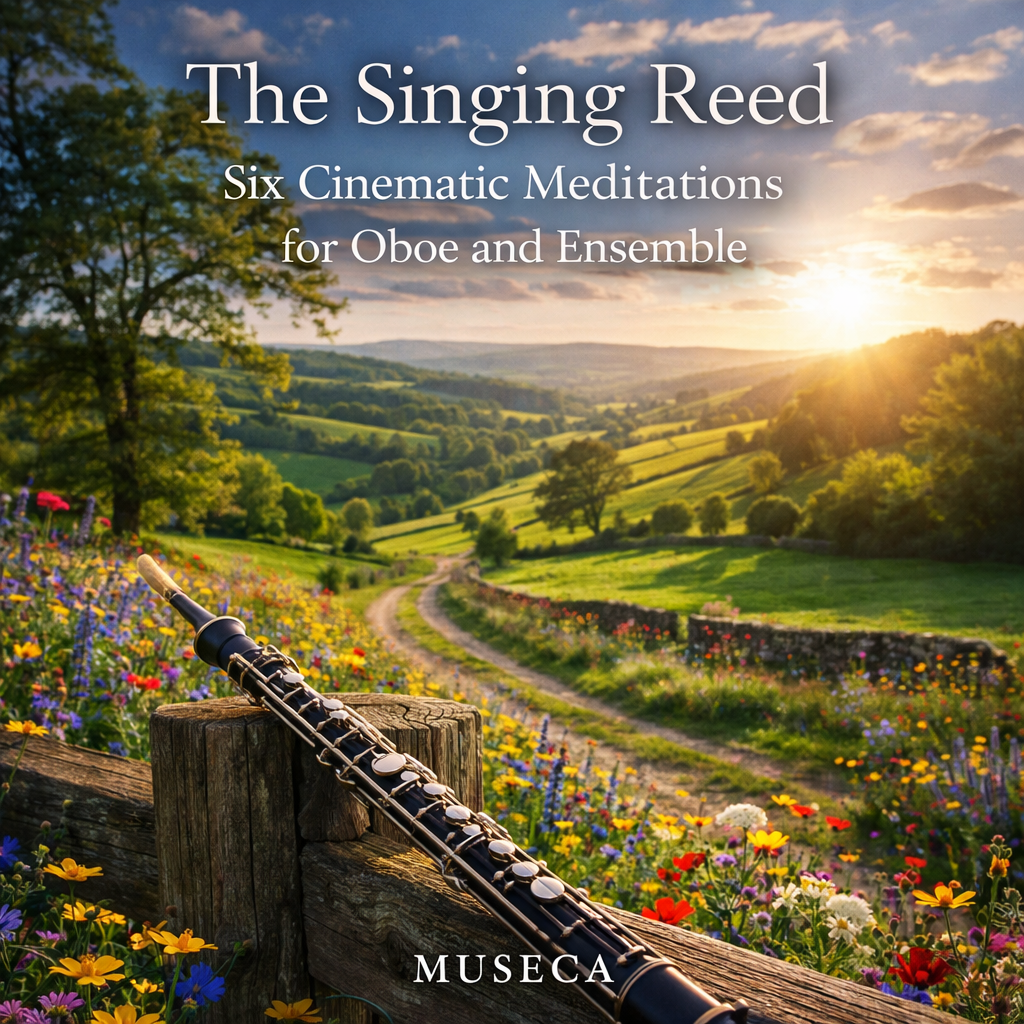
This album was conceived as a tribute to one of the most human voices in music: the oboe. Among orchestral instruments, the oboe has always occupied a special place. It can sound like prayer, memory, longing, innocence, mystery, or quiet resolve. Its tone is at once noble and vulnerable, capable of rising from the ensemble not with force, but with presence. In film music, it has often carried the inner life of a scene—the private emotion beneath the image, the solitary breath inside the larger world of the orchestra. In classical music, it has long served as a singer, a storyteller, and a bearer of lyrical truth.
The Singing Reed brings these two traditions together. The album is shaped by the emotional atmosphere of great cinematic writing and by the expressive lineage of the oboe in classical repertoire. Rather than imitate specific scores or concert works, these six pieces draw inspiration from the oboe’s enduring identities: sacred, elegant, romantic, mysterious, pastoral, and elegiac. Each track is an original meditation, written to allow the oboe to stand at the center of the musical drama as both soloist and narrator.
The ensemble surrounding it—strings, piano, harp, horn, and selected orchestral colors—is designed not to overpower the oboe, but to frame it, support it, and deepen its voice. The result is a chamber-cinematic sound world: intimate in scale, but expansive in feeling. These are not action cues or spectacle-driven pieces. They are musical interiors—reflections in which melody, breath, and tone carry the emotional arc.
Across the six tracks, the album moves through prayer, grace, memory, enchantment, landscape, and farewell. The oboe becomes many things along the way: a voice in solitude, a letter from another time, a witness to beauty and loss, a guide through hidden spaces, and finally a final singer at the edge of light. The aim of the album is simple: to let the oboe speak fully, and to let its singing remind us how much emotion can live in a single line.
Liner Notes
Prayer Over the Valley
The album opens in stillness. This piece presents the oboe in one of its oldest and most affecting roles: the bearer of prayer. The melody rises simply and without ornament, as though it has already existed somewhere before the music begins. Strings and harp do not compete with the oboe here; they form a luminous space around it, allowing the reed’s tone to carry a sense of reverence, tenderness, and quiet nobility. The atmosphere is cinematic, but inward rather than grand. This is the oboe as invocation.
Letter from the Manor
Grace, poise, and restraint shape this meditation. The music suggests a world of corridors, polished wood, old rooms, and private thought, but beneath its elegance there is also a subtle emotional tension. The oboe moves with intelligence and refinement, sometimes poised, sometimes lightly questioning, always expressive. This track draws on the instrument’s classical inheritance—its clarity, balance, and aristocratic beauty—while placing it inside a more narrative and atmospheric frame. It is the sound of memory written with careful hands.
Ashes of Summer
This is the album’s central lament. The oboe sings here not as ornament, but as memory itself: warm, fragile, and marked by loss. The piano and strings support the melody with a quiet, aching tenderness, allowing the line to breathe and unfold with emotional patience. There is no melodrama in this piece, only the deep recognition that beauty and sorrow often live side by side. The title suggests what remains after warmth has passed, and the music lingers in that threshold between love remembered and time accepted.
The Hidden Aviary
A change of motion arrives with this track. The oboe becomes agile, secretive, and lightly enchanted, moving through a texture of harp, strings, and transparent orchestral color. The music suggests hidden chambers, unseen wings, and small lives stirring behind walls of shadow and light. There is mystery here, but not darkness; wonder, but not spectacle. The track explores the oboe’s capacity for quicksilver movement and delicate character, offering a portrait of the instrument as both guide and enigma.
Pastoral for a Distant Road
The oboe has long been associated with open air, countryside, and the human figure set against landscape, and this piece embraces that tradition. Broad phrases, warm harmony, and gentle forward motion give the music a spacious and quietly noble character. The road in the title is both literal and inward: a path through distance, reflection, and calm endurance. Horn, harp, and strings widen the horizon, but the oboe remains the living center of the scene. This is pastoral music not as decoration, but as dignity.
Elegy in the Final Light
The closing meditation gathers the emotional threads of the album into a final farewell. It begins with near-solitude, the oboe alone or almost alone, then gradually opens into fuller orchestral radiance. Yet even as the music expands, the heart of the piece remains intimate. The elegy is not only about grief; it is also about release, acceptance, and the strange light that sometimes follows sorrow. By the end, the oboe returns to something like the voice with which the album began—human, exposed, singing into silence. It is a final breath, and the final truth of the record.
Version 1
Version 2
Playlist
- Track 1 - Prayer Over the Valley Museca 3:38
- Track 2 - Letter from the Manor Museca 3:05
- Track 3 - Ashes of Summer Museca 2:49
- Track 4 - The Hidden Aviary Museca 2:19
- Track 5 - Pastoral for a Distant Road Museca 3:05
- Track 6 - Elegy in the Final Light (Version 1) Museca 3:07
- Track 6 - Elegy in the Final Light (Version 2) Museca 3:22