
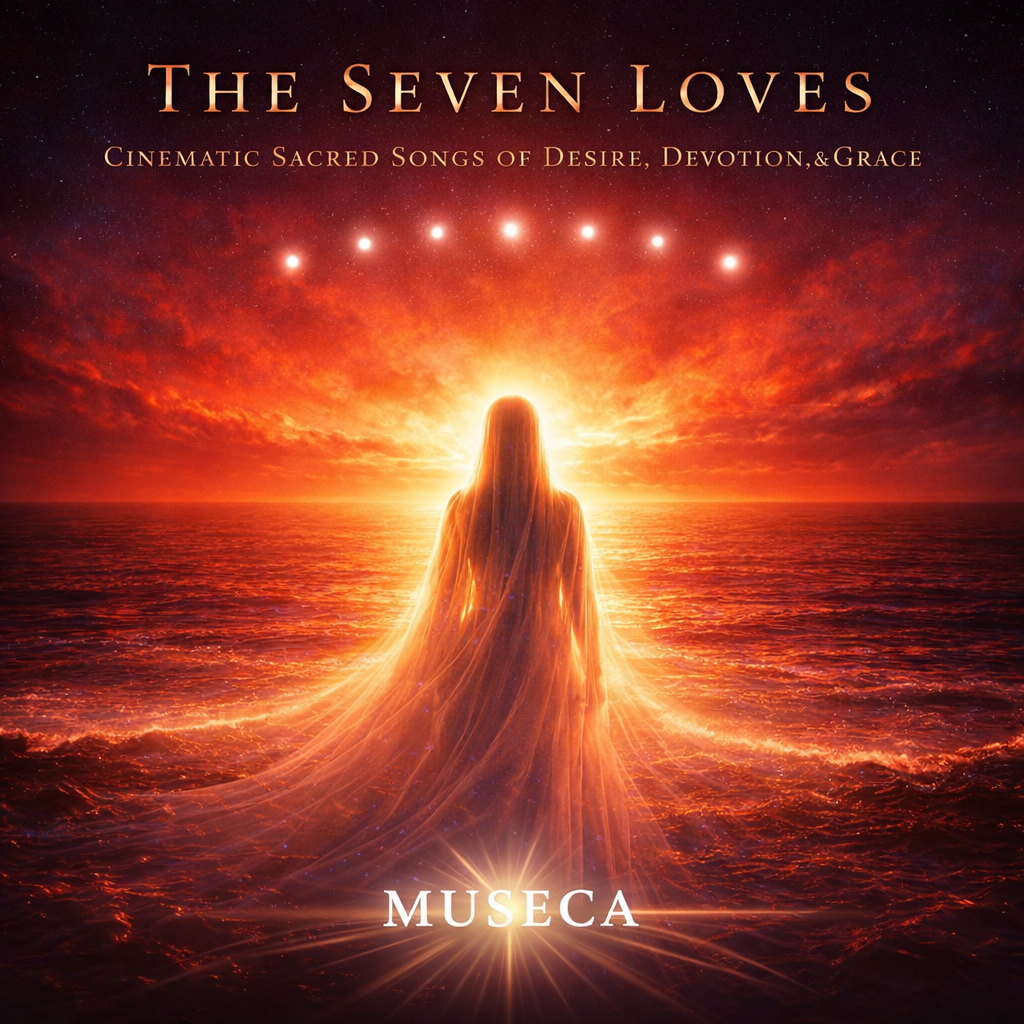
The Seven Loves is an album built on the idea that love is not one feeling but a spectrum of distinct human experiences. Part of that vocabulary comes from the classical Greek tradition, which most often distinguishes eros, philia, storge, and agape; part comes from later modern love-style theory, especially the framework associated with John Alan Lee, which adds terms such as ludus, pragma, and mania. Together, these seven forms allow love to be heard not as a single emotion, but as an inner architecture: playful love, passionate love, obsessive love, friendship love, familial love, enduring love, and self-giving love.
Ludus is the album’s point of first light. It is playful love: flirtation, wit, charm, teasing, delight in possibility. It is the smile before the vow, the dance before the embrace, the quickening of interest before the heart has fully declared itself. In later love-style theory, ludus is associated with love as play rather than burden: light-footed, exploratory, and often resistant to the heavy language of permanence. Yet it is not trivial. Ludus matters because much of love begins not in solemnity but in delight. It is the soul testing joy.
Eros is the deepening of that light into desire. In Greek thought, eros is passionate and sensual, but it is also aspiration: a longing toward beauty, toward what draws us beyond ourselves. It is not merely appetite. It is hunger made radiant. Eros is the body learning reverence through attraction, the heart discovering that desire can feel almost devotional in its intensity. In music, eros is warmth, pulse, breath, magnetism, and ache—the moment when beauty ceases to be distant and becomes personal.
Mania is what happens when longing loses proportion. In John Alan Lee’s framework, mania is marked by dependence, jealousy, uncertainty, emotional upheaval, and the need for reassurance. It is love under pressure: love frightened of loss, love turning inward on its own fear, love becoming fixation. Mania is not included here because it is ideal, but because it is human. Many people know the form of love that cannot rest, that rereads silence as danger, that mistakes intensity for depth. This album treats mania not as romance, but as the storm-shadow of desire.
Philia is the great corrective and companion to passion. In the Greek tradition, philia names friendship, mutual goodwill, shared life, and active concern for another’s well-being. It is built not on possession but on reciprocity, trust, conversation, and presence. Philia is the love that listens. It is the love of equals, of confidants, of those who know each other without spectacle. If eros says, “I am drawn to you,” philia says, “I am with you.” It is among the most sustaining forms of love because it rests on recognition rather than intoxication.
Storge is the tenderness of home. In the Greek vocabulary, it refers to the instinctive affection of family bonds, and later love-style theory also uses the word for a form of love that grows slowly, gently, and through familiarity. Storge is love that remembers. It lives in shelter, in repetition, in care that has become habitual without becoming empty. It is the hand that has fed you, the room that has held you, the voice that knows your childhood name. It is less dramatic than eros, less conversational than philia, but often more foundational. Storge is the quiet mercy of belonging.
Pragma is mature love: patient, practical, chosen, and enduring. In Lee’s theory, pragma is love shaped by logic, realism, and the long view. It is not cold; it is disciplined. It asks not only “What do I feel now?” but “What can be built, carried, protected, and kept?” Pragma is the architecture of devotion. It belongs to those who remain, who compromise, who return, who learn that love is not sustained by intensity alone. It is love after illusion has burned away and loyalty still stands. If eros is flame, pragma is the hearth.
Agape is the album’s final horizon. In the classical Greek-Christian tradition, agape is deliberate, self-giving love ordered toward the good of the other. It is associated with sacrifice, benevolence, and mercy; in later love-style language, it is likewise understood as altruistic, other-centered, and non-demanding. Agape does not ask first what it receives. It asks what it can bless. It is the love that forgives, nourishes, shelters, and gives without keeping score. If eros reaches toward beauty, agape bestows beauty. It is the most luminous form of love because it is least interested in itself.
This album moves through these seven forms not as seven isolated definitions, but as seven chambers of one human mystery. Love begins in play, ignites in desire, trembles into obsession, steadies in friendship, roots itself in home, matures through endurance, and finally opens into grace. That is the inner arc of The Seven Loves: not a theory lesson set to music, but a sacred-pop pilgrimage through the ways the heart reaches, clings, remembers, remains, and at last gives itself away.
Liner Notes
Spark Before the Flame — Ludus
This opening track is written about ludus, the playful form of love. It captures flirtation before commitment, delight before declaration, the light-footed energy of attraction when two people are still circling one another with curiosity and charm. Musically, the song is meant to shimmer rather than burn. Its melodic brightness, graceful motion, and soft sacred-pop atmosphere reflect the emotional truth of ludus: love in its earliest and most sparkling form, where joy itself becomes the first language of the heart.
Lyrics
[Verse 1]
You were laughter at the doorway
Light across a chapel floor
Not a promise, not a fire yet
Just a maybe asking more
[Pre-Chorus]
A glance, a turn, a hidden smile
The heart begins in little miles
[Chorus]
Spark before the flame
Name before the name
We were only dancing near the light
Still the dark was not the same
Spark before the flame
[Verse 2]
No forever in the moment
Only beauty passing through
But the air became a language
Every color leaning you
[Bridge]
Playful as the morning wind
Love begins where joy has been
[Chorus]
Spark before the flame
Name before the name
We were only dancing near the light
Still the dark was not the same
Where the Body Learns Your Name — Eros
This track is written about eros, the passionate and sensual form of love. Here the album moves from play into longing, from surface brightness into heat, desire, and embodied presence. The title suggests the moment when attraction becomes deeply personal, when another person is no longer simply beautiful in the abstract but felt intimately, physically, and inwardly. The music leans into warmth, pulse, and reverence, treating eros not as something crude or merely impulsive, but as a form of longing that can feel almost sacred in its intensity.
Lyrics
[Verse 1]
When your shadow touched my silence
Every room began to wake
Like the body heard a gospel
Only longing knew to make
[Pre-Chorus]
I did not choose the tide
I only felt it rise
[Chorus]
Where the body learns your name
Desire becomes a flame
Every breath a little holier
Every touch a little changed
Where the body learns your name
[Verse 2]
You were warmth beneath the winter
Blood returning into song
And the hunger was not empty
It was where I did belong
[Bridge]
Not just fire, not just need
But the heart made flesh in me
[Chorus]
Where the body learns your name
Desire becomes a flame
Every breath a little holier
Every touch a little changed
Where the body learns your name
The Ache That Would Not Sleep — Mania
This song is written about mania, the obsessive and unstable form of love. It represents desire after it has lost balance, when longing turns inward on fear and begins to feed on uncertainty. The emotional world of the piece is restless, insistent, and unresolved, reflecting the psychology of attachment under pressure. Mania is not celebrated here; it is recognized. It is the form love can take when fear of loss becomes stronger than the joy of presence, when the heart no longer rests but circles endlessly around its own need.
Lyrics
[Verse 1]
I kept hearing your footsteps
In the chambers of my mind
Every hour bent around you
Every prayer became a sign
[Pre-Chorus]
No sleep, no peace, no gentle door
The heart kept asking more
[Chorus]
The ache that would not sleep
Followed me too deep
Turned every light into a question
Turned every vow into a sea
The ache that would not sleep
[Verse 2]
Love can lose its holy balance
When it kneels before its fear
What I wanted was your presence
What I feared was losing here
[Bridge]
Teach this storm to loosen me
Teach this love to let me breathe
[Chorus]
The ache that would not sleep
Followed me too deep
Turned every light into a question
Turned every vow into a sea
The ache that would not sleep
When Two Souls Speak Plainly — Philia
This track is written about philia, the love of friendship, trust, companionship, and mutual regard. After the tension of mania, the album turns toward clarity and human steadiness. Philia is the love that listens, the love that speaks honestly, the love that remains through understanding rather than through possession. The song’s emotional center is conversation: one soul meeting another without performance or demand. Its musical warmth and balance reflect the dignity of friendship as one of the most sustaining and beautiful forms of love.
Lyrics
[Verse 1]
Not every love arrives as thunder
Some arrive and simply stay
At the table, in the questions
In the truth we do not trade
[Pre-Chorus]
No masks, no fear, no hidden art
Just one clear heart beside another heart
[Chorus]
When two souls speak plainly
The world grows calm and bright
Trust becomes a kind of shelter
Voice beside a voice in light
When two souls speak plainly
[Verse 2]
You have known my unfinished places
Still you did not turn away
There is mercy in good friendship
There is grace in what can stay
[Bridge]
Love can also be a hand
That helps another soul to stand
[Chorus]
When two souls speak plainly
The world grows calm and bright
Trust becomes a kind of shelter
Voice beside a voice in light
When two souls speak plainly
House of the Remembering Heart — Storge
This song is written about storge, the love of home, family, tenderness, and deep familiarity. It is rooted in memory and shelter—the kind of love that does not need to announce itself because it has already been woven into daily life, care, and belonging. The title suggests that the heart itself becomes a house made of remembered kindness. The music is intentionally intimate and protective, shaped by softness, nostalgia, and inward warmth. Storge is love that holds, love that remembers, love that makes a person feel known long before words are needed.
Lyrics
[Verse 1]
There is love that smells like cedar
And the rain on window glass
Love that folds a blanket round you
Love that keeps the old years fast
[Pre-Chorus]
It does not ask to be admired
It simply keeps the fire
[Chorus]
House of the remembering heart
Where the broken come to rest
Every room is made of kindness
Every silence softly blessed
House of the remembering heart
[Verse 2]
In the hands that fed and held me
In the names I still recall
There is tenderness still breathing
Through the cracks of every wall
[Bridge]
Home is not a place alone
It is the love that makes us known
[Chorus]
House of the remembering heart
Where the broken come to rest
Every room is made of kindness
Every silence softly blessed
House of the remembering heart
What We Keep Through Winter — Pragma
This track is written about pragma, the mature and enduring form of love. It is the love that survives seasons, hardship, disappointment, and time. Unlike the urgency of eros or the instability of mania, pragma is patient, practical, and chosen. It is love strengthened by repetition, tested by reality, and proven by return. The image of winter is central to the song: not as despair, but as the season in which true devotion is revealed. This is love not as excitement alone, but as fidelity, endurance, and quiet strength.
Lyrics
[Verse 1]
Love is not the first bright weather
Only blossom, only spring
Love is also bread in famine
Hands that carry everything
[Pre-Chorus]
When the cold comes to the door
We become what love is for
[Chorus]
What we keep through winter
What we guard through pain
Not the rush of being chosen
But the choice to stay again
What we keep through winter
[Verse 2]
There are vows the years make stronger
There are fires fed by will
And the holiest form of passion
May be quiet, may be still
[Bridge]
Steady heart and steadfast flame
Love returns and stays the same
[Chorus]
What we keep through winter
What we guard through pain
Not the rush of being chosen
But the choice to stay again
What we keep through winter
The Love That Asks for Nothing — Agape
This final track is written about agape, the self-giving and unconditional form of love. It brings the album to its highest emotional and spiritual point. Agape is love that seeks the good of the other without demand, without bargaining, and without keeping score. It is mercy, blessing, forgiveness, and compassionate presence. The song’s widening musical space and luminous tone are meant to reflect the nature of agape itself: expansive, radiant, and free. After moving through play, desire, obsession, friendship, family, and endurance, the album arrives here—at love as grace.
Lyrics
[Verse 1]
Love that does not count the cost
Love that stays when self is lost
Love that bends to lift another
Love that sees a stranger brother
[Pre-Chorus]
Not to possess, not to demand
Only to open heart and hand
[Chorus]
The love that asks for nothing
Still gives everything
Mercy like a field of sunlight
Grace in every wounded thing
The love that asks for nothing
[Verse 2]
It is bread and it is pardon
It is water in the dust
It is blessing without measure
It is shelter made of trust
[Bridge]
Higher than the heart can climb
Love becomes the light divine
[Final Chorus]
The love that asks for nothing
Still gives everything
Mercy like a field of sunlight
Grace in every wounded thing
The love that asks for nothing
Playlist
- Track 1 - Spark Before the Flame Museca 2:40
- Track 2 - Where the Body Learns Your Name Museca 3:12
- Track 3 - The Ache That Would Not Sleep Museca 3:12
- Track 4 - When Two Souls Speak Plainly Museca 2:26
- Track 5 - House of the Remembering Heart Museca 2:56
- Track 6 - What We Keep Through Winter Museca 3:09
- Track 7 - The Love That Asks for Nothing Museca 3:08