
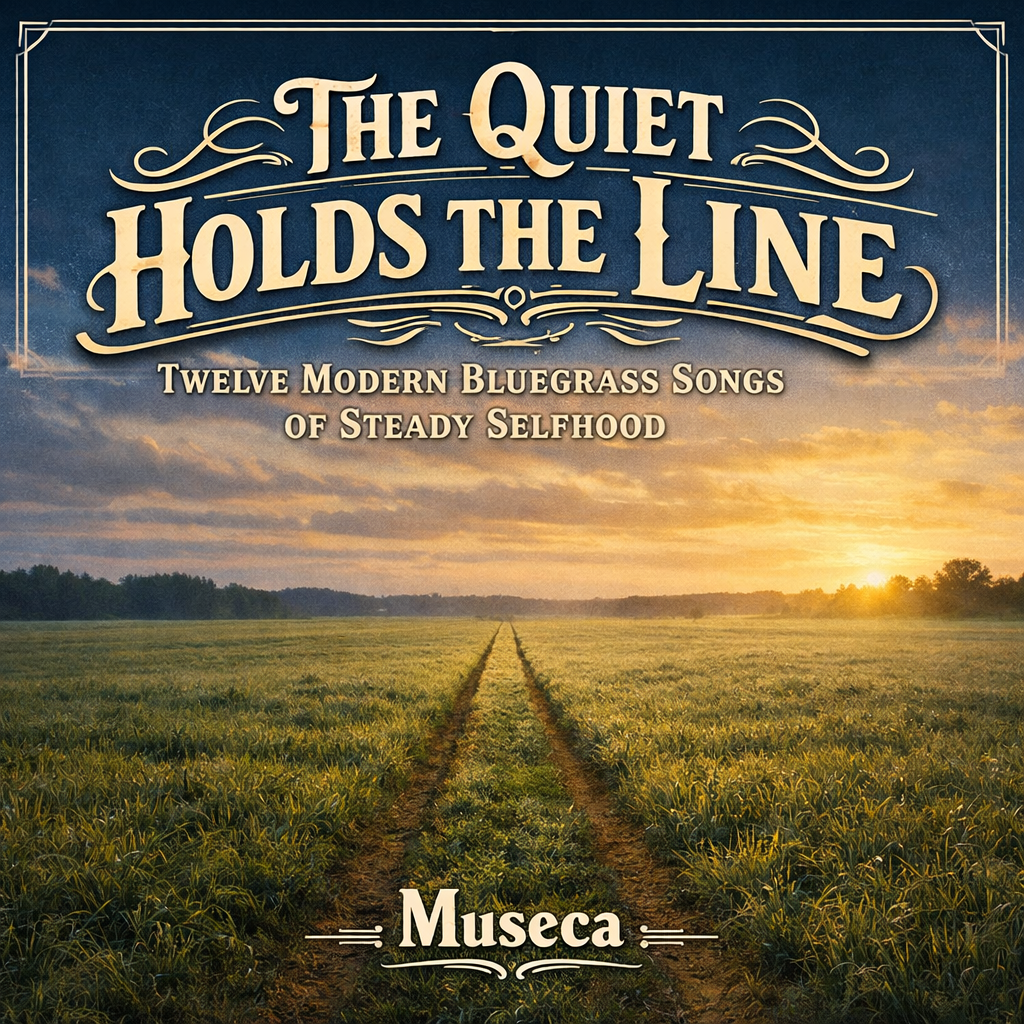
The Quiet Holds the Line is a modern bluegrass album built from a simple idea: peace is not a mood you stumble into—it’s a way of living you practice. These twelve songs trace the moment a life shifts from reflex to intention, from carrying everyone else’s noise to choosing what is true and steady. The world outside doesn’t suddenly get easier; the bills still show up, the heart still aches, and the old habits still call your name. But somewhere along the way, the narrator learns a quieter kind of strength—the kind that doesn’t need drama to feel real.
The record moves like a long exhale. It begins with recognition: how easily attention gets spent on fear, how quickly the day can be surrendered to other people’s urgency. Then come the small, decisive turns—morning light before the phone, one honest “no,” one boundary spoken without a speech. As the songs unfold, the body becomes a compass, integrity becomes practical, and creation becomes a daily way out of the trance. There is forgiveness here, but not return; compassion, but not self-abandonment. Again and again, the album insists on a calm, unshowy truth: you can love people and still choose yourself. You can be kind and still be clear.
Musically, the album stays rooted in the luminous restraint of modern bluegrass. Dobro, fiddle, mandolin, and upright bass carry the emotional weight with clarity rather than spectacle—solos that sing, harmonies that widen like light, and arrangements that leave room for breath. The sound is intimate and human: close-mic vocals, warm trio choruses, and acoustic textures that feel like front-porch honesty rather than performance. The songs don’t preach; they witness. They offer a soundtrack for anyone learning to stop negotiating with what drains them, and to start building a life that can hold steady.
In the end, The Quiet Holds the Line is not about perfection. It’s about recovery—recovering faster, returning sooner, choosing the next right thing without punishing yourself for being human. These are songs for anyone who wants less noise and more truth, less reaction and more soul. The quiet does not mean weakness. It means you’ve finally decided what you will protect. And once you do, the line holds.
Liner Notes
Operating System
The record opens with the simplest revelation: nothing external has to change for everything internal to change. The same town, the same bills, the same weather—yet a new “inner software” begins running underneath it all. The band stays deliberately uncluttered, letting mandolin chop and upright bass establish steadiness while fiddle and dobro answer the vocal like calm thoughts arriving on time.
Lyrics
[Verse 1]
Same town, same bills on the kitchen table
Same old weather on a worn-out road
But I quit running on the worry cable
And I’m learning how to carry my own load
[Chorus]
Same world, new way of living in it
I don’t chase the noise, I don’t drown in doubt
I changed what’s running underneath the surface
Now the light comes on when the lights go out
[Verse 2]
I used to feed my fears like a hungry baby
Every headline had me by the throat
Now I breathe, get still, and it saves me
Like a steady hand on a leaky boat
[Bridge]
I’m not above the ache, I’m just above the lie
I don’t have to fall apart to feel alive
[Chorus]
Same world, new way of living in it
I don’t chase the noise, I don’t drown in doubt
I changed what’s running underneath the surface
Now the light comes on when the lights go out
[Outro]
[Harmony: trio on final lines]
Same world… new way… of living in it
Attention Ain’t Free
A bright, driving reminder that attention is not an endless resource—it’s a form of payment. This song turns modern overload into classic bluegrass propulsion, with a hook built for harmony stacks and a dobro break that feels like reclaiming the wheel. It’s the album’s first clear act of sovereignty: refusing to bankroll fear with your focus.
Lyrics
[Verse 1]
Woke up to a screen full of somebody’s fire
Every “breaking” thing broke my day in two
Had my heart on a hook and my head in a wire
Like I owed the world my worry too
[Chorus]
My attention ain’t free
I’m done paying fear to stay
If it steals my peace,
It don’t get my time today
No, my attention ain’t free
I’m taking my power back
I ain’t funding the dark with my looking
I’m looking where the light is at
[Verse 2]
I don’t need a thousand voices in my pocket
Telling me I’m late, telling me I’m wrong
I need a front porch truth I can stand on
And a quiet that can make me strong
[Bridge]
Turn it off, step outside, let my mind come home
[Chorus]
My attention ain’t free…
[Harmony: duet then trio on final chorus]
Morning Light (Phone Later)
A porch-morning ritual set to a tender pulse: sunlight first, screen later, breath before noise. The lyric is intentionally practical—water, movement, a quiet reset—because the turning point here isn’t mystical, it’s habitual. The arrangement glows rather than pushes, with soft dobro swells and fiddle held tones that feel like daybreak entering the room.
Lyrics
[Verse 1]
I used to grab my phone like a life raft
Before my feet could even find the floor
Now I let the day arrive slow and honest
Like sunlight through an open door
[Chorus]
Morning light, phone later
Water first, then I breathe
I let my body set the meter
For what I’m gonna need
Morning light, phone later
Small as it sounds, it’s true
I don’t lose myself to the world
Before I even wake up to you
[Verse 2]
Five minutes moving, bare feet grounded
Hear a little bird, feel my chest unclench
It’s funny how the simplest things can save you
From the panic you were trained to live in
[Bridge]
I don’t need perfect—just a better start
[Chorus]
Morning light, phone later…
[Harmony: duet on final chorus]
Signal Mode
This is the album’s first deep exhale—slow, hymn-like, and spacious. The song moves from “red alert living” into a calmer kind of intelligence, where truth is felt quickly and cleanly. Harmonies widen as the chorus returns, not to create drama, but to illustrate coherence: the sound of a nervous system coming home.
Lyrics
[Verse 1]
I lived on red alert for so long
Called it “being ready,” called it “being strong”
But my nerves were tired and my spirit was thin
So I learned to get quiet and listen again
[Chorus]
I’m in signal mode now
Not the panic I wore
I can feel what’s true faster
Than I ever could before
I don’t have to fight the whole world
To finally feel safe
I can come back to myself
With one slow breath
[Verse 2]
If it’s loud, I step back
If it’s heavy, I set it down
If it’s real, it stays steady
Even when nobody’s around
[Bridge]
[Harmony: duet]
Peace ain’t a place—it’s a way
[Chorus]
[Harmony: trio]
I’m in signal mode now…
Yes When I Mean No
A confession with a backbone. The narrator recognizes how often “yes” becomes a reflex, a performance, a transaction for approval—and how expensive that habit truly is. Musically it has a light bounce, but the message lands hard: kindness doesn’t require self-erasure, and honesty can be delivered without cruelty.
Lyrics
[Verse 1]
I been saying “sure” like it’s automatic
Like a smile I put on when I’m tired inside
And I laugh it off, keep it nice and polite
Then I go home feeling like I lied
[Chorus]
I say yes when I mean no
And it costs me more than money
It steals my sleep, it sinks my glow
And it ain’t even kinda funny
So I’m learning a new word
That my heart can live behind
If it isn’t true, it isn’t mine
I won’t say yes when I mean no
[Verse 2]
I don’t owe an answer that explains my nature
To folks who like me small and overrun
I can be kind without being available
I can be loving and still be done
[Bridge]
One clean “no” is a door I can close
[Chorus]
I say yes when I mean no…
Self-Respect Made Visible
This is the boundary anthem—fast, snappy, and braced with conviction. The phrase at the center becomes the album’s thesis in miniature: boundaries aren’t harsh; they are self-respect you can see. The band leans into crisp momentum—mandolin driving, fiddle and dobro trading lines—because clarity is not timid. It moves.
Lyrics
[Verse 1]
I used to call it “keeping the peace”
When I swallowed my voice and stayed too sweet
But peace without me ain’t peace at all
It’s just me being easy to defeat
[Chorus]
Self-respect made visible
That’s all a boundary is
Not a fight, not a threat,
Just a line I finally live
I don’t hate you, I don’t blame you
I just choose what I allow
Self-respect made visible
And I’m showing it now
[Verse 2]
If you show up hot, I won’t climb in the fire
If you vanish days, I won’t praise your return
I’ll say it once, then I’ll watch what you do
‘Cause behavior is the truth you can’t unlearn
[Bridge]
I’m not building walls—I’m building a life
[Chorus]
Self-respect made visible…
[Harmony: trio on final chorus]
My Body Knows
The emotional center of the record arrives as a waltz—intimate, tender, and quietly devastating. Here the mind’s talent for rationalizing meets the body’s refusal to lie. The lyric doesn’t argue; it listens. The arrangement leaves space for the vocal to ache honestly while the fiddle carries a countermelody that feels like the truth you’ve been trying not to admit.
Lyrics
[Verse 1]
I can talk myself into anything
Make a mess sound like a plan
But my stomach tells the honest story
Before my mind can understand
[Chorus]
My body knows
What my pride won’t say
If my chest don’t open,
I don’t open the gate
If my gut goes tight,
I don’t push through the signs
I don’t need a speech
To read the lines
My body knows
[Verse 2]
Some folks leave me feeling scrambled
Like I lost my name somehow
Some folks make the room feel steady
And I breathe like I’m safe right now
[Bridge]
[Harmony: duet]
I’m done calling chaos “love”
[Chorus]
My body knows…
Detox Season
Transformation is rarely elegant at first. This track frames the messy middle as a clean-out rather than a collapse: when tolerance for what drains you drops, discomfort rises—briefly—and for a purpose. Minor colors in the verses give way to brighter choruses, mirroring the emotional arc of releasing what was never aligned and beginning to breathe again.
Lyrics
[Verse 1]
It got messy when I stopped pretending
That I didn’t feel what I always felt
Like my heart finally quit defending
The same old story I always told myself
[Chorus]
It ain’t a breakdown, it’s a clean-out
It ain’t the end, it’s a release
My tolerance dropped for the fake and the loud
And I’m learning what my quiet needs
Yeah it hurts, but it’s honest
Like rain washing dust from the air
It ain’t a breakdown, it’s a clean-out
And I’m breathing better there
[Verse 2]
Things I used to shrug off started burning
Jobs and jokes that drained me dry
My whole system started learning
How to stop calling harm “fine”
[Bridge]
I’m not losing it—I’m losing what was wrong
[Chorus]
It ain’t a breakdown, it’s a clean-out…
Forgive, Don’t Go Back
Forgiveness here is not reconciliation; it’s closure. The narrator chooses compassion without reopening the wound, wishing someone well from a distance that finally protects peace. The melody is built to linger, and the instrumentation is restrained on purpose—because this kind of strength doesn’t shout. It simply does not return.
Lyrics
[Verse 1]
I don’t carry it like a suitcase now
I set it down most days
But I remember what it cost me
To learn your kind of ways
[Chorus]
I forgive, but I don’t go back
That’s the line I draw
I can wish you well from far away
Without forgetting what I saw
Forgiveness clears the bitterness
It doesn’t rewrite fact
I forgive… but I don’t go back
[Verse 2]
I won’t reopen what I stitched shut
Just to prove I’m strong
I can be soft and still be finished
I can be right and still move on
[Bridge]
[Harmony: duet]
Peace loves distance sometimes
[Chorus]
I forgive, but I don’t go back…
Say It Once
A practical song about ending the habit of over-explaining. The narrator draws a clean edge, states it plainly, and then lets behavior do the talking. The stop-time attitude and tight bluegrass snap underline the point: boundaries don’t require a courtroom argument. They require one clear sentence and the courage to stand by it.
Lyrics
[Verse 1]
I used to write a whole essay
To make my “no” feel kind
Now I keep it plain and simple
And I let the truth unwind
[Chorus]
I’ll say it once
I won’t say it for an hour
I’m not having this talk
When you come in hot with power
I’ll say it clear,
Then I’m done explaining facts
‘Cause words can dance forever
But behavior don’t act
[Verse 2]
If you disappear, I won’t wait
If you twist it, I won’t chase
I’m not negotiating chaos
Just to keep you in my space
[Bridge]
[Stop-time emphasis]
I said it once—now I watch what you do
[Chorus]
I’ll say it once…
Plug One Leak
A release track—bright, lifted, and full of forward motion. It celebrates the underrated miracle of one small change: one conversation avoided, one door closed, one pattern interrupted—and suddenly the whole internal house gets quiet. The harmonies open into joy because relief is real music; it deserves a chorus.
Lyrics
[Verse 1]
I didn’t fix my whole life overnight
Didn’t find a brand-new me
I just shut one door I should’ve shut
And it set my whole heart free
[Chorus]
I plugged one leak
And the whole house got quiet
One small “no,” one clean line
And my nerves stopped trying
To hold up what was heavy
To keep someone content
I plugged one leak
And I could breathe again
[Verse 2]
Funny how the body knows right away
When you stop the slow bleed
Like peace comes running in the room
The minute you let it be
[Bridge]
[Harmony: duet]
Small changes, big relief
[Chorus]
[Harmony: trio]
I plugged one leak…
Responding From My Soul
The finale returns to stillness, but now it’s earned. The narrator doesn’t claim enlightenment—only presence, and the decision to respond rather than react. The arrangement builds like a slow sunrise: fiddle as a high halo, dobro as a gentle current, voices stacking into a final chorus that feels like steady selfhood made audible. The closing lines hold the album’s promise: not perfection—return.
Lyrics
[Verse 1]
I don’t need the world to soften up
Before I soften too
I don’t need the sky to clear itself
To know which way is true
[Chorus]
I’m done reacting to the weather
I’m done living on defense
I can stand in what I know is right
Without making it make sense
To everyone who wants my worry
To keep their world in control
I’m not perfect—I’m just present
Responding from my soul
[Verse 2]
I still cry, I still miss, I still stumble
Still learn the hard way sometimes
But I come back quicker to the center
Where the quiet holds the line
[Bridge]
[Harmony: duet → trio]
Peace is a practice, not a prize
[Final Chorus]
[Harmony: trio, lift intensity]
Responding from my soul…
[Outro]
[A cappella option on final words]
…from my soul
Playlist
- Track 1 — Operating System Museca 2:55
- Track 2 — Attention Ain’t Free Museca 2:55
- Track 3 — Morning Light (Phone Later) Museca 2:35
- Track 4 — Signal Mode Museca 2:21
- Track 5 — Yes When I Mean No Museca 2:51
- Track 6 — Self-Respect Made Visible Museca 2:10
- Track 7 — My Body Knows Museca 2:53
- Track 8 — Detox Season Museca 2:48
- Track 9 — Forgive, Don’t Go Back Museca 2:56
- Track 10 — Say It Once Museca 2:25
- Track 11 — Plug One Leak Museca 2:15
- Track 12 — Responding From My Soul Museca 2:45