
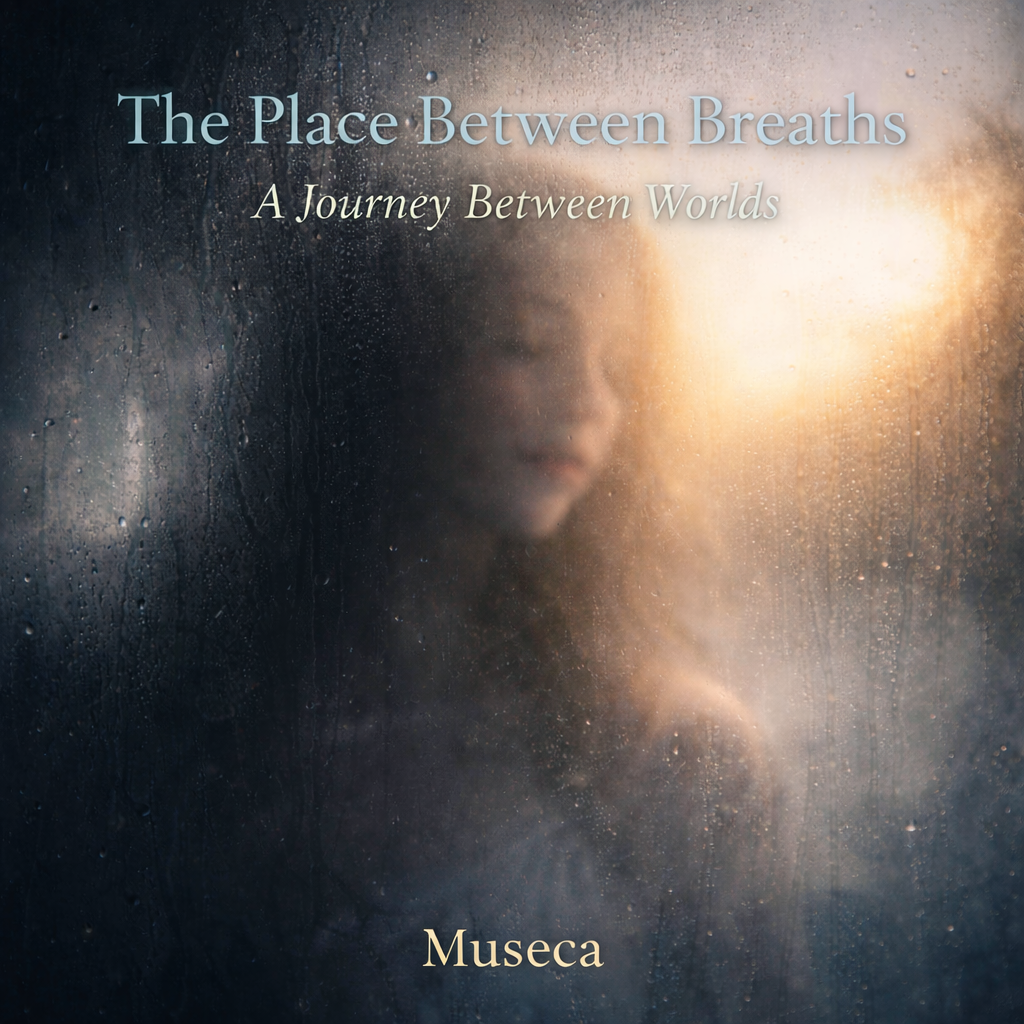
The Place Between Breaths is a narrative concept album about a near-death experience—more specifically, about the mysterious inner passage between apparent ending and return.
It tells the story of Elena Maris, a hospice nurse whose professional life has been devoted to accompanying others to the threshold of death while quietly carrying unresolved grief in her own heart. Years earlier, Elena lost her husband, and in the aftermath she did not collapse outwardly. Instead, she became composed, functional, and emotionally careful. Her adult daughter, Mara, experienced that restraint as distance. Love remained, but it had become difficult to reach. One night, after a long shift and in the midst of heavy rain, Elena is driving home when an emotionally charged moment connected to her daughter breaks open something inside her. There is an accident. The details are initially unclear. What follows is the heart of the album: Elena enters a spiritual in-between state in which she does not know whether she is dreaming, dying, dead, or suspended somewhere between worlds.
From that moment forward, the album unfolds chronologically as Elena passes through successive stages of consciousness. She first experiences disorientation and immersion in a strange, watery suspension. She then finds herself in a corridor-like realm outside time, a place that faintly resembles the hushed architecture of hospitals and waiting rooms, yet obeys no earthly logic. As she moves deeper into this threshold, memory begins to return—not as cold recollection, but as living warmth. She hears a chair move across a floor, a glass set down in a kitchen, the laughter of her daughter as a child, the familiar presence of the life she thought had receded forever. These memories do not simply comfort her; they begin to reveal what grief has done to her. Elena is shown, not with judgment but with clarity, how sorrow gradually made her guarded, distant, and unreachable, even to those she still loved. In the album’s central revelation, she sees that grief became a kind of inner dwelling place: a quiet, careful room she continued inhabiting long after its door had closed.
But The Place Between Breaths is not only about pain. It is about what pain cannot erase. As Elena moves beyond memory and beyond her identity as widow, nurse, mother, and mourner, she begins to remember something more essential: a self deeper than biography, older than grief, and untouched by death. In this luminous stage of the experience, she recognizes that love was never truly lost, only obscured by fear and sorrow. She realizes that consciousness is larger than the temporary form it wears, and that what she called “herself” in ordinary life was only part of a far greater being. At the threshold of that realization, Elena is given no command and no punishment—only a choice. She senses that she may continue onward into the greater light, or return. What draws her back is not unfinished ambition, but unfinished love. She hears Mara calling her, not as a memory but as a living presence. She feels again the pull of breath, body, weather, and human life. And so Elena returns—not unchanged, and not with easy answers, but with a transformed understanding of death, grief, and the sacred unfinishedness of the living.
The musical form of this album was designed specifically to serve that journey. Each track begins with spoken or semi-spoken text, often underscored by sparse ambient music, allowing the story to move forward in a direct and intimate way. These opening passages place the listener inside Elena’s consciousness before the full song begins. From there, the music gradually opens into sung lyrics, where the emotional and spiritual meaning of each stage can unfold more expansively. In many tracks, the narrative continues after the main sung section through an additional spoken or spoken-sung passage at the end, which serves as a bridge into the next chapter. This structure allows the album to function both as a sequence of songs and as a continuous dramatic work: part concept album, part spiritual monologue, part cinematic song cycle.
Stylistically, the album was composed in a cinematic ethereal art-pop language, blending intimate female vocals with ambient textures, soft piano, low drones, delicate strings, and a gradual bloom from speech into melody. The voice often hovers at the threshold between speaking and singing, which suits the subject of the album itself: a consciousness hovering between worlds. This method creates a fluid narrative experience in which storytelling and song are not separate forms, but two modes of the same unfolding awareness. The result is an album meant not only to be heard, but entered—a guided passage through fear, memory, truth, remembrance, and return.
Liner Notes
Track 1 — The Water Between
The album opens not with explanation, but with immersion. Elena does not yet know who she is in relation to what has happened. The listener is placed directly inside her disorientation: a realm of pressure, darkness, suspended motion, and faint calling. Water functions here both literally and symbolically. It suggests the accident that brought her to this threshold, but it also represents the state between forms—the place where identity loosens and ordinary time no longer holds. The spoken and semi-spoken opening lines are crucial in this track because they do not merely introduce the song; they enact the first fragile stirrings of consciousness in the in-between. The music rises softly beneath them, as if awareness itself were learning how to enter.
The sung portion of the track gives emotional shape to that confusion. Elena is not yet reflecting on her life, her grief, or her relationships. She is simply experiencing the shock of being nowhere she recognizes. The repeated phrase “the water between” becomes the first great image of the album: not life, not death, not waking, not disappearance, but a suspended middle realm. The ending spoken passage prepares the transition into the next track by introducing the idea of passage. What Elena first mistakes for an ending begins to reveal itself as a corridor. The mystery deepens, but it also starts to take form.
Lyrics
SPOKEN/SUNG INTRO
I hear something…
before I know I am hearing.
A sound without direction.
A calling…
without a mouth.
There is no sky here.
No ground.
Only pressure.
Only darkness…
moving.
Someone said my name.
Or I remembered it.
I cannot tell
which came first.
I try to open my eyes,
but what opens
is not sight.
It is distance.
A long, blue distance…
folding over itself.
I know this is not sleep.
Sleep has edges.
Sleep lets you fall
and find the bottom.
This has no bottom.
Something bright
passed through me
a moment ago.
Or around me.
A blade of light.
A breaking.
A silence afterward
so complete…
it almost sounded merciful.
I want to breathe,
and the wanting
becomes fear.
I want to rise,
and the rising
becomes memory.
There is water here.
Or the memory of water.
Something holding me…
without hands.
If I am dreaming,
why does it feel
older than I am?
If I am dying,
why do I still feel called
toward something unfinished?
A voice again.
Not far.
Not near.
As if it had been waiting
inside the quiet…
for me to stop resisting it.
And then—
beneath the dark—
a tone.
Soft.
Almost nothing.
As if music itself
were learning
how to enter.
SUNG
I woke where no morning had ever begun,
No shore, no ceiling, no shadow of sun,
Only a hush like the end of a cry,
Only a question too deep to ask why.
I reached for my name and it drifted away,
A thread in the undertow, silver and gray,
I felt the world loosen, but nothing was gone,
Only the shape of the life I had worn.
I am in the water between,
Not gone, not waking, unseen,
Held in a silence I cannot outrun,
Far from the night, but not yet the sun.
Something is calling through the blue deep,
Through what I lost, through what I keep,
I am not falling the way that I dreamed,
I am in the water between.
There was a light like a door in the rain,
There was a fracture that did not feel pain,
There was a moment the world let me through,
And all that remained was the sound of the blue.
I thought I was ending, I thought I was late,
I thought I had come to the last of my weight,
But under the hush and the slow-moving tide,
Something within me refused to divide.
I am in the water between,
Not gone, not waking, unseen,
Held in a silence I cannot outrun,
Far from the night, but not yet the sun.
Something is calling through the blue deep,
Through what I lost, through what I keep,
I am not falling the way that I dreamed,
I am in the water between.
Who is it speaking
where no lips move?
Who is it waiting
inside this room of blue?
If I surrender,
will I disappear?
Or will I hear at last
what was always here?
I am in the water between,
Not gone, not waking, unseen,
Held by a mercy I do not yet know,
Drawn by a current too quiet to show.
Something remembers when I cannot see,
Something is nearer than breathing to me,
I am not lost, though I do not know where I have been,
I am in the water between.
SPOKEN/SUNG OUTRO
The fear
did not leave me.
It only loosened.
And where I expected
an ending…
a passage appeared.
Not a tunnel.
Not a gate.
A corridor
of pale distance…
opening
where no wall had been.
No clocks.
No doors
I could touch.
Only the feeling
that something ahead of me…
already knew
my steps.
Track 2 — The Corridor Without Clocks
If the first track is immersion, the second is orientation without understanding. Elena has emerged from the watery suspension of the opening and now finds herself in a realm that resembles a corridor, a waiting place, a hospital hall after midnight—but emptied of all ordinary logic. This is one of the album’s most psychologically important tracks because it reveals Elena’s instinctive resistance. As a hospice nurse, she is accustomed to being the composed one, the person who names things, measures things, tends to the threshold from the side of the living. In this track, all those instincts remain present. She tries, quietly and almost unconsciously, to read the place as if it were a medical or mental event she can interpret. But the corridor will not submit to analysis.
The lack of clocks is not just an atmospheric detail. It is the first indication that Elena has entered a domain where chronology is secondary to consciousness. There is no measurable time here, only experience. The spoken opening introduces the first clear encounter with the guiding voice, which does not lecture or command. It simply tells her that she is not where she thinks—and that she is not lost. The sung section then expands Elena’s unease. She recognizes the textures of the threshold but not its meaning. By the end of the track, the corridor begins to soften and open, and what comes through it is not doctrine, but memory: the first sounds of ordinary life. That shift leads directly into the emotional warmth of the next chapter.
Lyrics
SPOKEN/SUNG INTRO
When I opened my eyes again…
the water was gone.
Or farther away.
I was standing.
At least…
it felt like standing.
A long corridor
stretched ahead of me.
Pale.
Silent.
Unending.
There were walls…
but they did not hold anything in.
There were lights…
but they did not come
from above.
No doors opened.
No clocks moved.
And yet…
I knew this place.
Not truly.
But enough
to fear it.
It carried
the stillness of a hospital
after midnight.
The kind of stillness
that waits beside a bed
and does not speak first.
I listened
for footsteps.
For a monitor.
For a voice
calling down the hall.
Nothing.
Only that same quiet…
watching me.
And then—
not beside me,
not ahead—
a voice.
Soft.
Certain.
You are not
where you think.
But you are not lost.
SUNG
I know these halls,
or something like them,
The hush before a name is said,
The light that lingers
after leaving,
The breath beside an unseen bed.
I know the hour
when machines grow distant,
When families speak in careful tones,
When every doorway
holds its silence,
And no one wants to die alone.
But this is not
the world I know,
No page, no pulse,
no room below,
No hands to guide,
no chart to read,
And still this place
is reading me.
This corridor without clocks,
This waiting without time,
No hour to hold,
no hand to stop,
No edge,
no end,
no sign.
This corridor without clocks,
Where silence learns my name,
I try to walk,
I try to wake,
But nothing here
behaves the same.
I count my breaths,
then lose the number,
I count the lights,
they do not end,
I tell myself
this is a fever,
A dream,
a break,
a mind unpinned.
I call for reason,
habit,
training,
For all the things
that used to hold,
But every answer
falls behind me,
And every certainty
grows cold.
Then comes that voice
without a body,
Calm as if it had always known:
You are not here
to measure endings.
You are here
to see your own.
This corridor without clocks,
This waiting without time,
No hour to hold,
no hand to stop,
No edge,
no end,
no sign.
This corridor without clocks,
Where silence learns my name,
I try to turn,
I try to stay,
But nothing here
will play that game.
If I am living,
why this distance?
If I am dying,
why this grace?
If I am neither,
who is standing
In my shape,
inside this place?
I know these halls,
or something like them—
But never one
that looked at me.
Never one
that asked in silence
What grief
had made me unwilling to see.
SPOKEN/SUNG OUTRO
Then…
for the first time,
the corridor changed.
Not all at once.
A warmth
moved through it.
Small.
Almost hidden.
Like light
under a door.
And with it—
a sound.
Not the sound
of this place.
A glass in a kitchen.
A chair moved
across a floor.
Someone laughing…
in another room.
Living sounds.
Near enough
to break me.
I turned toward them.
And the corridor,
which had given me nothing…
opened.
Track 3 — Echoes of the Living
This is the first truly tender track on the album. After the abstract unease of the corridor, Elena is suddenly met by the sounds of home: a glass on a table, a chair moving across the floor, laughter in another room. These are small, unheroic details, and that is exactly why they matter. The album does not introduce memory through grand revelation, but through the intimate acoustics of ordinary life. The living return first as atmosphere. What Elena thought she had lost forever begins to approach her not as a concept, but as a room still holding warmth.
The emotional center of the track lies in the realization that memory is not dead. It is not archival. It is alive, active, breathing. Elena encounters her daughter Mara as a child, and she senses Daniel not as abstract absence, but as presence carried in the textures of remembered domestic life. The song’s title is important: these are not simply echoes of the dead, but echoes of the living. The track insists that love does not vanish when a life changes form, and that memory itself may be more vivid, more immediate, and more morally demanding than Elena had allowed herself to believe. Yet this tenderness is not pure comfort. The spoken outro makes that clear. The return of memory begins to expose another truth: love remained, but Elena’s way of carrying it changed. Somewhere beneath the warmth, another door is waiting—not into recollection, but into truth.
Lyrics
SPOKEN/SUNG INTRO
The sound came first.
Not a voice.
Not a warning.
A glass
set down on a table.
Then—
a chair moved
across a floor.
Small sounds.
Living sounds.
The kind that mean
someone is home.
I stood still.
And the corridor,
which had been only distance,
filled with warmth.
Not heat.
Warmth.
The warmth of a room
still holding
the shape of a life.
I knew that warmth.
I knew it
before I knew
whose life it was.
And then—
laughter.
Not near.
Not far.
A child’s laughter…
turning a corner
inside me.
So sudden
I almost reached for her.
Mara.
Small enough
to disappear behind a doorway.
Bright enough
to fill a house.
And after that—
another sound.
Lower.
Familiar.
The sound of him
laughing in a kitchen,
as if nothing in the world
had ever been broken.
I thought memory
would feel farther away.
It did not.
It felt waiting.
SUNG
The sound came back
before the faces did,
A glass, a chair,
a floor that lived,
A room half-lit
by evening’s gold,
The kind of warmth
a house can hold.
And then a laugh
I knew at once,
A little burst
of light and run,
Mara in summer,
barefoot, fast,
As if no sorrow
could ever last.
Echoes of the living,
Not gone,
not still,
not through,
A room remembers softly
what love was made to do.
Not relic,
not illusion,
Not ash,
not shadow’s giving—
I thought that memory faded.
It was only waiting,
living.
I saw your hands
before your face,
The way you leaned
against the place,
A kitchen doorway,
late-day sun,
The sound of laughing
before grief came.
Daniel—
for one suspended breath,
You were not absence.
You were depth.
Not pulled from me
by time or pain,
But standing in the warmth again.
Echoes of the living,
Not buried
by the years,
A cup,
a chair,
a passing smile,
A house still full of tears.
But tears are not an ending,
And loss is not the whole of giving—
I thought that love had left me.
It was only waiting,
living.
I touched the air
and felt it break
With all the names
I could not say,
The ones I carried
like a stone,
The ones I thought
I held alone.
But every room
was full of breathing,
Every silence
full of thread,
And what I called
the past was only
Love still moving
through the dead.
Echoes of the living,
Near enough
to undo me,
A child,
a voice,
a kitchen light,
The place I used to be.
Not memory as museum,
Not fragments unforgiving—
I thought I had lost everything.
But something here
was living.
SPOKEN/SUNG OUTRO
The warmth should have comforted me.
It did.
And it did not.
Because the more I remembered…
the more I began to see
what had gone missing
long before this place found me.
Not love.
Never love.
Only my way
of carrying it.
I had turned grief
into something silent.
Something careful.
Something cold enough
to survive.
And somewhere,
beneath the sounds
of home—
another door
was waiting.
Not into memory.
Into truth.
Track 4 — What Grief Made of Me
This is the album’s central reckoning. By this point, Elena has passed through disorientation, resistance, and memory. Now she is brought face to face with what grief has done inside her. Importantly, this is not portrayed as punishment. No external judge condemns her. No cosmic tribunal issues verdicts. Instead, she is shown herself with an unbearable but merciful clarity. The spoken introduction establishes this tone immediately. Memory recedes. Comfort recedes. What remains is a stillness more honest than consolation. Elena expects to be shown what she lost, but instead she is shown what she became.
The song gives language to one of the album’s deepest insights: grief can disguise itself as devotion. Elena did not stop loving. She did not become cruel or empty. She became careful. She became measured, controlled, emotionally narrowed. She mistook numbness for strength and survival for faithfulness. This is why the track is called What Grief Made of Me rather than simply My Grief. It is about the shape grief imposed on the self over time. The lyrics deliberately blur the line between emotional truth and spiritual revelation, showing how sorrow can become an inner architecture that one continues inhabiting long after it has ceased to be life-giving. The spoken outro offers the first great release from that architecture. Once Elena has truly seen this smaller story, she cannot return to it unchanged. What begins to rise now is not mere recovery, but remembrance.
Lyrics
SPOKEN/SUNG INTRO
The warmth receded.
Not all at once.
As if the place itself
had understood
that memory alone
was not enough.
The sounds of home
fell quiet.
The kitchen.
The chair.
The laughter.
Gone.
And in their place—
a stillness
more honest
than comfort.
I thought
I would be shown
what I had lost.
Instead…
I was shown
what I had become.
Not cruel.
Not empty.
Only careful.
Careful with love.
Careful with speech.
Careful with needing.
As if grief
had taught me
that feeling less
was the price
of surviving.
I had called it strength.
I had called it duty.
I had called it
getting through.
But this place
did not listen
to the names
I gave things.
It only showed me
their shape.
And grief—
stripped of all
my language—
looked less like sorrow
than a room
I had gone on living in
long after the door
had closed.
SUNG
I wore my grief
like winter skin,
So long
I thought it had always been
The way a body
learns to stand,
The way a silence
fills a hand.
I called it calm.
I called it grace.
I called it simply
keeping place.
But underneath
the careful light,
It was a room
with all doors shut tight.
What grief made of me
Was not devotion,
not holy flame,
But distance dressed
as faithfulness,
And numbness with a gentler name.
What grief made of me
Was not love’s keeping,
Not sorrow’s honest sea,
It was a house
I would not leave
Because pain still sounded like memory.
I stood beside
the dying ones,
I held their hands,
I closed their rooms,
I spoke the words
the living need
When time has narrowed
into breath.
But all the while
I kept one chamber
Locked beyond
the reach of light,
A daughter waiting
outside my weather,
A heart gone dim
while I named it night.
What grief made of me
Was not devotion,
not sacred thread,
But careful walls
and measured breathing,
And all the things
I left unsaid.
What grief made of me
Was not the wound alone,
Not love denied by years,
It was the art
of surviving loss
By asking less of love
than tears.
I see it now
without accusation,
No voice condemns,
no hand decrees,
Only the truth
rising clear as water:
You could not heal
what you would not grieve.
I did not stop loving.
I stopped moving.
I stopped answering
what remained.
I turned my sorrow
into shelter,
And called the shelter
by your name.
What grief made of me—
Let me not carry it
unchanged.
Let me not call
this silence loyalty
if silence is what love became.
What grief made of me—
Let me see it
and let it break.
Let every careful room
fall open.
Let every sleeping part
awake.
SPOKEN/SUNG OUTRO
When the truth finished
showing itself…
it did not accuse me.
That was the mercy.
No judgment.
No sentence.
Only seeing.
And once seen—
I could not return
to the smaller story.
Not the story
where I was only wounded.
Not the story
where silence was virtue.
Not the story
where love belonged
only to what had been lost.
Something in me
was loosening now.
Not breaking.
Remembering.
And behind that remembering…
farther in—
there was light.
Not outside me.
Before me.
Within me.
Older than grief.
Older than my name.
Track 5 — Before I Had a Name
If Track 4 is the wound laid open, Track 5 is the revelation of what the wound could not destroy. This is the album’s most explicitly luminous chapter. Elena is no longer confined to the story of what happened to her, whom she lost, or how she survived. She begins to remember something deeper than personal memory: a self beneath role, beneath biography, beneath even the name by which she has known herself. The spoken opening must carry this with extraordinary gentleness, because the truth here is not dramatic in the theatrical sense. It is vast, intimate, and nearly impossible to defend against. Elena senses that her name is not false, but too small to contain the whole of what she is.
The song unfolds this insight with reverence. “Before I had a name” does not mean before existence. It means before identification, before the narrowing of the soul into a single earthly life. The track reveals the album’s metaphysical heart: consciousness is older than fear, older than grief, older than the body’s story. Elena is shown that she was not made whole or broken solely by the events of her earthly life. Rather, she participated in that life from a being deeper than circumstance. This recognition does not erase her humanity; it enlarges it. The spoken outro then introduces a subtle but crucial shift. Elena realizes that such remembrance does not carry her away from life. It brings her nearer to it. Nearer to the love she thought she lost. Nearer to the possibility of return.
Lyrics
SPOKEN/SUNG INTRO
The light did not rush toward me.
It waited.
As if it had never been absent.
As if I had only been turned
the wrong way
for years.
It was not a door.
Not a figure.
Not a judgment.
Only presence.
So steady…
so gentle…
I could not defend myself against it.
And there,
inside that stillness,
something stranger than memory began.
Not the remembering
of rooms,
or names,
or faces.
Something older.
A knowing
beneath identity.
A life
beneath the life
I had been calling mine.
I reached for my name—
and for one trembling moment,
it felt too small
to hold me.
Not false.
Only small.
As if I had worn it
for a while…
and mistaken it
for the whole of myself.
And the light,
without speaking,
seemed to say—
Before the grief.
Before the body.
Before the story.
You were.
SUNG
Before I had a name,
Before the skin,
Before the ache
I gathered in,
Before the years
could shape my face,
There was a wider
kind of grace.
Before the wound,
before the weather,
Before I learned
to hold together,
Before the grief
became my frame,
There was a life
beneath my name.
Before I had a name,
I was not lost,
not incomplete,
Not waiting
to be made by time,
Not only bone
and pulse and heat.
I was a flame
without a border,
A note before the song was sung,
And something in that ancient silence
Still remembers
what I was.
I see now
how small I made me,
How tightly
I held one sorrow’s thread,
As if the soul
could fit forever
Inside the rooms
where one life bled.
But love was larger
than my keeping,
And being
older than my fear,
And what I called
myself was only
The garment
I was wearing here.
Before I had a name,
I was not broken
into parts,
Not mother,
widow,
nurse,
or daughter—
Only light
with many hearts.
Not emptied
by the leaving,
Not ended
by the body’s frame,
I was,
and am,
and still am more
Than every story
of my name.
And if I came here
to remember,
Then let remembrance
open wide,
Let every borrowed
definition
Fall like shadow
from inside.
Before I had a name,
There was a love
that did not cease,
A self no grief
could close around,
A stillness
deeper than release.
And now it rises
through the silence,
Tender,
vast,
and unafraid—
Not making me
someone different,
But showing me
what still remained.
SPOKEN/SUNG OUTRO
I thought
this remembering
would carry me away.
It did not.
It brought me nearer.
Nearer to what had always been true.
Nearer to the love
I had mistaken
for loss.
Nearer to the life
still waiting
beyond this place.
And then—
for the first time—
I understood
that return
was possible.
Not required.
Possible.
A breath
still waiting for me
somewhere.
A voice
still calling me
by the name
I had not yet outgrown.
And with that knowing…
the light changed.
Not farther.
Closer.
Like morning
finding the edge
of closed eyes.
Track 6 — Breath Returning
The final track completes the arc not through conquest, but through consent. Elena is not dragged back into life, nor does she flee from death in terror. She is offered the possibility of return, and she recognizes that love in the world of the living still calls to her. The spoken opening frames this moment beautifully: the light comes not to take her, but to ask her. That distinction defines the tone of the ending. The body reappears not as a trap, but as a threshold. Mara’s voice returns not as memory, but as living relation. Elena becomes aware that she may continue onward or go back, and what makes the choice meaningful is that neither path is framed as error. Return is possible because love is unfinished.
The song itself is the album’s resolution in musical form. Breath becomes the great symbol of re-entry into time, body, pain, weather, relationship, and duty. But Elena does not return to the old life in the old way. She returns with a different understanding of what death is and is not. She knows now that death is not annihilation, and that love was never identical to possession. She comes back not with a system of answers, but with a widened capacity for living. The spoken outro preserves that humility. Elena does not claim to have brought back full language for what happened. She returns instead with room: room for grief, room for wonder, room for the living. The final insight is simple and large enough to close the whole album: she was not lost, and love was larger than she knew.
Lyrics
SPOKEN/SUNG INTRO
The light came nearer.
Not to take me.
To ask me.
And in that nearness,
I felt it—
somewhere far below,
or far within—
a body.
Heavy.
Waiting.
Still mine.
Not as a prison.
As a threshold.
I heard a sound then.
Not memory.
Not this place.
A voice,
broken by distance,
speaking my name
as if it still belonged
to the world.
Mara.
Not as a child now.
Not as an echo.
Living.
Calling.
And with her voice
came weight.
Cold.
Rain.
The faint ache
of breath not yet taken.
I understood then—
I could go farther.
Or I could return.
Not because I had failed
to leave.
Because love
was not finished.
Because one life
still waited
to be answered.
And somewhere,
beneath the light,
beneath the name,
beneath the long unbroken stillness—
my next breath
was waiting too.
SUNG
There was a breath
still waiting for me,
A thread of air,
a pulse of sea,
A body somewhere
under rain,
A name still carried
through the pain.
There was a voice
that crossed the distance,
Not from memory,
not from dream,
Mara calling
through the silence,
Pulling me back
through what had been.
Breath returning,
Slow and bright,
Not a fall
but entering light,
Not erased,
not taken through,
But given back
to what was true.
Breath returning,
Weight and skin,
The storm without,
the dawn within,
A heart still bruised,
a life still warm,
A soul come back
through rain and form.
I could have followed
farther inward,
Past all sorrow,
past all frame,
But love was waiting
in the living,
And called me
gently by my name.
Not the small name
that fear had carried,
Not the name
grief locked away,
But the one spoken
by the breathing,
The one the world
still needed me to stay.
Breath returning,
Not to the old
small room of pain,
But to the unfinished,
holy labor
of loving here
through loss and rain.
Breath returning,
Through the chest,
Through the ache
I could not mend,
Through the body,
through the weather,
Through the life
not at its end.
I know now
death is not the ending,
And love was never
what I lost,
Only hidden
under silence,
Only veiled
by what it cost.
So let me wake
with this remembering,
Let me rise
without disguise,
Let me answer
what is living,
Let me meet
my daughter’s eyes.
Breath returning,
First and deep,
Breaking water,
breaking sleep,
Morning finding
what remained—
A soul unchanged,
a life reclaimed.
Breath returning,
Soft and true,
I come back
not less,
but through,
Carrying light
I cannot explain,
Into the wound,
into the rain.
SPOKEN/SUNG OUTRO
Rain.
Then light
through my eyelids.
Then the weight
of breath
becoming mine again.
Not easy.
Not painless.
Mine.
Somewhere nearby,
a voice was speaking.
Not from beyond.
Here.
And for the first time,
the world sounded fragile
enough to love
without hiding from it.
I did not come back
with answers.
I came back
with room.
Room for grief.
Room for wonder.
Room for the living.
And when they asked me
where I had been—
I knew
I would never
have the language.
Only this:
I was not lost.
And love
was larger
than I knew.
Playlist
- Track 1 — The Water Between Museca 8:01
- Track 2 — The Corridor Without Clocks Museca 6:26
- Track 3 — Echoes of the Living (Spoken Intro) Museca 6:20
- Track 4 - What Grief Made of Me Museca 9:48
- Track 5 - Before I Had a Name Museca 7:39
- Track 6 - Breath Returning Museca 8:16