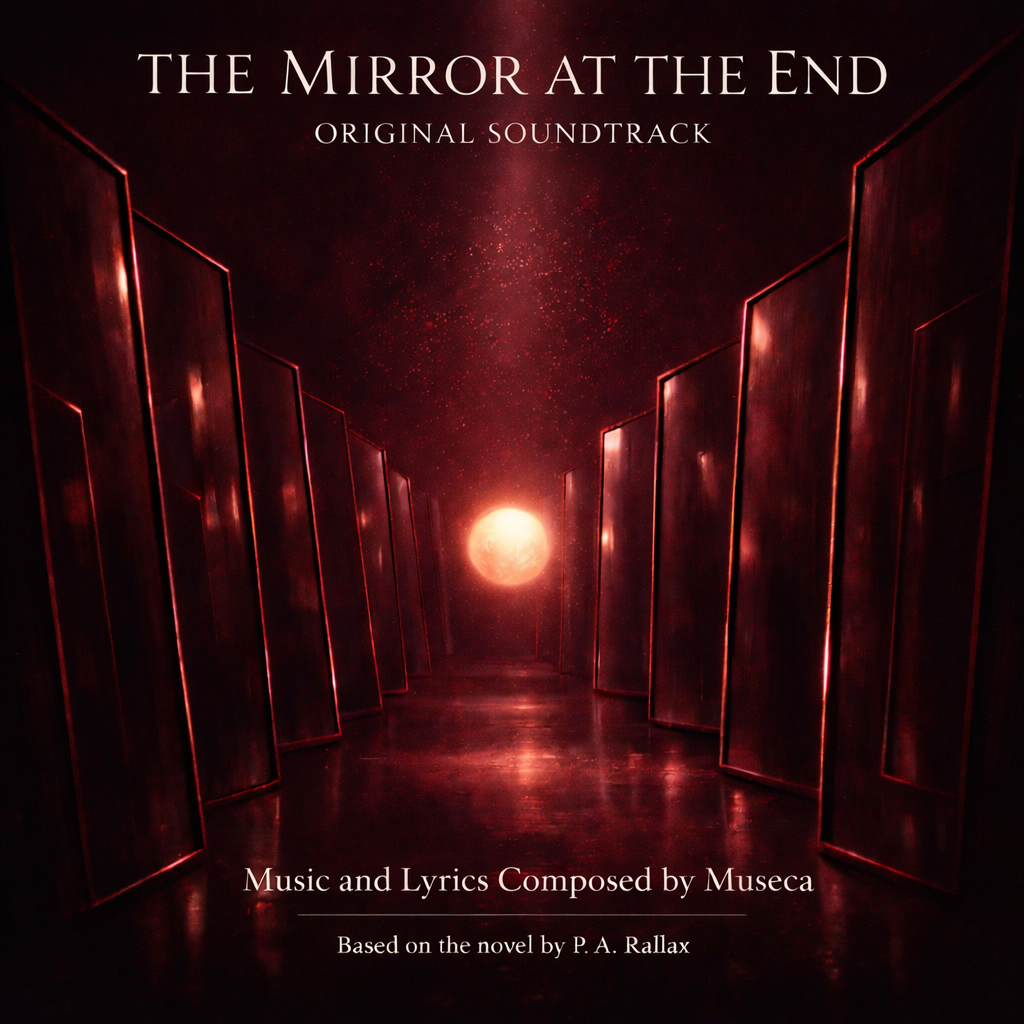
The Mirror at the End is a story about what happens when a human being can no longer hide from what their life has done to other lives.
In the novel, written by P. A. Rallax, the story begins not in the afterlife, but in an attic. A man named David discovers a box of papers left behind by his grandfather: a manuscript written in the first person, claiming to be the testimony of a soul after death. The voice speaks from a place beyond time, where there are no courts, no nations, and no uniforms—only memory made visible. It describes being led into a vast, shifting hall made out of its own self-image: banners, symbols, victories, speeches, and the grand narrative it once told about itself.
Then the walls begin to move.
The narrator is not dragged to punishment. Instead, it is invited—quietly and inexorably—to see. A presence known only as the Archivist appears: not a judge, not an accuser, but a guide. The Archivist’s role is simple and terrifying. Room by room, life by life, the soul is shown what its choices meant for others, in a detail that cannot be argued with or edited away. Every rationalization, every story of “necessity,” every abstraction used to justify harm falls away. What remains is impact.
The journey unfolds through a series of chambers, each one a living memory or a moral echo. The soul steps into the lives it affected, sometimes from the inside, sometimes as a witness.
In one chamber, we enter the world of a musically gifted child whose only refuge is his violin amid tightening walls and narrowing days.
In another, we stand beside a mother who survives what no one should have to survive, her grief stretching beyond any single event.
In a sterile “white room,” we experience institutional decisions dressed up as mercy and efficiency, where lives are ended without spectacle.
In perhaps the most unsettling space of all—the Unborn Room—we feel the weight of lives that never arrived: futures erased before they could take form, not as ghosts, but as palpable absence.
At times, the soul experiences events through other bodies: a soldier following orders and wrestling with his conscience, a child waiting in a line he doesn’t understand, a neighbor who chooses to look away and then lives with that silence. At other times, it stands outside and watches itself act, unable to interrupt what has already happened but equally unable to deny it. There is no external condemnation here. The only unbearable thing is accuracy.
Running parallel to this otherworldly review is David’s story in the present. As he reads the manuscript left behind by his grandfather, he has to decide what to do with it. Is it confession, allegory, madness, or something more precise and dangerous? His own life is shaped by the shadows of the past in quieter ways—family secrets, inherited silence, the way history bends the lives of people who think of themselves as ordinary. David’s thread grounds the metaphysical narrative in a very human problem: once you know the truth, what responsibility do you have toward it?
Throughout the novel, one idea returns in many forms: every soul will face itself. Not in fire, not in theatrical damnation, but in an encounter with unedited reality. The “mirror at the end” is not a magical object; it is the totality of one’s life seen from all sides—through the eyes of those we loved, those we harmed, those we ignored, and the selves we might have become. There is no way to flee this mirror, but there is also no need to. Its purpose is not to crush, but to reveal. Only what is seen can be changed.
The soundtrack you are about to hear, lyrics and music composed by Museca, was designed as a companion work to the book and as a self-contained narrative in music. It can stand alone as an album, or serve as the musical foundation for a future film or stage adaptation of The Mirror at the End. The score follows the same emotional and structural architecture as P. A. Rallax’s novel:
Section I paints the opening illusion of grandeur and the emergence of the Archivist, setting the spiritual tone for a review that is clinical, compassionate, and inescapable.
Section II moves into the realm of children and lullabies—fragile, resistant, haunted—where a simple melody can carry more weight than a speech.
Section III forms the core of the life review: soldiers and civilians, mothers and bystanders, institutional rooms and quiet acts of kindness, and the unbearable silence of unrealized lives.
Section IV gathers these threads into reckoning: the one question that cannot be avoided, an intimate act of lighting a candle for the past, and the great choral statement that “no one escapes the mirror.”
Section V closes in near-silence, releasing the listener not into a final judgment, but into an open possibility: the space in which a life, having seen itself clearly, can choose what to become next.
You do not need to read the book to understand the music. Each track has been written to function as a chapter in sound:
the crack in a self-glorifying story,
the tenderness of a lullaby sung in the wrong century,
the cold breath of an institutional corridor,
the weight of a room filled with lives that never were,
the tremor in one man’s voice when he chooses, finally, not to look away.
At the same time, the full novel The Mirror at the End by P. A. Rallax will be available as a downloadable PDF, so that listeners who wish can read the complete narrative while they listen. The album by Museca and the book by P. A. Rallax are designed as paired works: one in words, one in sound, both circling the same question from different angles.
This is not a conventional story about heaven and hell. It is a story about consequence, empathy, and the strange mercy of an honest mirror. The identity of the soul whose life we follow is revealed gradually within the novel and is left unnamed here—not as a trick, but as an invitation. If you come to the soundtrack without that knowledge, the music may ask you a different, more personal question: not “Who was he?” but “What would my own mirror show?”
In the end, The Mirror at the End is less about a single life than about the condition of being human. This soundtrack is meant to accompany that recognition—note by note, room by room—until the last sounds fade and you find yourself in your own quiet, looking into your own reflection.
To experience the complete narrative behind this soundtrack, you may download the full novel The Mirror at the End by P. A. Rallax in PDF format below. Reading the book alongside the music allows you to follow the life review chapter by chapter, deepening the emotional and spiritual resonance of each track.
THE MIRROR AT THE END
Original Soundtrack — Expanded Liner Notes with Narrative Alignment
SECTION I — OVERTURE & OPENING THEMES
Track 1 – The Mirror at the End
Key / Tempo: C minor · Largo
Concept: Central statement of the score; full orchestra and choir introduce the Mirror Theme—the truth that every soul will ultimately stand before what its life has done.
Book Alignment: Epilogue and overarching frame – “The Mirror at the End”
The soul is brought into the final chamber and confronted with the totality of its life, not as myth or justification, but as unedited reality.
Musical Role:
This opening establishes the entire spiritual architecture. A solo cello and low strings first outline the Mirror Motif, gradually joined by choir and full orchestra. Harmonies move between stark minor and brief flashes of transfigured color, suggesting that this confrontation is terrible and merciful at once. The track plants thematic material that will return in “Every Soul Will Face Itself” and culminate in “No One Escapes the Mirror.”
Track 2 – Every Soul Will Face Itself
Key / Tempo: E♭ major (with C-minor inflections) · Adagio
Concept: Reverent choral meditation; solo voice and later choir reflect gently on the life review as seeing rather than punishment.
Book Alignment: Early metaphysical chapters – “The Soul Awakens”
The narrator learns that what lies ahead is not a court of law, but a mirror: a place where every thought, act, and omission is shown in full context.
Musical Role:
Celesta, clarinet, and soft strings cradle a simple vocal line that feels almost like a private prayer. When the choir enters, the harmony widens without becoming grandiose. The music underscores the book’s central theological shift: what awaits is not a sentence, but an encounter with truth. Lines from this song echo conceptually later in “No One Escapes the Mirror,” tying the score’s beginning and near-end together.
Lyrics (English)
[Verse 1]
Every soul will face itself
Not in fire, not in shame
But in stillness, without a name
The mirror waits to show the way
[Verse 2]
Not to punish, not to blame
Not to pardon, not to claim
What was hidden now is plain
What we ran from still remains
[Chorus – Full Choir Enters]
Every soul will face itself
Beyond the veil, beyond the breath
Not to answer, not to flee
But to look and finally see
[Verse 3]
The weight we carried, the wounds we gave
The light we buried, the love we saved
It will rise without disguise
No more masks, no more lies
[Chorus – Refrain]
Every soul will face itself
Not by law but by the light
Not in fear but in the truth
Every soul will face itself
[Outro]
Every soul
Will face
Itself
Track 3 – The Hall of Glory
Key / Tempo: D minor · Maestoso, darkly processional
Concept: Monumental brass, low strings, martial snare; grand but unstable harmonies that slowly fracture.
Book Alignment: Prologue – The Hall of Glory
The soul arrives in what appears to be a triumphant afterlife chamber — banners, marble, torches, imagined legacy. But the grandeur flickers. The mirror blinks. The illusion begins to collapse.
Musical Role:
This theme opens with imperial confidence but introduces harmonic corrosion beneath the surface — chromatic brass shifts, destabilized pedal tones, subtle dissonant choir textures. The music must feel proud, but ominous — glory already cracking from within. Later cues reveal that this “hall” is not a reward but an ego-constructed façade that cannot survive real seeing.
Track 4 – David Opens the Box
Key / Tempo: E minor · Lento, intimate
Concept: Close-mic’d piano, soft clarinet, and faint string harmonics; a small, human-scale cue of discovery.
Book Alignment: Chapter One – The Box
In an attic, David finds his grandfather’s hidden manuscript: a first-person account claiming to be written from beyond death. This discovery pulls the living reader into the life review.
Musical Role:
The harmony moves in small, careful steps, as if David is turning pages mentally as well as physically. The orchestration remains chamber-sized, emphasizing intimacy and quiet tension. This track anchors the story in the present day and serves as a recurring motif for David’s thread whenever the narrative returns to the world of the living.
Track 5 – The Archivist’s Theme
Key / Tempo: G minor · Lento
Concept: Solo cello, harp, and soft strings; a calm, compassionate but unyielding presence.
Book Alignment: Early chapters – the appearance of the Archivist
The soul meets the Archivist, a guide who neither condemns nor excuses, but carefully curates and presents the truth of a life.
Musical Role:
The melody is shaped like a question that never forces an answer. There are no sharp climaxes, only long, patient lines. In later tracks, fragments of this theme appear behind other scenes, subtly reminding the listener that the Archivist is always present, even when invisible in the text. This cue defines the moral tone of the review: exacting, but not cruel.
SECTION II — LULLABIES AND CHILDREN’S ECHOES
Track 6 – Schlaf, mein Kind (German Lullaby)
Key / Tempo: F major with modal color · Lento
Concept: Gentle German lullaby for solo voice, piano, and soft strings; faint children’s echoes under the surface.
Book Alignment: Chapter Four – Jakob’s Music
The life review enters a childhood world where a young boy clings to music as his only refuge. A mother sings into a night that has already turned hostile.
Musical Role:
The melody rocks in simple intervals, evoking a cradle song, while harmonic shadows darken certain phrases. Very distant children’s cries or textures blend into the arrangement so quietly they feel like memory rather than sound design. The unresolved final chord denies the safety a lullaby usually promises, reflecting the book’s refusal to smooth over what history did to children.
Lyrics (German/English)
Verse 1
Schlaf, mein Kind, im Wind der Bäume
Sleep, my child, in the wind of the trees
Leise weint der Sternenschein
Softly the starlight weeps
Deine Wiege kennt kein Räume
Your cradle knows no boundaries
Nur das Herz und Nacht allein
Only the heart and the night alone
[Ambient Interlude – faint children’s cries begin under soft strings]
Verse 2
Nebel flüstert alte Lieder
Mist whispers ancient songs
Von verlornen Kinderzeit
Of childhood long since lost
Nur der Mond kehrt immer wieder
Only the moon returns again and again
Trägt dein Schlaf durch dunkle Zeit
Carries your sleep through darkened time
[Bridge – instrumental piano, subtle modulation, ghostly textures]
Verse 3
Wiegt die Zeit mein Kind, mein Lieben
Time rocks you, my child, my love
Wiegt dich durch den alten Schmerz
Rocks you through the old pain
Kleine Träume, fortgetrieben
Little dreams, driven away
Schlagen still in Mutters Herz
Beat softly in mother’s heart
Track 7 – Jakob’s Theme / Jakob’s Violin
Key / Tempo: G minor · Andante semplice
Concept: Celesta and harp outline a childlike, music-box motif; solo violin enters as Jakob’s voice, tender and increasingly sorrowful.
Book Alignment: Chapter Four – Jakob’s Music (inner world)
We see the child not as an emblem of tragedy, but as a specific person with a fragile inner life and a private musical sanctuary.
Musical Role:
The first phrases feel like something a child could hum: mostly stepwise movement, short cells, clear tonality. As the solo violin takes the melody, gentle vibrato and occasional sighing slides hint at a depth of feeling Jakob himself cannot articulate. The contrast between celesta innocence and violin ache mirrors the chapter’s juxtaposition of childlike perception with the encroaching horror around him.
Track 8 – Shlof, Mayn Kind — Zol Dikh Keyn Zumpf Nisht Nemen (Yiddish Lullaby)
Key / Tempo: D minor · Adagio
Concept: Yiddish lullaby for solo voice with klezmer-tinged violin and clarinet; quiet defiance against erasure.
Book Alignment: Later in Section II – Yiddish mother and child scenes
The soul experiences another family, another culture, another mother trying to protect her child with the only weapon left: a song that refuses to surrender.
Musical Role:
The melodic line uses characteristic Yiddish ornamentation—small turns, expressive slides—while the harmony stays close to D minor, occasionally touching relative modes that suggest stubborn hope. This lullaby is less about soothing and more about refusing to let memory or identity be drowned. The unresolved cadence leaves the listener in suspension, mirroring the unresolved fate of those the song holds.
Lyrics (Yiddish/English)
Verse 1
Shlof, mayn kind, der tog iz shvarts
Sleep, my child, the day is dark
In di fenster — keyn shtern iz nisht
In the windows — there is not a single star
Der vint shept kloges fun di vegn
The wind carries laments along the roads
A mame zingen, in shoyn keyn regn
A mother sings, though there is no more rain
Verse 2
Dayn tatn’s shtim iz in mayn blut
Your father’s voice lives in my blood
Zey hobn undz gevorfn in shmutz
They have cast us into the dirt
Nor mir shteyen vi der alter boym
Yet we stand like the ancient tree
Unzer lid iz sharf, un heylik-loybn
Our song is sharp and holy-praising
Chorus / Refrain
Zog nit keynmol az du geyst dem letstn veg
Never say that you are walking the final road
Un der toyt zol dikh nisht nemen
And may death not take you
Mir zingen, afile in shtilkayt
We sing, even in silence
Un in mir brent nokh dayn veltlekh oyt
And within me still burns your worldly oath (or sacred flame)
Verse 3
Shlof, mayn kind, in a velt fun shayn
Sleep, my child, in a world of beauty
Azoy hobn mir es mames geprayt
Thus our mothers have passed it down to us
A lid oyf di luf, oyf ash un blut
A song upon the air, upon ash and blood
Mit yidishn mut, un klang fun zeydns hut
With Jewish courage, and the sound of grandfather’s hat
Verse 4 (Repeat with harmonic lift)
Shlof, mayn kind, in a velt fun shayn
Sleep, my child, in a world of beauty
Azoy hobn mir es mames geprayt
Thus our mothers have passed it down to us
A lid oyf di luf, oyf ash un blut
A song upon the air, upon ash and blood
Mit yidishn mut, un klang fun zeydns hut
With Jewish courage, and the sound of grandfather’s hat
SECTION III — THE LIFE REVIEW – MIRRORS OF MEMORY
Track 9 – The Soldier’s Eyes
Key / Tempo: E minor · Adagio
Concept: Muted strings, low brass, ghost of a march pulse; war remembered from inside a single gaze, not from a battlefield panorama.
Book Alignment: Chapter Five – The Soldier’s Eyes
The soul is shown what it chose to do and not do in uniform—obedience, fear, rationalization, and the faces attached to those choices.
Musical Role:
Rhythmic hints of a march keep trying to form, but phrases stall or fragment. Harmonies sag by semitone, undercutting any sense of heroism. The cue never erupts into full war music; it stays trapped in the slow, heavy interior of someone who can no longer look away from what their eyes have seen.
Track 10 – Zofia’s Song (The Mother’s Witness)
Key / Tempo: G minor · Lento (3/4)
Concept: Wordless lament led by solo violin and cello over a rocking 3/4 pulse; grief too deep for language.
Book Alignment: Chapter Six – The Mother’s Witness
A mother survives what should have destroyed her. The soul stands with her as she carries loss through time instead of leaving it behind.
Musical Role:
The accompaniment moves like a slow waltz that has forgotten how to dance. Long, arching violin lines stretch over the bar lines, pulling against the pulse as if refusing to accept what has happened. By withholding lyrics, the track lets the listener supply their own imagination and empathy. This becomes one of the emotional pillars of the score, revisited later in echoing form.
Track 11 – T4: The White Room
Key / Tempo: C♯ minor · Largo, almost pulseless
Concept: Sparse piano clusters, icy string harmonics, distant mechanical drones; clinical horror without spectacle.
Book Alignment: Chapter Seven – The T4 Room
The soul enters an institutional space where lives are categorized and ended with paperwork instead of violence in the open.
Musical Role:
This cue avoids melodrama. There are no big swells, no overtly “sad” melodies—only sterile, fluorescent quiet. Chords appear more as static slabs of sound than progressions. Occasional high dissonances flare and then vanish, like instruments or equipment being adjusted. The music forces the listener into the chilling atmosphere of a system that has forgotten it is dealing with human beings.
Track 12 – The Bread in the Coat
Key / Tempo: E♭ minor · Andante, fragile
Concept: Gentle clarinet and warm strings; a small act of smuggled kindness held against an immense darkness.
Book Alignment: Interlude in the same section – The Bread in the Coat
The soul witnesses a hidden act of compassion: a piece of bread pushed into a coat at great personal risk, unseen by authorities, remembered forever by the one who received it.
Musical Role:
Here the scale shrinks to the size of two hands. Short, tender phrases in the clarinet are answered by strings in quiet, consonant intervals. The harmony avoids grand gestures and instead lingers on modest, luminous voicings. In the moral ledger of the life review, this cue reminds the listener that the smallest acts can weigh as much as the largest crimes.
Track 13 – The Silent Betrayal
Key / Tempo: B minor · Adagio, creeping
Concept: Low strings, piano, and sustained dissonances; the slow, quiet choice to look away.
Book Alignment: Chapter Eight – The Silent Betrayal
The soul is shown moments when it did nothing—not out of active malice, but out of convenience, fear, or fatigue.
Musical Role:
The music rarely rises above mezzo-piano. Lines begin to resolve but are held back by one stubborn dissonant note, creating a sense of moral discomfort rather than catharsis. Silence between phrases is as important as the notes themselves. The track embodies the book’s insistence that inaction is also a choice with consequences.
Track 14 – The Chamber of Almosts / The Unborn Room
Key / Tempo: D minor center · Largo, suspended
Concept: Wordless choir and evolving string clusters; a metaphysical room filled with the weight of lives that never arrived.
Book Alignment: Chapter Nine – The Unborn Room
The soul enters a space that holds the echo of futures erased before they could become actual people—possibilities denied existence by distant decisions.
Musical Role:
There is no melody in the usual sense. Instead, slowly shifting chords move like breaths, expanding and contracting without resolving. D minor is colored by added seconds and ninths, keeping everything hovering. With no text, the choir becomes a cloud of potential voices rather than a chorus of individuals. This track enlarges the story from specific scenes to a vast moral horizon.
Track 15 – I Was There
Key / Tempo: A minor · Andante, testimonial
Concept: Solo voice with piano and strings; direct, human confession set as a simple song.
Book Alignment: Late in the review – testimonial chapters
For the first time, the soul stops narrating around events and admits plainly: “I was there.” The evasions end.
Musical Role:
The setting is intentionally modest—no choir, no huge orchestra—so the focus stays on the voice and the words. The melody sits in a comfortable, speech-like range, avoiding operatic grandstanding. Subtle harmonic shifts underneath underscore moments of realization or regret. In the arc of the score, this is the moment where the inner narrative steps out from behind abstractions and acknowledges presence and responsibility.
SECTION IV — RECKONING AND RETURN
Track 16 – The Question
Key / Tempo: D minor · Lento, spacious
Concept: Quiet strings, piano, and occasional soft horn; large amounts of silence between phrases.
Book Alignment: Chapter Ten – The Question
After the review, one question remains: now that you have seen all this, what will you become?
Musical Role:
This cue is built from open-ended gestures rather than complete statements. Chords appear, hang in the air, and dissolve unresolved. The horn’s occasional entry feels like a distant voice asking something that cannot be answered quickly. Structurally, this track functions as the still point between judgment and response, giving both the soul and the listener space to feel the weight of what has been shown.
Track 17 – David’s Candlelight
Key / Tempo: E minor · Adagio / slow Andante
Concept: Harmonium, intimate male vocal, soft strings, and ambient choir; a small act of remembrance and responsibility.
Book Alignment: Chapter Eleven – David’s Return / closing scenes
Back in the world of the living, David chooses to light a candle—not to change history, but to see it clearly and refuse to turn away.
Musical Role:
A spoken prelude leads into a quiet, sung confession. The harmonium holds a gentle drone as strings and pad textures build slightly around the voice. The lyrics frame remembrance as a choice to stand with the past rather than behind it. An instrumental harmonium and cello interlude gives breathing room between memory and resolve. The track is intentionally smaller than the choral climaxes; its power lies in its humility.
Lyrics (English)
[Spoken prelude – male voice (David), whispered or intimate tone]
“I don’t know if they hear me now. Maybe it’s too late. Maybe it always was.
But tonight… I lit the candle anyway. Not to change the past… just to see it.
And if even one face still lingers in the light… I’ll speak.”
[Harmonium enters, sustained chord under breath pause]
Verse 1
[Solo male voice begins, gentle and reflective]
I lit a flame for all I knew,
A flicker where the silence grew.
Names unspoken, years erased —
Still I see each solemn face.
Verse 2
[Strings swell subtly beneath the harmonium]
The walls remember more than I,
The photographs, the lullaby.
I hold the past in trembling hands,
A candle burning where I stand.
Chorus
[Light ambient choir pad (wordless “ahh”) enters behind voice]
This is not to mourn, but name —
A light to warm the absent flame.
If I must speak, then let it be:
Forgive the part that once was me.
🎶 Instrumental Solo
[Harmonium solo — gentle and expressive, with soft cello counter-melody]
[No voice; allow a breath between memory and confession]
[Duration: ~20–30 seconds]
Bridge
[Solo voice returns over harmonium only]
I walked through ash, I turned away…
But now I choose to stay.
Verse 3
[Strings and ambient pad return subtly]
The night is deep, but not alone,
A single flame becomes a home.
I cannot change what came before,
But I will guard the evermore.
Final Chorus
[Full instrumentation – harmonium, strings, ambient choir]
This is not to mourn, but name —
A light to warm the absent flame.
And if they’re watching through the glass,
May this small candlelight still pass…
[Outro – harmonium fades, ambient cello swell]
[Optional final whisper (David)]: “Still… I remember…”
Track 18 – The Hall of Mirrors
Key / Tempo: C minor · Adagio, swirling
Concept: Canons, inversions, and overlapping patterns in strings and choir; the self seen from many angles at once.
Book Alignment: Final stages of the review – mirrored perspectives
The soul is surrounded by reflections of its life: its actions seen through other people’s eyes, from alternate vantage points, and from the inside out.
Musical Role:
Fragments of earlier themes chase each other in canon and retrograde. Reversed textures and echoing motifs create the impression of standing in a corridor lined with mirrors facing mirrors. This track does not build to a single peak; instead, it saturates the space with recurrence until the listener feels the density of a fully examined life. It prepares the ear for the stark clarity of the next piece, “No One Escapes the Mirror.”
Track 19 – No One Escapes the Mirror
Key / Tempo: D minor · Grave / Lento
Concept: Full orchestra and SATB choir; solemn, monumental statement of the spiritual law at the center of the story.
Book Alignment: Epilogue – confrontation with the mirror
The soul stands before the final mirror, where nothing can be hidden and nothing is mocked—only revealed.
Musical Role:
Low voices and organ-like sonorities open the piece, gradually expanding into a broad choral texture. Key lines echo the theology of earlier tracks (“Every soul will face itself”) but now without hesitation. Harmonies remain tonal and clear so the weight rests on text and massed sound rather than complexity. The ending is firm but not triumphant: a cadence that feels like truth laid bare, not victory or defeat.
Lyrics (English)
[Intro – Low Voices / Whispered or Soft Unison]
When the voices fall to silence,
When the crowd has gone,
When the story has no audience,
The mirror still remains.
[Verse 1]
No throne can hide a heartbeat,
No uniform conceals a hand.
No title, crown, or banner
Can turn the mirror’s gaze away.
[Pre-Chorus 1]
Not to punish, not to damn,
Not to crush a soul in fear —
But to show what we have carried,
What we planted, year by year.
[Chorus 1]
No one escapes the mirror.
No shadow hides its name.
No mask survives the seeing.
No fire, no shame — just flame.
Every soul will face itself.
Every life will come to light.
No one escapes the mirror,
In the stillness of that sight.
[Verse 2]
Kings and beggars stand together,
Children, soldiers, side by side.
Every wound we gave or mended
Rises from the depths inside.
[Pre-Chorus 2]
Not to weigh us by our titles,
Not to count us by our scars,
But to show the truth we carried
Like a field of hidden stars.
[Chorus 2]
No one escapes the mirror.
No shadow hides its name.
No mask survives the seeing.
No story stays the same.
Every soul will face itself,
Past all power, past all pride.
No one escapes the mirror,
With nothing left to hide.
[Bridge – Quieter, More Intimate]
In the glass, no judge is speaking,
Only all we chose to be.
Every thought and every silence
Comes to stand in clarity.
Not to cast us into darkness,
Not to throw us into flame,
But to let us finally witness
Who we were, without a name.
[Final Chorus – Full Choir, Expanded]
No one escapes the mirror.
No shadow, no disguise.
The heart at last stands open,
Reflected in its eyes.
Every soul will face itself,
Beyond the breath, beyond the veil.
Not in terror, not in triumph,
But in truth that cannot fail.
[Final Refrain – Slowed]
No one escapes the mirror.
No one escapes the light.
Every soul will face itself,
In the stillness
Of that sight.
SECTION V — CODA / EPILOGUE
Track 20 – A Note Before the Silence
Key / Tempo: G minor · Adagio sostenuto, fading into silence
Concept: Solo piano, soft strings, and faint high textures; a quiet epilogue that releases the listener into their own reflection.
Book Alignment: Author’s afterword spirit – “A Note Before the Silence”
The narrative voice steps back. No more chambers, no more arguments—only a final acknowledgment that what matters now is what the reader (and listener) will do with what they’ve seen.
Musical Role:
Short, simple phrases repeat with small variations, like someone writing and rewriting the last lines of a letter. The harmony never lands on a fully closed cadence; instead, textures thin until sound gives way to literal silence. This track gestures toward the book’s companion volume on the making of the soundtrack, but more importantly, it leaves the moral and spiritual question open. When the music stops, the “mirror” is no longer in the story—it is in the listener.
Playlist of Full Soundtrack (20 Tracks)
- The Mirror at the End Museca 4:15
- Every Soul Will Face Itself Museca 3:05
- The Hall of Glory Museca 2:40
- David Open's the Box Museca 3:08
- The Archivist’s Theme Museca 3:40
- Schlaf, mein Kind (German Lullaby) Museca 3:08
- Jakob’s Violin/ Jakob's Theme Museca 2:12
- Shlof, Mayn Kind — Zol Dikh Keyn Zumpf Nisht Nemen (Yiddish Lullaby) museca 4:08
- The Soldier’s Eyes Museca 3:23
- Zofia’s Song (The Mother’s Witness) museca 3:08
- T4: The White Room Museca 2:15
- The Bread in the Coat Museca 3:45
- The Silent Betrayal Museca 3:06
- The Chamber of Almosts / The Unborn Room Museca 3:10
- I Was There Museca 4:28
- The Question Museca 2:51
- David’s Candlelight Museca 5:05
- The Hall of Mirrors Museca 3:39
- No One Escapes the Mirror Museca 4:03
- A Note Before the Silence Museca 3:32