
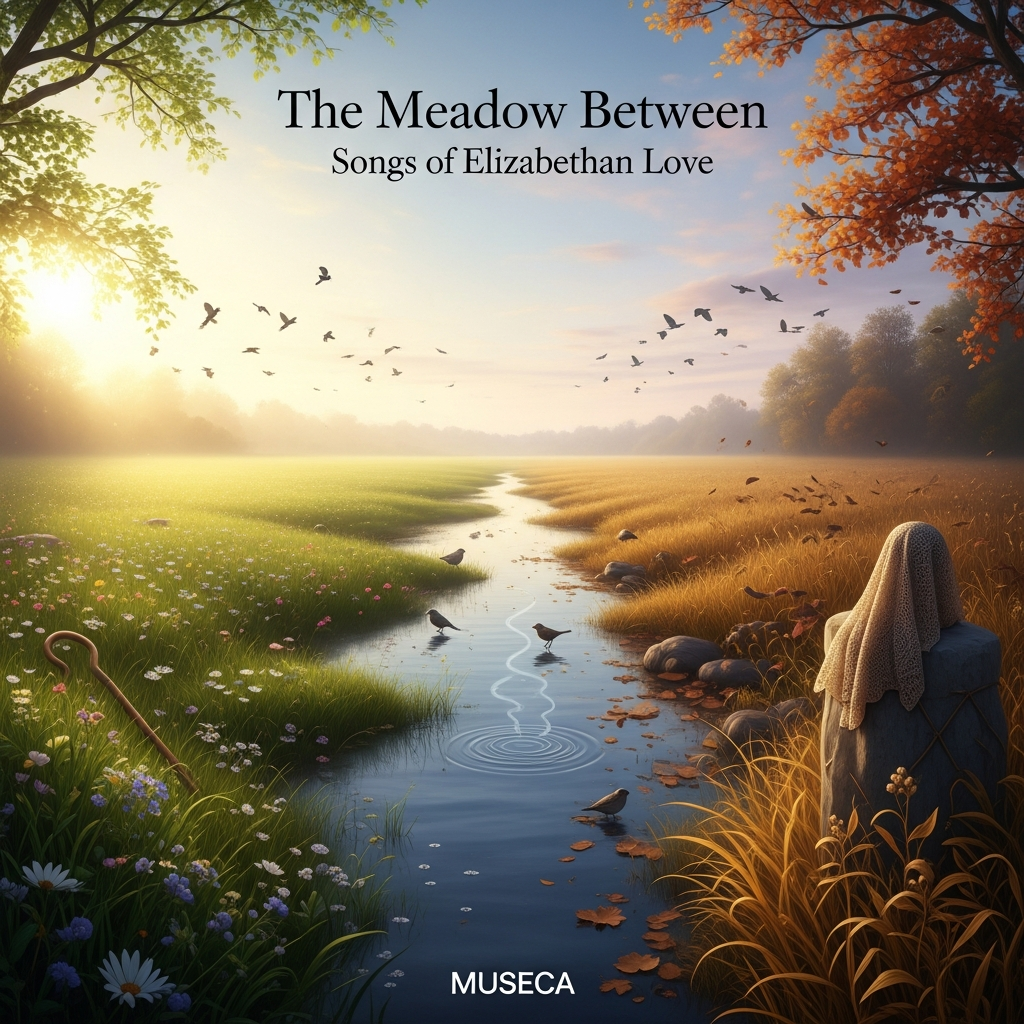
Album Introduction
“The Meadow Between” is a musical dialogue between love’s dream and love’s truth.
Inspired by the golden age of English poetry, it reimagines the famous exchange between two Renaissance voices — Christopher Marlowe, the fiery poet of youth and passion, and Sir Walter Raleigh, the reflective courtier who answered him with quiet wisdom.
In Marlowe’s “The Passionate Shepherd to His Love” (1599), a young shepherd invites his beloved to share an eternal spring — a world of flowers, music, and sunlight untouched by time.
A year later, Raleigh penned “The Nymph’s Reply to the Shepherd” (1600), written as a direct response.
The nymph listens and answers with grace: she reminds him that rivers rage, roses fade, and time alters all things.
Their two poems — one full of promise, the other of reflection — form one of the most beautiful poetic dialogues in English literature.
This album transforms that exchange into a three-part musical suite:
- Track I – “Come Live with Me”: the shepherd’s song, bright and hopeful.
- Track II – “The Meadow Between”: an instrumental passage through summer’s stillness — time passing.
- Track III – “The Nymph’s Reply”: the nymph’s gentle answer, autumnal and wise.
Musically, The Meadow Between merges Elizabethan imagery with modern cinematic folk.
Harp, acoustic guitar, flute, and cello weave together a pastoral soundscape that honors both the language of the 16th century and the emotional intimacy of contemporary composition.
The voices — male and female — represent not merely two people, but two eternal forces:
idealism and realism, youth and maturity, spring and autumn.
“The meadow between” is the place where their voices meet — where dream and truth coexist, and where the music of love lingers beyond time.
Liner Notes
Track 1 – Come Live with Me
Based on: “The Passionate Shepherd to His Love” by Christopher Marlowe (1599)
Christopher Marlowe, Shakespeare’s contemporary and rival in genius, wrote “The Passionate Shepherd to His Love” as a vision of simple, idyllic affection.
It belongs to the pastoral tradition, where love unfolds in perfect harmony with nature.
The shepherd’s voice is warm, persuasive, and filled with youthful imagination — he sees only endless spring.
Each stanza expands upon his first invitation, offering roses, rivers, and song in exchange for companionship.
In this musical adaptation, Museca preserves the rhythm and tenderness of Marlowe’s verse, giving it new life as a modern cinematic folk ballad sung by a male voice — the shepherd himself.
Original Poem (1599)
Come live with me and be my love,
And we will all the pleasures prove,
That valleys, groves, hills, and fields,
Woods, or steepy mountain yields.
And we will sit upon the rocks,
Seeing the shepherds feed their flocks,
By shallow rivers to whose falls
Melodious birds sing madrigals.
And I will make thee beds of roses,
And a thousand fragrant posies,
A cap of flowers, and a kirtle
Embroidered all with leaves of myrtle.
A gown made of the finest wool,
Which from our pretty lambs we pull,
Fair lined slippers for the cold,
With buckles of the purest gold.
A belt of straw and ivy buds,
With coral clasps and amber studs:
And if these pleasures may thee move,
Come live with me and be my love. The shepherd swains shall dance and sing
For thy delight each May morning:
If these delights thy mind may move,
Then live with me and be thy love.
Adapted Lyrics (Museca)
[Verse 1]
Come live with me and be my love,
Where valleys sigh and rivers move.
We’ll wander through the morning dew,
And dream of all that love can prove.
[Verse 2]
I’ll weave thee beds of tender roses,
And garlands made of fragrant posies.
A crown of spring, a silken thread,
Where every petal paints us red.
[Bridge]
By shallow rivers to whose falls,
Melodious birds sing madrigals.
Their gentle song, the world stands still,
And every heart bends to their will.
[Chorus]
Through the hills and gentle valleys,
Where the sky and meadow meet,
We shall walk the path of lovers,
Barefoot hearts and singing feet.
[Verse 3]
The shepherds’ song shall be our tune,
Beneath the sun, beneath the moon.
Come live with me, the world is wide—
Love’s simple grace shall be our guide.
[Final Chorus] [Repeat]
Through the hills and gentle valleys,
Where the sky and meadow meet,
We shall walk the path of lovers,
Barefoot hearts and singing feet.
[Outro]
By shallow rivers…
Melodious birds sing madrigals.
Come live with me… and be my love.
Come Live with Me
Track 2 – The Meadow Between
This instrumental piece represents the passage of time between Marlowe’s invitation and Raleigh’s reply — the unspoken summer between spring’s promise and autumn’s truth.
No words are needed here: the instruments themselves tell the story of changing light.
The harp introduces Marlowe’s melody, warm and hopeful; the flute carries it downstream as the tempo slows and the harmony darkens.
By the end, cello and strings whisper in minor tones — the first hint of Raleigh’s reply.
Mood: tranquil → wistful → contemplative.
Duration: ~2 minutes.
Instrumentation: harp, guitar, flute, cello, strings.
It is the silence between the poems — the meadow where love’s voice passes into memory.
The Meadow Between
Track 3 – The Nymph’s Reply
Based on: “The Nymph’s Reply to the Shepherd” by Sir Walter Raleigh (1600)
Historical Context
Raleigh’s poem is both a literal and philosophical answer to Marlowe’s shepherd.
Each stanza mirrors the form and rhythm of Marlowe’s, but turns his promises into reflections on impermanence.
Where the shepherd’s rivers are gentle, Raleigh’s rage; where Marlowe’s roses bloom, Raleigh’s fade.
The nymph does not reject love — she only recognizes that time and truth cannot be ignored.
Museca’s adaptation gives her voice to a female singer, with soft harp and cello accompaniment.
Her tone is calm, wise, and tender — not cynical, but compassionate — as though she is answering across the meadow to the song that once called her name.
If all the world and love were young,
And truth in every shepherd’s tongue,
These pretty pleasures might me move
To live with thee and be thy love.
But time drives flocks from field to fold,
When rivers rage and rocks grow cold,
And Philomel becometh dumb,
The rest complains of cares to come.
The flowers do fade, and wanton fields
To wayward winter reckoning yields:
A honey tongue, a heart of gall,
Is fancy’s spring, but sorrow’s fall.
Thy gowns, thy shoes, thy beds of roses,
Thy cap, thy kirtle, and thy posies
Soon break, soon wither, soon forgotten,
In folly ripe, in reason rotten.
Thy belt of straw and ivy buds,
Thy coral clasps and amber studs,
All these in me no means can move
To come to thee and be thy love. But could youth last and love still breed,
Had joys no date nor age no need,
Then these delights my mind might move
To live with thee and be thy love.
[Verse 1]
If all the world and love were young,
And truth in every shepherd’s tongue,
These pretty pleasures might me move,
To live with thee and be thy love.
[Verse 2]
But time drives flocks from field to fold,
When rivers rage and nights grow cold.
The flowers fade, and roses die,
The sweetest dreams in winter lie.
[Bridge]
The gowns, the caps, the kirtles fine,
Soon break, and wither, one by one.
All those delights the springtime yields,
Lie scattered now in empty fields.
[Chorus]
If love could last, if youth could stay,
Then joy would never drift away.
But time, dear heart, will never prove,
That youth or love can long enough.
[Verse 3]
The shepherd’s tune grows faint and still,
The brook runs slow beneath the hill.
And I, though touched by what you sing,
Can promise not eternal spring.
[Final Chorus]
If love could last, if youth could stay,
Then joy would never drift away.
But time, dear heart, will never prove,
That youth or love can long enough.
[Outro]
Then live your dream beneath the skies,
But know that even beauty dies.
And though I could not be your dove,
I bless your song — and call it love.
The Nymph’s Reply
Playlist
- Come Live with Me Museca 4:42
- The Meadow Between Museca 3:43
- The Nymph’s Reply Museca 3:45