There is a particular kind of musical genius that cannot be contained by a single tradition. It must live in two worlds at once, drawing nourishment from both, transforming each by contact with the other. Lalo Schifrin — born Boris Claudio Schifrin in Buenos Aires, Argentina, in 1932 — is precisely that genius. His life has been a sustained act of bridge-building: between jazz and the symphony, the concert hall and the cinema, the street rhythms of Buenos Aires and the intellectual rigour of Paris.
His formation was exceptional. His father was concertmaster of the Philharmonic at the Teatro Colón. By twenty he had won a scholarship to the Paris Conservatory, studying under Olivier Messiaen by day and performing in the Left Bank jazz clubs by night. He returned to Buenos Aires, formed a concert jazz band, and was heard by Dizzy Gillespie — who invited him to New York. In 1958, Schifrin arrived in America. Everything was about to begin.
The Techniques
What separates Schifrin from the merely talented is the intellectual architecture behind his instincts. His scores are built on a rigorous understanding of how music acts on the subconscious. The Greek modes as emotional templates. Intervals mapped to specific psychological states — the tritone generating irresolvable tension, the minor second producing pure dread, the perfect fifth offering the ear a rare moment of rest. Scales of limited transposition that hover without resolving, creating the perpetual searching quality of “The Plot” in Mission: Impossible. The Fibonacci series applied to rhythmic accents, producing patterns that feel both inevitable and unpredictable simultaneously.
His central concept — audio-visual counterpoint — treats the relationship between music and image as a two-voice counterpoint: the image is the tenor, the music is the response. That response can move in parallel, tracking the image moment by moment, or contrary motion, playing against the screen to create irony or revelation. And when nothing serves the moment better than absence, Schifrin prescribes silence — a hard cut to nothing — as the most powerful musical statement of all.
In 2008, Schifrin gathered a lifetime of these convictions into his autobiography, Mission Impossible: My Life in Music. His words on the horizon still ahead of every composer remain the most honest summary of his creative worldview — and the most enduring challenge he left for those who follow:
“In music, the choices are infinite. The possibilities of sound combinations with the acoustic instruments of a symphony orchestra, a jazz band or a chamber ensemble have not yet been exhausted. What has been done in the field of electronic music so far has not even scratched the surface of a vast continent to be explored.”
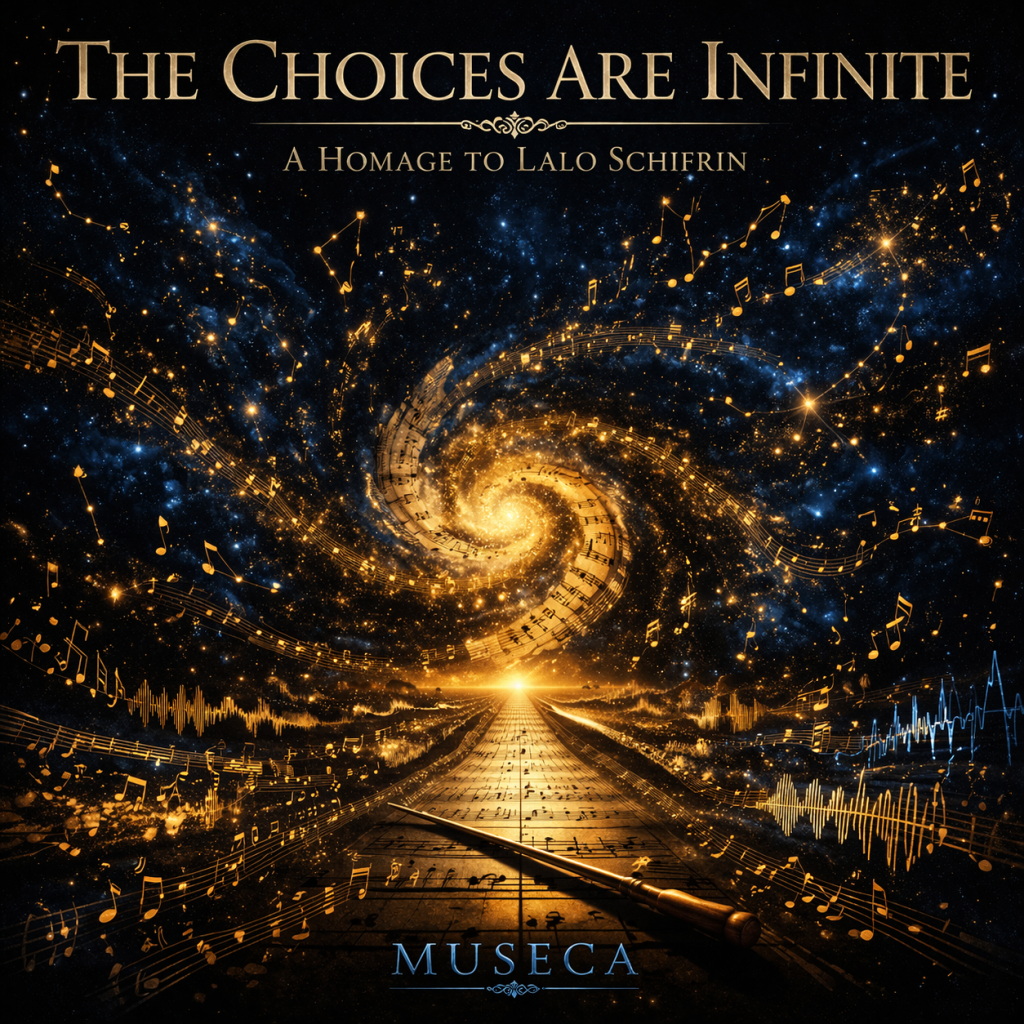
That vast continent — acoustic, electronic, and everything between — is the territory this album sets out to explore. Not to exhaust it. Schifrin himself knew that was impossible. But to walk a few of its paths, guided by the compass he left behind.
The Album
A homage is not an imitation. Every track here is an original composition derived entirely from the principles, techniques, and philosophy Schifrin documented in his own words. The Fibonacci rhythmic drive of the opening. The tritone architecture of the noir piece. The milonga rhythm beneath jazz harmony in the tango. The horror lullaby built on his exact technique from Amityville Horror — sweetness and menace sharing the same musical space, simultaneously. The cimbalom love theme, the orchestral suite that ends not with a fade but with a hard cut to silence.
Liner Notes
The Fibonacci Pursuit (Action · Thriller)
Schifrin Technique — The Fibonacci Series Applied to Rhythm
Schifrin was among the first film composers to apply Leonardo Fibonacci’s mathematical sequence — 1, 2, 3, 5, 8, 13, 21 — directly to rhythmic accent patterns. Rather than placing accents at predictable intervals, he distributed them according to the series, so that each grouping of notes or rests follows the sum of the two that came before it. The result is rhythm that feels organically alive: never mechanical, never truly predictable, yet never chaotic. The ear senses an internal logic it cannot quite name.
This piece is built entirely on that logic. A locked 5/4 time signature — a direct nod to the Mission: Impossible DNA — provides the metronomic container, while the brass accents, trombone cluster chords, and snare cracks land according to the Fibonacci sequence layered above it. The ostinato bass line drives relentlessly forward beneath a trumpet motif constructed from the 9-note scale of limited transposition, a scale Schifrin describes as ideal for vigorous action scenes. The piece ends with a hard cutoff — no fade, no resolution — because, as Schifrin understood, the most powerful endings are the ones the audience doesn’t see coming.
“During an action scene, we may have a fast background with percussion and string instruments. In order to intensify the drama, we can add accents following the Fibonacci series.” — Lalo Schifrin
Diabolus (Film Noir · Suspense)
Schifrin Technique — The Tritone as Irresolvable Tension
In the Middle Ages, the tritone — the augmented fourth, the interval that splits the octave exactly in half — was condemned as diabolus in musica: the devil in music. Organists were reportedly sentenced to death for playing it in sacred settings. Schifrin devotes an entire chapter of his book to the tritone’s power, tracing its path from medieval prohibition through the whole-tone scales of early cinema into his own scoring practice. The tritone cannot resolve. It hovers. It threatens. It is the sound of something that has not yet happened but inevitably will.
This piece is anchored on that interval from its first note. A solo pizzicato double bass states a cold tritone motif alone, then an alto flute answers it — the exact two-voice texture Schifrin used in the Film Noir episode of his Fantasy for Screenplay and Orchestra. A vibraphone enters, and the strings begin a slow harmonic pyramid, adding one voice at a time from the bottom upward — a Schifrin orchestration technique he used throughout his career to build from nothing to full orchestral pressure. The piece reaches a dissonant tutti, then collapses back. The detective wins the battle. The war continues.
“The tritone was called diabolus in musica and was sometimes forbidden. Nevertheless, this interval in our day and age is very useful for establishing tension.” — Lalo Schifrin
Porteño (Jazz · Argentine Tango Fusion)
Schifrin Technique — Audio-Visual Counterpoint · Two Worlds in One Voice
Schifrin’s theory of audio-visual counterpoint describes two simultaneous voices — image and music — moving in either parallel or contrary motion. But the concept applies equally to the interior architecture of a single piece. Porteño is a composition in which two musical traditions — Argentine tango and American jazz — exist in genuine counterpoint with each other: neither subordinate, neither dominant, each making the other more meaningful by the friction of their coexistence.
The milonga rhythmic pattern forms the foundation, strummed acoustically in the manner Schifrin describes when writing about his Bolivian and Argentine scores — guitar and tiple imitating the charango. Above it, jazz piano voicings drawn from bebop harmony (the language of his years with Dizzy Gillespie) carry the melody. A bandonéon-like accordion provides the tango’s emotional centre. The bridge opens into a jazz improvisation section, free from the tango rhythm, before the milonga reasserts itself for the final statement. This is the sound of Schifrin’s own biography set to music: Buenos Aires and New York sharing the same bar line.
“I led a double life: during the day, at the conservatory, and in the evenings, playing jazz. I never lost my passion for cinema.” — Lalo Schifrin
Scorpio’s Lullaby (Horror · Supernatural)
Schifrin Technique — Contrary Motion · Sweetness Against Menace
Of all the techniques Schifrin documents in his book, perhaps none is more immediately unsettling than his use of contrary motion in the horror genre — specifically, the placement of something innocent and sweet in direct, simultaneous opposition to something dark and threatening. He did it for the Amityville Horror main title, writing a haunting lullaby for three children’s voices accompanied by harp and muted strings, while low brass drones and water phone textures (a bow drawn across metal rods submerged in water) created a suffocating counter-atmosphere beneath. He did it again for Dirty Harry, where a lone female voice humming a simple motif over tune glasses gave the villain Scorpio an identity more chilling than any horror score could achieve through conventional means.
This piece inherits both. A solo female voice hums a three-note lullaby over harp. The texture is almost domestic in its simplicity. Then, slowly and without announcement, the low brass enters beneath — muted French horns holding long tones that push against the tonality of the lullaby without ever disrupting its melody. The strings divide and form minor-second clusters. By the piece’s centre, the voice is singing the same simple three notes it opened with. Everything around it has become unbearable. The lullaby ends alone. Three notes. Silence.
“The contrast between the sweetness of the voices and the ominous textures by the orchestra became very chilling. Water phones were added to bring out the fearful emotion.” — Lalo Schifrin
Cimbalom Road (Romance · Ethnic Journey)
Schifrin Technique — Ethnic Scale Systems · Love Theme as World Music
Schifrin writes that a love scene will often travel through multiple emotional states — attraction, tentative approach, doubt, conflict, and finally passion — and that the composer’s job is to write a theme flexible enough to make that journey without losing its identity. He also writes extensively about the power of ethnic instrumentation to locate a love story in a specific world: the cimbalom, a Central European hammered dulcimer he used in The Eagle Has Landed, carries within its timbre an entire geography of longing — Eastern European folk music, Romani melody, the sound of something both ancient and immediate.
This piece opens with solo cimbalom stating a lyrical love theme, accompanied only by the gentlest string cushion. The strings gradually expand. Then the bridge shifts into the North African and Middle Eastern scale Schifrin documents — its characteristic augmented second interval lending the melody a new colour, a sense of distance traveled. A solo oboe carries the theme through this landscape over a quiet tabla rhythm. The cimbalom returns for the final chorus with the theme harmonically transformed by everything it has passed through. It is the same melody. It is not the same melody.
“A love scene may go through different moods. The theme can be manipulated and the harmonies and counter lines can help to create the right emotions coming from the screen.” — Lalo Schifrin
Fantasy (Coda) (Orchestral Suite)
Schifrin Technique — Fantasy for Screenplay · Silence as Final Statement
In 2002, the Chicago Symphony Orchestra commissioned Schifrin to write a work that functioned like film music — but without a film. The result, Fantasy for Screenplay and Orchestra, became the most complete single expression of his entire compositional philosophy: a work that moves through the emotional landscape of cinema — main title, film noir, comedy, love scene, action fugato, climax — without any image to follow, proving that the techniques of film music, when liberated from the screen, constitute a genuine and self-sufficient musical language.
This piece follows that same arc. A six-note trumpet motif announces the main title. A cold jazz episode in the manner of his film noir writing follows — pizzicato bass, alto flute, vibraphone. A waltz interlude lightens the air before a lyrical love theme swells through the full strings. Then the fugato: brass voices entering in strict imitation, rhythm tightening, the harmonic pressure building until every theme that has appeared in this album returns simultaneously in a final fortissimo statement. And then — as Schifrin prescribes for the great tragic endings, for films about atrocity and the depths of human darkness — not a fade. A hard cut. Silence. The audience is left to sit in what they have just heard. That silence is the last note. It is also the most important one.
“Complete silence could be the best ending for a film. No background music is necessary, and the audience is left to meditate in silence. Silence is also music.” — Lalo Schifrin
Playlist
- Track 1 - The Fibonacci Pursuit Museca 2:26
- Track 2 - Diabolus Museca 3:50
- Track 3 - Porteño Museca 3:08
- Track 4 - Scorpio's Lullaby Museca 3:34
- Track 5 - Cimbalom Road Museca 5:35
- Track 6 - Fantasy (Coda) Museca 2:48