
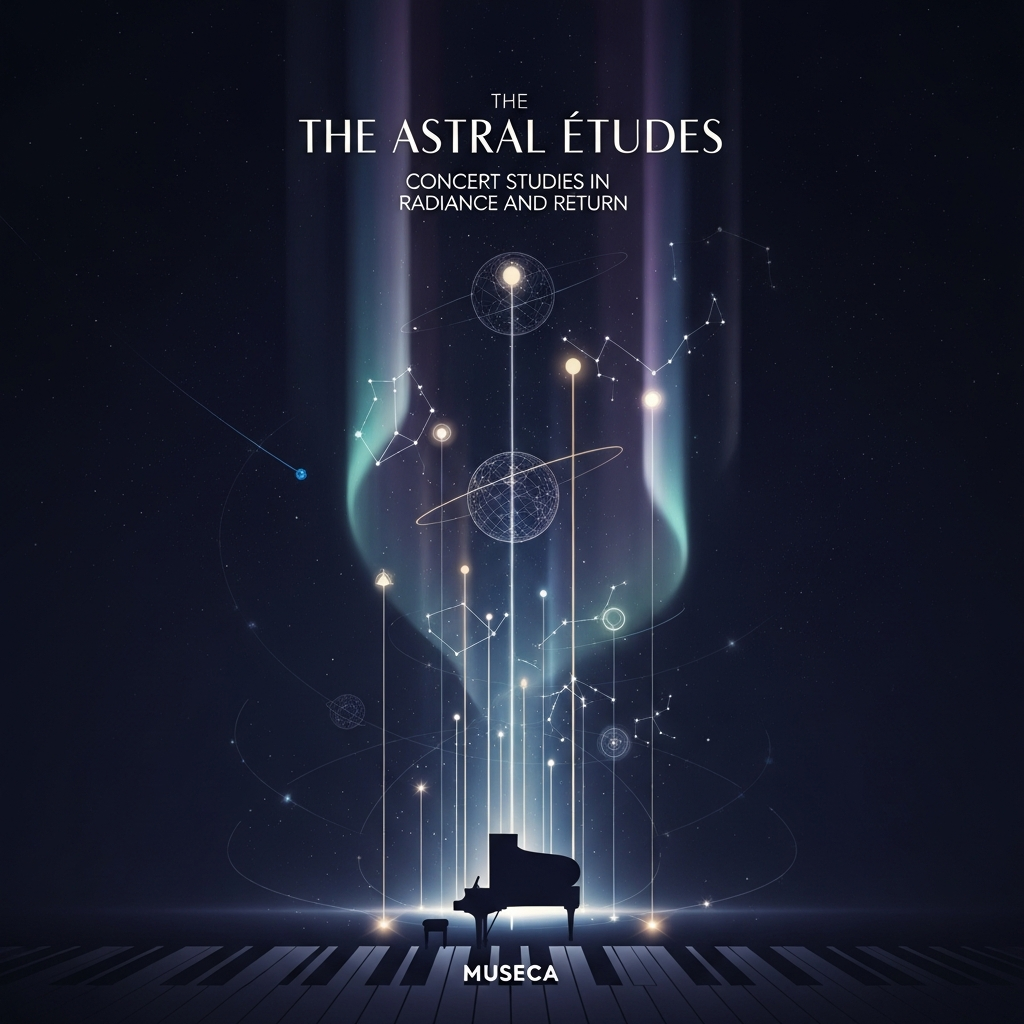
The Astral Études: Concert Studies in Radiance and Return is a cycle of sixteen piano études conceived less as technical showpieces than as guided crossings—miniature rituals in which technique becomes a vehicle for inner perception. Each piece focuses on a specific pianistic discipline—singing tone, voicing, resonance control, pedaling, endurance, independence—yet the goal is never athletic display. Instead, these studies treat the piano as a luminous instrument of atmosphere: a place where touch becomes breath, harmony becomes color, and repetition becomes prayer.
The album is structured as an arc through distinct spiritual terrains. The opening Lyrical Études establish “first light,” a language of clarity and intention; the Pastoral Études ground that light in earth and openness. The Dreamlike Motifs loosen time, inviting the listener into symbol and floating memory. At the center, two Beethovenian meditations—Ode to Joy Étude and Storm and Solace—stand as pillars of human resolve, where radiance is earned rather than assumed. The journey then turns inward through nocturne realms, culminating in a three-part C♯ minor triptych that explores shadow not as despair, but as depth. The polyrhythm étude reframes time itself as a braided continuum, and the final Lyrical Étude returns home—quietly transfigured—closing the cycle with a radiance made gentle by having passed through night.
Liner Notes
Lyrical Étude No. 1 (First Light)
A gentle opening invocation: a singing line that feels newly discovered, as if the piano is learning to speak in light. The texture stays transparent and sincere, prioritizing breath, phrasing, and tone—less “display,” more emergence. It sets the album’s spiritual premise: technique in service of revelation.
Lyrical Étude No. 2 (Silver Breath)
Here the lyricism deepens into a steadier pulse, like calm walking meditation. The right hand floats with quiet authority while the harmony subtly shifts beneath, creating a soft chiaroscuro of warmth and coolness. It is an étude of control—how to sustain a line that remains luminous without ever becoming loud.
Pastoral Theme Étude No. 1 (Green Prayer)
A pastoral scene rendered as devotion: open intervals, gentle rocking motion, and the feeling of air moving through leaves. The technique is disguised inside simplicity—balance, voicing, and the discipline of restraint. This is “nature” not as postcard, but as sanctuary.
Pastoral Theme Étude No. 2 (Meadow Halo)
Brighter and more expansive, this pastoral study leans into flowing figurations that ripple like wind over tall grass. The harmonic language remains grounded, but the resonance grows wider, turning the landscape into something slightly mythic. It is an étude in buoyancy: keeping motion light while letting the piano glow.
Dreamlike Motif No. 1 (Veil of Stars)
A motif appears and recedes like a half-remembered message, framed by soft blurs of harmony. The rhythm feels suspended, inviting the listener into that liminal space where time loosens and meaning becomes symbolic. Technically, it focuses on featherweight touch and graded dynamics—dream logic made playable.
Dreamlike Motif No. 2 (Moonlace)
More intimate and strange, this second dream study drifts through delicate tonal ambiguities, as if the melody is illuminated from behind. The motif is threaded through shifting colors, encouraging a sense of listening inward rather than forward. It is an étude in “quiet precision,” where small inflections carry the emotional weight.
Lyrical Étude No. 3 (Rising Ember)
The lyric line now carries heat: broader arcs, firmer pulse, and harmonies that lean toward longing. It feels like resolve taking shape—still tender, but increasingly deliberate. The technical focus is on projecting melody through richer textures without losing the singing core.
Ode to Joy Étude (Radiant Hymn)
A clear beam of affirmation enters the cycle, not as quotation for spectacle but as spiritual architecture—joy as a disciplined craft. The writing celebrates resonance, chordal clarity, and the communal lift of familiar contour. It is an étude in radiance: keeping brilliance clean, centered, and unforced.
Storm and Solace: A Beethovenian Meditation (Thunder Benediction)
This is the album’s turning point—weather as philosophy. Turbulent gestures and stern harmonies evoke Beethoven’s moral gravity, yet the music repeatedly chooses steadiness over chaos, returning to grounded cadence like a prayer answered through endurance. It is an étude in emotional stamina: power controlled by conscience.
Nocturne Étude No. 1 (Lantern in Mist)
Night arrives softly, with a melody that glows at the edge of silence. The accompaniment cradles the line in vaporous motion, demanding refined pedaling and careful voicing so the harmonies shimmer rather than smear. This étude teaches the piano to become a lantern—warm, focused, and human.
Nocturne Étude No. 2 (Midnight Rose)
Darker and more fragrant, this nocturne leans into chromatic tenderness and a deeper register palette. The melody blooms slowly, as if opening under moonlight, while the inner voices carry private countermelodies that reward close listening. It is an étude in sensual nuance: weight, release, and the art of lingering.
Nocturne in C♯ Minor No. 1 (Obsidian Pool)
The C♯ minor triptych begins at its most inward—still water, deep color, and an almost confessional simplicity. The harmony holds tension like a vow, letting dissonance resolve only when it has fully spoken. This is an étude of gravity: how to make quiet feel inevitable.
Nocturne in C♯ Minor No. 2 (Blue Ashes)
Here the night is unsettled, with flickers of intensity and a sense of memory passing through the hands. The texture thickens, then thins, as if emotion cannot decide whether to surface or vanish. It is an étude in controlled volatility—keeping the flame contained while letting it burn.
Nocturne in C♯ Minor No. 3 (The Hidden Star)
The final C♯ minor nocturne lifts the gaze: the same darkness, but with a faint beacon embedded inside the harmony. Long lines and spacious chords create a feeling of distance—lonely, yet guided. It is an étude in transcendence from within shadow: sustaining hope without breaking the nocturnal spell.
Étude in Polyrhythm (3:4) (Time Weaving)
A deliberate re-entry of intellect and pattern: two temporal streams braided into a single living fabric. Rather than feeling mathematical, the polyrhythm becomes ceremonial—like a ritual drum against a steady heartbeat. This étude trains independence and focus while suggesting a spiritual insight: time itself is layered.
Lyrical Étude No. 4 (Return to Radiance)
The cycle closes by returning to song, now transformed—wider in breath, calmer in certainty, and gently illuminated by everything that came before. The harmony feels earned, as if the piano has traveled through night and brought back a quieter kind of light. It is an étude of homecoming: virtuosity as tenderness, radiance as peace.
Playlist
- Lyrical Etude No. 1 (First Light) Museca 3:10
- Lyrical Etude No. 2 (Silver Breath) Museca 3:33
- Pastoral Theme Etude No. 1 (Green Prayer) Museca 3:00
- Pastoral Theme Etude No. 2 (Meadow Halo) Museca 4:05
- Dreamlike Motif No. 1 (Veil of Stars) Museca 3:00
- Dreamlike Motif No. 2 (Moonlace) Museca 2:50
- Lyrical Etude No. 3 (Rising Ember) Museca 2:10
- Ode to Joy Etude (Radiant Hymn) Museca 3:29
- Storm and Solace: A Beethovenian Meditation (Thunder Benediction) Museca 5:44
- Nocturne Etude No. 1 (Lantern in Mist) Museca 3:02
- Nocturne Etude No. 2 (Midnight Rose) Museca 4:14
- Nocturne in C♯ Minor No. 1 (Obsidian Pool) Museca 3:24
- Nocturne in C♯ Minor No. 2 (Blue Ashes) Museca 2:53
- Nocturne in C♯ Minor No. 3 (The Hidden Star) Museca 4:00
- Étude in Polyrhythm (3:4) (Time Weaving) Museca 2:25
- Lyrical Etude No. 4 (Return to Radiance) Museca 3:00