
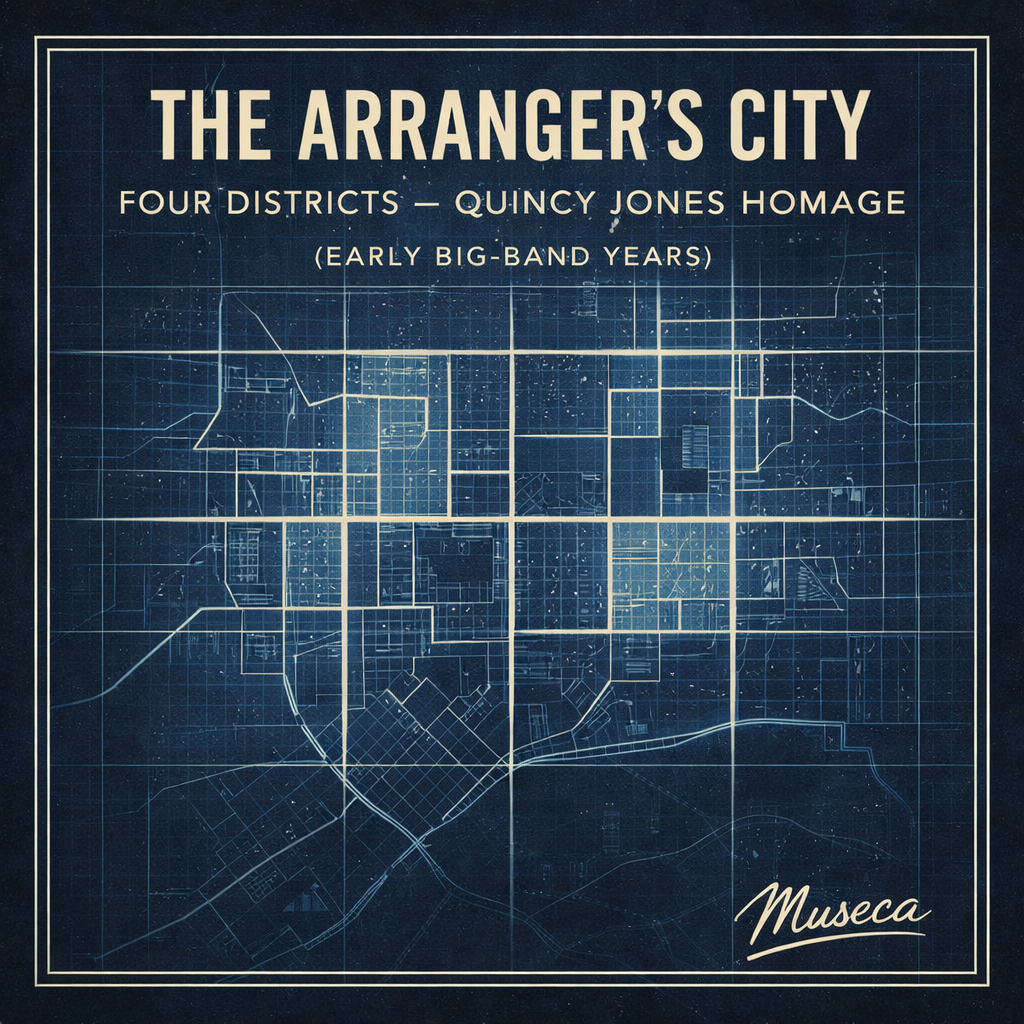
This homage album returns intentionally to Quincy Jones’s earliest and most formative arena: the jazz bandstand, where his reputation was forged as an arranger with uncommon clarity, velocity, and control. Before the world came to know him as a producer, executive, and cultural force, Quincy was already practicing a rarer craft—the ability to make a large ensemble move as a single mind while still sounding alive, conversational, and human. The Arranger’s City — Four Districts — Quincy Jones Homage (Early Big-Band Years) is written in that spirit. It is not a recreation of specific recordings, nor a collage of borrowed licks; it is four original charts built from the same compositional spine, each chart revealing a different face of big-band writing: the brilliance of swing architecture, the intelligence of inner-line counterpoint, the discipline of clave-driven ensemble rhythm, and the emotional breadth of a ballad that can still lift into motion when the moment is right.
Technically, the album is designed the way an arranger thinks—through recurrence, transformation, and orchestral pacing. A single short motif functions as the city’s “address,” appearing in every track so the listener always feels oriented, even as the style shifts. In one district the motif is stated plainly as a headline melody, the way a classic opener announces itself with confidence. In another it slips into the ensemble’s interior, living in tenor and baritone motion while the lead voices carry a more angular surface line; the music swings not because it is loud or busy, but because the inner mechanics are moving with inevitability. In the Latin district, the same notes are re-timed and re-weighted so the motif becomes rhythm first, aligned to clave rather than swing; the horns stop behaving like a long-lined orchestra and start speaking in architected stabs, with the rhythm section acting as an engine built from tumbao bass and montuno harmony. In the final district, the motif is stretched into longer breath and voiced for warmth—close sax harmony, muted brass pads, and a deliberate widening of space—before returning in double-time as a last statement of ensemble unity.
The harmonic language stays loyal to big-band tradition while remaining contemporary in color. The center of gravity is functional motion—ii–V logic, secondary dominants, and voice-leading that makes the band feel like it is always going somewhere—yet the sonorities are chosen for elegance rather than nostalgia. Major centers favor 6/9 warmth, minor centers lean into m6/9 intimacy, and structural arrivals often open into maj9(#11) for a restrained Lydian lift that reads as “light” without turning theatrical. Tensions are handled the way professional charts handle them: altered dominants appear to create propulsion, suspensions delay resolution with just enough friction, and occasional passing diminished chords stitch the fabric between larger harmonic pillars.
Orchestration is treated as narrative, not decoration. Reeds and brass are written as characters with distinct roles: saxes provide close-knit discourse and solis that can be velvet or razor depending on spacing; trumpets carry brilliance and punctuation, sometimes muted for intimacy, sometimes open for the skyline; trombones supply weight and harmonic truth, anchoring the ensemble while shaping the direction of the phrase. Across the album, a recurring timbral signature—an alto voice paired with muted trumpet—appears like a familiar streetlight, briefly illuminating the motif so the listener recognizes the city even when the scenery changes. And because this is an homage to the arranger’s art, the pacing is built like scoring: clear exposition, development through solos and written ensemble evolution, then a controlled escalation—shout chorus, mambo, or double-time lift—that arrives with precision rather than force. The result is a tight four-track statement: concise, intentional, and rooted in the early big-band discipline that made Quincy Jones Quincy Jones.
Liner Notes
Uptown Blueprint opens the city at full daylight—fast swing, clean pavement, and a skyline built from brass hits that land with inevitability. The central motif appears like a street sign you recognize instantly, then reappears in different guises: in tight sax blocks, in sly muted trumpet color, and finally in a shout chorus that feels less like volume and more like engineering. This is big-band craft as architecture—precise entrances, sharp releases, and motion that never loses its gait.
Neon Counterlines shifts the same city into evening: the harmony deepens, the edges sharpen, and the writing becomes about what happens between the obvious lines. The motif is no longer a headline; it becomes an inner current—threaded through tenor and baritone voices, answered by upper-structure brass colors, and stitched together by counterpoint that swings without showing off. The district’s light is not brightness but detail: close voicings, moving interiors, and ensemble logic that rewards repeat listening.
Harbor Rumba moves the city to the water, where rhythm becomes law. Here the motif is rebuilt as percussion—clave-aligned horn stabs, montuno machinery in the piano, and a tumbao bass line that turns harmony into momentum. The band stops behaving like a swing orchestra and starts behaving like a disciplined street ensemble: brass and reeds speaking in short, powerful phrases, then opening into a mambo section where the whole waterfront seems to surge forward at once. It is not “Latin flavor,” but a structural change in language.
Dawn Over the Bandstand closes the suite with a slower sky and a wider frame. The motif returns as something lyrical—stretched into longer breath, softened by close sax harmony and muted brass pads, as if the city is listening to itself before it wakes. Then, without breaking the narrative, the final district lifts into double-time swing: the same material, newly illuminated, now carried by forward motion and a last, elegant ensemble statement. The ending lands on a single decisive hit—clean, intentional, and complete—like a final look back at a skyline you’ve learned by heart.
Playlist
- Uptown Blueprint Museca 3:48
- Neon Counterlines Museca 3:05
- Harbor Rumba Museca 2:33
- Dawn Over the Bandstand Museca 3:05