
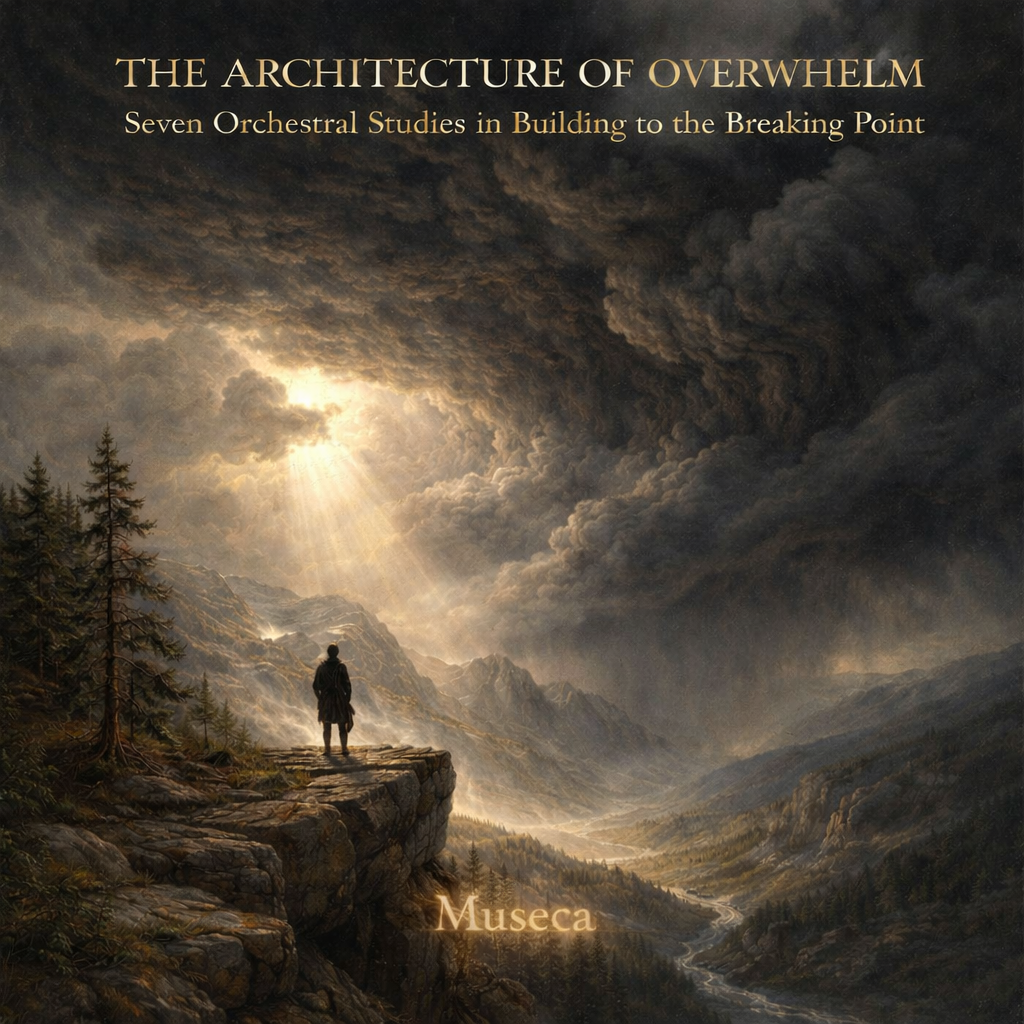
THE ARCHITECTURE OF OVERWHELM
Seven Orchestral Studies in Building to the Breaking Point
INTRODUCTION
On the Techniques of Emotional Overwhelm
There is a moment in music when technique becomes transcendence—when the careful accumulation of compositional craft suddenly ignites into something that bypasses the intellect entirely and strikes directly at the heart. I call these moments climaxes, but that clinical term hardly captures what actually happens: the catch in the throat, the involuntary tears, the sensation that the music has become too beautiful or too powerful to bear. The listener is not merely moved but overwhelmed.
No composer in the Western tradition understood the architecture of these moments better than Pyotr Ilyich Tchaikovsky. His symphonies, ballets, and orchestral works contain some of the most devastating emotional climaxes ever written—moments that have reduced audiences to tears for over a century. Yet these moments are not accidents of inspiration. They are carefully constructed, built from specific techniques that Tchaikovsky refined throughout his career. The overwhelming emotion is real, but it is engineered.
This album is an educational exploration of seven specific techniques Tchaikovsky and his Romantic contemporaries employed to build toward emotional breaking points. Each track isolates and demonstrates a single technique, allowing the listener to experience—and understand—how these moments of overwhelm are constructed. Myr goal is not to diminish the magic by revealing the mechanics, but rather to deepen appreciation for the extraordinary craft that underlies these transcendent experiences.
The Seven Techniques
Technique A.1: Chromatic Linear Motion. The movement of a melodic or bass line in half-steps rather than through traditional scale patterns creates a sense of inexorable gravitational pull. Each half-step feels like a “squeeze” toward the next, creating momentum that compounds with every measure. When Tchaikovsky employed chromatic descent in the bass, he created the sensation of being dragged toward an inescapable emotional destination—most famously in the coda of his Romeo and Juliet Fantasy Overture, where the love theme is chromatically pulled down into devastation.
Technique A.2: Harmonic Non-Closure. The deliberate avoidance or delay of expected harmonic resolution creates a state of suspended anticipation—a musical embodiment of longing that keeps reaching but never grasping. Each deceptive cadence compounds the ache; each evaded resolution intensifies the desire for arrival. When resolution finally comes (or pointedly fails to come), the accumulated tension releases with devastating effect.
Technique A.3: Motivic Diminution and Fragmentation. Presenting a musical idea in progressively shorter note values creates the sensation of acceleration even when the tempo remains constant. Quarter notes become eighths, eighths become sixteenths, and the listener perceives the music speeding toward crisis. Coupled with fragmentation—breaking the motif into smaller and smaller pieces—this technique creates an almost unbearable sense of compression and urgency as the music hurtles toward its climax.
Technique A.4: Pedal Point Anchoring. A sustained or repeated note in the bass that persists while harmonies churn above creates the musical equivalent of gravitational pull. No matter how far the upper voices wander, they remain tethered to that immovable foundation, and the listener feels the inevitable pull toward resolution. When Tchaikovsky placed a dominant pedal beneath increasingly intense harmonic activity, he created unbearable tension that demanded release.
Technique A.5: The Breath Before the Plunge. Just before the climactic moment, the music pulls back briefly—a sudden drop in dynamics, a moment of rhythmic stillness, a brief harmonic hesitation. This “breath” creates contrast that makes the subsequent arrival feel even more overwhelming. It is the silence before the thunder, the held breath before the plunge, the moment of terrible stillness that makes the release feel inevitable and shattering.
Technique A.6: Over-Delivery. Extending the climax beyond its “expected” endpoint creates overwhelm through generosity rather than restraint. When the listener expects the music to begin receding after the peak, it instead pushes further—another statement, another fortissimo chord, another orchestral layer. The effect is of emotion too vast to be contained, of a heart that keeps finding more to give when it seemed already to have given everything.
Technique A.7: Orchestral Layering (Staged Entries). The gradual addition of instrumental forces—building from a solo or small ensemble to full orchestra—creates a cumulative sense of growing power. Each new entry adds weight, color, and intensity. The overwhelming effect comes from forces gathering, joining, building toward a unified climax where all voices finally speak together in a wall of sound that seems to contain the entire emotional universe.
The Arc of Overwhelm
Throughout this album, each study follows a carefully considered emotional arc: soft opening, gradual emotional build, beautiful passionate climax, soft tapering coda, and powerful final punctuation. This structure—rather than sustained intensity from start to finish—reflects a crucial insight about how emotional overwhelm actually functions. True devastation comes not from relentless force but from contrast. The powerful final chord shatters precisely because it follows silence; the climax moves us because we remember the tender opening.
I have drawn on the full palette of Romantic orchestration—the warm nobility of French horn, the plaintive voice of English horn, the primordial depths of contrabassoon, the brilliant declaration of trumpet, the infinite gradations of string color. Each study features specific instrumental choices designed to demonstrate its technique with maximum clarity and emotional impact.
The album progresses through a deliberate emotional journey. I begin with descent into darkness (chromatic motion), move through longing (harmonic non-closure), pursuit (motivic diminution), patient hope (pedal point), natural power (the breath before the storm), overflowing love (over-delivery), and finally arrive at cosmic creation (orchestral layering). By the final track, I have traveled from the depths to the heights, from tragedy to transcendence, demonstrating along the way the full range of techniques available to composers who wish to build toward the breaking point.
These techniques are not mere historical curiosities. They remain as effective today as they were in Tchaikovsky’s time, because they are grounded in fundamental aspects of human perception and emotion. Understanding them does not diminish their power—if anything, it deepens our appreciation for the extraordinary craft that goes into creating those moments when music becomes overwhelming. The architecture is visible, but the experience remains transcendent.
Welcome to the architecture of overwhelm.
Liner Notes
STUDY NO. 1: CHROMATIC DESCENT
Demonstrating Technique A.1: Chromatic Linear Motion
Chromatic linear motion—the movement of a melodic or bass line in half-steps—creates a sense of inexorable gravitational pull. Each half-step feels like a “squeeze” toward the next, creating momentum that compounds with every measure.
For this opening study, I chose to demonstrate chromatic descent through a programmatic journey into darkness—dramatic, turbulent, and intensely passionate. I drew inspiration from the coda of Tchaikovsky’s Romeo and Juliet Fantasy Overture, where the love theme is chromatically pulled down into devastation.
The orchestration is string-dominated, with cellos and double basses carrying the chromatic descent while upper strings provide emotional commentary. Brief solo oboe passages emerge—plaintive moments where a single voice cries out against the inevitable. The piece begins pp in hushed darkness, builds toward a passionate climax, then recedes into a reflective coda before a single powerful final chord punctuates the silence.
Harmonically, I employed Phrygian and harmonic minor inflections to create romantic tragedy—beautiful in its darkness. Through-composed structure was essential: one continuous dramatic arc, each half-step making the next more inevitable, until the music simply cannot descend any further.
Duration: 3–4 minutes | Instrumentation: Full Orchestra with Solo Oboe
Reference: Tchaikovsky, Romeo and Juliet Fantasy Overture (coda)
STUDY NO. 2: HARMONIC NON-CLOSURE
Demonstrating Technique A.2: Harmonic Non-Closure
Harmonic non-closure—the deliberate avoidance of expected resolution—creates a musical embodiment of longing that keeps reaching but never grasping. Each deceptive cadence compounds the ache; each evaded resolution intensifies the desire for arrival.
I chose to demonstrate this technique through unrequited longing—a lover reaching toward someone forever out of reach. The emotional temperature is melancholy and resigned, inhabiting a space of quiet, private grief.
The featured solo is English horn, chosen for its veiled, dusky quality that speaks from deep sorrow. Muted strings and harp support it—the harp’s arpeggios embodying the “reaching” gesture, cascading upward then falling back when the cadence deceives. The tempo is Adagio, slow enough to allow each unresolved cadence to hang in the air. The dynamic arc remains intimate throughout: pp to mp and back to pp.
The ending employs a plagal “Amen” cadence (IV–I)—resolution that feels like acceptance rather than achievement, bringing peace without fulfillment. The longing remains unrequited, but the heart has found rest.
Duration: 3–4 minutes | Instrumentation: Solo English Horn, Muted Strings, Harp
Reference: Tchaikovsky, Symphony No. 5, Movement II
STUDY NO. 3: MOTIVIC DIMINUTION
Demonstrating Technique A.3: Motivic Dimintion and Fragmentation
Motivic diminution—presenting a musical idea in progressively shorter note values—creates the sensation of acceleration even when the tempo remains constant. Coupled with fragmentation, this technique creates almost unbearable compression and urgency.
I chose to demonstrate this through a dark, menacing chase where the predator inexorably closes in. As the motif fragments and accelerates, the hunter draws nearer; by the time we reach obsessive repeated notes, the quarry is cornered. I drew inspiration from Mussorgsky’s Night on Bald Mountain.
The hunting motif is introduced by low brass—trombones and tuba—embodying the predator: patient, relentless, unstoppable. The orchestration builds in layers with each diminution stage; as the motif gets smaller and faster, the orchestra gets bigger. The tempo follows a Moderato-to-Allegro trajectory in galloping 6/8. Phrygian and Locrian modes create an exotic, primal menace.
After the climax, a quiet coda gives way to the hunting motif’s return—now slow, deliberate, and victorious. The predator stands over its prey.
Duration: 4–5 minutes | Instrumentation: Full Orchestra with Featured Low Brass
Reference: Mussorgsky/Ravel, Night on Bald Mountain
STUDY NO. 4: DOMINANT PEDAL
Demonstrating Technique A.4: Pedal Point Anchoring
A pedal point—a sustained bass note persisting while harmonies change above—creates the musical equivalent of gravitational pull. No matter how far the upper voices wander, they remain tethered to that immovable foundation.
I chose to demonstrate this through the image of a vigil—waiting through the night for dawn. The pedal point becomes the unchanging darkness; the harmonies represent the hopes of one who waits; resolution is dawn breaking at last. I drew inspiration from Puccini’s Madama Butterfly “Humming Chorus” and Barber’s Adagio for Strings.
The featured solo is violin, its singing quality embodying the voice of the one who waits. Warm strings and soft brass chorales support it, with harp arpeggios entering as dawn approaches. The tempo is Adagio; the structure is a gradual crescendo of hope, each phrase adding more light until dawn breaks.
The ending employs a plagal “Amen” cadence—but unlike Study No. 2’s resignation, here it is benediction: sacred affirmation that hope was rewarded.
Duration: 3–4 minutes | Instrumentation: Solo Violin, Strings, Brass Chorales, Harp, Timpani
References: Puccini, Madama Butterfly / Barber, Adagio for Strings
STUDY NO. 5: THE BREATH BEFORE THE PLUNGE
Demonstrating Technique A.5: The Breath Before the Plunge
Just before the climactic moment, Tchaikovsky often pulls back briefly—a sudden drop in dynamics, a moment of stillness. This “breath” creates contrast that makes the subsequent arrival feel even more overwhelming. It is the silence before the thunder.
I chose to demonstrate this through a gathering storm—that eerie moment when birds go silent, the air becomes electric, and everything holds its breath before the sky opens. The emotional character is majestic and terrifying—the Romantic sublime.
The featured solo is trumpet, heraldic and commanding, announcing the storm like a voice from heaven. The orchestral texture is built on antiphony between strings (swirling wind) and brass (thunder). Timpani rolls, string tremolo, and rushing scales create a fully immersive storm soundscape. The structure is a wave form—multiple builds and retreats, each larger than the last.
The “breath” moment is realized as a hushed string tremolo—ppp, barely audible—before the fff explosion. The silence makes the thunder terrifying.
Duration: 3–4 minutes | Instrumentation: Full Orchestra with Featured Trumpet
Reference: Beethoven, Symphony No. 6 “Pastoral,” Movement IV
STUDY NO. 6: EXTENDED CLIMAX
Demonstrating Technique A.6: Over-Delivery
Over-delivery—extending the climax beyond its expected endpoint—creates overwhelm through generosity rather than restraint. When the listener expects the music to recede, it instead pushes further: another statement, another fortissimo chord. The effect is of emotion too vast to be contained.
I chose to demonstrate this through love overflowing—each time the music seems to have declared fully, it finds more to say, rising higher, refusing to stop. The emotional arc moves from tender to ecstatic.
The featured solo is French horn, chosen for its ability to embody both tender intimacy and soaring grandeur. Warm strings cradle each statement, swelling beneath the solo voice. The tempo is Andante cantabile; the structure is through-composed overflow, each phrase exceeding the last. The dynamic arc moves through multiple stages: p → f → ff → fff.
The ending embodies over-delivery in purest form: the orchestra reaches what seems like the final chord, but the horn continues to climb, soaring even higher, refusing to end. Love that cannot be contained even by conclusion.
Duration: 3–4 minutes | Instrumentation: Solo French Horn, Warm Strings
Reference: Tchaikovsky, Symphony No. 5, Movement II
STUDY NO. 7: ORCHESTRAL LAYERING (GENESIS)
Demonstrating Technique A.7: Orchestral Layering (Staged Entries)
Orchestral layering—the gradual addition of instrumental forces from solo to full orchestra—creates a cumulative sense of growing power. Each new entry adds weight, color, and intensity until all voices speak together in a wall of sound.
For this final study, I chose to demonstrate orchestral layering through creation itself—Genesis, a universe emerging from void. Each instrumental entry becomes an act of creation. The emotional character begins primordial and mysterious, giving way to majesty by the triumphant conclusion.
The first voice from the void is bass clarinet or contrabassoon—creation beginning in the abyss. The layering proceeds register by register, low to high, creating the sense of creation rising from depths toward celestial heights. Timpani rolls provide the “heartbeat” of existence; at the final climax, a tam-tam stroke announces completion.
The tempo follows an Adagio-to-Moderato trajectory; the structure is continuous accumulation—one unbroken arc from solo voice to full orchestra. Modal coloring (Dorian/Mixolydian) gives creation a timeless, mythic quality. The triumphant V–I cadence announces with cosmic certainty that the universe is complete.
This study brings the album full circle: I began with descent into darkness; I end with the emergence of a universe.
Duration: 3–4 minutes | Instrumentation: Full Orchestra, Solo Bass Clarinet/Contrabassoon, Timpani, Tam-tam. Reference: Mahler, Symphony No. 2 “Resurrection,” Finale
Playlist
- STUDY NO. 1: CHROMATIC DESCENT Museca 4:12
- STUDY NO. 2: HARMONIC NON-CLOSURE Museca 3:47
- STUDY NO. 3: MOTIVIC DIMINUTION Museca 3:20
- STUDY NO. 4: DOMINANT PEDAL Museca 3:35
- STUDY NO. 5: THE BREATH BEFORE THE PLUNGE Museca 3:18
- STUDY NO. 6: EXTENDED CLIMAX Museca 4:48
- STUDY NO. 7: ORCHESTRAL LAYERING (GENESIS) Museca 4:01