
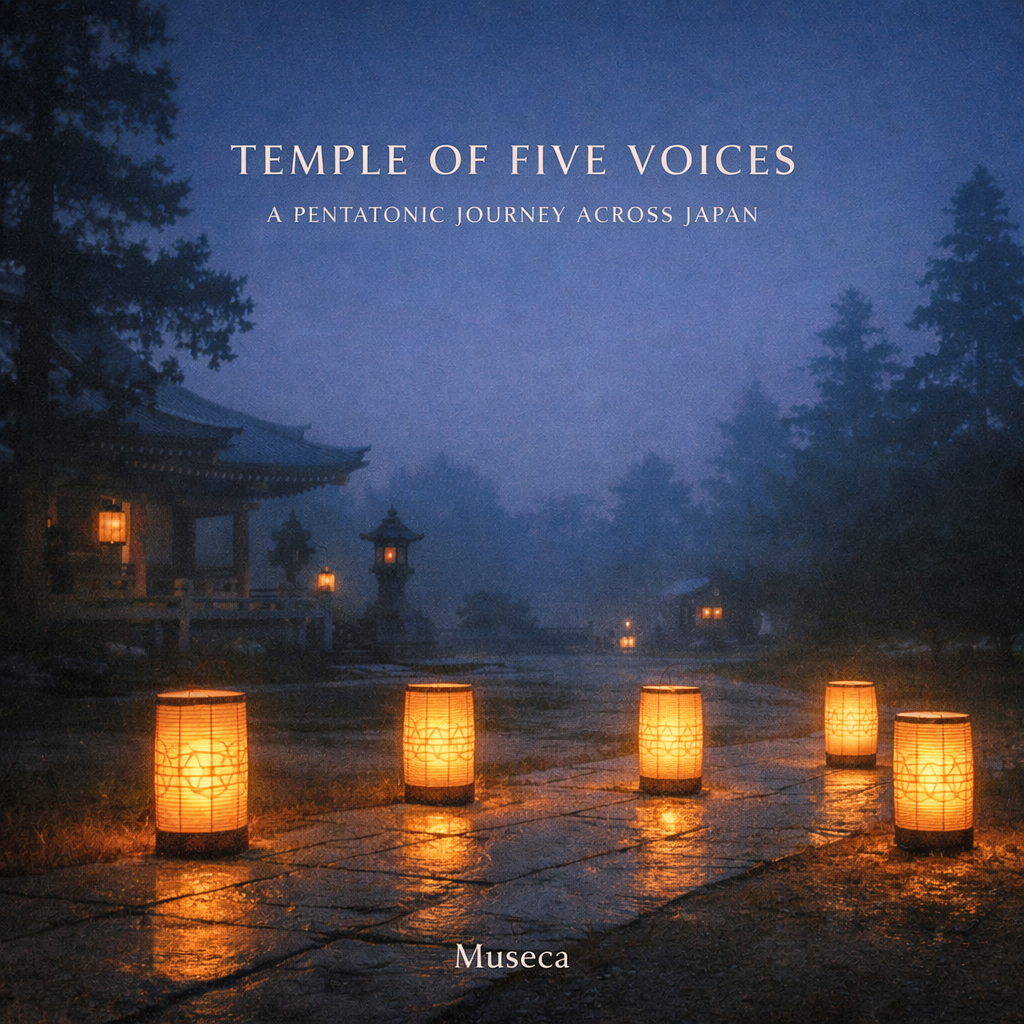
Temple of Five Voices
A Pentatonic Journey Across Japan
This album is a walk through five core Japanese pentatonic colors—and a few bordering modes—reimagined for contemporary ears. Each piece begins with a historical/folk timbre (koto, shakuhachi, temple bells, taiko), then opens into modern idioms: city-pop shimmer, lo-fi jazz, ambient choral haze, and cinematic strings. The intent is not pastiche but dialogue: to let each scale speak in its own breath and let modern texture listen.
The title points to the heart of this music: five-note systems whose intervals carry precise emotional temperatures. Because these scales are sparse, every degree matters; a single semitone can turn a melody from lantern-warm to moon-cold. Where possible, I keep drones and open fifths under the line—closer to how these sounds live on instruments like koto and shakuhachi—then invite harmony to bloom carefully around them.
Below is a concise, composer-ready guide to the scales featured on the album. Formulas are given relative to the tonic (“1”). Where helpful, I note practical cadences, voicings, and production ideas.
The core five (pentatonics):
1) Yo — anhemitonic, bright
Degrees: 1–2–4–5–6 (no semitones)
Color: Open, luminous; ideal for hopeful or nostalgic moods.
Cadences & cells: 6–5–4–2–1; call/response 1–2–1 and 4–5–4.
Voicing ideas: Open fifths (1–5), add 2 or 6 for soft color; sus chords over a bass drone on 1 or 5.
On the album: “Yo — Lanterns at Dusk” (city-pop / chill groove).
2) In-sen (concert “In”) — hemitonic, introspective
Degrees: 1–♭2–4–5–♭7
Color: Ethereal, quietly dramatic; the semitone (1–♭2) is the signature sigh.
Cadences & cells: [1–♭2–1], [4–5–4], and a gentle settle ♭7→1.
Voicing ideas: Quartal stacks (1–4–♭7), open fifths with the ♭2 as an upper neighbor in melody; avoid major/minor thirds to preserve ambiguity.
On the album: “In-sen — Bell and Mist.”
3) Hirajōshi — koto classic, tender-melancholic
Degrees: 1–2–♭3–5–♭6
Color: Minor-leaning without ♭7; plaintive but clear.
Cadences & cells: 2–♭3–2 and 5–♭6–5; endings on 1 or 5 feel natural.
Voicing ideas: Pedal 1 with melodic motion 2↔♭3; string-friendly double-stops (1–♭6, 2–5).
On the album: “Hirajōshi — Paper Boats” (with Café del Mar and chamber variants).
4) Kumoi (Kumoi-jōshi) — cool-minor without ♭7
Degrees: 1–2–♭3–5–6
Color: Clear, wistful; pairs beautifully with jazz inflection.
Cadences & cells: 6–5–1; 2–♭3–2; gentle 6→1 resolves.
Voicing ideas: Add6/sus colors over 1; brushed-kit lo-fi textures keep it intimate.
On the album: “Kumoi — Rain on Garden Stones.”
5) Iwato — austere Locrian-subset
Degrees: 1–♭2–4–♭5–♭7
Color: Suspended, cavernous; no third or sixth—pure tension and space.
Cadences & cells: 4–♭5–4, ♭7→1, and the knife-edge ♭2→1.
Voicing ideas: Quartal stacks (♭2–4–♭5), low tom/taiko ostinati on 1; temple bell on ♭5 for punctuation.
On the album: “Iwato — Gate of Silence” and the interlude “Iwato — Stone Corridor.”
(Related: “Lantern at the Stone Door — 岩戸の灯,”)
6) Miyako-bushi (“Sakura” color) — mournful, iconic
Degrees: 1–♭2–4–5–♭6
Color: Nostalgic/ceremonial; shares a pitch set with “hon-kumoi-jōshi” in equal temperament.
Cadences & cells: ♭6–5–4 and ♭2→1 for soft ache.
Voicing ideas: Strings con sordino; koto arpeggios under a sustained 1 or 5 drone.
On the album: “Miyako-bushi — Sakura After Snow.”
Close relatives and naming notes
Hon-kumoi-jōshi
Degrees (ET): 1–♭2–4–5–♭6
Functionally the same pitch set as Miyako-bushi in modern equal temperament; in traditional practice they’re treated differently by center and melodic behavior.
On the album: “Hon-kumoi-jōshi — Suspended Bridge.”
“Akebono” (usage umbrella)
The term “Akebono” is used variably; in modern practice it often points to either a Miyako-bushi set (1–♭2–4–5–♭6) or a Hirajōshi-like set (1–2–♭3–5–♭6). For this album I treat Akebono as an In-derived, dawn-hued color.
On the album: “Akebono — Pale Dawn.”
Japan-adjacent color
Ryūkyū / Okinawan pentatonic
Degrees: 1–3–4–5–7 (hexatonic variant adds 2 → 1–2–3–4–5–7)
Color: Sun-salt air; the 3–4 and 7–1 half-steps give its unmistakable lift.
Cadences & cells: 7→1 glow; 3–4–3 ornaments.
On the album: “Ryūkyū — Coral Wind.”
Expanded modal frames from gagaku (heptatonic ecosystems)
These are modal families rather than fixed pentatonics, but they sit naturally over pentatonic bones and inform orchestration and melodic contour.
Ryō class (brighter): commonly realized as
Ichikotsu-chō (D flavor), Sōjō (G), Taishiki-chō (E)
Ritsu class (darker): commonly realized as
Hyōjō (E), Ōshiki-chō (A), Banshiki-chō (B)
Think of each chō as a center with characteristic steps and auxiliary tones around a five-note core. Sustained drones, heterophony (simultaneous melodic variants), and gentle percussion (shō-like clusters, tam-tam) honor the lineage while remaining modern.
On the album: “Ryō (Ichikotsu-chō) — Court Procession,” “Ritsu (Hyōjō) — Moon Over Pavilion,” and “Ritsu (Banshiki-chō) — Final Offering.”
Temple of Five Voices — A Pentatonic Journey Across Japan
Liner Notes
1) Yo — Lanterns at Dusk
Yo scale (1–2–4–5–6). A welcome in warm colors: koto and electric guitar trace simple cells (1–2–1, 4–5–4) over a steady city-pop groove. Harmony stays open—no thirds—so brightness comes from 2 and 6 against a 1/5 drone. Handbells mark the horizon.
2) In-sen — Bell and Mist
In-sen (1–♭2–4–5–♭7). The semitone sigh (1–♭2) is the voice of this piece. Shakuhachi carries long arcs while koto harmonics and temple bowls open the space. Cadences resolve with ♭7→1; harmony avoids thirds to preserve the scale’s ambiguity.
3) Hirajōshi — Paper Boats
Hirajōshi (1–2–♭3–5–♭6). An art-song miniature set for piano and strings, with a Café del Mar variant. The melodic hinge is 2–♭3–2; endings relax on 1 or 5. Con sordino strings and felt piano keep the texture intimate—ink drying on the page.
Lyrics
Verse 1
Paper boats, a quiet stream,
Lanterns drift, we follow gleam.
Footsteps hush on weathered stone,
All we carry: wind and tone.
Chorus
Guide me, river, slow and bright,
Fold my worries into light;
Let the ink of evening flow—
Send my paper heart to go.
[Short violin solo over chorus changes, then Verse 2]
Verse 2
Names we wrote in tender lines,
Bloom and fade like sakura signs;
If the shore forgets our names,
Water keeps the soft refrains.
[End with humming tag on tonic, niente.]
4) Kumoi — Rain on Garden Stones
Kumoi (1–2–♭3–5–6). Lo-fi jazz anatomy: brushed kit, upright bass, and felt-piano voicings that lean on add-6 and suspended shapes. The absence of ♭7 keeps the minor tint transparent; raindrop figurations ornament the 2↔♭3 turn.
5) Iwato — Gate of Silence
Iwato (1–♭2–4–♭5–♭7). Austere, Locrian-leaning minimalism: taiko/toms articulate 1, modular pulses outline 1–♭2–4, and a bell on ♭5 punctuates each cycle. No third, no sixth—time suspended between stone and breath.
6) Iwato — Stone Corridor (Interlude)
Same pitch set, but narrower lens. A 60–75-second corridor study: drone on 1, a brief swell on 1–4–♭7, cadence by ♭7→1. Designed as a palate-cleanser before strings return.
7) Miyako-bushi — Sakura After Snow
Miyako-bushi (1–♭2–4–5–♭6). The “Sakura” color rendered for koto and orchestra. Motion often traces ♭6–5–4 and the soft ache of ♭2→1. The arrangement blooms gradually—grief turning into blossom rather than triumph.
8) Hon-kumoi-jōshi — Suspended Bridge
Equal-temperament pitch set matches Miyako-bushi (1–♭2–4–5–♭6), but phrasing and center differ. Here the feeling is weightlessness: shō-like pad clusters, wordless choir, and suspended tones over an unmoving bass. Endings avoid hard cadences to keep the bridge “in air.”
9) Akebono — Pale Dawn
Akebono (In-derived, dawn register). Handpan ostinato and harp harmonics create a first-light hush. Bells appear every few phrases rather than on the bar line, letting the ear drift. Passing tones are brief; the scale’s serenity carries the scene.
10) Ryō (Ichikotsu-chō) — Court Procession
Heptatonic/modal frame from gagaku’s Ryō class. Hichiriki-style lead over shō-inspired clusters and strings. The procession moves slowly, with heterophonic strands rather than chordal pushes. Tam-tam swells mark entrances; resonance is part of the counterpoint.
11) Ritsu (Hyōjō) — Moon Over Pavilion
Ritsu class, Hyōjō center. A nocturne of drones, koto tremolo, and airy choir pads. Phrases resolve to 1 or 5; vibrato is minimal. The piece asks for patience—notes arrive like steps on lacquered wood.
12) Ritsu (Banshiki-chō) — Final Offering
Hybrid-orchestral finale. Taiko underlines structural pillars; choir rides long lines above shō-style pads. The arc moves from solemn to radiant without using Western cadential clichés—closure comes from timbre and breath, not dominant–tonic gravity.
Bonus (Track 13): Lantern at the Stone Door — 岩戸の灯 (Iwato no Hi)
Alternate / Ambient Version
Iwato rendered as cinematic ambient: shakuhachi, koto, strings, temple bell, and low taiko in slow bloom. English/Japanese verses mirror the act of listening at a sealed rock door—the refrain carries names away like water through dark light.
Playlist
- Yo — Lanterns at Dusk Museca 3:03
- In-sen — Bell and Mist Museca 4:10
- Hirajōshi — Paper Boats Museca 2:38
- Kumoi — Rain on Garden Stones Museca 2:13
- Iwato — Gate of Silence Museca 2:29
- Iwato — Stone Corridor (Interlude) Museca 3:56
- Miyako-bushi — Sakura After Snow Museca 1:15
- Hon-kumoi-jōshi — Suspended Bridge Museca 2:25
- Akebono — Pale Dawn Museca 3:24
- Ryō (Ichikotsu-chō) — Court Procession Museca 3:42
- Ritsu (Hyōjō) — Moon Over Pavilion Museca 2:28
- Ritsu (Banshiki-chō) — Final Offering Museca 3:22
- Lantern at the Stone Door — 岩戸の灯 (Iwato no Hi) Museca 5:19