
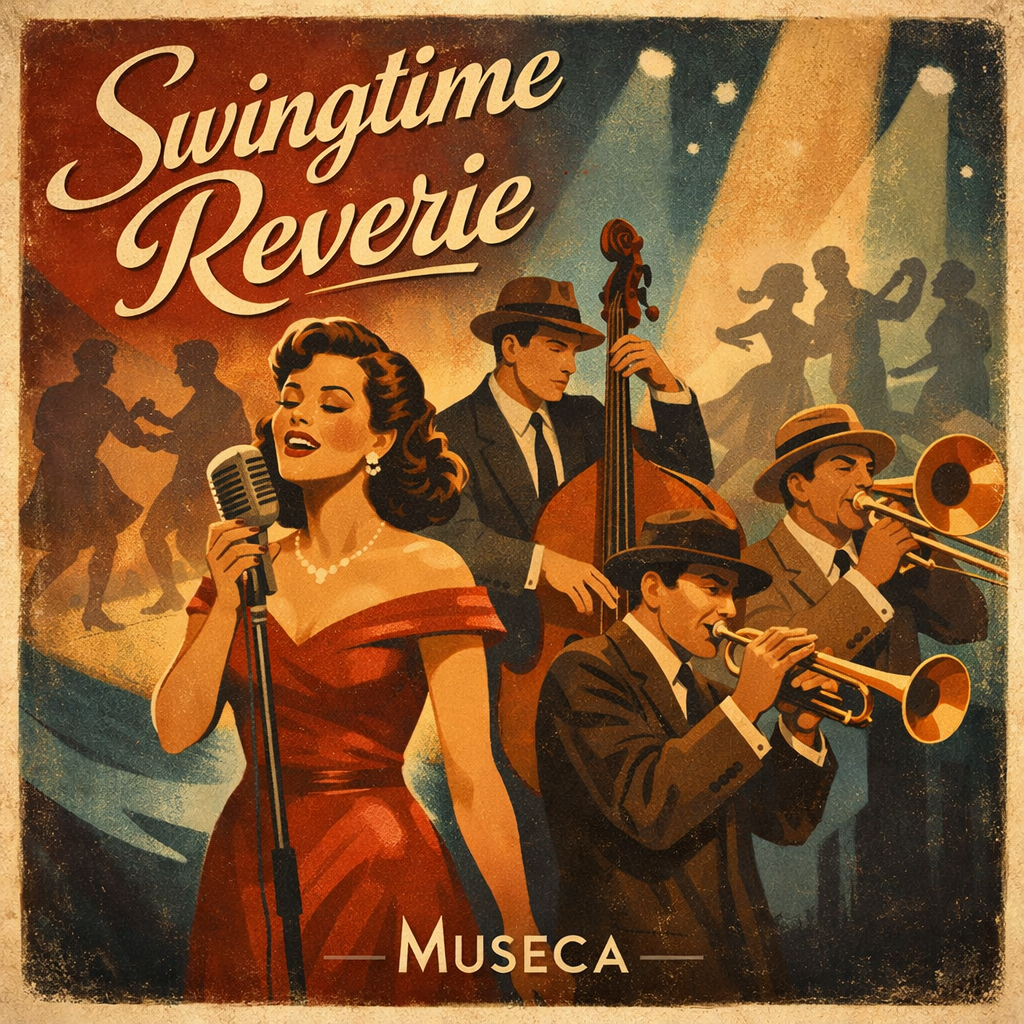
Swingtime Reverie
The Music of the 1940s – A Decade of Swing, Sentiment, and Soul
The 1940s was a turning point — in history, in spirit, and in sound. It was a decade shaped by war and recovery, uncertainty and hope. In America, the music of the era did more than entertain — it comforted, rallied, and remembered. From candlelit living rooms to overseas battlefields, melodies were carried by radio waves and passed between jukeboxes and dance halls, binding a generation in rhythm and emotion.
At the heart of the soundscape was Big Band Swing — bold, brassy, and impossibly alive. Its intricate arrangements and irresistible grooves turned orchestras into engines of joy. And yet, threaded through the pulse was tenderness: the war years introduced sentimental ballads and patriotic anthems that gave voice to separation, love, and longing. This was also the golden age of vocal harmony trios, of boogie-woogie pianists, of romantic crooners and jazz virtuosos — each playing their part in shaping the rich, multifaceted soul of the ’40s.
Swingtime Reverie is Museca’s tribute to that decade of musical resilience. Each song is an original composition inspired by iconic recordings from the era — not covers, but new creations written in the spirit, style, and storytelling tradition of the time. From the high-energy sparkle of “Bugle Call Bop” to the wistful farewell of “Ticket Back to You,” this album reimagines the emotional terrain of the 1940s: the big nights, the quiet goodbyes, the laughter at the edge of chaos.
With every brass flourish and vocal harmony, we honor the music that shaped our parents’ teenage years — when even in the midst of turmoil, swing still swung, hearts still beat to melody, and hope danced just ahead of the downbeat.
So cue the band, smooth the hem of that satin dress, and step back into a dream scored in swing: this is Swingtime Reverie.
Liner Notes
Brass Boy from Brooklyn
Inspired by the irrepressible spirit of wartime swing, this opening track introduces a larger-than-life character whose trumpet becomes both calling card and compass. “Brass Boy from Brooklyn” celebrates the joy, humor, and resilience of young musicians swept into history, carrying rhythm wherever duty took them. It’s a jump-start to the album — full of brass swagger, harmony sparkle, and the belief that music could lift morale as powerfully as any speech.
Hotfoot Jubilee
If the lights flicker and the floorboards shake, you’ve arrived at “Hotfoot Jubilee.” This is the sound of dance halls erupting, of swing bands pushing tempos just past reason, and of a crowd forgetting tomorrow exists. Inspired by the unstoppable energy of Glenn Miller–era swing, the track is pure kinetic joy — a celebration of movement, release, and the communal electricity of a room that refuses to sit still.
Next Stop Harlem
“Next Stop Harlem” is a love letter to arrival — not just at a station, but at a cultural heartbeat. Riding the rails uptown, the song captures the elegance, ambition, and creative magnetism of Harlem at its peak. With polished jazz phrasing and a sense of anticipation in every chord, it honors the city as destination, muse, and promise, where rhythm and identity meet under glowing streetlights.
Quarter to Crazy
As midnight approaches, restraint disappears. “Quarter to Crazy” lives in that final stretch before the clock resets — when the band is locked in, the solos stretch longer, and the room teeters on joyful chaos. Inspired by Count Basie’s late-night swing authority, this instrumental-driven track thrives on call-and-response, shouted encouragement, and the thrill of musicians daring each other to go one chorus further.
Waltz for Havana
Sultry, slow, and suspended in memory, “Waltz for Havana” drifts like perfume through a half-lit ballroom. Inspired by the exotic romance of “Begin the Beguine,” the song blends swing elegance with Latin sway, telling the story of a single night that lingers long after it ends. It’s a meditation on fleeting intimacy — the kind that leaves behind a melody stronger than time.
Shadow on My Pillow
This is the album’s quiet heart. “Shadow on My Pillow” pares everything down to feeling: a room, a memory, a presence that hasn’t quite left. Inspired by the tender crooner ballads of the era, the song speaks to absence without bitterness — only longing. The shadow is not fear, but love’s echo, resting softly where someone once was.
Midnight Carousel
Dreamlike and circular, “Midnight Carousel” turns romance into motion. Inspired by the lush serenity of “Moonlight Serenade,” the song imagines love as something that spins gently through time — returning again and again in memory. Clarinet lines and glowing harmonies create a sense of suspended night, where the past and present blur into a single revolving dream.
Express to Memphis
With rhythm in its wheels and swing in its stride, “Express to Memphis” turns travel into celebration. This is a journey powered by music — where every stop has a beat, every passenger a story, and the destination promises rhythm and release. Inspired by the iconic train songs of the era, it’s playful, kinetic, and proudly American, reminding us that movement itself can be music.
Cuba Calling
Bright, cheeky, and irresistible, “Cuba Calling” dances between fantasy and curiosity. Inspired by the Andrews Sisters’ tropical swing, the song captures the allure of an island seen through wartime eyes — exotic, intoxicating, and slightly dangerous. Beneath the flirtation lies a knowing wink: paradise always has a deeper rhythm, and sometimes it’s unclear who’s leading the dance.
Monkey in a Bowtie
Smooth on the surface and sly underneath, “Monkey in a Bowtie” delivers its wisdom with a grin. Inspired by Nat King Cole’s moral jazz storytelling, the song skewers appearances without cruelty, reminding us that style alone doesn’t make character. With a walking bass and finger-snapped ease, it’s a fable for grown-ups — playful, pointed, and timeless.
Ticket Back to You
The album closes by turning inward. “Ticket Back to You” is a homecoming song — not just to a place, but to a person. Inspired by “Sentimental Journey,” it gathers the emotional threads of the album and gently brings them home. After the dances, the trains, the nights and neon, what remains is connection. This final track doesn’t rush; it trusts the journey, and it knows where it’s going.
Bonus Track: When the Lanterns Glow Again
Written in homage to the wartime hope embodied by Vera Lynn, this bonus track stands as a quiet benediction. “When the Lanterns Glow Again” imagines peace not as victory, but as return — lights in windows, voices reunited, mornings restored. It closes the door softly on the decade, leaving behind not silence, but reassurance.
Lyrics
xx
Postscript
The 1940s was an era where melody met memory — where trumpets swung and ballads soothed, and where every note carried the heartbeat of a world at war and in love. Swingtime Reverie draws from this wellspring, tracing the rhythms that shaped a generation and still echo today.
At the core was Big Band Swing — up-tempo, horn-driven jazz that filled ballrooms with movement and joy. Alongside it, Traditional Pop emerged with velvet-voiced crooners offering comfort across distant radios. Wartime songs carried soldiers and sweethearts through long separations with lyrics of devotion, longing, and home.
Meanwhile, quieter revolutions brewed in the South — the early stirrings of rhythm and blues and country music rising from juke joints and rural back porches. These parallel voices would later change the face of popular music forever.
This album bows to the legends:
Glenn Miller, who gave the world “In the Mood” and “Moonlight Serenade.”
The Andrews Sisters, who harmonized patriotism and sass.
Sinatra and Crosby, whose voices became the soundtracks of resilience.
Ellington, Basie, Shaw, and Dorsey, whose orchestras made swing immortal.
Ella and Billie, who gave jazz its aching soul.
Their songs, like “Sentimental Journey,” “I’ll Be Seeing You,” and “White Christmas,” became more than hits — they became keepsakes of hope.
The themes they carried — wartime goodbyes, sweet reunions, candlelit dances, and the ache of devotion — still stir something deep. And though the era has passed, its music has not. It lingers in every slow dance, every film score, every whispered promise that someday, we’ll meet again.
Swingtime Reverie is not just an album. It’s a salute — to the voices, the melodies, and the hearts that kept singing through it all.
— Museca
Playlist
- Brass Boy from Brooklyn Museca 2:26
- Hotfoot Jubilee Museca 3:10
- Next Stop Harlem Museca 2:19
- Quarter to Crazy Museca 3:54
- Waltz for Havana Museca 2:26
- Shadow on My Pillow Museca 3:09
- Midnight Carousel Museca 4:11
- Express to Memphis Museca 2:20
- Cuba Calling Museca 2:21
- Ticket Back to You Museca 3:45
- When the Lanterns Glow Again Museca 3:34