
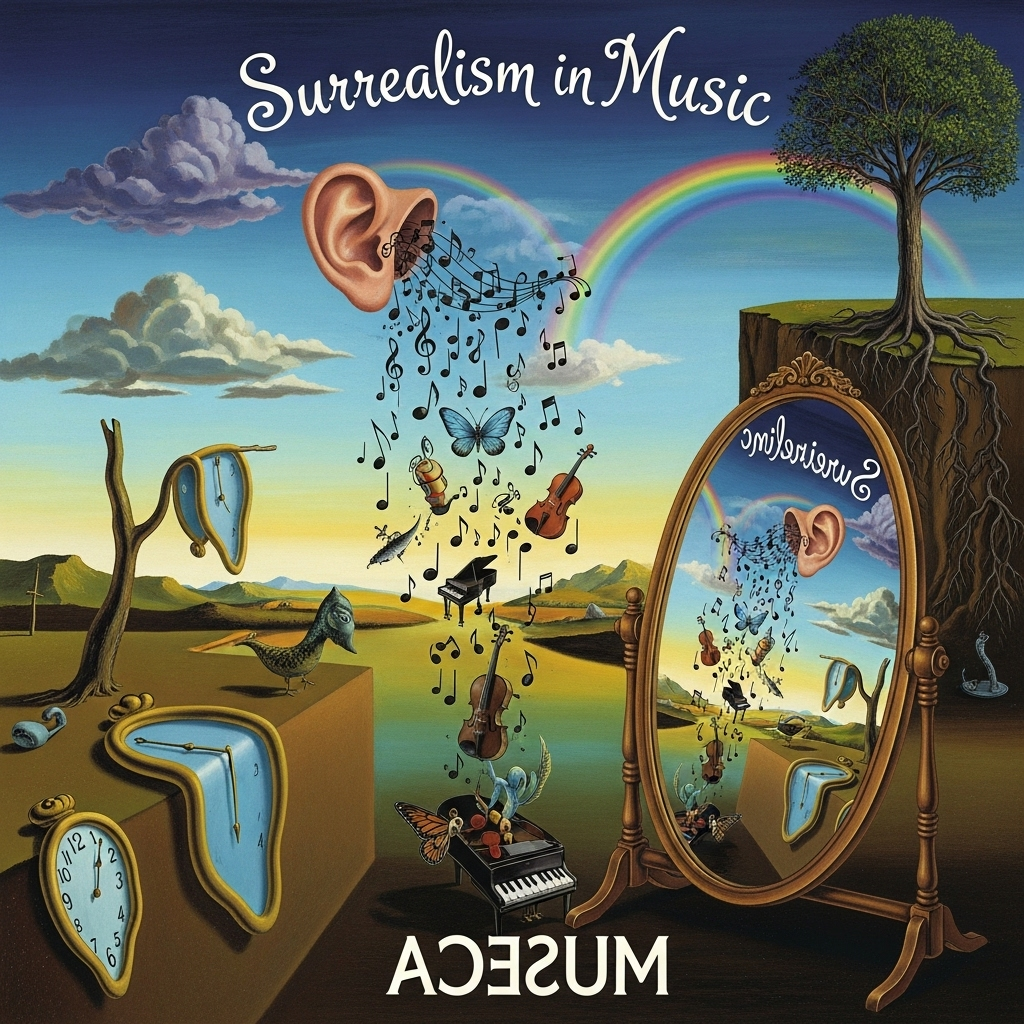
cisuM ni msilaerruS
acesuM
Surrealism in Music began as an artistic revolt against the limits of reason. Emerging in the early twentieth century, it sought to liberate creativity from logic, convention, and surface appearances, turning instead toward dreams, intuition, chance, and the unconscious. Surrealist artists believed that truth was not found in what is orderly and rational, but in what is symbolic, irrational, and deeply felt.
In painting and sculpture, surrealism revealed itself through impossible landscapes, distorted objects, and familiar forms placed in unsettling contexts. In literature, it appeared as automatic writing, fractured narratives, and language freed from linear meaning. Music, however, posed a unique challenge: it was already abstract. To be surreal in music was not to abandon realism, but to reshape perception itself—to bend time, disrupt expectation, and allow sound to behave as memory and dream rather than structure and argument.
Surrealism in music lives in subtle transformations. A waltz may retain its elegance while the floor beneath it disappears. A melody may feel familiar yet refuse to resolve. Silence may become as expressive as sound. Humor and melancholy often coexist, as they do in dreams, and irony may appear not as mockery but as gentle distance. Rather than telling stories, surrealist music creates states of mind.
This album is conceived as a journey through those states. Each piece functions as a room within a dream—connected not by narrative progression, but by psychological association. Mirrors, clocks, stillness, and soft distortions recur as motifs, reflecting surrealism’s fascination with time, identity, and perception. The influence of early pioneers such as Erik Satie can be felt in the quiet wit and restrained absurdity of certain moments, while later explorations of silence, chance, and sonic ambiguity inform the album’s spaciousness and calm.
Surrealism in Music does not aim to explain or illustrate surrealism. It practices it. The compositions favor atmosphere over resolution, suggestion over declaration. They invite the listener to experience sound as a living, shifting presence—something that listens as much as it is heard.
This is not an album about escaping reality, but about encountering it differently. Like surrealist art in all its forms, it asks the listener to suspend certainty, enter the dream willingly, and discover meaning not in answers, but in sensation itself.
Liner Notes
The Mirror Invitation
The album opens as a threshold rather than a beginning. This piece embodies one of surrealism’s central ideas: inversion. Like a mirror-written invitation that must be read in reflection, the music unfolds backward in spirit, drawing the listener inward through reversed gestures, suspended harmony, and quiet anticipation. Sound here does not announce itself; it beckons. The listener steps through the mirror and leaves ordinary perception behind.
The Umbrella Dreams of Tea
Inspired by the gentle absurdity of early surrealist pioneers, this piece embraces irony, restraint, and quiet humor. In surrealism, ordinary objects often acquire inner lives, and here the music behaves with similar whimsy. Simple gestures are treated with exaggerated seriousness, pauses linger too long, and calm becomes slightly uncanny. It is surrealism at its most polite and mischievous, where logic smiles faintly before drifting away.
Afternoon with a Lost Metronome
Time becomes unreliable in this chamber-like reverie. A metronome suggests order, but here it wanders, hesitates, and eventually forgets its role. The music evokes memory rather than measurement—an afternoon that feels familiar but cannot be placed. Surrealism often explores time as psychological rather than mechanical, and this piece gently unhooks rhythm from certainty.
Reflections at Château Ferrières
This work draws on surrealism as immersive environment and social theater. Layers of sound reflect one another like chandeliers in mirrored halls, creating elegance that is both luxurious and disorienting. The music suggests a dream of opulence where space multiplies and perception folds back on itself. It is less a location than a sensation: reflection as atmosphere.
Midnight on Rue des Paradoxes
Night transforms the surreal into something intimate and introspective. This piece moves through a shadowed cityscape where contradictions coexist—warmth and distance, familiarity and unease. Surrealism here is not shocking but subtle, revealing how the ordinary becomes strange under altered light. Melody wanders like a solitary figure, never quite arriving, always listening.
The Violin Melts at Dawn
As light enters the dream, form begins to dissolve. This piece translates one of surrealism’s most iconic images—the melting object—into sound. Strings soften, pitch bends, and harmony liquefies, suggesting transformation rather than collapse. The violin does not break; it yields. Reality becomes fluid, and sound turns luminous, hovering between matter and memory.
The Ear Listens to Silence
Surrealism often reveals what lies beneath expression, and here that layer is silence itself. Sparse textures and extended stillness draw attention to listening as an active act. Sound appears briefly, then recedes, as if testing its own existence. The piece invites awareness rather than emotion, embodying surrealism’s fascination with perception turned inward.
The Banquet of Broken Clocks
The album concludes with time fully unbound. Clocks no longer measure; they fracture, stop, and dissolve. This final piece is ceremonial rather than conclusive, evoking a surreal ritual where duration loses meaning. Familiar motifs flicker like memories at a long table, then fade without resolution. The dream does not end—it simply releases the listener, leaving time suspended.
Playlist
- The Mirror Invitation Museca 2:00
- The Umbrella Dreams of Tea (A Surreal Miniature in the Spirit of Erik Satie) Museca 1:39
- Afternoon with a Lost Metronome Museca 3:58
- Reflections at Château Ferrières Museca 1:50
- Midnight on Rue des Paradoxes Museca 2:43
- The Violin Melts at Dawn Museca 3:40
- The Ear Listens to Silence Museca 2:56
- The Banquet of Broken Clocks Museca 3:09