
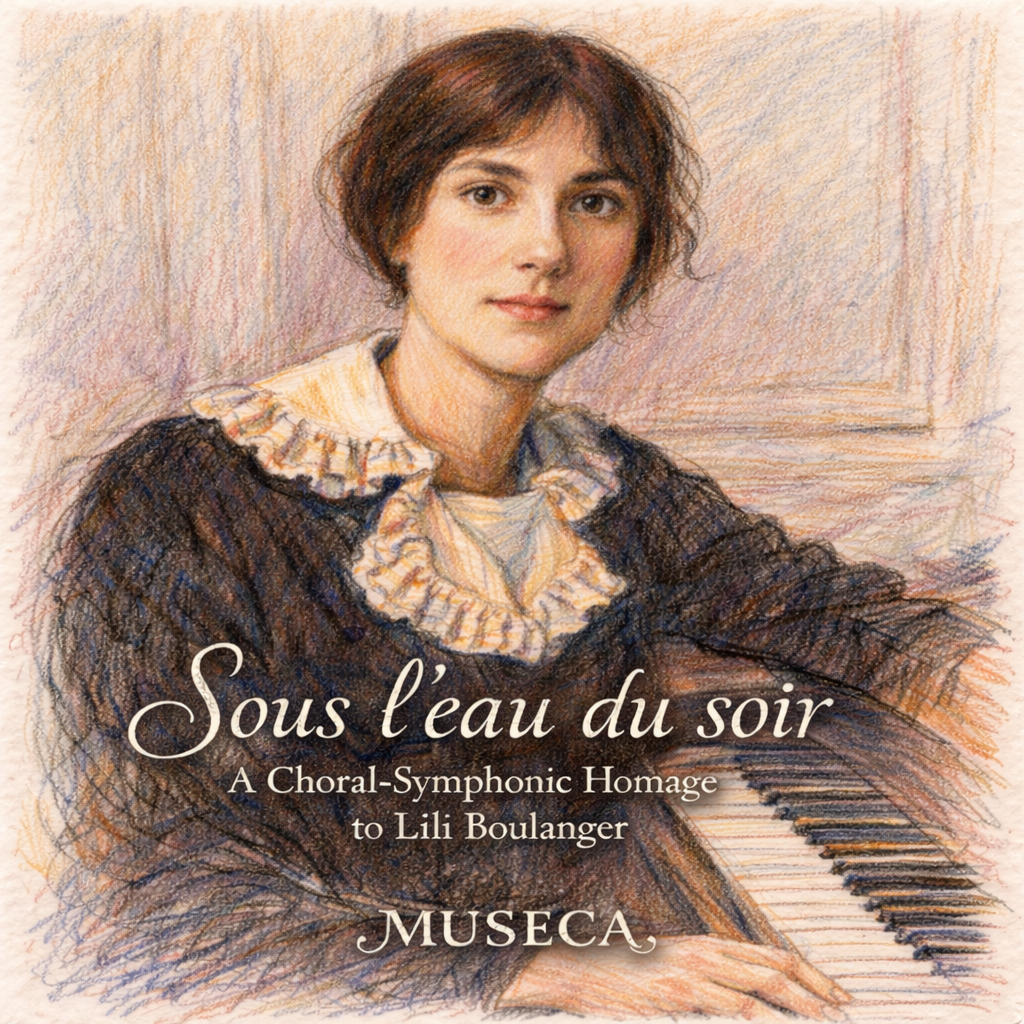
Sous l’eau du soir is a choral-symphonic homage to Lili Boulanger—a composer whose voice arrived with astonishing clarity and then vanished too soon. Born into a distinguished Parisian musical family, Boulanger emerged as one of the most original talents of early twentieth-century France. In 1913, she became the first woman to win the Prix de Rome for composition, a landmark achievement that signaled not only a personal triumph, but a shift in who could be heard and recognized within the highest institutions of European music.
Her music speaks in a language of luminous harmony and spiritual weight: chords that glow rather than “resolve,” melodies that feel like breath, and choral writing that can turn from intimate prayer to vast, architectural sorrow. Within a tragically short life—she died in 1918 at age 24—she created works of uncommon emotional truth, moving effortlessly between radiance and darkness, devotion and doubt, tenderness and abyss.
This album does not quote her themes. Instead, it follows her sensibility: the shimmer of water and the gravity of silence, the slow accumulation of choral light, the sense that beauty can be both fragile and immense. Sous l’eau du soir offers six original studies shaped by Boulanger’s spirit—music written at the edge of breath, where memory becomes echo and the evening holds its secrets.
Liner Notes
Rome, 1913 — The Gate of Firelight
An opening gesture of arrival—radiance shaped by restraint. Strings, harp, and choral “breath” unfold over a persistent tonal memory, as if a door is slowly being brought into focus rather than thrown open. The choir functions as atmosphere as much as statement: luminous vowels, suspended color, and a single brief pillar of orchestral force before the music returns to quiet, leaving only the afterimage of light.
Sirens Over Still Water (Wordless)
A study in shimmer and distance. Muted strings and harp ripples create a surface that never stops moving, while upper voices hover like reflections rather than narrative singers. The piece treats the choir as waterlight—soft-edged, wave-shaped, and deliberately unnamed—so the emotion arrives through timbre and harmonic drift, not through declaration.
Sirens Over Still Water (French Poemlet)
The same world, now given a quiet text—an original poemlet in French, sung with legato phrasing as if the words are dissolving into the water they describe. The language is intimate and indirect: nothing is claimed, nothing is explained. The voices fold, the moon listens, memory opens and closes. The result is less “song” than whispered architecture: poetry carried by orchestral color.
Lyrics (Français)
Sous l’eau du soir, nos voix se plient,
comme un fil d’argent sur la peau.
La lune écoute, puis s’éloigne,
et le silence devient écho.
Nous chantons bas, sans te nommer,
pour ne pas briser la lumière.
Une vague ouvre la mémoire,
une autre la referme.
Reste, musique, au bord du souffle.
Reste, sans forme, sans couronne.
Et que l’eau garde nos secrets
dans son miroir qui frissonne.
Lyrics (English)
Beneath the evening’s water, our voices fold,
like a silver thread against the skin.
The moon listens, then drifts away,
and silence becomes an echo.
We sing softly, without naming you,
so as not to break the light.
One wave opens memory,
another closes it again.
Stay, music, at the edge of breath.
Stay, without shape, without a crown.
And may the water keep our secrets
in its mirror that shivers.
Metta (Prayer for All Beings)
A devotional center built on simplicity and response. A humble solo line offers short invocations, answered by the choir as a living halo—gentle repetitions that gather meaning through accumulation. The orchestration remains warm and human, avoiding spectacle; the power comes from the steadiness of compassion and the feeling of breath becoming harmony.
Lyrics (English)
TENOR:
May every heart be held in light.
May fear loosen its grip.
May kindness remain.
CHOIR (soft, repeated):
May all be free.
May all be at peace.
TENOR:
May every breath return to calm.
CHOIR (soft, repeated, fading):
May all be free.
May all be at peace.
De Profundis — Out of the Depths
The album’s abyss: slow weight, deep registers, and choral mass shaped like stone. Harmonic pressure increases by degrees—density, register, and dissonance—until a single crest breaks the surface. Afterward, the music does not “triumph”; it survives. Light returns as something earned: quieter, thinner, and more truthful for having passed through the depths.
Pie Jesu — Afterglow (Benediction)
A closing candle. Minimal text, intimate pacing, and a soft choral veil placed over harp and strings. The aim is not resolution but continuation—an ending that feels like a final breath held in the room. The last sonority is allowed to remain suspended, as if the music is still present even after it stops speaking.
Playlist
- Track 1 — Rome, 1913 — The Gate of Firelight Museca 1:18
- Track 2 — Sirens Over Still Water Museca 1:21
- Track 3 — Sirens Over Still Water (French Poemlet) Museca 1:38
- Track 4 — Metta (Prayer for All Beings) Museca 1:36
- Track 5 — De Profundis — Out of the Depths Museca 1:38
- Track 6 — Pie Jesu — Afterglow (Benediction) Museca 1:19