
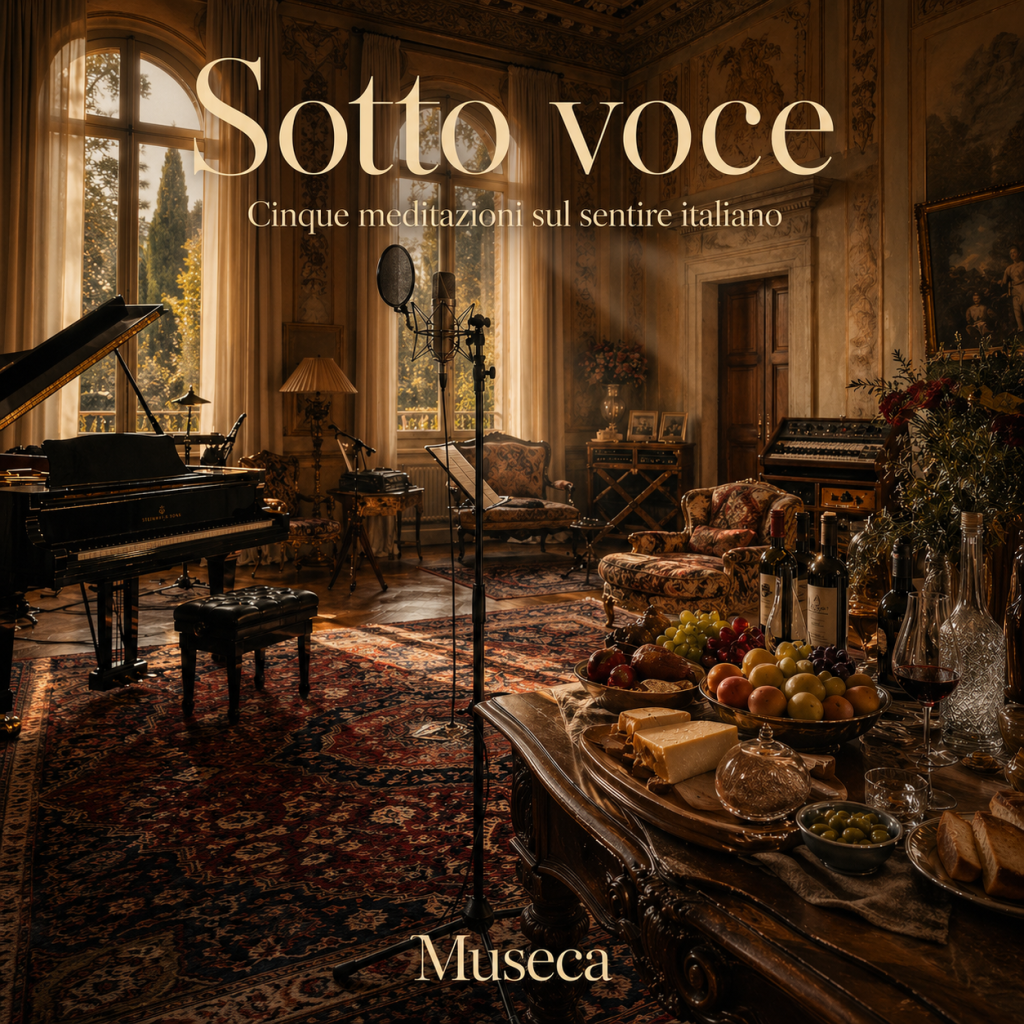
When I named this series Sotto Voce — under the voice — I did not yet know that the Italian album would arrive third. Now that it has, the album takes for itself the phrase the entire series was named after. Sotto voce is an Italian musical instruction: under the voice, in a half-voice, restrained. It is the marking a composer writes when the music must be sung as if not quite spoken aloud — when intimacy matters more than projection, when what is half-said carries more than what is declared. The Italian language gave Western music this instruction. This is the album where the series claims its native phrase.
The Sotto Voce style is a synthesis I have been developing across several albums: the lyrical refinement of European art song held within the atmospheric ground of Café del Mar chillout production, with the sacred-sensual register of classical crossover (Paul Schwartz’s Aria trilogy, Emma Shapplin, the contemplative side of Sarah Brightman, Era, Karl Jenkins) shaping the warmth between. Restraint is the discipline. The voice never reaches for operatic spinto. The orchestration stays classical rather than synthetic. Sub-bass pulse and soft kick anchor each track in chillout’s quiet ceremony, while the foreground belongs to art song. The result is meant to be both deeply rooted and immediately accessible — music that can hold its weight at any volume, but reveals more when listened to closely.
In Italian, the sotto voce discipline takes on a particular character. Italy gave the West not only the instruction but the entire vocabulary of art song restraint: the aria da camera tradition, the bel canto principle that the most expressive singing is often the most contained, the late-Romantic operatic threshold passages where Puccini and Mascagni held entire orchestras in suspension while the voice sang almost to itself. The Italian language is built for this register. Its open vowels and gentle consonants reward singing softly; its melodic prosody emerges naturally from speech itself. When an Italian sings sotto voce, the language does not have to be reduced — it is already there.
This album draws on three Italian lyrical traditions: the high lyrical economy of Petrarch, the philosophical-melancholic depth of Leopardi, and the conversational warmth of the Italian canzone d’autore (Battisti, Mina, Battiato). It draws on four instrumental traditions across its interludes: the atmospheric orchestral writing of Respighi, the Mascagni intermezzo (the canonical Italian instrumental melancholy held with grace), the Italian Baroque largo tradition of Corelli and Vivaldi, and the suspended-time orchestral writing of Puccini. The vocal palette draws on Cecilia Bartoli’s restrained register and Roberta Mameli’s aria da camera refinement, with Mina’s raccolto coloring at the album’s warmest center.
The album is built as a sequence of five Italian emotional territories — five untranslatable feelings that English does not quite have words for, held one after another as wordless meditations between them carry the album’s instrumental traditions. The five named feelings are tenerezza, struggimento, dolcezza, abbandono, and grazia — tenderness as Italian warmth and closeness, the yearning so intense it physically aches, the sweetness that has nothing to prove, the active spiritual surrender of giving oneself over, and the gift received that one neither earned nor asked for. The four interludes inhabit four further untranslatable territories: meraviglia (Dante’s word for wonder), malinconia (Italian melancholy), quiete (the plenitude of stillness), and sospensione (the held breath at the threshold).
There is no temporal anchor. En sourdine, the French album in this series, was structured as a single day descending from clear morning to deep night, with the hours themselves carrying the architecture. The Italian album has no day. Italian’s deepest gift to the inner life is not its hour-vocabulary but its emotional vocabulary, and so the album organizes itself emotionally rather than temporally. Each track is a meditation on a single feeling held in isolation — a vocabulary made audible. The cycle as a whole forms an arc the listener can sense without needing to follow: tenderness opens, the longing arrives early and gives the warmth its weight, sweetness lifts the album back into light, surrender prepares the closing, and grace is what arrives when the reaching stops.
Two cross-album signatures connect this album to the others in the series. En sourdine opened on tendresse and closed on grâce; Sotto voce opens on tenerezza and closes on grazia. Each language’s word for tenderness opens its album; each language’s word for grace closes it. The series’ permanent shape: every Sotto Voce album begins in nearness and arrives at gift. Three lyrical phrases also cross between the French and Italian albums in their respective languages — encore and ancora, reste and resta, and most centrally Tout est grâce and Tutto è grazia. The same recognition spoken in different tongues.
The album closes on the word grazia itself, with its secondary anchor Tutto è grazia — everything is grace. Italian collapses what other languages separate: grazie is thank you, grazia is grace, and the same word names the gift one gives a friend and the gift Dante receives at the end of the Paradiso. To give thanks for everything is to recognize everything as grace. This is the album’s deepest theological-aesthetic statement, made small and quiet at the closing track’s last lines. The album does not arrive at grace through striving. It arrives at grace because the striving has ended, and what was always already there is finally noticed.
This is music for late afternoons, for evenings alone, for the hours when the day’s noise quietens and one can hear oneself thinking. It does not ask to be listened to closely, but it rewards close listening. Like the Italian language itself, it is built for the half-voice — for what is said almost not aloud, for what is meant by what is held back. Sotto voce: under the voice. The instruction Italy gave to all of music, returning now in its native tongue.
Liner Notes
Tenerezza, vicino a te
The album opens on the warmest of the five Italian emotional territories. Tenerezza is Italian tenderness — distinct from the French tendresse by being warmer, more bodily, less refined-restrained. Italian tenderness includes physical closeness as part of its meaning. It is what one feels holding someone or being held; it lives in the present moment, not in memory or distance.
The anchor word is vicino — near, close. Italian vicino carries both spatial and emotional closeness in a single word; English needs two separate words to translate it. The lyrics circle and return to vicino, vicino a te — near, near you — as the threshold the rest of the album opens through. The voice is intimate, the address is direct, the speaker is fully present rather than reaching.
The track is set in E major at 72 BPM, the album’s warmest threshold tempo. Solo cello carries the lead instrumental voice in middle register — the cello rather than violin because cello lives in the human voice’s range and creates the impression of two close voices rather than a voice plus a higher commentary. The cello is the vicino: the near voice beside the singer. Light harp arpeggiation provides foundation; a single oboe enters in the second verse as a gentle counter-voice. Sub-bass pulse and soft kick anchor the track in the album’s chillout ground without disturbing its intimacy.
The lyrical voice draws on Petrarch’s lyrical economy — the canzoniere’s vocabulary of nearness rendered in contemporary Italian rather than archaic syntax. Petrarchan vocabulary at its quiet core: dolce, cor, amor, vicino. The verses keep their lines short. The refrain holds vicino almost as a vow.
The cello’s voice will return in Dolcezza later in the album — the album’s first cross-track instrumental memory thread, making the warmth-to-warmth lineage audible across the cycle.
Lyrics (Italian/English)
Italian
Verse 1
Resto qui, vicino a te.
Non parlo. Non chiedo.
Il tuo respiro, accanto al mio,
è la sera che si posa.
Chorus
Vicino, vicino a te —
dove non serve dire.
Vicino, vicino a te —
dove il cuore sa
Verse 2
Una mano sulla mano.
Il silenzio che si apre.
La luce che ci tiene
senza chiedere perché.
Chorus
Vicino, vicino a te —
dove il tempo si ferma.
Vicino, vicino a te —
dove l’amore respira.Coda
Vicino…
vicino…
vicino a te.
English Translation
Verse 1
I stay here, near you.
I do not speak. I do not ask.
Your breath, beside mine,
is the evening settling down.
Chorus
Near, near you —
where there is no need to speak.
Near, near you —
where the heart knows.
Verse 2
A hand upon a hand.
The silence opening.
The light that holds us
without asking why.
Chorus
Near, near you —
where time stops.
Near, near you —
where love breathes.Coda
Near…
near…
near you.
Interludio: Meraviglia
The first instrumental interlude. Meraviglia — Dante’s word for wonder, the soul’s leaning toward the marvelous. Distinct from English “wonder” by carrying both the marveling response and the marvelousness of the thing marveled at, sustained rather than dissipated. Not awe, which is closer to fear; not surprise, which fades. Meraviglia is the soul held in attention before something larger than itself.
The composer voice is Respighi — specifically the atmospheric-orchestral Respighi of the Pines of Rome “Pines of the Janiculum” (the nightingale movement, his most contemplative orchestral writing), the Fountains of Rome “Fountain at Dawn,” and the Trittico botticelliano. Sustained string pads, harp, solo woodwind voices, atmospheric color, no big climaxes. The Respighi of stillness, not the Respighi of the Roman parade.
The interlude is set in E Lydian at 70 BPM — the same E center as the opening track but with the raised fourth that opens the harmony toward wonder. Lydian is the historical mode of marvel in Western modal vocabulary, used by composers across centuries when the music wants to lift the ear toward something luminous. Solo flute carries the primary melody, joined by solo oboe in counterpoint, with solo violin entering in very high register at the held-marvel section as the Respighi nightingale gesture. Light celesta tinge appears briefly for Botticelliano coloring.
There is no climactic peak. The track inhabits sustained held wonder throughout, then opens at its close toward C-sharp minor — preparing the deeper interior turn that the next track will take.
Struggimento, ancora
The album’s first descent into deep interior territory. Struggimento is Italian yearning so intense it physically aches — untranslatable into any single English word. Closer to Portuguese saudade than to French nostalgie, with a bodily component the other languages lack. The word derives from struggere — “to melt, to consume, to wear down” — and the feeling is yearning that consumes the one feeling it.
What makes struggimento distinctly Italian, however, is that it is held with grace. It is not despair, which is closed; struggimento is open — the soul still reaches even though the reaching aches. This is the feeling Leopardi inhabited in L’infinito and A Silvia: the philosophical ache made luminous through contemplation. The lyrical tradition of this track is Leopardian throughout: short lines, immense weight, simple language carrying philosophical depth.
The anchor word is ancora — still, yet, again. Italian ancora holds three meanings simultaneously: temporal continuation, spatial continuation, and recurrence. All three are active in struggimento: the longing that continues, that remains, that returns. Ancora deliberately echoes encore from En sourdine — the same word in two languages, marking the series’ cross-album resonance.
The track is set in C-sharp minor with Phrygian inflections at 66 BPM. C-sharp minor is the relative minor of E major (the opening track’s key) — making struggimento the shadow side of tenerezza’s warmth, the longing that closeness contains within itself. The Phrygian inflections introduce the specifically Italian struggimento color, used in Italian Baroque slow movements when the music wants the ache to feel ancient.
Solo violin carries the lead instrumental voice in plaintive Italian register — the lineage from Tartini and Geminiani through Paganini to Puccini’s solo violin in his orchestral interludes. The violin sings beside the voice as a second lamenting voice, the two trading the lyrical line in close dialogue. The climactic section lifts gently toward the album’s first emotional peak — but still sotto voce, still restrained. Struggimento’s defining gesture is that the ache crests but does not break.
The line Il dolore, la sua grazia — sorrow, its own grace — quietly seeds the album’s closing word seven tracks early. The track ends on e basta — “and that is all,” the Italian phrase carrying both resignation and acceptance. Leopardi’s spirit: the ache acknowledged, then released into silence.
The violin’s voice will return in Abbandono — the album’s deepest cross-track memory thread, struggimento’s longing carried forward and released into surrender.
Lyrics (Italian/English)
Italian
Verse 1
Sento ancora il tuo nome
nel respiro della sera.
Non si parte mai del tutto.
Resta sempre qualcosa.
Chorus
Ancora, ancora —
questo cuore che chiama.
Ancora, ancora —
e nessuno risponde.
Verse 2
Le ore non guariscono.
Solo, imparano a portare.
Il vuoto ha la sua forma.
Il dolore, la sua grazia.
Bridge
Ancora — sei qui dentro.
Ancora — sei lontano.
Ancora — questo amore
che non sa morire.
Coda
Ancora…
ancora…
e basta.
English Translation
Verse 1
I still hear your name
in the breath of evening.
One never leaves entirely.
Something always remains.
Chorus
Still, still —
this heart that calls.
Still, still —
and no one answers.
Verse 2
The hours do not heal.
They only learn to carry.
Emptiness has its shape.
Sorrow, its own grace.
Bridge
Still — you are here within.
Still — you are far away.
Still — this love
that does not know how to die.
Coda
Still…
still…
and that is all.
Interludio: Malinconia
Malinconia is Italian melancholy, distinct from French mélancolie douce by being slightly more dramatic, more conscious of its own shape, more willing to swell. It is the feeling of standing inside one’s own sadness with full awareness of it as something almost beautiful — not the diffuse soft sadness of mélancolie douce, but a melancholy with weight, presence, and formal elegance. Melancholy that has accepted itself.
The composer voice is Mascagni’s Cavalleria rusticana intermezzo specifically — possibly the most famous instrumental interlude in the entire opera repertoire and the canonical Italian instrumental statement of melancholy held with grace. Any Italian listener immediately recognizes this textural language: violin section in unison carrying the lyrical cantabile melody, harp arpeggiation in compound meter providing the rocking foundation, sustained organ-like inner voices (originally pit harmonium), a single emotional peak with the melody restated an octave higher in fuller orchestration, then a tapering recession.
The track is an original interlude written in the textural and harmonic language of the intermezzo, not a transcription. Set in A minor at 64 BPM in 6/8 — the only track on the album in compound meter, because the rocking 6/8 is part of what makes the intermezzo’s melancholy feel cradled rather than driven. Solo cello enters as countermelody in the second statement, deepening the texture; solo oboe joins for color at the climactic moment. A brief lift toward F major at the peak prepares the harmonic territory of the album’s structural recovery in the next track.
The track sits between struggimento’s deep ache and dolcezza’s recovery into warmth. Where struggimento was longing actively reaching, malinconia is the same feeling at rest — accepting itself, beautiful in its sadness, no longer reaching. This is the emotional pivot of the album’s first half.
The intermezzo voice will return in Sospensione late in the album — the second cross-track memory thread, the album recalling its earlier melancholy at the threshold to grace before letting it dissolve.
Dolcezza
The album’s structural recovery point — the warm rise out of the struggimento-malinconia valley. Also the only track on the album where tempo increases from one track to the next. This rise is essential to the album’s shape; without it, the album would feel like continuous descent. Dolcezza arrives like sunlight after a long evening — not bright, but warm, and the warmth lifts the whole album.
Dolcezza is Italian sweetness as a moral and aesthetic quality, not just sensory. Untranslatable into English in its full sense; English “sweetness” is too saccharine, “gentleness” too neutral, “tenderness” overlaps with tenerezza. Dolcezza is the quality that makes a person dolce — gentle in spirit, warm without effort, present without demanding. It is what one feels in afternoon sunlight on a hillside, in the company of someone who asks nothing. Sweetness that has nothing to prove.
This is the album’s only track drawing on the canzone d’autore tradition rather than the high literary lineage. Dolcezza in Italian sensibility lives more naturally in the Italian singer-songwriter tradition than in Petrarch — the lyrical economy of Battisti, the interpretive restraint of Mina at her most raccolto (gathered, contained), with a light contemplative tinge from Battiato. The verses are conversational, with images placed simply rather than developed metaphorically. Where the opening track was refined-warm and struggimento was stark-philosophical, dolcezza is conversational-warm. The voice speaks rather than declaims.
The anchor word is dolce itself — the simplest anchor word on the album, deliberately so. The track is set in F major at 70 BPM — pastoral key, the warmest of the diatonic majors. F major is also Mascagni’s intermezzo peak key (which was seeding this modal home) and will return as the closing track’s key, making dolcezza-leading-to-grazia the album’s harmonic resolution arc.
Solo classical guitar carries the lead instrumental voice — Italian classical guitar tradition, close-miked, single notes lyrically deployed, never strummed accompaniment. The Battisti studio recording register specifically, where classical guitar functioned as the warm lyrical companion to the voice. Light flute appears briefly in the second verse for dolcezza’s air-and-light quality.
The opening track’s solo cello returns at the climactic refrain — the album’s first cross-track instrumental memory event. The cello voice that was vicino in the album’s opening returns now as a remembered warmth inside the present sweetness. The line quando tutto si quieta — when everything quietens — quietly seeds the territory of the next interlude.
The classical guitar’s voice will return at the album’s closing track, completing the dolcezza-to-grazia warmth thread.
Lyrics (Italian/English)
Italian
Verse 1
C’è una luce che non chiede.
Sta lì, e basta.
Come una mano che non stringe —
solo, ti accompagna.
Chorus
Dolce, così dolce —
questo modo di restare.
Dolce, così dolce —
senza dover spiegare.
Verse 2
Una giornata che si apre.
Il pane sulla tavola.
Il nome che dici piano
quando nessuno ti sente.
Chorus
Dolce, così dolce —
questa cosa che resta.
Dolce, così dolce —
quando tutto si quieta.
Coda
Dolce…
così dolce…
dolce.
English Translation
Verse 1
There is a light that does not ask.
It is there, and that is all.
Like a hand that does not grip —
only, walks beside you.
Chorus
Sweet, so sweet —
this way of staying.
Sweet, so sweet —
without having to explain.
Verse 2
A day that opens itself.
Bread on the table.
The name you say softly
when no one hears you.
Chorus
Sweet, so sweet —
this thing that remains.
Sweet, so sweet —
when everything quietens.
Coda
Sweet…
so sweet…
sweet.
Interludio: Quiete
The album’s deepest instrumental interlude — the one that reaches furthest back in the Italian tradition, into the Baroque largo tradition. Quiete is the active stillness of a place that has gathered into rest — a chapel late in the afternoon, a hillside in deep summer, the moment when wind drops and the trees hold their breath. It is a plenitude of stillness, not an emptiness.
The Italian Baroque masters knew this register intimately. The composer voice draws on Corelli’s Christmas Concerto slow movements and Pastorale, Vivaldi’s famous largo from the Concerto for Two Violins in A minor RV 522 and the Winter largo from The Four Seasons, and Geminiani’s contemplative passages. These works are the canonical Italian Baroque statements of quiete.
The track is an original interlude in this tradition’s textural and harmonic language. Solo violin in Italian Baroque register carries the primary cantabile voice — sostenuto delivery, long phrases, minimal vibrato in period-aware style, lyrical-modal melodic shape. Solo cello enters as second voice in the middle section, the trio-sonata two-voice dialogue that defined Italian Baroque chamber writing. Sustained chamber organ pad provides the continuo foundation, with pizzicato walking low strings providing the steady step of the Baroque bass line.
Set in D Dorian at 60 BPM — the most luminous of the minor-tinged modes, the canonical Italian Baroque slow-movement mode. Suspensions and held dissonances resolve slowly downward, the Baroque slow-movement signature. A brief lift toward D major in the middle section — the moment of harmonic light inside the held minor stillness, the Baroque equivalent of a sun-shaft falling across a dim chapel.
The interlude is the album’s temporal anchor moment. Even though the album as a whole has no temporal organization, this track’s Baroque voice creates an audible historical depth — the album’s sense of Italian tradition reaching back through centuries. Without this track, the album might feel too contemporary. Quiete is where the album touches the deepest Italian musical past.
Harp drops out for this track — the only vocal-or-interlude track on the album without harp, the textural pivot that makes quiete’s Baroque distinctness audible. Harp returns in the surrender that follows.
Abbandono
The album’s surrender. Abbandono is Italian surrender, letting-go, abandoning oneself — but the word carries an active spiritual sense that English “surrender” lacks. Abbandonarsi is to give oneself over to something — to grace, to feeling, to another, to the moment. It is the act of releasing one’s grip while remaining present. The Italian mystical tradition uses abbandono in exactly this register — found also in De Caussade’s L’abandon à la providence divine, the parallel French phrase, the same concept across both languages.
This is what makes abbandono distinct from struggimento and malinconia: those feelings hold the speaker; abbandono is the speaker letting the holding go. The grammar of the feeling is reflexive — mi abbandono (I abandon myself), not sono abbandonato (I am abandoned). The track’s lyrical voice carries this reflexive quality throughout.
The lyrical tradition is Leopardi again, but a different Leopardi than struggimento’s. The earlier track drew on Leopardi’s L’infinito register — the philosophical ache, the held longing. This track draws on Leopardi’s Il sabato del villaggio and the late hymn-like poems’ register: the moment when ache turns toward acceptance, when the speaker stops reaching and begins to receive what is. Leopardi has both registers; the Italian reader recognizes the difference.
The anchor word is resta — stay, remain — used not as appeal (resta con me) but as imperative-subjunctive che resti (let it stay, let it be). The phrase echoes reste from En sourdine, but with shifted grammatical posture: from direct address to reflexive permission. The cross-album resonance is preserved; the meaning has deepened.
The track is set in B-flat minor with major-mode inflections at 64 BPM, with brief lifts toward G-flat major and a climactic moment lift toward D-flat major. The album’s harmonic descent reaches its deepest point here. This is the most harmonically complex track on the album — surrender itself is movement, the giving-over of the held thing, and the harmonic instability is the track’s emotional architecture.
Solo viola appears for the first time on the album as primary instrumental voice — the contemplative middle of the string family, neither the bright lead of the violin nor the warm bass of the cello but the between-voice. Its arrival at the moment of surrender is right both timbrally (the dark-warm color matches abbandono’s emotional register) and architecturally (a new voice entering at this point in the album marks the shift toward a new posture).
At the climactic section, the solo violin from struggimento returns — the album’s deepest cross-track memory event. The violin that was struggimento’s ache returns now inside abbandono’s release, and the listener hears the longing being carried into the surrender, then released. This is the album’s emotional spine made audible.
The line io senza me — I, without myself — is the deepest Italian mystical register without using overtly religious language. It is the exact Italian translation of the Christian mystical abandonment to grace tradition without invoking it explicitly. The track ends on e basta, echoing struggimento’s closing phrase — the same words at the same architectural position carrying the journey from longing-acknowledged to longing-released.
This track is the album’s spiritual climax, even though the closing track is its emotional arrival. The release of the held longing into surrender is what makes grace possible in the album’s logic.
Lyrics (Italian/English)
Italian
Verse 1
Lascio andare la mano.
Lascio andare il nome.
Quello che è stato, è stato.
Quello che resta, resta.
Chorus
Che resti, che resti —
io non chiamo più.
Che resti, che resti —
io non tengo più.
Verse 2
Apro le mani al vuoto.
Il vuoto è già pieno.
Apro il cuore al silenzio.
Il silenzio già parla.
Bridge
Che resti — l’amore senza nome.
Che resti — il dolore senza voce.
Che resti — la luce senza chiedere.
Che resti — io senza me.
Coda
Resta…
resta…
e basta.
English Translation
Verse 1
I let go of the hand.
I let go of the name.
What has been, has been.
What remains, remains.
Chorus
Let it stay, let it stay —
I no longer call.
Let it stay, let it stay —
I no longer hold.
Verse 2
I open my hands to the emptiness.
The emptiness is already full.
I open my heart to the silence.
The silence already speaks.
Bridge
Let it stay — love without a name.
Let it stay — sorrow without a voice.
Let it stay — light without asking.
Let it stay — I, without myself.
Coda
Stay…
stay…
and that is all.
Interludio: Sospensione
The album’s threshold — the suspended breath between abbandono’s release and grazia’s arrival. Sospensione is Italian suspension, the held breath, the not-yet, the moment between letting-go and what-arrives. The Italian word is used in everyday speech for anticipation held still — the moment before a letter is opened, the breath before someone speaks, the silence before grace. It is time made spatial — the held interval, the threshold itself.
The composer voice is Puccini’s atmospheric orchestral writing — the Suor Angelica miracle scene, the Madama Butterfly humming chorus orchestral frame, the La Bohème Act IV death scene, the Manon Lescaut intermezzo, the Tosca Act III opening before “E lucevan le stelle.” These passages share Puccini’s defining late-orchestral gesture: harmony that hovers without resolving, suspended chords held without resolution downward, orchestrational thinning toward the end of phrases, dynamic restraint never approaching forte. Italian opera invented the orchestral threshold; this track claims that tradition explicitly as the album’s gateway to grace.
The English horn — corno inglese — appears for the first time on the album as primary woodwind voice. It is the canonical threshold instrument of late-Romantic orchestral music, used by Puccini constantly for atmospheric passages and contemplative writing. Darker and more melancholic than oboe, with a singular pastoral-elegiac color. Its first appearance at this album moment is architecturally deliberate: a new instrumental color entering at the album’s penultimate moment, marking the threshold to grace as its own distinct sonic territory.
Set in A-flat major sustained at 58 BPM — one of the most celestial major keys in tonal music, used by Puccini for his transcendent moments. The track ends on a slow shift toward F major (the closing track’s key), the canonical resolving downward third — the move that says we have arrived.
The Mascagni intermezzo voice from earlier in the album returns in the second section — the second cross-track instrumental memory event. Where struggimento’s violin returned in abbandono as the album’s spiritual climax, the intermezzo voice returns here as valedictory memory: the album recalling its own melancholy at the threshold to grace, then letting it go.
A solo violin sustained in very high register — the Puccini high-violin signature — appears in the track’s stillest moment. This is the most fragile gesture on the album: a single voice held at the top of its range, time stopped at the highest tonal point.
The track has no climactic peak. Its architectural function is to be the held interval itself, the suspension that does not resolve until grace arrives.
Grazia
The album’s arrival. Grazia is the most theologically and aesthetically loaded word in the Italian language. Grazia in Italian everyday speech means thank you (grazie), gift, gracefulness, kindness, favor, and theological grace — all in one word. When an Italian says grazia, the word does not separate the everyday from the divine; the same word names both the gift one gives a friend and the gift Dante receives at the end of the Paradiso. This is the deepest Italian theological-aesthetic vocabulary: grace as gift received that one neither earned nor asked for.
Everything in the album has been preparing this arrival. The closeness of tenerezza, the ache of struggimento, the warmth of dolcezza, the surrender of abbandono — all converge here. Grazia is what abbandono receives. The released hands, opened to emptiness, find themselves filled. The album’s logic: not that grace is achieved, but that grace arrives when reaching stops.
The lyrical tradition is Petrarch returning from the opening track — closing the album with the same lyrical voice that opened it. Specifically, Petrarch’s Rime sparse in their most contemplative-arrival register: the late sonnets where the speaker reaches a moment of settled clarity. The voice is inflected by Dante’s Paradiso close — not by quoting Dante, but by carrying his settled clarity in the moment of arrival. The line l’amor che move il sole e l’altre stelle — the love that moves the sun and the other stars — is the canonical Italian lyrical statement of grace as cosmic love; this track resonates with that line without quoting it.
The track has three anchor elements layered: grazia itself, repeated throughout; tutto è grazia (everything is grace) — the secondary anchor at climactic moments, directly translating Tout est grâce from En sourdine and serving as the series’ permanent close; and grazie (thank you, in plural) — used in the coda as the quotidian form of the same word. The album closes on the recognition that the gift received and the gift given thanks for are the same gift.
Set in F major at 56 BPM — the album’s slowest tempo. F major is the same key as dolcezza, making grazia feel like the fulfillment of the album’s earlier warmth rather than a new arrival. The two tracks share the key; the difference is the posture of the listener. Dolcezza lived in F major as warmth; grazia arrives in F major as gift.
Solo cello returns as primary instrumental voice — completing a textural arc across the album. The opening track used solo cello; the closing track returns to solo cello. The cello frames the album. The closing track’s cello sings with the voice as a kind of parallel arrival — the cello and the voice both arriving at grace together, neither leading the other.
The classical guitar from dolcezza returns at the climactic section — the album’s final cross-track instrumental memory event, completing the dolcezza-to-grazia harmonic and emotional spine. The listener hears: the warmth of the day, returning now as the warmth of arrival.
For the first and only time on the album, a wordless mixed choir enters at the climactic section — sotto voce beneath the soprano, in the register of Górecki’s Symphony No. 3 wordless writing, Pärt’s Stabat Mater wordless passages, Karl Jenkins’ Adiemus, and Paul Schwartz’s Aria 3 “Ave Maria” choral pad. The choir’s first appearance at grazia makes the album’s closing feel like arrival in a community of voices rather than continued solitary meditation.
The line Tutto è grazia / e io qui, ancora — everything is grace, and I, here, still — is the album’s deepest internal cross-resonance. Ancora was struggimento’s anchor word; its return at the album’s closing climactic phrase carries the album’s emotional logic in a single word transformed: the same ancora that meant still longing now means still here, in grace. The same word at the beginning and the end of the journey, meaning two different things.
The album’s continuous sub-bass thread — established in the opening track and carrying through every track including all the interludes — fades to silence only here, in this track’s coda. The album’s heartbeat is released into silence at grazia’s arrival, the way breath quiets at moments of grace.
The track ends with two words the album has been moving toward from its first measure: Grazie (thank you) and Grazia (grace). Italian collapses what other languages separate. Grazie and grazia are the same word in different grammatical postures. The album’s closing recognition is that to give thanks for everything is to recognize everything as grace. Gratitude is grace recognized.
Lyrics (Italian/English)
Italian
Verse 1
Tutto quello che è venuto,
era un dono.
Tutto quello che è andato,
era un dono.
Chorus
Grazia, grazia —
parola che conosce.
Grazia, grazia —
quello che ricevo.
Verse 2
Non ho cercato il sole.
Il sole è venuto comunque.
Non ho meritato la luce.
La luce era già qui.
Bridge
Tutto è grazia —
il dono e chi lo riceve.
Tutto è grazia —
la mano che si apre.
Tutto è grazia —
il silenzio che risponde.
Tutto è grazia —
e io qui, ancora.
Coda
Grazie…
grazie per tutto.
Grazia.
English Translation
Verse 1
Everything that came
was a gift.
Everything that left
was a gift.
Chorus
Grace, grace —
a word that knows.
Grace, grace —
what I receive.
Verse 2
I did not seek the sun.
The sun came anyway.
I did not deserve the light.
The light was already here.
Bridge
Everything is grace —
the gift and who receives it.
Everything is grace —
the hand that opens.
Everything is grace —
the silence that answers.
Everything is grace —
and I, here, still.
Coda
Thank you…
thank you for everything.
Grace.
Playlist
- Track 1 — Tenerezza, vicino a te Museca 2:59
- Track 2 — Interludio: Meraviglia Museca 3:14
- Track 3 — Struggimento, ancora Museca 3:00
- Track 4 — Interludio: Malinconia Museca 3:15
- Track 5 — Dolcezza Museca 3:25
- Track 6 — Interludio: Quiete Museca 3:05
- Track 7 — Abbandono Museca 4:03
- Track 8 — Interludio: Sospensione Museca 3:28
- Track 9 — Grazia Museca 3:30