
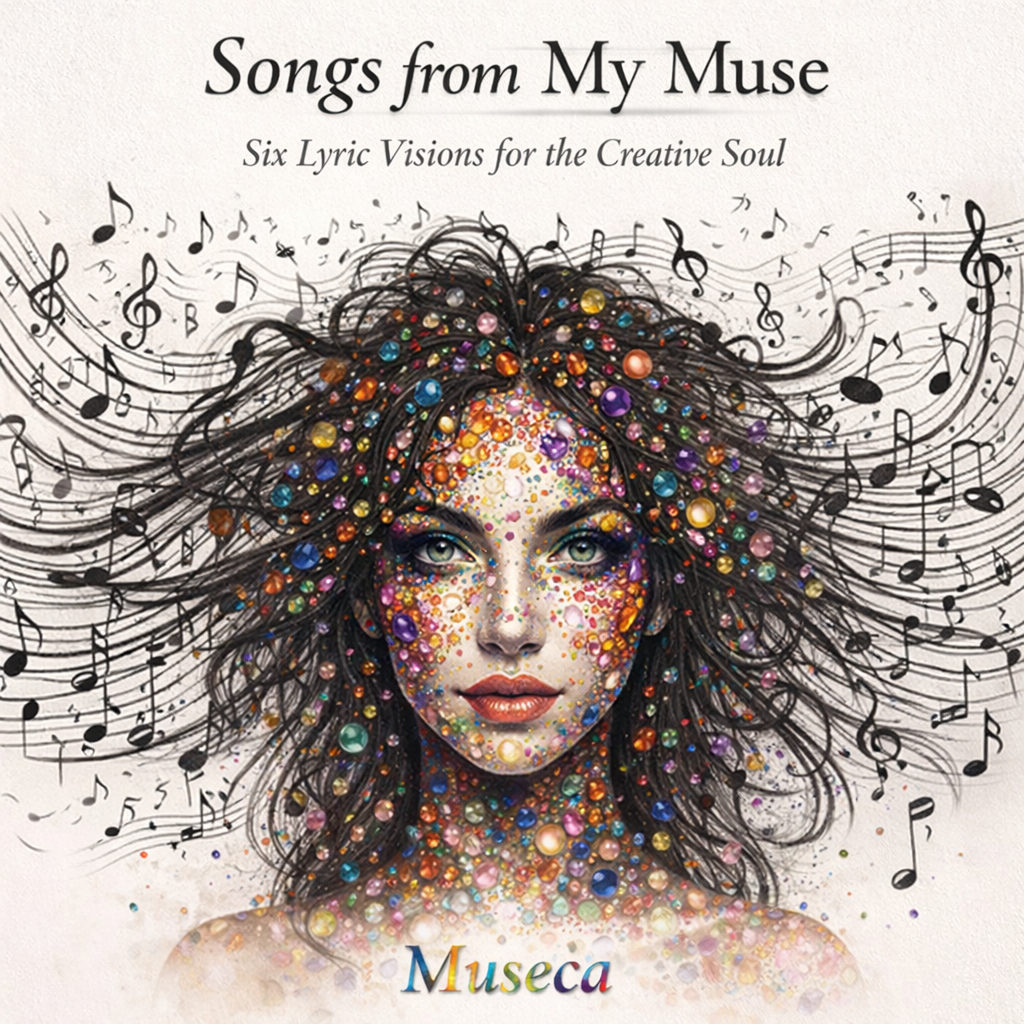
Songs from My Muse is a cycle of lyric songs imagined from the other side of inspiration: not the artist singing to the Muse, but the Muse singing to the artist. Across these six pieces, the Muse appears as comforter, witness, guardian, challenger, and guide — a feminine voice that speaks to the creative soul in moments of doubt, silence, longing, rejection, and renewal.
Musically, the album lives in a neo-romantic chamber-orchestral world shaped by intimacy rather than spectacle. Its language draws on the expressive warmth of piano, harp, English horn, cello, solo violin, French horn, and soft strings, with choir used sparingly at moments of spiritual expansion. The emotional atmosphere is tender, luminous, and inward: each song feels less like performance than visitation, as though the singer has entered the private inner chamber where art is born.
The six songs form a continuous arc. The Muse first calls the artist back from despair, then remains beside them through creative drought, darkness, misunderstanding, and loneliness, until finally she leads them into renewed song. What emerges is not simply a collection of love songs, but a meditation on artistic calling itself: the mysterious force that remembers us when we have forgotten ourselves, that guards the hidden flame, and that asks us to create not because the world always understands, but because the soul must answer what it was made to sing.
Liner Notes
Return to the Fire
The album opens with the Muse as rescuer and remembrance. She does not flatter the artist or deny suffering; instead, she calls the creative soul back to its original flame. The song establishes the central premise of the cycle: inspiration is not merely decorative or occasional, but a living force that finds the artist even in shame, exhaustion, and inner collapse. The orchestral language is intimate at first, then gradually opens toward transcendence, allowing the final chorus to feel less like performance than spiritual restoration.
Lyrics
[Verse 1]
You, who were carved from storm and flame,
Why do you hide your light now?
The world may turn from your true name,
But I will not let you bow.
[Verse 2]
Your silence is not your song’s end,
It waits beneath the ash.
Your wounds are doors that open still,
Not ruins of the past.
[Chorus]
Return to the fire,
The spark you still hold.
You are not lost,
Only weary and cold.
Let the music within
Rise out of despair.
You are the flame
The night cannot wear.
[Instrumental Interlude]
(solo violin over harp arpeggios; French horn enters halfway, warm and noble)
[Bridge]
You do not need
To be understood.
Only be true
To your hidden good.
[Final Chorus – Choir joins]
Return to the fire,
Return to the flame.
Sing through the sorrow,
And sing your name.
The world may forget,
But heaven remembers.
You are the fire.
You are the ember.
[Outro]
You are the fire…
You are the ember…
I Kept the Lamp Lit
Here the Muse speaks as patient guardian. During periods of artistic drought, when the page remains blank and the imagination seems to have withdrawn, she reveals that she has not gone anywhere. The imagery of the lamp suggests both devotion and watchfulness: inspiration survives even when it is no longer felt. Musically, the song is quieter and more domestic in its emotional setting, less like a revelation and more like a whispered reassurance in a dim room. It gives the album one of its gentlest expressions of fidelity.
Lyrics
[Verse 1]
When your hands fell from the page,
And winter entered every room,
I did not leave your broken chair,
Or let the last chord lose its bloom.
[Verse 2]
I watched the dust collect on dreams,
I heard your tired and faithless breath.
I kept one candle by your heart,
A little flame that outlived death.
[Chorus]
I kept the lamp lit for you,
Through the long unwriting night.
Even when you could not see me,
I was guarding what was bright.
I kept the lamp lit for you,
By the door you meant to close.
Love does not depart in silence.
It waits. It watches. It knows.
[Bridge]
Rest is not surrender.
Stillness is not the end.
The song beneath your silence
Is already turning again.
[Final Chorus]
I kept the lamp lit for you,
For the hand, the page, the breath.
What is born in true devotion
Is stronger than despair or death.
Write Me in the Dark
This song deepens the cycle by rejecting the idea that true creation requires ideal conditions. The Muse urges the artist to write not after pain has passed, but from within uncertainty, shadow, and incompletion. Darkness here is not presented as mere despair; it is a chamber of gestation, a place where hidden truths take shape. The musical setting should carry that tension — inward, shadowed, and searching — while the refrain opens into something more luminous. The result is a song about artistic courage: the willingness to create before clarity arrives.
Lyrics
[Verse 1]
Do not wait for noon to name me.
I arrive where candles fail.
I have lived in ink and midnight,
In the breath behind the veil.
[Verse 2]
Bring me your unfinished trembling,
Bring me the page you almost burned.
Beauty is not born from safety.
It is born where night is turned.
[Chorus]
Write me in the dark,
Where the hidden rivers start.
Write me in the wound,
In the chamber of the heart.
Do not ask for perfect light
Before you let the truth begin.
I am the hand inside the shadow.
Write me there. Write me within.
[Bridge]
Not every song is sunlight.
Not every grace is clear.
Some revelations enter softly,
And ask for courage more than cheer.
[Final Chorus]
Write me in the dark,
Till the dark itself can sing.
What you feared was your ending
Was the opening.
When the World Refused Your Name
At the center of the album stands the Muse as defender of the misunderstood artist. This track addresses rejection, dismissal, and the humiliation of not being received by one’s own age or audience. Yet the song does not become bitter. Instead, it restores dignity by placing artistic vocation above applause, fashion, or permission. The Muse reminds the subject that not all truth is immediately welcomed, and not every audience is capable of hearing what is given to them. The orchestration here carries more nobility and breadth, allowing woundedness to rise into resolve.
Lyrics
[Verse 1]
Let them close their gilded salons.
Let them speak and turn away.
Gold applause is not the measure
Of the truth you came to say.
[Verse 2]
There are ears that fear your thunder,
Eyes too small to hold your flame.
But the stars do not ask permission
Before they enter night by name.
[Chorus]
When the world refused your name,
I was singing it in fire.
When the doors were shut against you,
I was lifting your desire.
You were never made for favor.
You were made to sound the deep.
What is given by the soul
No shallow age can keep.
[Bridge]
Do not bend your music smaller
To fit a narrow room.
The rose is not ashamed
That some prefer no bloom.
[Final Chorus]
When the world refused your name,
Heaven knew it all along.
Not every age deserves the artist.
Still the artist gives the song.
I Was There in the Silence
This is the most inward and intimate song of the cycle. The Muse speaks not as flame or summons, but as presence itself — quiet, faithful, almost maternal. She reveals that even in loneliness, when no external answer comes, the artist has not been abandoned. The silence in this song is sacred rather than empty. It becomes the place where companionship is most deeply known, not through spectacle, but through nearness. Its sparse musical atmosphere should preserve that stillness, making the listener feel that the Muse is almost singing from within the room itself.
Lyrics
[Verse 1]
I was there in the silence
After everyone had gone,
In the room that felt too heavy,
In the hour before the dawn.
[Verse 2]
I was there beside your breathing,
Where the ache refused to cease.
Not to banish every sorrow,
But to keep you near to peace.
[Chorus]
I was there in the silence,
Where no human answer came.
I was there in the stillness,
Calling softly through your name.
Not with thunder,
Not with spectacle,
Not with visions bright and wild.
Only near.
Only faithful.
Like a mother with a child.
[Bridge]
When you thought
No one heard you,
I heard everything.
[Final Chorus]
I was there in the silence,
And I will be there still.
Love does not require noise
To prove its will.
Sing Until Morning
The closing song gathers the album into movement and renewal. Having consoled, guarded, and defended the artist, the Muse now commissions them to continue — to carry the wound into song, to persist until darkness begins to thin, to let creation become the path into dawn. The title suggests endurance, but also transformation: morning is not simply the end of suffering, but the moment when suffering is transfigured through expression. With its gradual rise into fuller orchestral and choral sonority, the track serves as the album’s final act of release. The cycle ends not in resolution alone, but in vocation renewed.
Lyrics
[Verse 1]
There is a border where night thins,
Where grief begins to lose its throne.
Walk with me until the horizon.
Do not leave your voice alone.
[Verse 2]
You were not given song for hiding,
Nor breath for merely bearing pain.
Take the wound and turn it outward.
Make it light. Make it rain.
[Chorus]
Sing until morning,
Till the dark gives back the sky.
Sing until morning,
Till the buried answer rises.
What you carried as a sorrow
May become another’s guide.
Sing until morning.
I am with you at your side.
[Bridge]
One note, then another.
One breath, then another.
This is how the soul
Re-enters the world.
[Final Chorus]
Sing until morning,
Till the window fills with gold.
Sing until morning,
Till the shattered heart grows bold.
You were never only surviving.
You were being shaped to shine.
Sing until morning.
Let your life become the line.
Playlist
- 1. Return to the Fire Museca 4:38
- 2. I Kept the Lamp Lit Museca 3:12
- 3. Write Me in the Dark Museca 3:44
- 4. When the World Refused Your Name Museca 3:10
- 5. I Was There in the Silence Museca 4:23
- 6. Sing Until Morning Museca 3:24