
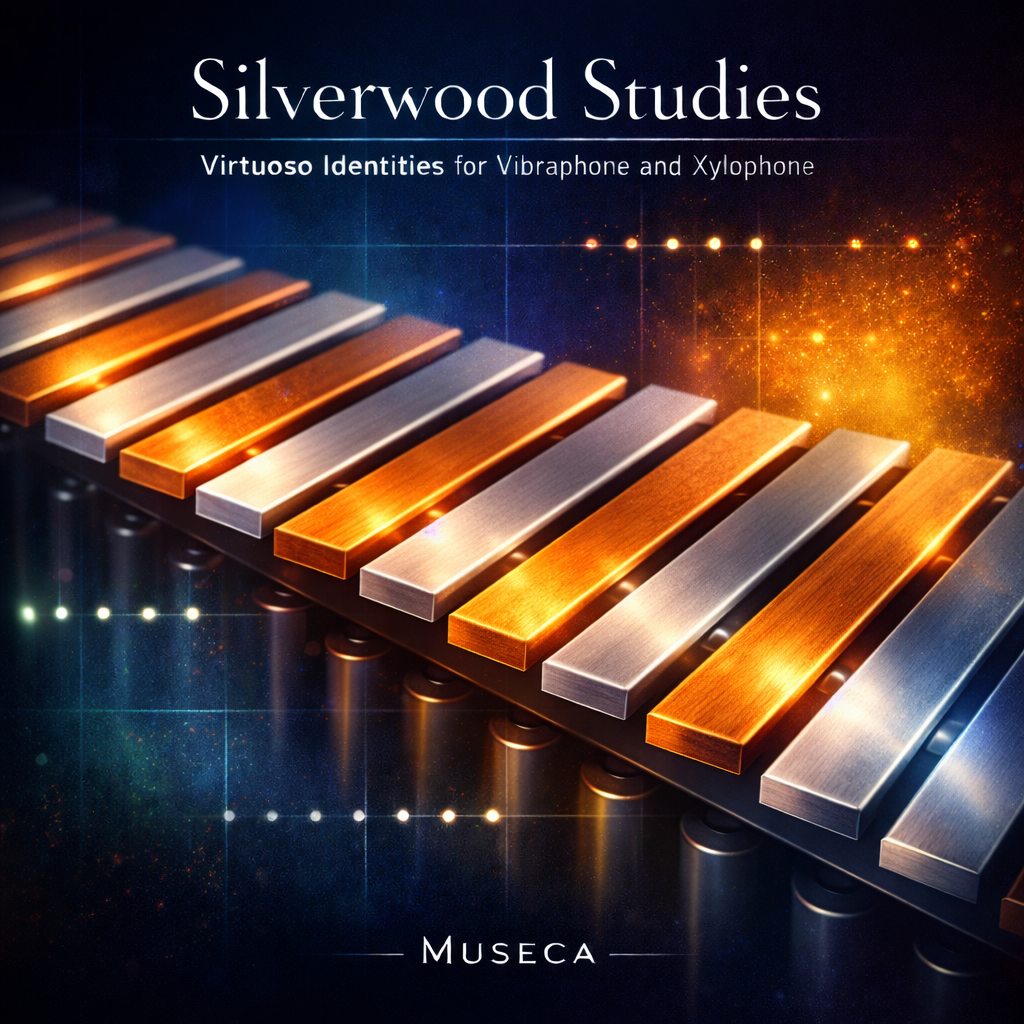
Silverwood Studies is built around two instruments that share a simple physical truth—a bar struck by a mallet—and then diverge into two entirely different personalities. The album’s concept is to place those personalities in a modern dance environment where the rhythm is stable, spacious, and relentless: Afro House, and its coastal cousin on this record, Afro-Bossa House. In both styles, the groove does not need the lead instrument to “carry” the beat. That freedom allows the mallet voice to step forward and become the signature.
The vibraphone is the album’s voice of resonance. Its metal bars sustain, shimmer, and bloom; it can hold notes long enough to behave like a singer or a synth pad while still remaining unmistakably acoustic. The pedal is central to its character—opening and closing the ring of the instrument the way a pianist shapes harmony. On these tracks, the vibraphone is treated as both lead and harmony: melodic hooks that feel vocal, and offbeat chord stabs that supply warmth without crowding the low end. The result is “light in motion”—a sound that floats above the kick and log-drum foundation, with subtle tremolo and delay adding movement without stealing focus from the groove.
The xylophone is the album’s voice of clarity. Its wooden bars speak with immediate attack and rhythmic definition, making it perfect for hook-driven dance writing. Where the vibraphone can linger, the xylophone can punctuate. It becomes a melodic percussion instrument in the most literal sense—capable of riffs that lock into 3–3–2 phrasing, call-and-response figures, and octave flashes that read like a dancer’s footwork. In this context, the xylophone is not a decorative sparkle; it is the track’s identity marker—something you can recognize instantly, even over a crowded club system.
Afro House provides the ideal stage for both. Its core—kick, shakers, deep bass, and log-drum accents—creates a steady, hypnotic engine with enough negative space for a featured instrument to remain prominent. On the Afro House pieces, the mallets are mixed like a lead vocalist: forward, confident, and clean. The rhythm section stays disciplined so the ear never has to hunt for the melody.
Afro-Bossa House adds a second dimension without changing the album’s rule. Here, the house pulse remains steady, but the percussion language borrows from bossa and Afro-Latin sensibilities: softer shaker contours, clave-like dotted accents, hints of tumbao-shaped motion. Those elements are intentionally kept as color and texture, not as competing lead features. The mallet instruments remain the stars—vibraphone for glowing harmonic sophistication, xylophone for rhythmic hook brilliance—while the Afro-Bossa layer gives the grooves a sunlit elegance and a more human sway.
Across the album, the integration is practical and deliberate: tight reverb in the drop so the lead remains crisp; “bloom” only in breakdowns so the mallet resonance feels cinematic; sidechain that respects the kick while preserving melodic presence; and, above all, arrangements that treat vibraphone and xylophone as primary voices rather than ornaments. Silverwood Studies is Museca’s statement that acoustic instruments can speak fluently inside modern club forms—and not as guests, but as the main event.
Liner Notes
Velvet Pedal (Vibraphone Afro House Mix)
This track establishes the album’s central premise: the groove is the floor, and the vibraphone is the chandelier. A steady Afro House engine holds the body in place while the vibraphone takes full lead—pedaled, luminous, and unapologetically forward in the mix. The stabs are voiced like harmonic breath, and the melody is allowed to “sing” without competing instruments crowding its space.
Lantern Logline (Vibraphone Afro House Mix)
Here the vibraphone becomes a storyteller that speaks in short sentences—riff, reply, and return. The rhythm section stays disciplined and minimal so the mallet line can behave like a featured soloist, building anticipation through repetition and small variations. The result is club-ready momentum with a melodic intelligence: a hook you can follow, not merely feel.
Eight-Step Spark (Xylophone Afro House Mix)
The xylophone steps into the spotlight as a pure hook engine. Its 3–3–2 phrasing feels inevitable against the four-on-the-floor pulse, turning rhythmic geometry into melody. The tone is softened just enough to stay elegant, but the articulation remains crisp—each strike a signature mark that defines the track’s identity from the first bar.
Kinetic Ribbons (Xylophone Afro House Mix)
A faster, more athletic study in motion, built around xylophone figures that spiral and snap back into place. The percussion architecture is tribal but controlled, leaving air around the mallet line so the ear never loses the lead. In the breakdown, the track strips back to the essentials, then returns with a sharper edge—like a ribbon pulled taut and released.
Veranda Pulse (Vibraphone Afro-Bossa House Mix)
This is where the album leans toward elegance without sacrificing the dance floor. Bossa-inflected percussion colors flicker around a steady house foundation, and the vibraphone carries both harmony and melody with pedal realism. The chords feel sunlit but restrained; the groove remains nocturnal and modern—an intersection of warmth and precision.
Rio Afterhours (Vibraphone Afro-Bossa House Mix)
A late-night companion piece that treats the vibraphone as a full harmonic instrument—vamp, answer, and shimmer. The Latin elements are present as texture rather than spectacle, allowing the vibraphone to remain the central voice. The breakdown expands into space, then snaps back into a dry, forward mix where the lead lines cut with confident clarity.
Clave in Bloom (Xylophone Afro-Bossa House Mix)
The xylophone takes the role of rhythmic flower: bright, repeating motifs that bloom through subtle variation. A clave-like sensibility shapes the percussion without turning the track into a pastiche; it stays firmly in a club vocabulary. The hook is designed to be memorable at low volume and irresistible at high volume—clean, warm, and sharply defined.
Tumbao Spark (Xylophone Afro-Bossa House Mix)
This closing track is a celebration of articulation. The xylophone hook is bold and athletic, punctuated by octave flashes that feel like quick glints of light off polished wood. The rhythm section carries a tumbao-like contour beneath the steady kick, and the arrangement reserves its biggest “bloom” for transitions—then pulls back to a tight, forward drop where the mallet voice remains unmistakably in command.
Playlist
- Velvet Pedal (Vibraphone Afro House Mix) Museca 4:02
- Lantern Logline (Vibraphone Afro House Mix) Museca 6:08
- Eight-Step Spark (Xylophone Afro House Mix) Museca 3:23
- Kinetic Ribbons (Xylophone Afro House Mix) Museca 2:35
- Veranda Pulse (Vibraphone Afro-Bossa House Mix) Museca 4:27
- Rio Afterhours (Vibraphone Afro-Bossa House Mix) Museca 3:56
- Clave in Bloom (Xylophone Afro-Bossa House Mix) Museca 1:17
- Tumbao Spark (Xylophone Afro-Bossa House Mix) Museca 5:16