
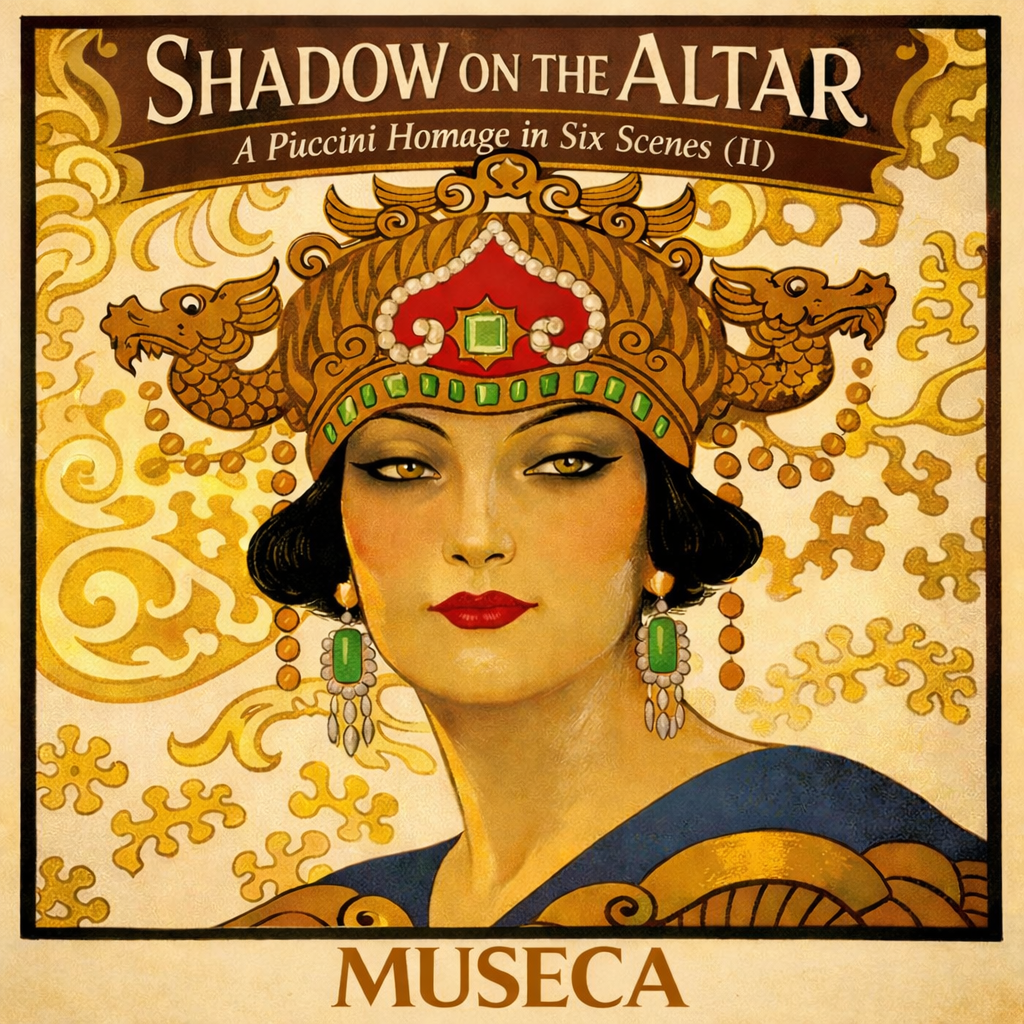
Shadow on the Altar: A Puccini Homage in Six Scenes (II) is conceived as the companion work to my first Puccini mini-cycle, One Beautiful Day: A Puccini Homage in Six Scenes. Where the first album distilled Puccini’s lyric radiance—dawn-lit orchestral atmosphere, intimate confessional arias, and a predominantly hope-forward harmonic trajectory—this second cycle turns deliberately toward Puccini’s chiaroscuro dramaturgy: the Tosca world of pressure, surveillance, prayer, and moral risk. It is still Puccini by craft, but viewed through darker glass—less “sunrise lyricism,” more cathedral shadow.
Technically, the shift begins with orchestration and register. The ensemble is treated as architectural space: muted strings and low tremolo beds function like stone walls holding resonance, while horns remain largely halo-like and restrained, avoiding the cinematic “hero brass” profile. Woodwinds—especially oboe and clarinet—act as close-up narrative cameras, delivering short, psychologically charged lines that emerge from silence and retreat back into it. Harp is used sparingly as punctuation, more like reflected candlelight than decoration. Even in moments of intensity, momentum is created primarily through string-driven compression and harmonic tightening, not percussion or sheer volume.
Harmonically, this cycle leans more aggressively into Puccini’s late-Romantic tension devices: chromatic voice-leading, semitone “pressure” tones, and delayed resolutions that function as dramatic stakes rather than color alone. Cadences are frequently withheld or redirected—through suspensions, deceptive turns, and dominant prolongations—so that release becomes a moral event, not a formal convenience. The arias are shaped as operatic prayer and plea: speech-inflected rubato, long arching cantabile, and expressive appoggiaturas timed to the text’s emotional hinge points. Dynamics are intentionally controlled—often living in p–mf—so that climaxes arrive as rare, earned revelations rather than constant display.
Finally, the album’s dramatic arc is engineered to break open at the end. While the earlier cycle’s hope was present from the outset, this cycle earns its light through struggle: the final scene adopts the structural posture of Nessun dorma—not by quotation, but by adopting its disciplined architecture of contained intensity, tiered orchestral build, and vow-like refrain (“Vincerò”) held until the moment it must be sung. The result is a second Puccini homage that complements the first: two mini-operas, each built from Puccini’s genius of vocal inevitability and orchestral subtext—one painted in dawn, the other carved in shadow.
Liner Notes
Black Candles at Dawn
The cycle opens in a cathedral hush: muted strings and low tremolo establish the stone-and-smoke atmosphere, with harmony tightening by half-steps rather than announcing itself in bold cadences. Horns appear as a distant halo—present, but withheld—while brief woodwind close-ups flicker like candlelight on marble. The pacing is deliberately operatic: tension rises in waves, then drops into sudden silences that feel like staged breath. The final sonority remains suspended, as if the room itself is waiting for a voice to speak.
I Will Not Confess
This aria is conceived as defiant prayer—more Tosca than lyric reverie. The soprano line is written in long-breathed cantabile, shaped by speech-inflected rubato, with climaxes earned through delayed resolution rather than volume. Underneath, the orchestra sustains chromatic pressure through appoggiaturas and suspensions that resolve late, so the harmony behaves like moral weight. Muted strings provide the veil, harp punctuates like liturgy, and horns remain restrained—fate as shadow, not spectacle. The ending withholds closure, leaving the vow intact but uncomfortably alive.
I Will Not Confess (English)
Lyrics
[Verse 1]
In candle smoke, I hear the city pray,
But mercy hides and turns its face away.
They ask my name like steel upon the tongue—
I hold my breath and let no hymn be sung.
[Verse 2]
I’ve paid in tears for every honest word,
Yet still the dark insists it must be heard.
If truth is chained, I will not bow my head—
My heart is mine, though every door is dead.
[Chorus]
I will not confess—
Not to the night, not to their hands.
If faith is fire, it understands.
I will not confess.
[Bridge]
God of the silent, if you see me now,
Teach me to stand without a holy vow.
Let fear pass through me like a bitter rain—
And leave me still, unbroken, in my name.
[Final Chorus]
I will not confess—
Not to the night, not to their hands.
If faith is fire, it understands.
I will not confess.
I Will Not Confess (Italian)
Lyrics
[Verso 1]
Nel fumo delle candele prega la città,
ma la pietà si nasconde e non verrà.
Mi chiedon nome—è ferro sulla lingua—
io tengo il fiato e nessun inno si stringa.
[Verso 2]
Ho pagato in lacrime ogni parola vera,
eppure il buio pretende la sua preghiera.
Se la verità è in catene, non mi piegherò—
il cuore è mio, anche se il mondo chiuse restò.
[Ritornello]
Non confesserò—
né alla notte, né alle loro mani.
Se la fede è fuoco, mi comprende domani.
Non confesserò.
[Ponte]
Dio del silenzio, se mi vedi ora,
insegnami a stare senza altra ancora.
Lascia passare il timore come pioggia amara—
e resta in me la forza, chiara.
[Ritornello Finale]
Non confesserò—
né alla notte, né alle loro mani.
Se la fede è fuoco, mi comprende domani.
Non confesserò.
Under the Marble
An intermezzo of footsteps and concealed grief, where the orchestra speaks what cannot be spoken aloud. Solo cello carries the confessional thread, answered by oboe and clarinet in brief, human “close-ups.” The harmonic language is compressed—semitone tension and inner-voice suspensions—yet the texture stays intimate, allowing silence to function as drama. Rather than developing themes symphonically, the music unfolds in paragraphs of breath and hesitation. It closes unresolved, like a corridor that turns out of sight.
Mercy, If You Hear Me
A quiet plea aria, sculpted as a single melodic sentence that breaks the heart by refusing to overstate itself. The soprano remains close to the listener—tender, controlled—while the orchestra supports with velvet-muted strings and a few carefully placed woodwind sighs. Harmonic shifts are minimal but decisive: one chromatic inflection changes the emotional temperature, and delayed cadences make each request feel precarious. The climax is brief and human-scale, then the line retreats into a whispered surrender. The final chord hangs, like a candle refusing to go out.
Mercy, If You Hear Me (English)
Lyrics
[Verse 1]
Mercy—if you hear me, stay with me,
Don’t leave me alone in the darkening sea.
I gave my life to a love that was true,
Now I tremble… but I still reach for you.
[Verse 2]
If there is a sky beyond these walls,
Let the night not be the only thing that calls.
Hold my hand—without a word to say—
Like a candle that refuses to fade.
[Chorus]
Mercy… gentle mercy…
Don’t let me fall without the truth.
If I must lose, then let me be
At least a light—before I leave.
[Coda]
Listen… listen to my breathing…
Mercy, If You Hear Me (Italian)
Lyrics
[Verso 1]
Pietà… se mi ascolti, resta qui,
non lasciarmi sola nel buio così.
Ho dato la vita a un amore sincero,
e ora tremo—ma ancora spero.
[Verso 2]
Se c’è un cielo oltre queste mura,
fa’ che la notte non sia più paura.
Tieni la mia mano, anche senza parole—
come una candela che non vuole morire.
[Ritornello]
Pietà… dolce pietà…
non farmi cadere senza verità.
Se devo perdere, fammi restare
almeno luce—prima di andare.
[Coda]
Ascolta… ascolta il mio respiro…
The Staircase of Knives
This orchestral scene is operatic suspense without “trailer” rhetoric: tension is generated by low-string tremolo and quiet ostinato, not percussion impact. Harmony compresses by chromatic inches, creating a sense of inevitability—an approaching decision rather than a chase. Brass is used as shadow—horns and low tones that darken the air—while upper strings retain a strained lyric contour, keeping the music psychologically legible even at its most tense. Sudden hushes function as stage cuts, where the audience feels the room, the breath, the danger. The ending stops short, holding the listener on the threshold of consequence.
Te Deum of Ash (Vincerò Refrain)
The finale is designed as transfiguration: contained intensity that gradually unlocks into a single, noble breakthrough. In the spirit of Nessun dorma, the tenor line is broad and declamatory—dramatic but controlled—saving true force for the final refrain. The orchestra builds in tiers, strings first, then warm horns, with brass reserved for the moment of release; the drama is architectural, not loud. “Vincerò” arrives as a vow rather than a victory lap—repeated, widened, and finally sustained at the crest before yielding to a dignified cadence. In that last turn, the album’s shadowed harmonic world is not erased; it is redeemed—light earned, not granted.
Te Deum of Ash (Vincerò Refrain) (English)
Lyrics
[Verse 1]
No—no one sleeps while the dark still breathes,
I stand in the hush where the stone church grieves.
The night may threaten, the knives may gleam—
But I am fire inside the dream.
[Verse 2]
I hear the dawn through the iron and ash,
A distant bell in the silence’s crash.
They think I’m broken—yet here I stand,
With light returning to my hand.
[Refrain]
Vincerò—
Vincerò…
Beyond the fear, beyond the veil—
Vincerò…
[Bridge]
Let every shadow learn my name,
Not as a wound—but as a flame.
The sky will open. The doors will yield.
My heart—unmasked. My spirit—sealed.
[Final Refrain]
Vincerò—
Vincerò!
Vin… ce… rò!
Te Deum of Ash (Vincerò Refrain) (Italian)
Lyrics
[Verso 1]
Nessuno dorme mentre il buio respira,
io sto nel silenzio dove la pietra sospira.
La notte minaccia, i coltelli nel cor—
ma dentro il mio sogno arde un sol.
[Verso 2]
Sento l’aurora tra ferro e cenere,
un campanile lontano che torna a vivere.
Mi credono vinto—ma eccomi qua,
con luce che sale e mi guiderà.
[Ritornello]
Vincerò—
Vincerò!
Oltre la paura, oltre il vel—
Vincerò!
[Ponte]
Che l’ombra impari il mio nome, stanotte,
non come ferita—ma fiamma che lotte.
Si apre il cielo, la porta cederà,
il cuore svelato—la vita dirà.
[Ritornello Finale]
Vincerò—
Vincerò!
Vin… ce… rò!
Playlist
- Track 1 — Black Candles at Dawn (Orchestral Prelude) Museca 3:00
- Track 2: I Will Not Confess (English) Museca 2:48
- Track 2: I Will Not Confess (Italian) Museca 3:55
- Track 3: Under the Marble (Intermezzo) Museca 3:00
- Track 4: Mercy, If You Hear Me (English) Museca 2:22
- Track 4: Mercy, If You Hear Me (Italian) Museca 2:41
- Track 5: The Staircase of Knives (Orchestral Scene) Museca 2:20
- Track 6 - Te Deum of Ash (Italian) Museca 3:05
- Track 6 - Te Deum of Ash (Vincerò Refrain) (English) Museca 3:02
- Track 6 - Te Deum of Ash (Italian) Museca 3:05