
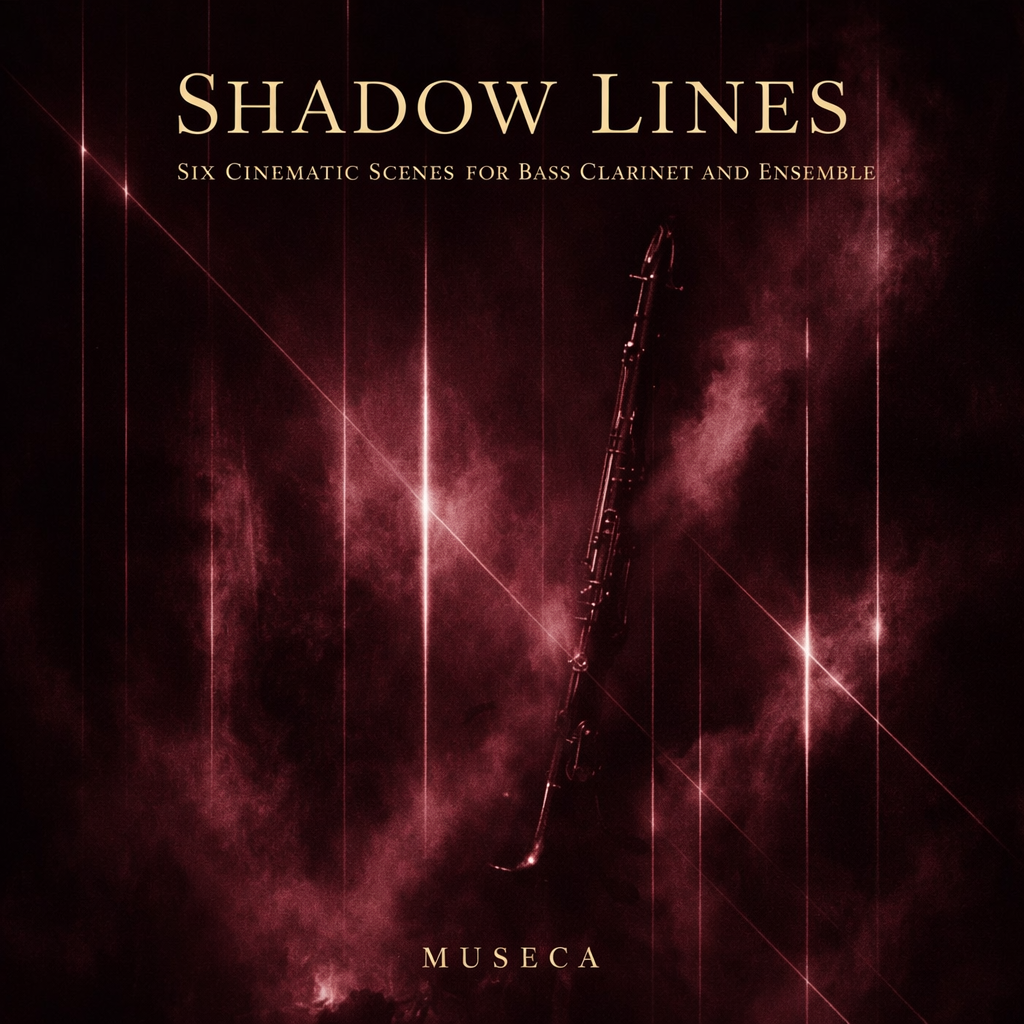
Shadow Lines
Six Cinematic Scenes for Bass Clarinet and Ensemble
There are instruments that declare themselves immediately, and there are instruments that seem to emerge from the edge of hearing, as if they had been waiting in the dark long before the music began. The bass clarinet belongs to the second kind. It does not arrive like a trumpet or blaze like a violin. It breathes its way into the listener’s imagination. Its voice is low, warm, shadowed, and uncannily human — capable of sorrow without sentimentality, menace without brutality, and tenderness without losing its mystery.
Shadow Lines was conceived as a film album without a film: six original instrumental scenes in which the bass clarinet becomes the central dramatic voice. Across these pieces, it is not treated merely as orchestral color, but as narrator, witness, and hidden protagonist. Sometimes it moves through suspended corridors of unease; sometimes it sings like a memory too deep for words; sometimes it hovers at the threshold between the psychological and the supernatural. Strings, harp, low woodwinds, and dark chamber-orchestral textures surround it not as decoration, but as architecture — spaces through which the bass clarinet passes, listens, warns, and remembers.
The album draws upon the long cinematic life of the bass clarinet as an instrument of tension, inwardness, dread, and dark lyric beauty. Yet these six tracks are not imitations of existing scores. They are original cue-poems, shaped by the logic of film music: opening atmosphere, obsession, character, estrangement, ritual, and end-credits release. Each track presents the instrument in a different dramatic role, while the album as a whole remains unified by a single guiding idea: that the bass clarinet can carry an entire emotional world from within the shadows.
If these pieces have a common subject, it is not simply darkness, but the many kinds of feeling that live inside it — grief, secrecy, wonder, danger, memory, and the strange beauty of what remains unresolved. Shadow Lines is music for imagined images, for stories half seen, for rooms still holding their silence after the characters have gone. Above all, it is an album about voice: the voice from below, from behind, from within — the voice of the bass clarinet, speaking at last in full.
The Voice of the Depths is a monograph devoted to one of music’s most haunting and compelling voices: the bass clarinet. Rich, dark, and remarkably expressive, this instrument has long occupied a unique place in both classical concert music and film scoring, where it can suggest mystery, solitude, menace, lyricism, and profound emotional depth.
Liner Notes
Opening Corridor
The album begins not with a declaration, but with an arrival. The bass clarinet steps forward as a solitary presence, as though entering a dim hallway already charged with memory. This opening cue establishes the instrument in its most cinematic role: not merely as color, but as atmosphere itself — warm, shadowed, and psychologically alert. The piece draws on the bass clarinet’s long association with unease, introspection, and the uncanny, allowing the listener to cross the threshold into a world where every sound suggests a story just out of sight.
The Hidden Room
Here the bass clarinet becomes an instrument of obsession. A repeating figure circles inward, patient and inescapable, while the ensemble seems to breathe around it rather than accompany it. This track is built in the spirit of the bass clarinet’s function in psychological film scoring: a structural pulse, a source of pressure, a voice that turns suspense into architecture. The effect is not overt terror, but elegant dread — the sense that something concealed is gathering force behind a locked door.
Ashes of the Heart
The third scene turns from suspense toward character. The bass clarinet sings here with grave tenderness, its low register carrying a melody that feels deeply personal, almost confessional. This is the instrument at its most humane: sorrowful without sentimentality, dark without losing warmth. In film terms, it functions as an emotional signature, the kind of timbre that can define a soul in a few phrases. The cue is meant to feel like memory after loss — intimate, bruised, and unforgettable.
Alien Chamber
With this track, the album crosses into estrangement. Small oscillations, suspended harmonies, and uneasy spacing turn the bass clarinet into an uncanny presence — not quite human, not quite mechanical, but hovering somewhere in between. The instrument’s darker timbre and capacity for eerie articulation make it ideal for music of enclosure, distance, and altered perception. This is the album’s most disorienting space: a chamber of shadows, signals, and unanswered meanings.
The Ritual Below
This cue places the bass clarinet at the center of a ceremonial darkness. Rather than sharing the emotional burden with the ensemble, it dominates the scene as the principal voice, surrounded by low sonorities and sparse gestures that feel archaic, secretive, and inward. The piece reflects one of the most compelling lessons of the research behind this album: that the bass clarinet can carry an entire dramatic fabric on its own, sustaining menace, mystery, and expressive gravity without surrendering its lyric identity. It is the deepest chamber in the cycle — a place of shadowed rite rather than overt action.
End Credits in Smoke
The final track releases the tension without resolving every question. The bass clarinet returns not as threat, but as witness — reflective, darkly luminous, and touched by resignation. What remains at the end of the album is the instrument’s singular paradox: a voice from the depths that can suggest grief, secrecy, menace, lyricism, and strange beauty all at once. This closing cue lets those qualities settle into their final form, like smoke after the story has ended but before the room has fully cleared.
Playlist
- Track 1 - Opening Corridor Museca 2:20
- Track 2 - The Hidden Room Museca 2:58
- Track 3 - Ashes of the Heart Museca 3:10
- Track 4 - Alien Chamber Museca 2:15
- Track 5 - The Ritual Below Museca 2:59
- Track 6 - End Credits in Smoke Museca 2:55