
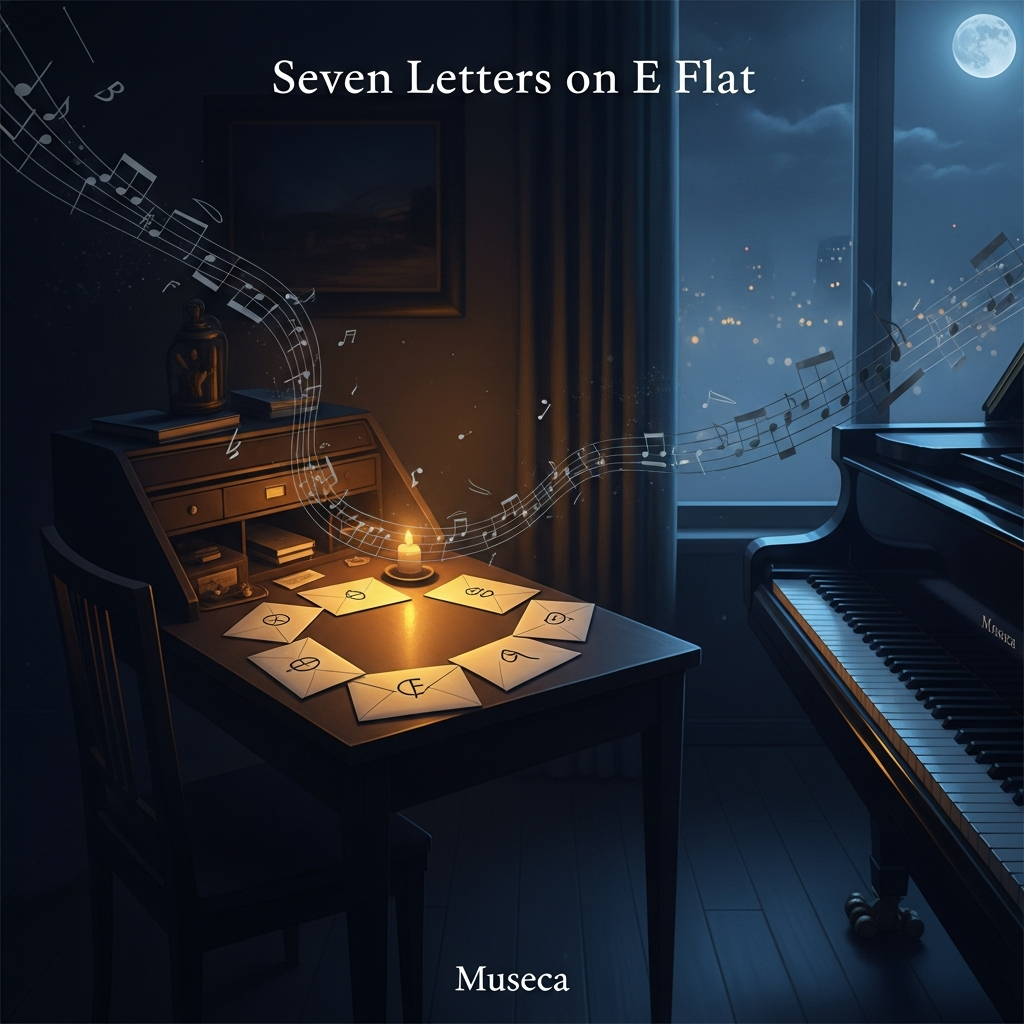
Seven Letters on E♭
Seven Letters on E♭ is a cycle of seven original solo-piano preludes, each written in one of the seven diatonic modes. The modes can be understood as seven distinct “personalities” drawn from the same family of notes—each defined by which scale degrees feel most stable, which tones feel like light, and which tones feel like shadow. In practical terms, the modes are:
Ionian (the familiar major mode): clear, balanced, and resolved
Dorian (minor with a natural 6): reflective, noble, quietly bright within sadness
Phrygian (minor with a lowered 2): intimate tension, closeness, and gravity
Lydian (major with a raised 4): luminous, lifted, and quietly ecstatic
Mixolydian (major with a lowered 7): open warmth, smile-without-finality
Aeolian (natural minor): pure minor weight, tender and direct
Locrian (with a lowered 2 and lowered 5): unsettled, fragile, and on the edge of resolution
These are not treated here as a classroom demonstration. They are treated as emotional lenses—seven ways to hear the same tonal center, seven inks used to write on the same page.
Chopin’s preludes were ideal vehicles for this kind of exploration because the prelude, in his hands, became a complete world in miniature: a single gesture, a single texture, a single mood—compressed into a short span with unmistakable intent. A Chopin-type prelude is not primarily about formal symmetry; it is about concentration. A single musical idea can bloom, darken, tighten, and dissolve in under two minutes—like a private thought said aloud only once. That makes the prelude form perfectly matched to modal writing. Modes thrive when the listener is invited to inhabit a color fully, without needing a long exposition or a grand argument. Each prelude in Seven Letters on E♭ therefore pairs a distinct mode with a distinct pianistic identity—arpeggio haze, chorale blocks, recitative pauses, moto perpetuo—so that the mode is felt in the hands as much as it is heard in the harmony.
The choice to center all seven preludes on E♭ is deliberate. E♭ sits in a poetic region of the piano—warm, vocal, and resonant—capable of supporting deep bass gravity while allowing the upper register to glow without turning brittle. It is a key that invites cantabile writing and subtle pedaling, and it carries a natural “midnight” character: intimate rather than brilliant, luminous rather than loud. Keeping one tonic throughout also makes the concept audible in the simplest way: you are always in the same room, but the lamplight changes. The tonal center remains constant; the emotional weather shifts.
Taken together, these seven pieces form a single statement: one piano, one tonal home, seven modal faces. Seven Letters on E♭ is an invitation to listen for fine differences—how a single altered scale degree can tilt the heart, how a familiar center can feel newly uncertain, newly radiant, newly tender. Each prelude is a letter sealed with the same address, written in a different hand.
Liner Notes
1) Prelude I — Letter Unsealed (E♭ Ionian)
The cycle opens in plain sight: E♭ as a warm, dependable home. A singing line rises as if the first sentence has been waiting all day to be written, while the accompaniment stays soft and steady—more breath than rhythm. This prelude establishes the album’s premise: the same tonic can hold many truths, beginning with clarity and quiet tenderness.
2) Prelude II — Ash on Velvet (E♭ Dorian)
Here, the atmosphere turns inward without turning bleak. Dorian’s signature brightness within minor—its natural sixth—adds a faint lift to the melancholy, like a memory that hurts but also steadies you. The motion feels rocking and intimate, with inner voices that sigh rather than declare, suggesting a letter written carefully, as if to avoid smudging the ink.
3) Prelude III — The Close Door (E♭ Phrygian)
This is the album’s closest whisper—tension brought near enough to feel personal. Phrygian’s lowered second degree creates a sense of closeness, like standing too near a secret and feeling the air change. Chordal recitative and measured silences shape the drama: phrases speak, stop, reconsider, and speak again—an unmailed letter folded and unfolded in the dark.
4) Prelude IV — Window of Light (E♭ Lydian)
Lydian opens the room. The raised fourth degree flashes like a sudden glint on glass, turning familiar harmony into something airborne and bright. Rippling arpeggios carry the music forward with a buoyant, suspended joy—radiant but never loud—before the light gently recedes, leaving the afterimage of its shimmer.
5) Prelude V — Salon After Midnight (E♭ Mixolydian)
A playful interlude with impeccable manners and a slightly crooked grin. Mixolydian’s lowered seventh softens the feeling of “full resolution,” letting phrases end with charm rather than finality. The pulse hints at dance—light, crisp, and conversational—like a late-night salon where laughter is polite, but the eyes say more than the words.
6) Prelude VI — Black Ink, Soft Hand (E♭ Aeolian)
The emotional gravity of the set gathers here. Aeolian—natural minor—speaks plainly, without the theatrical pull of a sharpened leading tone; the sadness feels honest, not staged. Chorale-like voicings and slow suspensions make each harmony feel weighted and inevitable, as if the letter is being written with a careful hand that refuses melodrama.
7) Prelude VII — The Unsteady Stair (E♭ Locrian)
The final letter is written from the edge. Locrian destabilizes the ground beneath the tonic—especially through its lowered second and lowered fifth—creating a restless, brittle electricity. Yet E♭ remains a recurring anchor, a hand on the rail as the steps shift. The motion tightens, the tension peaks, and the ending arrives like a clean cut: abrupt, controlled, and strangely inevitable.
Playlist
- Prelude I — Letter Unsealed (E♭ Ionian) souledout 2:11
- Prelude II — Ash on Velvet (E♭ Dorian) souledout 1:23
- Prelude III — The Close Door (E♭ Phrygian) souledout 2:17
- Prelude IV — Window of Light (E♭ Lydian) souledout 1:15
- Prelude V — Salon After Midnight (E♭ Mixolydian) souledout 2:24
- Prelude VI — Black Ink, Soft Hand (E♭ Aeolian) souledout 1:04
- Prelude VII — The Unsteady Stair (E♭ Locrian) souledout 1:47