
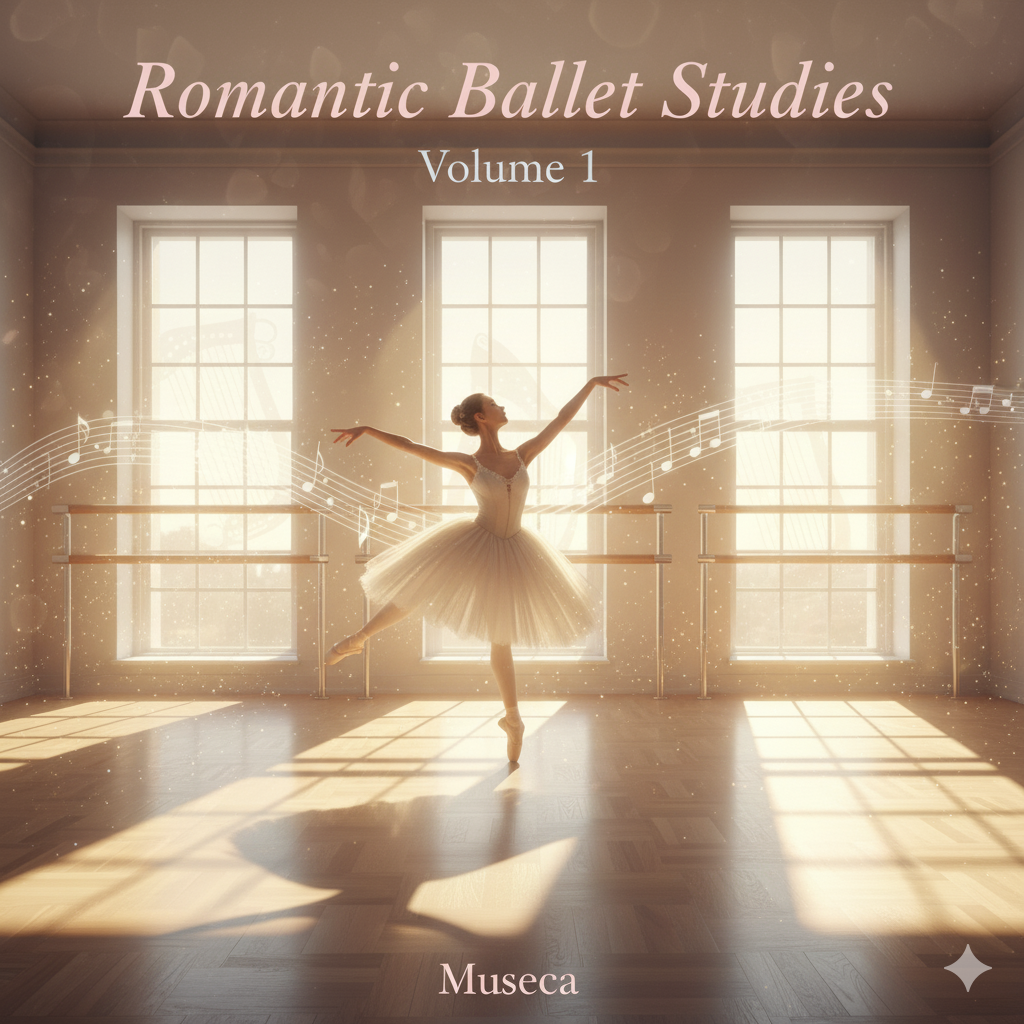
Romantic Ballet Studies, Vol. I — Introduction
This collection is a study in lyrical motion: brief, self-contained ballet scenes that explore how a single melody can breathe, turn, and return—much as two dancers find new meanings each time they meet. Written in the romantic idiom with a clear Tchaikovskian palette—muted strings, harp shimmer, warm woodwinds, and restrained percussion—the album treats dance not as spectacle but as refined storytelling through line and cadence.
Across ten tracks, the sequence follows a stage arc. A Processional opens the space with measured dignity; two intimate pas de deux trace the contour of a private vow; a Village Tarantella and a Mazurka de Salon offer character color and buoyancy; a modern Chamber-Folk Interlude (7/8) adds asymmetry and breath; a Pas de trois widens the conversation; and the Grand Pas (Adagio → Coda) closes with ceremonial grace and a radiant, economical flourish. Each cue is built for choreography—phrases are countable, cadences land where lifts belong, and textures thin exactly where the stage needs air.
Musically, the writing privileges cantilena and clarity. Melodies sing in the upper strings and oboe/clarinet, harmony shifts by purposeful suspensions rather than spectacle, and the harp binds scenes with discreet arpeggios. Sparkle—celesta, glockenspiel, triangle—appears only at structural peaks, never to overwhelm the line. Even in brighter numbers, the dynamic center remains human-scale, closer to the pit than to the cinema.
For listeners, the invitation is simple: hear the choreography inside the score. In the adagios, notice the long inhalations before cadences—the natural place for a promenade or supported turn. In the character dances, feel the accent on the second beat (mazurka) or the gentle forward lean of 6/8 (tarantella). In the 7/8 interlude, the asymmetry nudges the body toward new pathways while the harmony stays affectionate and familiar.
As a first volume, this album is both homage and toolkit—compact forms you can stage, adapt, or expand. The aim is practical beauty: music that stands on its own yet leaves space for bodies, light, and silence. If Romantic ballet is an art of breath and balance, these studies are ten ways to measure that breath—and ten invitations to dance it.
Liner Notes
Processional — Grand Entrance
A measured curtain-raiser in restrained hues. Low strings and soft horns shape a dignified line while harp threads quiet light between phrases. The cadence lands cleanly for a first tableau or geometric corps formation, offering room for deliberate épaulement and unison breath before the story begins.
A Lilt of Moonlight — Pas de deux
An intimate waltz drawn with muted strings and a clear violin cantilena, answered by cello. The harmony leans on suspensions rather than spectacle, inviting supported arabesques, promenade turns, and one unhurried lift at the apex of the phrase. The ending exhales to stillness, like a vow said softly.
Village Tarantella — Divertissement
A bright 6/8 interlude with spiccato strings, woodwind twirls, and tambourine grace notes. The tune moves like lanterns in a courtyard—quick, playful, and grounded. Ideal for a compact ensemble dance that refreshes the stage picture without breaking the album’s chamber scale.
Chamber-Folk Interlude (7/8)
Asymmetry with affection. A 2+2+3 pulse underpins oboe and violin in counter-song while harp ticks a modest ostinato. The line invites counter-canon and traveling floor patterns; the folk tint remains warm, as if Tchaikovsky stepped briefly into an uneven path and found it lyrical.
Courtyard Nocturne II — Pas de deux
A sister piece to “A Lilt of Moonlight,” this adagio waltz deepens the palette: solo violin, then a cello reply, a modest lift through a whole-step modulation, and a return under harp arpeggios. The orchestration keeps the pit close and the air clear for breath, balance, and the final niente.
Snowlit Arcade — Pas de trois
Three voices trace one thought. Viola begins with a dusky cantabile; violin and cello enter like companions who already know the steps. The central lift brightens to B♭ major, then the line settles back into muted strings and a clarinet glow. Space is left for counter-supported promenades and quiet recoveries.
Mazurka de Salon — Character Dance
An elegant nod to salon character tradition. The accent softens onto beat two; clarinet leads with pizzicato strings and harp taps. Steps can be crisp yet unforced—heel-toe patterns, quarter-turns, and diagonal crossings—giving the stage a change of color without widening the orchestral frame.
Valse of Lanterns — Corps Waltz
A valse lente that opens like a whisper and turns, almost imperceptibly, into a valse brillante. Celesta or glockenspiel appears only at the crest, brightening the ensemble without overwhelming it. Designed for circular patterns that expand and contract, ending with a quiet, shared bow of light.
Grand Pas — Adagio
Ceremonial and spacious. Long suspensions create natural ledges for promenades, arabesques, and balances. Harp arpeggios bind each breath, while clarinet and soft horns color the cadence. The music favors poise over volume; every phrase feels like a held hand.
Grand Pas — Coda
A concise valse brillante to gather the themes and send them home. Strings and woodwinds trade rapid figures; triangle and celesta sketch the edges. The close is radiant but disciplined, finishing with a subito pianissimo that leaves the dancers—and the audience—standing in a clear, luminous hush.
Playlist
- Processional / Grand Entrance (2/4 or 4/4) Museca 2:33
- A Lilt of Moonlight — Pas de deux Museca 3:00
- Village Tarantella — Divertissement Museca 2:31
- Chamber-Folk Interlude (7/8) Museca 4:18
- Courtyard Nocturne II — Pas de deux Museca 2:27
- Snowlit Arcade — Pas de trois Museca 2:00
- Mazurka de Salon — Character Dance Museca 2:12
- Valse of Lanterns — Corps Waltz Museca 3:03
- Grand Pas — Adagio Museca 3:02
- Grand Pas — Coda Museca 2:42