
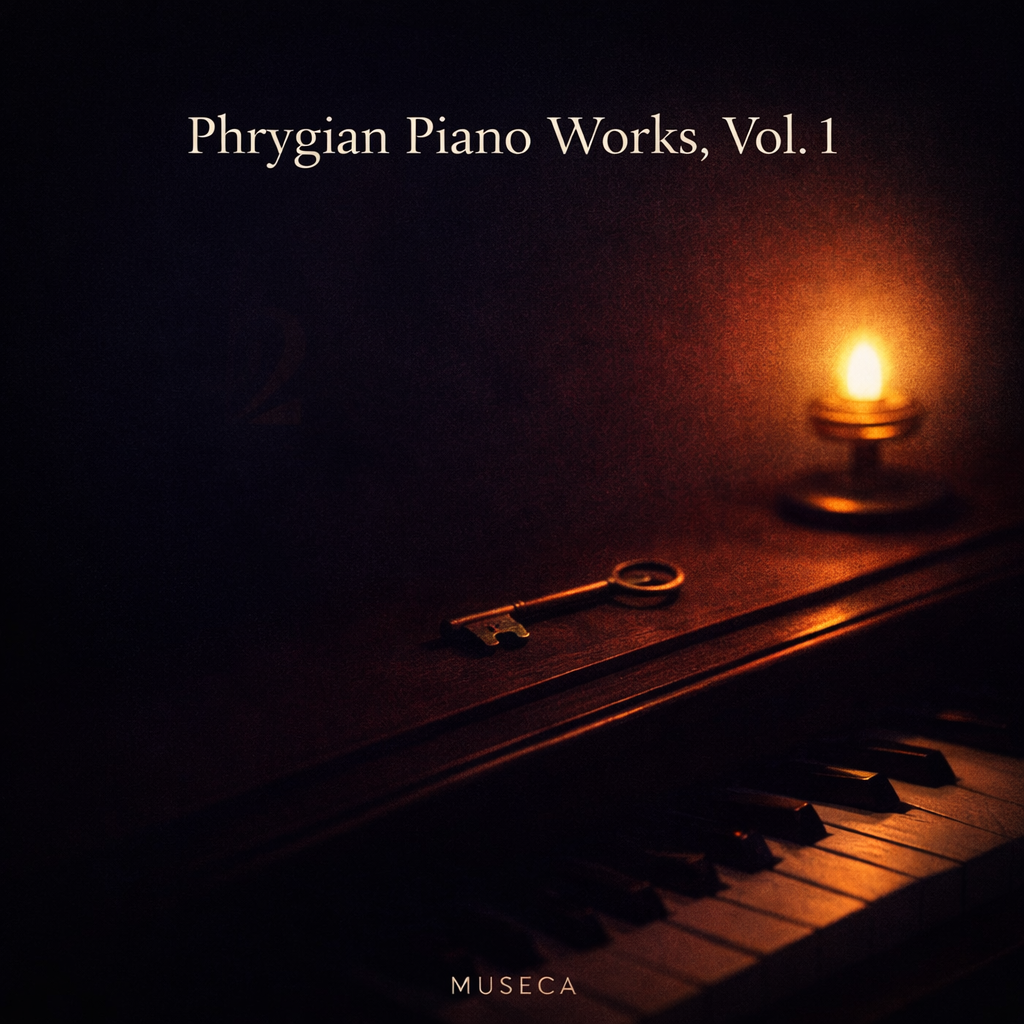
Phrygian Piano Works, Vol. 1 — Introduction
The Phrygian mode places tension at the threshold. On the piano, that tension is intimate—felt in the fingertips where the tonic brushes against the lowered second and refuses to resolve. Rather than broadcasting drama, Phrygian compresses it, turning harmony into breath pressure and voicing into architecture. This volume explores that pressure across eight short forms—etude, nocturne, intermezzo, toccata, elegy, and prelude—written for solo piano with occasional, understated duo colors.
The language here is deliberately elemental: tonic pedals, i↔♭II pivots, and lines that orbit instead of “arrive.” Voicings favor low–mid resonance and close intervals; rubato is used to suspend cadence rather than to inflate it. Where Dorian opens and Aeolian laments, Phrygian watches—lamplight in a corridor, the soft geometry of a courtyard at night. Production remains natural and close: felt hammers, clear decay, and room tone that keeps the listener within arm’s length of the keys.
The sequence traces a quiet arc from study to steel. “Etude in C Phrygian: Crossing Lamps” establishes the motor—the left-hand ostinato as moving floor—while “Nocturne in E Phrygian: Lamplight” shows how the same harmony can exhale. “Intermezzo in D…,” “Toccata in A…,” and “Elegy in B…” rotate character without abandoning the modal center, and “Prelude in F♯ Phrygian: Iron Veins” nods to heavier materials, binding this acoustic set to the broader Museca canon.
Above all, these pieces are designed to be playable, recordable, and re-arrangeable: concert takes, intimate room versions, or chamber doubles (piano + cello) without rewriting the harmonic skeleton. The result is a small atlas of Phrygian pianism—music that carries its own light, walks at a measured pace, and makes a virtue of what it refuses to resolve.
Liner Notes
The Weight of a Key
A study in restraint: tonic pedal and close-voiced chords let the left hand carry gravity while the right hand sketches brief illuminations. Every cadence is softened—more inhaled than spoken.
The Close Door Prelude (E-flat Phrygian)
A short preface with the hinges visible. The lowered second is treated tenderly, turning the opening into a room of breath and wood, where the melody seems to glance back before stepping through.
Etude in C Phrygian: Crossing Lamps
An ostinato left hand lays a moving floor (i↔♭II) over which a lyrical right hand threads lantern motifs. The mechanics are audible by design—virtuosity as quiet architecture.
Nocturne in E Phrygian: Lamplight
Rubato suspends the clock. Low-mid voicings absorb the semitone’s charge, so the tension becomes warmth rather than alarm—a candle halo around a minor thought.
Intermezzo in D Phrygian: Quiet Steps
Andante in 3/4, a corridor piece. A walking bass voice and gentle inner patterns keep the scene in motion without destination, as if pacing outside a closed door.
Toccata in A Phrygian: Doorways
Moto-perpetuo figures test the edges of articulation while keeping the harmony austere. Momentum is the subject; the toccata opens and closes a series of imaginary doors without crossing them.
Elegy in B Phrygian: Ashfall
Sparse, low register, air between phrases. Optional cello doubles the human breath in the line; the harmony refuses consolation, choosing witness over lament.
Prelude in F♯ Phrygian: Iron Veins
Forged piano color—harder hammers, controlled resonance—drives a steady pulse that nods to heavier materials. A final braid to the broader canon: pressure, poise, and the dignity of unresolved light.
Playlist
- The Weight of a Key Museca 2:33
- The Close Door (E♭ Phrygian) Museca 2:11
- Etude in C Phrygian: Crossing Lamps Museca 2:14
- Nocturne in E Phrygian: Lamplight Museca 3:10
- Intermezzo in D Phrygian: Quiet Steps Museca 3:53
- Toccata in A Phrygian: Doorways Museca 4:52
- Elegy in B Phrygian: Ashfall Museca 3:27
- Prelude in F♯ Phrygian: Iron Veins Museca 2:42