
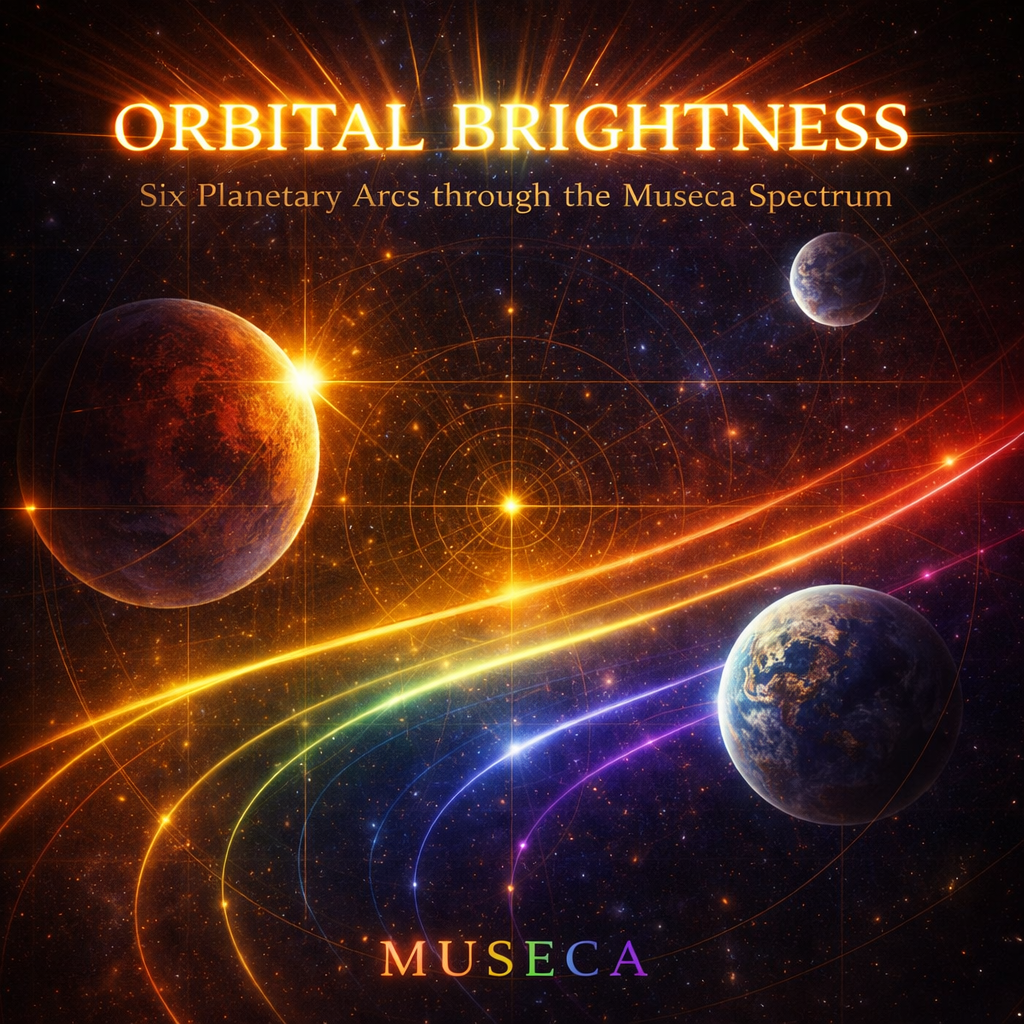
Orbital Brightness: Six Planetary Arcs through the Museca Spectrum begins as an homage to one of the great monuments of planetary imagination in Western music: Gustav Holst’s The Planets. Holst’s suite, composed during the 1910s, does not present the solar system in scientific terms, nor as a neutral astronomical survey. It presents seven planetary movements shaped by their astrological significance—Mars, the Bringer of War; Venus, the Bringer of Peace; Mercury, the Winged Messenger; Jupiter, the Bringer of Jollity; Saturn, the Bringer of Old Age; Uranus, the Magician; and Neptune, the Mystic. In that sense, Holst gives us the planets as mythic and psychological portraits: immense archetypes of temperament, force, and human feeling.
This album reveres that achievement, but it departs from it deliberately. Its deeper point of origin lies in Johannes Kepler’s Harmonice Mundi of 1619, one of the most extraordinary books in the history of thought. In that work, Kepler did not treat harmony as a mere metaphor. He sought to show that the world itself is structured by proportion: geometrical, musical, metaphysical, astrological, astronomical, and even spiritual. Harmonice Mundi unfolds across five books, moving from polygons and congruence to musical ratios, celestial configurations, and finally the harmonic relations of planetary motion itself. It is also the work in which Kepler announced what later became known as his third law of planetary motion.
That distinction defines the entire spirit of this album. Holst gives us the planets as dramatic beings, almost as masks of the soul. Kepler gives us the planets as relationships: proportion, interval, motion, spacing, and ordered difference. Holst’s universe is vivid, theatrical, and character-driven. Kepler’s universe is architectural, harmonic, and cosmological. Orbital Brightness stands between them. It honors Holst’s planetary imagination, but it re-envisions the heavens through Keplerian harmony and through the Museca spectrum of modal brightness, where modes are heard not merely as scales but as gradations of light, gravity, color, and inward pressure.
For that reason, the planets in this album are not treated primarily as Roman deities, nor as pieces of raw astronomical data. They are heard instead as arcs of tonal light. Mercury becomes quick brilliance and unstable flame; Venus, circular gold and radiant stillness; Mars, angular red force; Jupiter, breadth and air; Saturn, distant gravity. Their identities arise through modal color, harmonic tension, registral weight, and orbital character rather than through overt narrative depiction. In Museca’s language, each movement is a planetary field of brightness—a way of hearing motion as color, and color as harmonic condition.
One of the most important departures from Holst is the inclusion of Earth. Holst’s The Planets omits Earth, and several commentators and program-note traditions explain this omission by pointing to the suite’s astrological basis: Earth does not function in astrology as one of the planets in the same way the others do, because it is the point of reference. Holst himself emphasized that the work was inspired by astrological significance rather than by astronomy.
Museca restores Earth not as a correction to Holst, but as a necessary symbolic center. In this album, Earth is the hinge of breath: the listening world, the human midpoint, the place where cosmic relation becomes inner experience. If Mercury is swiftness, Venus serenity, Mars severity, Jupiter amplitude, and Saturn law, then Earth is the one planet that hears. It is the threshold between outward orbit and inward consciousness. Within the Museca brightness spectrum, Earth stands for mediation: between hope and sorrow, motion and stillness, heaven and embodiment. It is the planet not only beneath our feet, but within our hearing.
So this album may be understood as a homage to Holst’s planetary imagination, re-envisioned through Kepler’s Harmonice Mundi and the Museca spectrum of modal brightness. Holst remains the point of reverence. Kepler provides the deeper harmonic cosmology. Museca supplies the new compositional language. What results is neither a retelling of The Planets nor a literal realization of the old “music of the spheres,” but a new planetary suite in which the heavens are heard as modal arcs of light, gravity, proportion, and suspended concord.
Liner Notes
Mercury: Quick Arc of Fire
Mercury opens the album in a spirit of homage to Holst’s quicksilver imagination, but it is not conceived here as the witty messenger of astrological character alone. In The Planets, Mercury is agile, volatile, and airborne; in Orbital Brightness, that agility is re-heard through Kepler’s world of proportion and motion. Kepler’s Harmonice Mundi sought relationships between planetary movement and harmonic order, and Mercury, with its rapid changeability, becomes the ideal emblem of unstable brilliance. Holst gives Mercury personality; Kepler suggests velocity and ratio; Museca translates both into brightness. The result is a movement of flicker, leap, and luminous restlessness: not a portrait of a god, but a field of quick-burning tonal light. Kepler’s larger project in Harmonice Mundi was to connect geometry, music, and planetary motion into one ordered cosmos, and Mercury here becomes the album’s first spark of that idea.
Venus: Circle of Gentle Gold
Venus bows most directly to Holst in atmosphere, because Holst’s Venus remains one of the great musical visions of repose and inward peace. Yet this track departs from Holst’s mythic-psychological stillness by imagining Venus less as a divine feminine archetype and more as a nearly circular harmonic condition. Kepler’s universe is one of measured relation, and Venus becomes here a planet of smooth continuity, radiant equilibrium, and tonal calm. In Museca terms, Venus belongs to the gentler side of the brightness spectrum: glowing, centered, and almost without friction. Where Holst gives us peace, Museca gives us circular serenity; where Holst paints a personality, Kepler and Museca suggest a proportion of light.
Earth: The Hinge of Breath
This movement marks the album’s most explicit departure from Holst. The Planets omits Earth because Holst’s suite is based on astrology rather than astronomy; Earth is the point of reference, not one of the astrological planetary characters in his design. Museca restores Earth deliberately. In this album, Earth is not merely another planet added for completeness. It is the symbolic center of hearing: the place where cosmic relation becomes human feeling. Holst’s suite gazes outward toward archetypal presences; Orbital Brightness turns inward here and asks what it means for the listener, on Earth, to stand inside Kepler’s harmonic cosmos. Earth is therefore the hinge of the entire work — between brightness and shadow, knowledge and longing, orbit and breath. It is the one movement that sounds not only planetary, but inhabited.
Mars: Red Angle
Holst’s Mars is one of the most famous embodiments of relentless force in orchestral music, and its shadow inevitably lies over any later planetary suite. This track acknowledges that inheritance, but it moves away from the idea of war as spectacle and toward something more severe and abstract. Kepler’s cosmos is not primarily theatrical; it is mathematical, tensile, and exact. Thus Mars becomes here an angular red force — not simply violence, but sharpness, pressure, and resistant motion. If Holst’s Mars is war, Museca’s Mars is orbital severity. Its meaning lies in friction: the hard edge in the brightness spectrum, the planet where interval becomes angle and energy becomes constraint. The movement therefore belongs as much to Kepler’s geometry as to Holst’s drama.
Jupiter: Broad House of Air
Holst’s Jupiter is exuberant, expansive, and magnificently public. This movement preserves the sense of breadth, but it withdraws from overt celebration. In the Museca conception, Jupiter is not chiefly jollity but amplitude: the spacious architecture of brightness at its most generous. It is the planet of room, lift, and noble breathing. Here Kepler’s influence is especially important, because Jupiter is heard less as mythic festivity and more as harmonic proportion on a grand scale. The music suggests a great atmosphere that can hold many things without strain. If Mercury flickers and Mars cuts, Jupiter receives and spans. It is the largest interior chamber in the suite — Holstian in width, Keplerian in order, and Museca in tonal air.
Saturn: The Far Foundation
Holst’s Saturn, subtitled The Bringer of Old Age, is among the deepest and most haunting movements in The Planets, and this track responds to that gravity with reverence. But where Holst hears age, processional inevitability, and existential weight, Museca hears Saturn as lawful distance: the far foundation of the planetary field. Kepler’s Harmonice Mundi is not merely about beauty; it is about structure, necessity, and the intelligibility of relation. Saturn becomes the emblem of that far law. Its darkness is not chaos, but order seen at a great remove. In the brightness spectrum, Saturn resides near the edge where illumination thins into austerity. The track thus speaks to Holst’s solemn majesty while shifting the focus from mortality to cosmic patience.
The Sixth Heaven Is Listening
This movement leaves the direct lineage of Holst’s planetary titles and enters more fully into the Keplerian imagination. Kepler did not simply describe planets as isolated objects; he sought the harmony of their relations, the way the cosmos itself might be understood as ordered through number, interval, and motion. The Sixth Heaven Is Listening represents that threshold. It is the point in the album where individual planetary identities begin to lean toward one another. Rather than depicting a single celestial body, the music suggests a universe in attentiveness: layered modes, partial alignments, and suspended expectation. Holst’s suite moves from planet to planet as a sequence of character worlds; this movement asks what lies between them. In Museca’s language, it is the space where separate brightness fields begin to resonate.
Orbital Brightness
The final track is the album’s fullest statement of departure. Holst’s The Planets ends in mystery with Neptune and its fading offstage chorus; Orbital Brightness answers that tradition by offering not mysticism alone, but synthesis. Kepler’s great ambition in Harmonice Mundi was to hear the world as one intelligible order — geometric, musical, planetary, metaphysical — and this closing movement gathers the album’s brightness fields into a single spiral arc. The choir, introduced only here, symbolizes revelation: not a doctrinal heaven, but the moment when proportion becomes audible as radiance. If Holst gives us the planets as mythic presences, and Kepler gives us the heavens as harmonic relationships, then this final movement gives us the Museca response: a cosmos heard as modal light. It does not conclude with a hard cadence because the universe, in this conception, is never merely finished. It remains suspended, luminous, and still unfolding.
Playlist
- Track 1 - Mercury: Quick Arc of Fire Museca 2:18
- Track 2 - Venus: Circle of Gentle Gold Museca 3:00
- Track 3 - Earth: The Hinge of Breath Museca 2:12
- Track 4 - Mars: Red Angle Museca 2:44
- Track 5 - Jupiter: Broad House of Air Museca 3:25
- Track 6 - Saturn: The Far Foundation Museca 3:59
- Track 7 - The Sixth Heaven Is Listening Museca 3:19
- Track 8 - Orbital Brightness Museca 2:17
- Track 9 - The Eternal Choir Museca 2:33