
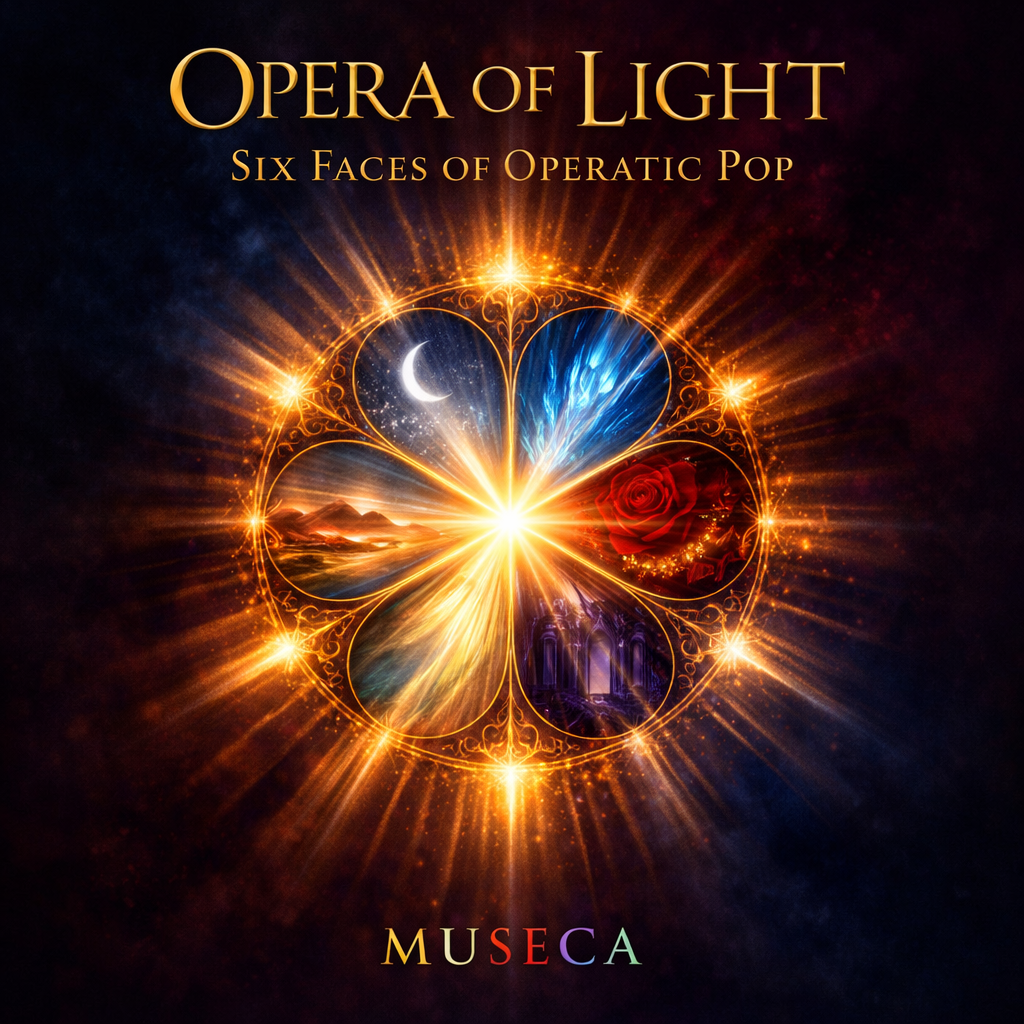
Operatic pop stands at the meeting point of two traditions that were never as far apart as they sometimes seem. Opera, which emerged in late sixteenth-century Florence, was conceived as a union of music, theater, heightened emotion, and vocal spectacle. Centuries later, classical crossover and opera-pop revived that same instinct in a modern form: the trained or semi-operatic voice placed inside the structures, production language, and emotional directness of popular music. In the late twentieth century, artists such as Sarah Brightman, Andrea Bocelli, and later ensembles like Il Divo helped bring this hybrid sound to a large international audience, while producers such as Frank Peterson expanded it by combining orchestral writing with ambient electronics, cinematic textures, and global sonorities.
This album is conceived as a compact survey of that expressive territory. Rather than treating operatic pop as a single sound, it approaches the genre as a family of related forms. Each track explores a different branch of the style, showing how the operatic voice can inhabit radically different musical worlds while retaining its essential qualities: vocal elevation, long melodic line, theatrical feeling, and an instinct for transcendence. The result is not merely a sequence of songs, but a gallery of six operatic-pop archetypes.
The first style represented here is the Classical Crossover Ballad. This is perhaps the most publicly recognizable form of operatic pop: lyrical melody, lush strings, piano-led harmony, gradual crescendos, and a vocal line that preserves operatic breadth while remaining song-driven and intimate. Its power lies in emotional clarity. It does not attempt to stage an opera scene in full; instead, it condenses operatic yearning into the architecture of the modern ballad. In this mode, the orchestra supports the singer as a field of atmosphere and uplift, and the chorus becomes the place where private feeling opens into something universal.
The second style is Opera-Techno / Symphonic Pop. Here the operatic voice is placed against electronic pulse, ambient synthesis, sequenced rhythm, and cinematic production. This branch became especially distinctive in the 1990s and 2000s, when crossover producers fused soprano lines, choir textures, and orchestral gestures with studio-built sound worlds more commonly associated with electronica and dream pop. In this setting, the voice seems to float above time: ancient in technique, modern in environment. The contrast is the point. The beat gives motion; the soprano gives altitude.
The third style is Neo-Romantic Popera. This form looks back most directly to nineteenth-century Italian opera—to the melodic sweep, emotional urgency, and harmonic generosity associated with the Romantic stage—while recasting those values inside a contemporary song format. Here the emphasis is on fate, longing, memory, and exalted love. The line wants to sing expansively; the harmony wants to support revelation; the orchestration wants to bloom. If the classical crossover ballad is intimate and accessible, neo-romantic popera is unabashedly grand. It welcomes rubato, climax, and vocal splendor.
The fourth style is Gothic / Baroque Operatic Pop. This is the nocturnal branch of the genre: darker harmony, cathedral resonance, tolling bells, choir shadows, organ sonority, and ornamental figures that evoke older sacred or courtly music. It often draws on the psychological weight of liturgical space and the dramatic chiaroscuro of Baroque gesture, but places those elements inside a modern dramatic song frame. The result is neither pure early music nor pure dark pop. It is a stylized theatrical darkness—elegant, ritualistic, and emotionally heightened.
The fifth style is World Operatic Fusion. Classical crossover has long been enriched by non-Western timbres, modal inflections, and percussion traditions, especially when artists and producers sought textures that could suggest distance, myth, desert, sea, pilgrimage, or dream. In this branch, operatic singing is not abandoned; rather, it is reframed by instruments and rhythmic languages drawn from beyond the standard European orchestra. The voice becomes a traveler across musical geographies. The atmosphere becomes more sensuous, more spatial, and often more mysterious.
The sixth and final style is Duet / Ensemble Operatic Pop. If opera is fundamentally dramatic, then dialogue must eventually enter. The duet form allows operatic pop to become relational: not merely a singer expressing emotion, but voices encountering one another, answering, blending, separating, and rejoining. This branch includes romantic duets, anthem-like pairings, and ensemble finales in which harmony itself becomes narrative. In such music, the crossover ideal reaches one of its most satisfying forms: the immediacy of pop song joined to the interpersonal drama of opera.
Taken together, these six tracks propose that operatic pop is not a novelty genre, but a flexible and serious expressive language. It can be lyrical or electronic, sacred or sensual, intimate or monumental, solitary or dialogic. Its uniqueness lies in its refusal to choose between refinement and accessibility, between vocal discipline and popular immediacy, between old-world resonance and modern production. This album is an invitation to hear those possibilities side by side: six faces of one radiant form.
Liner Notes
Sanctuaire de Lune inhabits the world of the Classical Crossover Ballad, where operatic technique is distilled into a lyrical, emotionally direct form. The French language lends a natural softness and fluidity to the melodic line, allowing the soprano to move between intimacy and elevation without rupture. The orchestration—piano, strings, and subtle world percussion—supports a gradual crescendo architecture typical of the style: the voice begins in near-whispered reflection and expands into a luminous, sustained chorus. This is operatic expression translated into the language of the modern ballad, where the drama is internal and the climax is emotional rather than theatrical.
Lyrics
[Intro – Whispered, ambient]
Chaque nuit… je reviens… au sanctuaire de lune…
[Verse 1 – soft, flowing soprano]
Sous la clarté de l’argent pur,
Je marche sur l’eau du futur.
La lune m’ouvre ses bras fermés,
Sanctuaire des âmes aimées.
[Chorus – rising, orchestral]
Sanctuaire de lune, emporte-moi,
Dans les rêves où l’amour ne meurt pas.
Chante encore nos vœux oubliés,
Par-delà les cieux étoilés.
[Verse 2 – emotional swell]
Un souffle ancien m’appelle là-bas,
Une voix que seul mon cœur voit.
Même l’ombre devient lumière,
Dans ce temple lunaire.
[Chorus – fuller, layered]
Sanctuaire de lune, emporte-moi,
Dans les rêves où l’amour ne meurt pas.
Chante encore nos vœux oubliés,
Par-delà les cieux étoilés.
[Outro – whispered, fading]
Emporte-moi… là où la lune veille…
Étoile de Verre shifts into Opera-Techno / Symphonic Pop, where the operatic voice is placed within a hybrid sonic environment of electronic pulse and cinematic orchestration. The French text floats above ambient textures and rhythmic propulsion, creating a dual temporal experience: the beat suggests forward motion, while the soprano line feels suspended, almost timeless. This contrast defines the sub-style. The voice does not compete with the production; it transcends it. The result is a crystalline sound world in which fragility and power coexist, and where classical vocal agility is refracted through modern studio architecture.
Lyrics
[Intro – Whispered voice over ambient piano and synth]
Je suis née dans le silence… d’une lumière oubliée.
[Verse 1 – gentle, expressive soprano]
Sous un ciel brisé de marbre froid,
Je marchais seule, sans voix, sans foi.
Une étoile m’appelait sans bruit,
Verre pur dans la nuit qui luit.
[Chorus – soaring and powerful, supported by strings and beat]
Étoile de verre, éclate en moi,
Chante ma peine, efface mes lois.
Monte plus haut que mes douleurs,
Danse au sommet de mes couleurs.
[Verse 2 – building intensity]
Chaque éclat, un chant oublié,
Ma voix s’élève, libérée.
Même cassée, je peux briller,
L’écho du ciel vient me porter.
[Chorus – repeat with greater strength, optional choral support]
Étoile de verre, éclate en moi,
Chante ma peine, efface mes lois.
Monte plus haut que mes douleurs,
Danse au sommet de mes couleurs.
[Outro – Whispered voice again, fading out with ambient textures]
Et même brisée… je suis lumière.
La Rose et il Destino embodies Neo-Romantic Popera, the most direct heir to nineteenth-century operatic expression. Sung in Italian—the natural language of bel canto—it embraces expansive phrasing, emotional immediacy, and melodic generosity. The harmonic language supports long arcs of tension and release, while the orchestration remains rooted in piano and strings, avoiding modern rhythmic intrusion. This is the most “operatic” of the tracks in its emotional posture: fate, longing, and devotion are not implied but declared. The voice is given full license to bloom, culminating in a climactic high register that affirms the style’s allegiance to Romantic intensity.
Lyrics
[Intro – soft, rubato piano]
Nel silenzio… ti cercavo…
[Verse 1]
Tra le ombre del mio destino,
Ho trovato il tuo respiro.
Come rosa nella notte,
Sei fiorita dentro me.
[Pre-Chorus – growing intensity]
Ogni sogno mi conduce a te,
Come vento che non si fermerà…
[Chorus – soaring, Puccini-style]
La rosa e il destin, siamo noi,
Due cuori persi tra cielo e poi…
Se il tempo cade, resterai,
Nel canto eterno che non muore mai!
[Verse 2 – more impassioned]
Tra le lacrime e la luce,
La tua voce mi conduce.
Anche quando il mondo trema,
Sei la mia eternità.
[Pre-Chorus]
Ogni strada torna sempre a te,
Come fuoco che non morirà…
[Chorus – expanded, more orchestration]
La rosa e il destin, siamo noi,
Due anime intrecciate ormai…
Se il giorno svanisce, tu sarai
La luce viva che mi guiderà!
[Bridge – quiet to explosive]
Se perdo il cielo…
Se cado giù…
Il tuo amore… mi rialzerà!
[Final Chorus – full orchestral climax]
La rosa e il destin, siamo noi!
Grido al mondo: non finirà mai!
Nel mio cuore vivrai, vivrai—
Per l’eternità!
[Outro – sustained high note, orchestral resolution]
Per l’eternità…
Les Cloches de Minuit enters the shadowed domain of Gothic / Baroque Operatic Pop. Here, Latin and French intertwine to evoke both sacred ritual and personal introspection. The sonic palette—pipe organ, harpsichord, tolling bells, and choral textures—draws on the resonance of cathedral space and the ornamental gestures of early music, yet the structure remains that of a modern song. Darkness is not merely thematic; it is harmonic and textural. The track unfolds like a nocturnal liturgy, where the soprano voice navigates between solitude and collective memory, supported by a choir that functions as both echo and witness.
Lyrics
[Intro – distant bells, whispered choir]
Nocte profunda…
Sub umbra caeli…
Les cloches sonnent…
[Verse 1]
Campanae noctis vocant me,
Per ventos nigros, per somnia.
Sous les voûtes du ciel fermé,
Je marche seule vers minuit.
[Pre-Chorus]
Audi… audi vocem umbrarum,
Le silence ouvre ses bras.
In tenebris ardet hora,
Et mon âme tremble en moi.
[Chorus]
Les cloches de minuit, sonnez pour moi,
In nocte sacra, lux abscondita.
Au cœur des pierres, le ciel me voit,
Et l’ombre chante: requiem, gloria.
[Verse 2]
Organa plorant dans le froid,
Et l’écho tombe autour de moi.
Sub luna mortua suspirans,
Cor meum cherche encore la foi.
[Pre-Chorus]
Audi… audi vocem umbrarum,
Comme un souffle dans les croix.
In tenebris ardet nomen,
Que la nuit garde pour moi.
[Chorus]
Les cloches de minuit, sonnez pour moi,
In nocte sacra, lux abscondita.
Au cœur des pierres, le ciel me voit,
Et l’ombre chante: requiem, gloria.
[Bridge – quieter, organ and choir]
Dies obscura… hora vera…
Sous la cendre, une étoile est là.
Miserere… miserere…
Minuit s’ouvre comme un roi.
[Final Chorus – full choir, bells, soaring soprano]
Les cloches de minuit, sonnez pour moi,
In nocte sacra, rex memoria.
Au fond des âges, j’entends ta voix,
Requiem aeternam… et lux in mea.
[Outro – fading bells, choir]
Lux in mea…
Les cloches… de minuit…
Jardin des Sables explores World Operatic Fusion, where the operatic voice becomes a vessel moving across cultural timbres and modal landscapes. French text is interwoven with non-lexical vocalizations that suggest Middle Eastern and Mediterranean traditions, while instruments such as oud, ney, and frame drums reshape the harmonic and rhythmic field. The soprano line adapts subtly—retaining its classical foundation while absorbing ornamentation and phrasing influenced by these traditions. The result is not pastiche but synthesis: a sound world in which geography dissolves, and the voice becomes both narrator and traveler within an imagined sonic desert.
Lyrics
[Intro – airy, free, with oud and ney]
Ah… ya leïl…
Dans le souffle du sable…
Ah… ya nour…
[Verse 1]
J’ai vu la lune au bord des dunes,
Tracer ton nom dans la poussière.
Le vent portait des voix anciennes,
Comme un secret venu des mers.
[Pre-Chorus]
Et mon cœur suivait la lumière,
Sous les étoiles sans sommeil.
Une prière dans le silence,
Un feu doré sous le ciel.
[Chorus]
Jardin des sables, ouvre-toi,
Cache mon rêve entre tes bras.
Dans chaque grain brûle une mémoire,
Un chant d’amour, un chant d’espoir.
[Verse 2]
Les palmes d’ombre et de silence
Bercent la nuit de leur parfum.
J’entends ton pas dans la distance,
Comme un mirage qui me revient.
[Pre-Chorus]
Et mon âme boit la poussière
Comme un vin d’or et de soleil.
Je vais vers toi, voix invisible,
Au-delà du temps qui veille.
[Chorus]
Jardin des sables, ouvre-toi,
Cache mon rêve entre tes bras.
Dans chaque grain brûle une mémoire,
Un chant d’amour, un chant d’espoir.
[Bridge – freer, more ornamented]
Ah ya leïl… ah ya leïl…
Le désert chante en moi…
Ah ya nour… ah ya nour…
Et ton visage est roi…
[Final Chorus – full orchestral/world fusion climax]
Jardin des sables, garde-moi,
Sous ton ciel vaste et sans émoi.
Dans chaque grain renaît l’histoire,
D’un cœur perdu devenu gloire.
[Outro – fading ney and breathy vocalise]
Ah… ya leïl…
Jardin des sables…
Entre le Ciel et Nous concludes the album in the form of Duet / Ensemble Operatic Pop, where the operatic voice becomes relational rather than solitary. The interplay between soprano and tenor—across French and English—creates a dialogic structure that mirrors the dramatic roots of opera itself. Each voice carries its own emotional trajectory, and their convergence in the chorus produces a harmonic and narrative resolution. The addition of ensemble textures and choir in the final section expands the scale, transforming the duet into a collective ascent. In this sub-style, operatic pop reaches its most theatrical expression: not through staging, but through the meeting of voices that affirm one another in sound.
Lyrics
[Intro – soft piano, distant strings]
[FEMALE, softly]
Entre le ciel… et nous…
[MALE, softly]
There is a light… still waiting…
[Verse 1 – Female]
Entre le ciel et nous, j’entends
Le souffle ancien du firmament.
Ton nom s’élève dans la nuit,
Comme une étoile qui me suit.
[Verse 2 – Male]
Between the dark and dawn’s first fire,
I hear your voice lift something higher.
A quiet flame beyond the blue,
A world becoming bright through you.
[Pre-Chorus – alternating]
[FEMALE]
Si tout s’efface…
[MALE]
If shadows fall…
[FEMALE]
Je te retrouverai…
[MALE]
I will hear your call…
[Chorus – duet]
Entre le ciel et nous, there is a song,
A place where broken hearts still belong.
Au-delà du temps, beyond the night,
We rise together into light.
[Verse 3 – Female then Male]
[FEMALE]
Les vents du sort n’ont rien changé,
Mon cœur vers toi s’est dirigé.
[MALE]
No distance ever closed the way,
Your echo turned my night to day.
[Pre-Chorus – fuller]
[FEMALE]
Même le silence…
[MALE]
Even the end…
[FEMALE]
Ne peut briser…
[MALE]
What love can mend…
[Chorus – duet, broader orchestration]
Entre le ciel et nous, there is a song,
A place where broken hearts still belong.
Au-delà du temps, beyond the night,
We rise together into light.
[Bridge – ensemble lift]
[FEMALE]
Je tombe et tu me guides…
[MALE]
You call and I believe…
[BOTH]
No star is ever lost
When two souls never leave.
[Final Chorus – full duet with choir]
Entre le ciel et nous, sing ever on,
Through every shadow, through every dawn.
Au-delà du temps, beyond all fear,
Your voice, your light, are always here.
Entre le ciel et nous, one flame, one sky,
One love that lives and does not die.
Ensemble enfin, our hearts take flight,
We rise together into light!
[Outro – sustained final note, choir under]
[FEMALE + MALE]
Into liiiight…
Dans la luuuumière…
Playlist
- Track 1 — Sanctuaire de Lune Museca 3:21
- Track 2 — Étoile de Verre (Star of Glass) Museca 3:32
- Track 3 — La Rose et il Destino Museca 3:59
- Track 4 — Les Cloches de Minuit Museca 4:03
- Track 5 — Jardin des Sables Museca 5:09
- Track 6 — Entre le Ciel et Nous Museca 4:42