
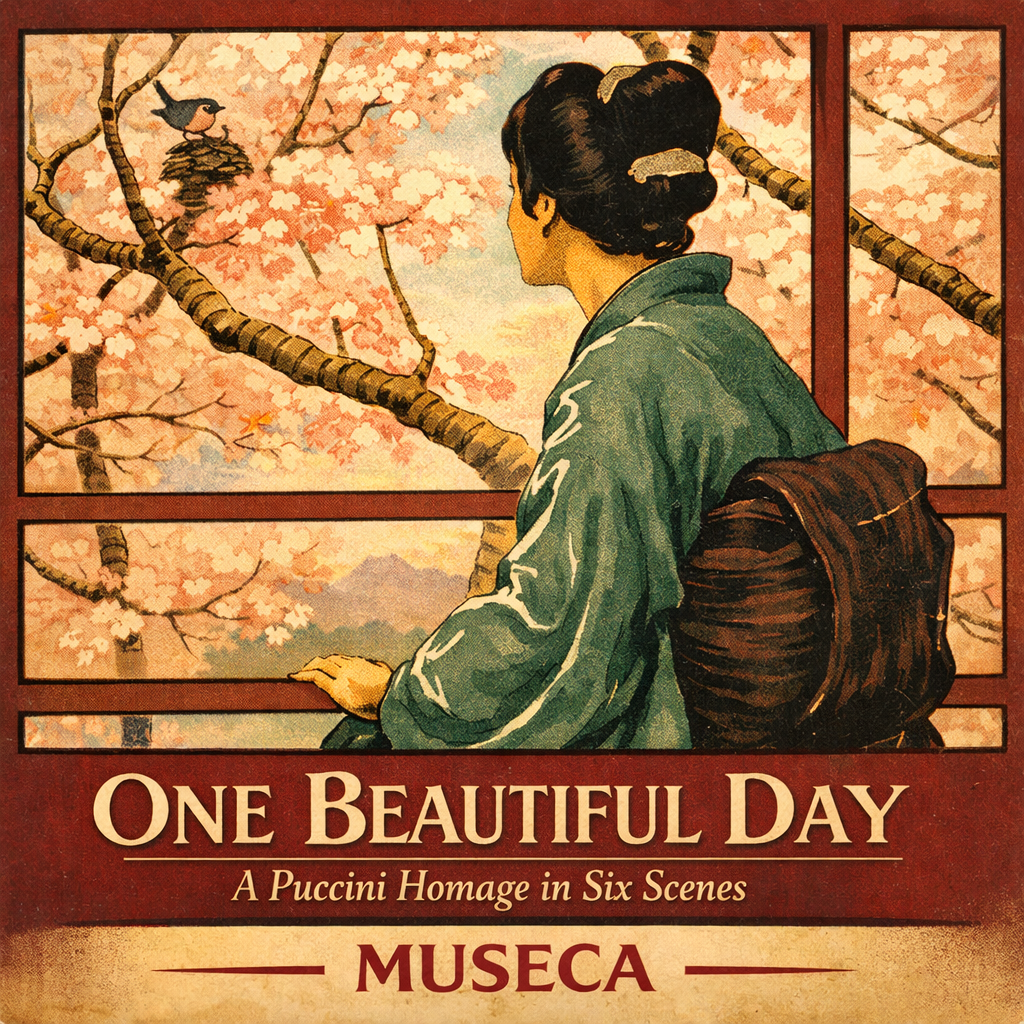
One Beautiful Day: A Puccini Homage in Six Scenes is conceived as an operatic miniature—six connected tableaux built in reverence to the rare musical genius of Giacomo Puccini, a composer whose gift was not merely melody, but total dramatic integration. Puccini possessed an uncanny ability to fuse vocal line, orchestral color, harmonic trajectory, and theatrical pacing into a single psychological current. His music “breathes” like lived emotion: the voice speaks with inevitability, the orchestra illuminates subtext, and harmony functions as narrative pressure—leaning, delaying, and finally releasing at precisely the moment the heart can no longer hold.
In crafting this homage, I adopted Puccini’s most defining technical fingerprints. The vocal writing is built on long-arch cantabile shaped by speech-inflected rhythm—phrases that expand and contract through rubato rather than metrical display—while remaining anchored in a clear tonal center. I rely heavily on Puccini’s favorite expressive mechanism: the appoggiatura as dramaturgy—a tone that leans into dissonance and resolves late, creating that unmistakable “ache” at the emotional threshold. Harmonically, the album maintains tonal clarity while employing late-Romantic elasticity: chromatic voice-leading, secondary dominants, and pivoting mediants that color the scene without dissolving it. Resolution is frequently postponed through suspensions, added tones, and deceptive harmonic detours, so cadences feel earned rather than procedural.
Orchestrationally, I treat the ensemble in Puccini’s own dramaturgical hierarchy. Strings act as atmosphere—muted veils, divisi warmth, tremolo undercurrents, and inner-voice suspensions that generate heat without noise. Woodwinds function as close-ups, carrying intimate countermelodies and brief confessional turns (especially oboe and clarinet), while horns supply a restrained “halo” of fate behind the human line. Harp appears as punctuation—glints of light, breath, and memory—rather than decorative continuo. Even the more tense orchestral scene is shaped less by impact than by operatic suspense: low-string tremolo, chromatic compression, and sudden hushes that behave like stage silence.
The six scenes are designed as one coherent arc: a prelude that opens the curtain, two aria-like confessions modeled on Puccini’s supreme art of lyrical inevitability, an intermezzo where the orchestra speaks what words cannot, a darker scene of tightening fate, and a finale that reunites the album’s core motifs—hope and shadow—into a final transfiguration. The result is not imitation, but craft-based homage: Puccini’s genius translated into a compact, unified cycle where harmony becomes psychology, orchestration becomes light, and a single voice can turn waiting into dawn.
Liner Notes – Best experienced in order—each scene resolves (or withholds) the next.
Dawn Over the Curtain
A Puccini-style prelude in miniature: muted strings form a veil of early light while harp chords glint like dew on fabric. The harmony drifts with late-Romantic elasticity—never fully settling—so that expectation accumulates in the air. Woodwinds appear as brief close-ups, hinting at the album’s central “hope” idea without resolving it. The ending withholds completion on purpose: the orchestra stops just short of the answer, leaving space for the soprano to enter as inevitability rather than interruption.
Version 1
Verson 2
One Beautiful Day (Aria I, “Un bel dì” spirit)
This aria is shaped in the spirit of Un bel dì: hope held against evidence, intimate at first, then gradually blooming into radiance. The vocal line is designed to feel unavoidable—long-breathed, Italianate, and lyric—supported by warm strings and harp, with woodwinds offering tender counter-speech. Harmonic color intensifies at emotional thresholds through appoggiaturas and delayed resolutions, allowing the climactic ascent to arrive as a release of belief rather than display. The final bars soften into suspended warmth, as if the promise remains alive beyond the last word.
One Beautiful Day (Aria I, “Un bel dì” spirit) (English)
Lyrics
[Verse 1]
One beautiful day, the sky will open wide,
And I will hear your footsteps in the light.
The world will hold its breath beside the sea,
And every shadow will remember me.
[Verse 2]
I trace your name in air that cannot stay,
I keep a candle where the night was laid.
They tell me “let it go”—but still I know,
Hope is the quiet thing that will not go.
[Chorus]
One beautiful day—
I’ll see you there, I swear,
Beyond the hush, beyond despair.
If love is true, it finds its way…
One beautiful day.
[Bridge]
If I am wrong, let morning break me clean,
But if I’m right, the whole world turns serene.
I’ll stand where dawn and water meet as one,
And wait—until the waiting is done.
[Final Chorus]
One beautiful day—
I’ll see you there, I swear,
Beyond the hush, beyond despair.
If love is true, it finds its way…
one beautiful day.
One Beautiful Day (Aria I, “Un bel dì” spirit) (Italian)
Lyrics
[Verso 1]
Un giorno bello, si aprirà il ciel così,
e sentirò i tuoi passi dentro il chiaror.
Il mondo tace, come in riva al mar,
e ogni ombra torna a ricordarmi amor.
[Verso 2]
Scrivo il tuo nome nell’aria che va via,
tengo una fiamma dove regnò la notte.
Mi dicon “basta”… ma io lo so, lo so:
la speranza è un filo che non si spezzò.
[Ritornello]
Un giorno bello—
ti rivedrò, lo giuro,
oltre il silenzio, oltre il futuro.
Se l’amore è vero, trova la via…
un giorno bello.
[Ponte]
Se mi sbaglio, l’alba mi spezzerà,
ma se ho ragione, il mondo cambierà.
Starò dove l’acqua incontra il sole,
e aspetterò—finché l’attesa muore.
[Ritornello Finale]
Un giorno bello—
ti rivedrò, lo giuro,
oltre il silenzio, oltre il futuro.
Se l’amore è vero, trova la via…
un giorno bello.
[Finale: tenere sospeso l’accordo; l’ultima parola svanisce dolcemente]
Sealed in Silence
The intermezzo carries the album’s private heart. Solo cello and wind replies speak in the register of confession—what a character cannot say onstage becomes orchestral truth. Muted strings sustain a luminous hush while the harmony turns gently bittersweet, balancing tenderness with restraint. Rather than “developing” material in a symphonic sense, the music breathes in paragraphs, letting pauses and half-resolutions do the dramatic work. It closes with an unfinished tenderness that naturally opens the door to the next plea.
Dear Heart, Please (Aria II — “O mio babbino caro” spirit)
A short, jewel-like aria inspired by the emotional posture of O mio babbino caro: direct sincerity, a single melodic sentence, and one clean peak. The orchestration stays velvet-soft—strings and harp as a cradle—so the voice reads as human and immediate, not theatrical for its own sake. Harmonic shifts are minimal but carefully timed: one bittersweet turn is enough to change the entire meaning of the line. The ending does not “win”—it simply remains, suspended in mercy.
Dear Heart, Please (Aria II — “O mio babbino caro” spirit) (English)
Lyrics
[Verse]
Dear heart, please—don’t turn away from me,
I’ve carried this love so quietly.
If I must fall, let it be in your grace,
Not in the cold of an empty place.
[Chorus]
Hold me, just once—
Let mercy be my song.
If love is true, it won’t be wrong…
Dear heart, please.
[Tag / Coda]
I ask so little—only to remain,
A light in your window, not a name in the rain.
Dear Heart, Please (Aria II — “O mio babbino caro” spirit) (Italian)
Lyrics
[Verso]
Caro cuore mio, non ti voltare,
questo amore l’ho tenuto in silenzio.
Se devo cadere, sia nella tua pietà,
non nel gelo d’una città.
[Ritornello]
Tienimi, soltanto un istante—
fa’ che la grazia sia il mio canto.
Se l’amore è vero, non farà male…
caro cuore mio.
[Coda]
Chiedo così poco—solo restare,
una luce alla tua finestra, non un nome nel mare.
The Knife of Fate
Here the homage turns toward Puccini’s darker dramatic engine—more Tosca than idyll. Low strings pulse with quiet inevitability, and brass is used sparingly as a shadow rather than a spectacle: fate is present, but never shouting. Chromatic pressure accumulates in waves, interrupted by sudden hushes that feel like stage breath before an irreversible choice. Even at its most tense, the music retains lyric contour in the upper strings—danger rendered with elegance, not noise.
Vow in the Smoke
The finale fuses the album’s two worlds: orchestral atmosphere and operatic confession, darkness and transfiguration. Motifs associated with hope and fate interweave—first in conflict, then in gradual reconciliation—until the voice lifts the orchestra into a warmer, clearer horizon. The form moves like Puccini drama: intimate opening, controlled expansion, a radiant climax, and a tender retreat. The closing cadence is delayed to the last possible moment, so the final resolution feels earned—an oath fulfilled not by certainty, but by the courage to sing.
Vow in the Smoke (Finale — Voice + Orchestra) (English)
Lyrics
[Verse 1]
Smoke on the wind, and the world holds its breath,
I walk through the hush where the heart learns faith.
If fear is a knife, I will not be undone—
I carry a vow like a hidden sun.
[Verse 2]
All that I lost, all the nights I survived,
Become the gold edge of the day I arrive.
No door stays closed to a love that is true;
No shadow can keep what is meant to come through.
[Chorus]
I swear it now—
I will not turn away.
Hope has a voice, and it calls my name.
If love is fire, it lights the way…
I swear it now.
[Bridge]
Let the darkness speak its final line,
I answer with breath, with light, with time.
And if I tremble, let it be from grace—
As dawn returns to its rightful place.
[Final Chorus]
I swear it now—
I will not turn away.
Hope has a voice, and it calls my name.
If love is fire, it lights the way…
I swear it now.
[Hold the last “now” in a soaring operatic climax, then soften]
[Coda]
One beautiful day… we rise.
Vow in the Smoke (Finale — Voice + Orchestra) (Italian)
Lyrics
[Verso 1]
Fumo nel vento, e il mondo trattiene il respiro,
cammino nel vuoto dove nasce il mio ardire.
Se il timore è un coltello, non mi spezzerà—
porto un giuramento come sole in città.
[Verso 2]
Tutto ciò che ho perso, le notti che ho passato,
diventa il bordo d’oro del giorno ritrovato.
Nessuna porta resta chiusa all’amor che è vero;
nessuna ombra può tenere ciò che torna intero.
[Ritornello]
Lo giuro ora—
non mi volterò.
La speranza ha voce, e mi chiamerà.
Se l’amore è fuoco, la via mi darà…
lo giuro ora.
[Ponte]
Lascia che l’ombra dica l’ultima parola,
io rispondo col fiato, con luce che consola.
E se tremo, che sia per grazia soltanto—
mentre l’alba ritorna nel suo incanto.
[Ritornello Finale]
Lo giuro ora—
non mi volterò.
La speranza ha voce, e mi chiamerà.
Se l’amore è fuoco, la via mi darà…
lo giuro ora.
[Tenere “ora” in un climax operistico, poi svanire dolcemente]
[Coda]
Un giorno bello… ci rialzerà.
Playlist
- Track 1: Dawn Over the Curtain (Version 1) Museca 2:10
- Track 1: Dawn Over the Curtain (Version 2) Museca 2:35
- Track 2 — One Beautiful Day (English) Museca 3:08
- Track 2 — One Beautiful Day (Italian) Museca 3:00
- Track 3 — Sealed in Silence (Intermezzo) Museca 3:08
- Track 4 — Dear Heart, Please (Aria I) (English) Museca 2:03
- Track 4 — Dear Heart, Please (Aria II) (Italian) Museca 3:00
- Track 5 — The Knife of Fate Museca 3:28
- Track 6 — Vow in the Smoke (English) Museca 4:00
- Track 6 — Vow in the Smoke (Italian) Museca 3:27