
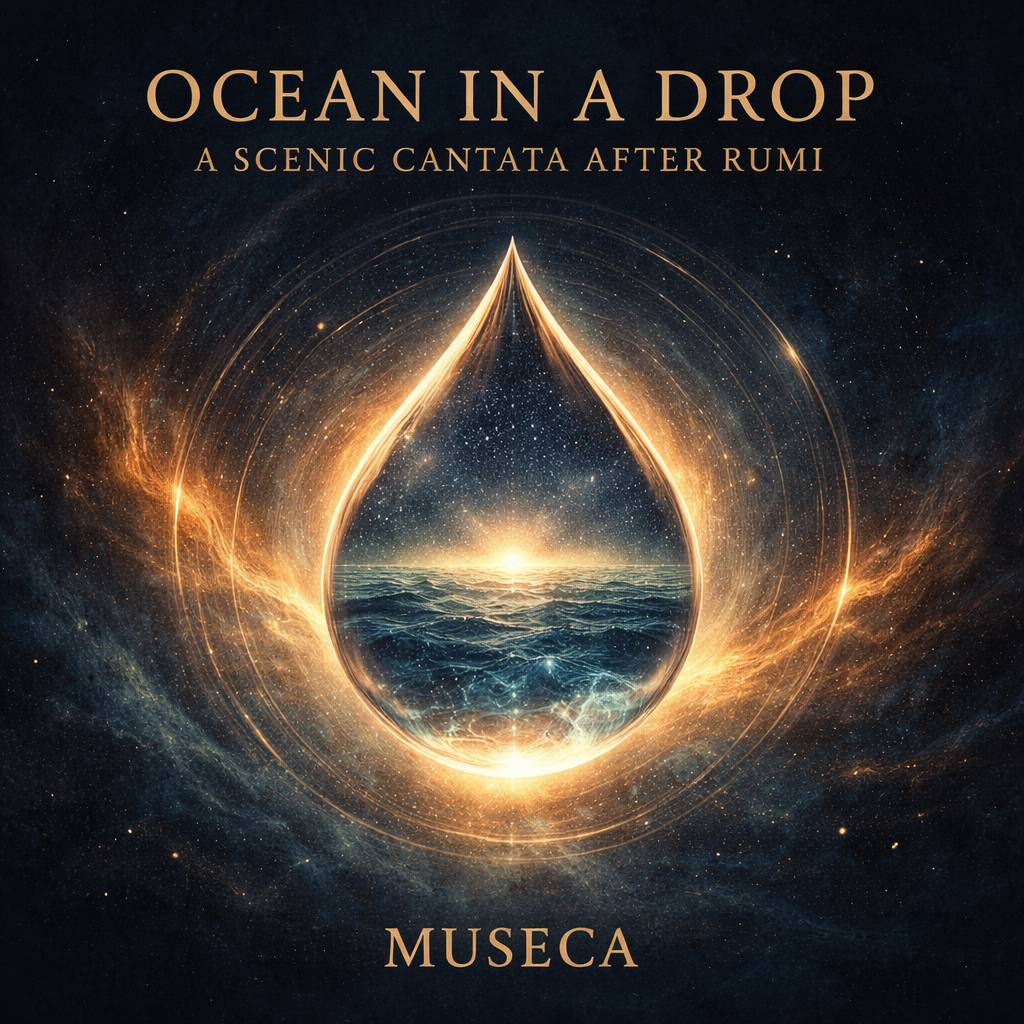
Ocean in a Drop: A Scenic Cantata after Rumi is an album-length ritual in music: a choral journey that moves from cosmic awe, to human invitation, to renewal, to ecstatic unity, into silence—then back to a final return. Its purpose is to create a spiritual experience that is non-religious: an audience doesn’t have to belong to any tradition to feel its message. The album is designed to be performed (or listened to) as a single arc—like entering a circle, being changed inside it, and leaving with a quieter, steadier light.
At its core, the cantata explores one central idea drawn from Rumi’s worldview: separation is an illusion, and the soul’s work is to remember wholeness. Each movement is a different facet of that remembering: “Wheel of Light” frames existence as motion and return; “The Invitation” welcomes every kind of person into the circle; “Spring of the Heart” celebrates inner renewal; “The Drop and the Ocean” delivers the revelation that the infinite lives inside the finite; “Silence and Flame” honors the truth beyond words; and “Caravan of Joy” closes by returning to the invitation, as if the cycle must begin again.
The album incorporates Rumi not by presenting strict, literal translations, but by crafting a performance libretto inspired by his imagery and teachings—the way a composer might shape ancient texts into chantable, theatrical lines. Rumi’s poetry is often expansive and flowing; this cantata distills it into elemental phrases suitable for choral declamation: turning, breath, flame, dust and stars, the ocean and the drop, and the sanctity of silence. Well-known Rumi motifs (the universal invitation to “come,” the ocean-in-a-drop paradox, and the primacy of silence) are treated as recurring symbols—musical “icons” that can be repeated, layered, shouted, or whispered in an Orff-like ritual style.
In other words, the album’s meaning is not “about” Rumi as a literary figure; it is about what his poetry points to: a lived experience of unity, renewal, and surrender. The cantata format—with chorus as the communal voice, children’s choir as innocence and continuity, and percussion as the heartbeat of ritual—turns that poetic philosophy into a shared sonic ceremony.
Liner Notes
Prologue – Wheel of Light
The opening movement draws on one of Rumi’s most persistent metaphors: turning. In his poetry, the cosmos, the soul, and the seeker are all in motion—circling, whirling, returning. This prologue does not quote a single poem, but distills Rumi’s vision of existence as a living wheel animated by breath and flame. The music’s weight and repetition evoke inevitability rather than fate: not punishment, but participation. To turn is to live. To resist turning is to suffer. The prologue establishes the cantata’s central premise: everything that follows is already in motion.
Lyrics
Turn, turn, O wheel of flame.
Turn, turn, O wheel of breath.
Circle of dust, circle of stars.
All is turning, all is one.
Chant I – The Invitation
This movement is closest in spirit to Rumi’s most famous welcoming poem, often paraphrased as “Come, come, whoever you are.” Rumi’s philosophy rejects exclusion—no matter how broken, wandering, or contradictory a person may be, the invitation remains open. By giving the opening lines to a children’s choir, the cantata emphasizes innocence and unconditional welcome. The adult choir’s response reflects Rumi’s insistence that despair itself is the only real barrier. The chant becomes a ritual threshold: crossing it means choosing participation over exile.
Lyrics
[Children’s Choir, soft, innocent, unison]
Come, come, whoever you are.
Wanderer, lover of leaving.
It does not matter.
[Adult Choir, echo, stronger]
Ours is not a caravan of despair.
Come, even if you have broken your vows a thousand times.
[Full Choir, fortissimo, with stomps and claps]
Come! Come! Yet again, come, come!
Come! Come! Yet again, come, come!
[Children’s Choir echoes softly at the end]
Come, come…
Chant II – Spring of the Heart
Rumi frequently uses the seasons as metaphors for the inner life, especially spring as a sign of spiritual awakening after inner winter. This chant embodies his belief that transformation is natural, not forced. Growth happens when the heart opens, not when it is coerced. The playful, dance-like quality of the music mirrors Rumi’s joy-filled mysticism: enlightenment is not grim or ascetic, but fertile, green, and alive. Renewal here is not moral improvement—it is remembrance of one’s own capacity to bloom.
Lyrics
[Men’s Choir]
Be like a tree — bloom again.
Be like a tree — bloom again.
[Women’s Choir, answering]
Break open your heart — bloom again.
Break open your heart — bloom again.
[Full Choir, swaying, with harp and flute doubling]
Winter is gone, the world is green.
Winter is gone, the world is green.
[All voices together, joyful and rhythmic]
Sing, sing, the world is green!
Sing, sing, the world is green!
Chant III – The Drop and the Ocean
The philosophical core of the cantata lies in this movement. Rumi repeatedly challenges the illusion of separation, using the paradox of the drop and the ocean to express unity without erasing individuality. The text adapts this idea into stark, chantable declarations, allowing the choir to enact the teaching musically: unison fractures into layers, layers surge into overwhelming unity, and unity collapses into silence. This mirrors Rumi’s insight that intellectual understanding cannot sustain ecstasy; realization must eventually dissolve back into humility.
Lyrics
[Adult Choir, unison, stark]
You are not a drop in the ocean.
You are the ocean in a drop.
[Choir splits into antiphony, call and response]
Men: Not the echo, but the sound.
Women: Not the shadow, but the flame.
[Layered ostinati, building ecstasy]
Basses/Tenors: Ocean in a drop. Ocean in a drop.
Altos: Flame in the heart. Flame in the heart.
Sopranos (faster): One in all, all in one. One in all, all in one.
[Full Choir, fortissimo, climax]
Ocean in a DROP!
Flame in the HEART!
One in ALL!
All in ONE!
[Sudden collapse, whispered unison]
Ocean… in a drop.
Chant IV – Silence and Flame
Rumi taught that language ultimately fails at the deepest level of truth. His oft-quoted line, “Silence is the language of God,” is not anti-expression, but a reminder that words point beyond themselves. This chant steps outside regular meter, allowing sound to thin into breath, bells, and whispered resonance. Fire remains present—not as spectacle, but as a quiet inner heat. Here, the music practices what Rumi preached: surrendering explanation in favor of presence.
Lyrics
[Adult Choir, whispered chant]
Silence is the language.
Silence, the answer.
All else is poor translation.
[Children’s Choir, soft drone hum “ahhh” underneath]
[Adult Choir, very soft, sustained]
Flame speaks in silence.
Silence is the flame.
[End in whispered unison]
Silence… silence…
Finale – Caravan of Joy
The cantata closes by returning to the invitation, reflecting Rumi’s cyclical view of spiritual life. Awakening is not a final destination; it is a continual arrival. The word “caravan” suggests movement together—souls traveling in community rather than isolation. The full choir’s ritual power affirms shared joy, but the final echo belongs to the children’s voices alone, symbolizing continuity beyond any single generation or performance. In Rumi’s philosophy, joy is not an ending—it is the sign that the journey has resumed.
Lyrics
[Full Choir, strong and ritual]
Come, yet again, come, come.
Come, yet again, come, come.
[Adult Choir, layered voices]
Circle of dust, circle of stars.
Circle of dust, circle of stars.
[Children’s Choir joins, clear and bright]
Come, yet again, come, come.
Come, yet again, come, come.
[Full Choir, fortissimo, pounding 3/4 with percussion]
COME! YET AGAIN, COME, COME!
COME! YET AGAIN, COME, COME!
[Final echo — Children’s Choir only, pianissimo]
Come… come…
Playlist
- Prologue – Wheel of Light Museca 3:11
- Chant I – The Invitation Museca 2:03
- Chant II – Spring of the Heart Museca 2:41
- Chant III – The Drop and the Ocean Museca 3:00
- Chant IV – Silence and Flame Museca 2:55
- Finale: Caravan of Joy Museca 2:20