
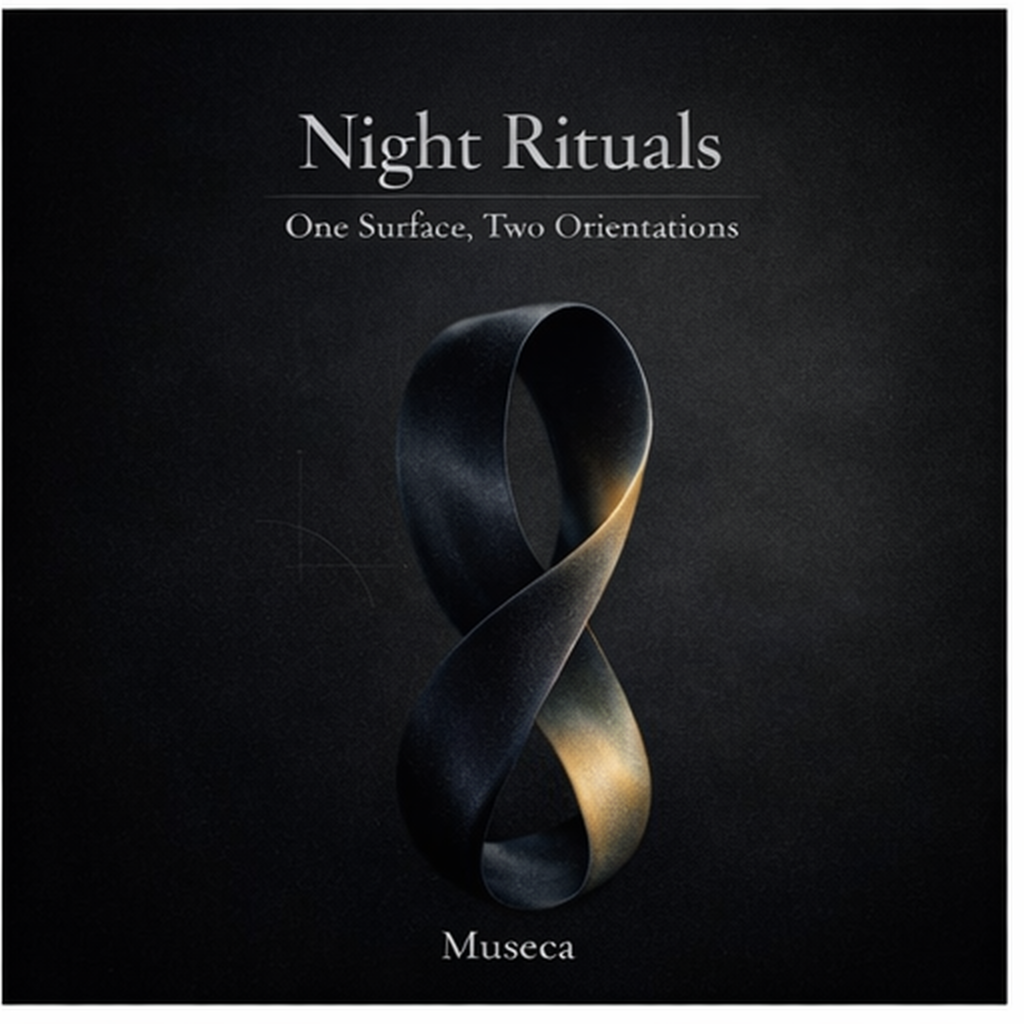
Night Rituals — One Surface, Two Orientations
Night Rituals is the first orientation of the Möbius concept: the spiritual encountered through motion, pulse, and embodiment. Rather than treating “the physical” as a lower realm to escape, this album approaches the body as a valid spiritual instrument—where trance, repetition, and groove can become a form of recognition.
The sound world is ritual deep house with North Indian color: a grounded four-on-the-floor continuum carried by deep bass and percussion, layered with tabla, tanpura-style drone, sitar texture, and breath-like melodic traces that function as the “veil.” A featured solo violin appears as a recurring turning point—phrased with meend-like slides and ornaments (Indian-adjacent, without becoming a classical raga recital)—rising into a mid-track swell that feels like perception rotating from one side of the surface to the other.
Across the album, the music emphasizes continuity: a stable foundation you never truly leave, while harmony, timbre, and meaning subtly reorient. The vocals are intentionally sparse—brief mantra fragments that surface like flashes of clarity within the groove. The result is a nocturnal ritual in which the “other side” is not reached by crossing a boundary, but by turning within the same world.
This is the album’s premise in sound: one surface, two orientations—and the veil is not a wall, but a turn.
Liner Notes
Night Rituals is the nocturnal half of the Möbius metaphor: embodiment as a spiritual practice. The album is built on a single continuous surface of groove, where “crossing over” is replaced by reorientation. Ritual deep house provides the stable floor, while North Indian color, drone, and ornament become the turning mechanism: the veil as a shift in angle, not a wall. Throughout, the harmonic language leans into the charged adjacency of E↔F (a Phrygian/Locrian tint) so the listener feels the threshold as something intimate and persistent. Vocals appear only as sparse mantra fragments—brief flashes of meaning that surface and disappear back into motion—while the featured violin arrives as the signature “turn,” phrased with Indian-adjacent slides and ornaments that bloom into a mid-track swell before dissolving into a long, controlled fade.
Apparent Two Sides (E↔F Prelude)
A slow-opening invocation that establishes the album’s physical-spiritual paradox: one steady pulse under a drone that never lets you fully “settle.” The bass and tanpura-like ground imply E as home, while F appears as a gentle pressure point—present, close, unavoidable. The production is deliberately spacious, letting the ear acclimate to the idea that tension can be devotional rather than anxious.
Veil Note (Rotation, Not Wall)
Here the groove tightens and the veil becomes rhythmic. Percussion articulations and filtered stabs behave like a hinge: the same harmony, re-lit from different angles. The track’s motion is less about progression than rotation—micro-shifts in timbre, articulation, and placement that make the listener feel the surface “turn” without ever leaving the floor.
Both/And Engine (Coexisting Pulses)
This is the engine room of the record: a confident ritual groove where opposites are not resolved but made cooperative. Tabla patterns interlock with deep-house percussion, creating a two-layer pulse that reads as one body. The track demonstrates the album’s central method—coexistence as propulsion—so the threshold feels kinetic rather than static.
Embodied Prayer (Body as Expression)
A more lyrical, breath-forward track where the low-end becomes almost heart-like in its steadiness. Sitar and bansuri colors arrive as soft highlights, not as featured “world-music” gestures, keeping the sound inside the album’s restrained frame. The mantra fragments are used like candlelight—brief illumination—before the arrangement opens into a warmer, more compassionate swell.
The Möbius Twist (Orientation Shift)
The clearest enactment of the concept: the track pivots by changing perspective rather than changing location. A breakdown strips the surface down to drone and pulse, then rebuilds with altered emphasis—what felt like background becomes foreground. The harmony leans hardest into the E↔F friction here, making the “twist” audible as a change in how the same notes are weighted.
One Surface (Locrian Cantabile)
A darker, more introspective chapter that treats instability as songful. The tonal center feels present but slightly untrusted, with melodic lines that circle rather than land—cantabile phrasing over a floor that refuses theatrical closure. The result is not despair, but quiet lucidity: the recognition that beauty can live inside unresolved geometry.
Integration Field (Blended Realms)
This track is about adhesion: textures that previously alternated now blend. Percussion and drone sit closer together, and the mix feels less like layers and more like a single fabric. It’s the album’s integration statement—body and spirit not as two competing channels, but as one composite timbre.
Perspective Inversion (Theme Turned Over)
A reflective mirror-piece where motifs return with their emotional polarity flipped. Elements that once signaled “shadow” now read as intimacy; what once felt “bright” now feels exposed. The sense of inversion is achieved by arrangement and register rather than big harmonic change—an audible reminder that the veil is often just a turn of attention.
Threshold in the Ordinary
A grounded, human-feeling track that locates the sacred inside the everyday mechanics of groove. The percussion is clean and confident, the melodic gestures modest, and the overall arc favors steadiness over spectacle. It functions as a practical spiritual thesis: the threshold is not an event you wait for; it is the surface you live on.
Return Without Leaving (Loop Closure)
The album closes the way a Möbius strip closes: by arriving where you started with a changed orientation. The final section makes room for the long coda—vocals recede, the violin’s last ornaments soften, and the entire mix performs a slow diminuendo into silence. The ending is intentionally unforced: not a “final answer,” but a completed turn, leaving the listener inside continuity rather than conclusion.
Playlist
- TRACK 1 — Apparent Two Sides (E↔F Prelude) Museca 3:08
- TRACK 2 — Veil Note (Rotation, Not Wall) Museca 7:01
- TRACK 3 — Both/And Engine (Coexisting Pulses) Museca 5:42
- TRACK 4 — Embodied Prayer (Body as Expression) Museca 2:53
- TRACK 5 — The Möbius Twist (Orientation Shift) Museca 2:55
- TRACK 6 — One Surface (Locrian Cantabile) Museca 6:20
- TRACK 7 — Integration Field (Blended Realms) Museca 3:09
- TRACK 8 — Perspective Inversion (Theme Turned Over) Museca 3:05
- TRACK 9 — Threshold in the Ordinary Museca 5:27
- TRACK 10 — Return Without Leaving (Loop Closure) Museca 2:47