
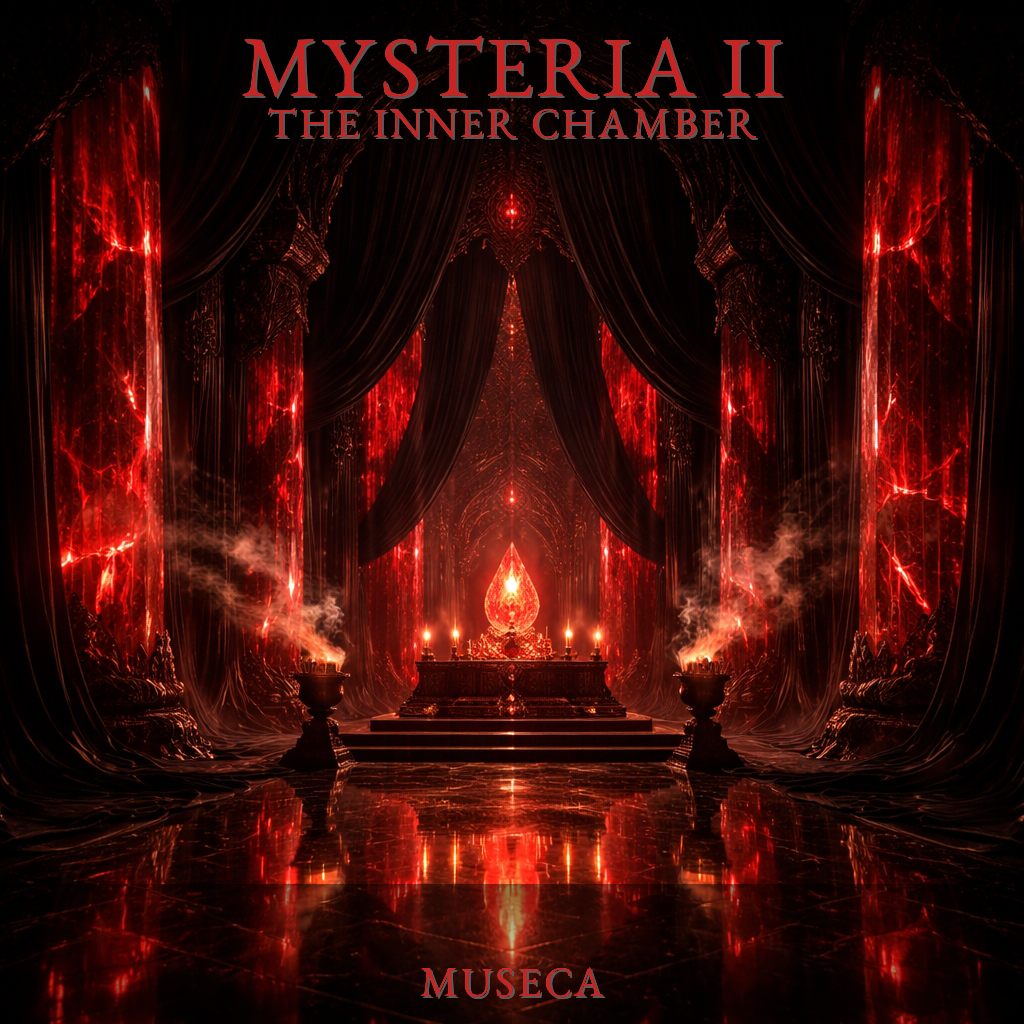
Mysteria II: The Inner Chamber continues the world opened in Mysteria, but it does not merely return to it. The first album stood at the threshold: veils, incense, whispered invocations, and the first movement into ritual space. This second volume steps further inward. It enters the chamber behind the veil — the darker room, the more secret room, the place where memory, longing, desire, grief, and revelation no longer appear as separate experiences, but as different faces of the same inner fire.
The sound of this album is deeper, warmer, and more nocturnal. Its pulse remains ritualistic rather than dance-driven: a slow ceremonial groove built from hand percussion, low drones, deep bass movement, bells, breath textures, chant haze, and luminous electronic space. The atmosphere is still sacred and sensual, but the emotional center has shifted. Here the mystery is no longer something merely approached. It is inhabited. The music lingers inside shadow, inside ash, inside silence, and discovers there not emptiness, but presence.
Phrygian becomes one of the defining colors of the album, bringing an archaic, secretive, almost forbidden atmosphere to many of the tracks. Aeolian provides the emotional gravity of longing and lament. Dorian offers rare moments of warmth and inward lift. Locrian appears as a shadow-language — unstable, haunted, and beautiful — used sparingly where the chamber opens onto deeper uncertainty. Together, these modes create a sound world that is dark without becoming cold, ceremonial without becoming rigid, intimate without losing its sense of myth.
A defining feature of The Inner Chamber is its use of instrumental voices as presences within the ritual. The ney, duduk, muted trumpet, bass clarinet, low cello, bells, and frame drum do not function here as showpieces or solos in the ordinary sense. They enter like figures in a rite: speaking briefly, carrying breath, sorrow, memory, or warning, and then dissolving back into the atmosphere. Alongside them move the album’s recurring human textures — breathy female vocals, low male whispers, chant-like murmur, and lyrics that remain sparse, incantatory, and symbolic.
Across its eight tracks, the album traces an arc of descent and transformation. It begins in embers and secrecy, moves through invocation, memory, trance, instability, lament, and hidden flame, and closes in a form of quiet transfiguration. The light reached at the end is not bright in the ordinary sense. It is a light discovered within darkness, a gold concealed beneath ash, a fire that survived the chamber and was changed by it.
Mysteria II: The Inner Chamber is music for inward listening — for night, for solitude, for the hour when thought softens and the deeper self begins to speak. It is not music that explains. It suggests, invokes, and reveals by degrees. It invites the listener not simply to hear, but to enter.
Liner Notes
Veil of Embers
The album opens not at the threshold, but already within. A low drone, ritual pulse, distant bells, and the mournful breath of the ney create the sense of entering a chamber lit by ember rather than flame. The music moves slowly and deliberately, as if each sound were part of an older rite. This track establishes the darker atmosphere of the second album: less invitation, more descent; less unveiling, more inhabiting what has already been revealed.
In the Chamber of Your Name
This piece is the first intimate invocation of the album. The lyric turns inward toward an unseen presence that may be beloved, divine, remembered, or all three at once. The breathy vocal line and low cello give the song its tenderness, while the groove beneath it keeps the body quietly engaged. It is a song of return, not arrival — a recognition that some names are spoken most truly in silence.
Lyrics
[Verse]
In the chamber of your name
I am only breath and flame
Touch the dark that does not sleep
Call the silence from the deep
[Verse]
Under stone and under skin
Let the hidden rite begin
What I lost became your sign
What was yours is moving mine
[Chorus]
In the chamber of your name
I return without a face
All the shadows speak in light
All the distance turns to grace
[Bridge]
[Male whispers underneath: veni, mane, in nocte, in igne]
[Chorus]
In the chamber of your name
I return without a face
All the shadows speak in light
All the distance turns to grace
Ashes of the Rose
Memory becomes perfume, residue, and trace. This track carries a softer sorrow than the others, with muted trumpet and restrained vocal lines shaping an atmosphere of faded beauty. The rose here is not romantic decoration, but a symbol of what once burned brightly and now survives in scent, ash, and remembrance. Dorian warmth allows the music to grieve without collapsing into darkness, giving the piece its gentle, haunted nobility.
Lyrics
[Verse]
Ashes of the rose remain
Perfume moving through the rain
What was touched is hidden still
What was lost returns at will
[Verse]
Velvet shadow, ember air
Memory is waiting there
In the wound a flower sleeps
In the dark its silence keeps
[Refrain]
Ashes of the rose
Ashes in the light
Love becomes a trace
Burning through the night
[Bridge]
[Muted trumpet answers the voice]
[Keep the vocal intimate and restrained]
[Refrain]
Ashes of the rose
Ashes in the light
Love becomes a trace
Burning through the night
Beneath the Seventh Veil
One of the album’s most physical tracks, this piece is built on ritual motion rather than overt momentum. Frame drum, darbuka, bass clarinet, and deep bass pulse create a slow trance that suggests movement beneath concealment. The title evokes not mystery at a distance, but intimacy protected by layers. What lies beneath the seventh veil is not spectacle, but depth — the hidden rhythm of secrecy itself.
The Inner Chamber
The title track stands at the center of the album as its most charged and unstable moment. Here the sacred and the forbidden come closest together. The Phrygian–Locrian tension gives the song a sense of entering a space where identity cannot remain intact, where desire becomes ordeal and revelation. The duduk, low chant, and whispered female textures make the chamber feel alive, as though it were not merely a room, but a presence waiting to receive what enters it.
Lyrics
[Verse]
I entered where the walls could breathe
Where silence wore a living skin
The lamp was low, the air was deep
And something old was drawing in
[Verse]
No crown, no name, no outer sign
Could cross the threshold as before
The chamber kept its hidden fire
Behind the wound, beneath the door
[Chorus]
In the inner chamber
I vanish and remain
In the inner chamber
Desire becomes a flame
[Bridge]
[Low male chant underneath]
[Female whispers circle the lead]
[Duduk answers the final line of each phrase]
[Chorus]
In the inner chamber
I vanish and remain
In the inner chamber
Desire becomes a flame
Stone of Sleep
This is the album’s deepest shadow. Sparse, suspended, and haunting, the track uses Locrian color to suggest a beautiful instability, as if the floor beneath consciousness were slowly dissolving. Bass clarinet, distant bells, low drone, and whispered textures create a dream-state that is neither wholly restful nor threatening, but strangely in between. The “stone” of the title suggests weight, burial, ruin, and permanence; “sleep” suggests passage, forgetting, and inner descent.
When the Bells Forgot the Dawn
A lament in sacred form, this piece explores absence without theatrical grief. The muted trumpet and female lead carry sorrow with dignity, while the underlying pulse prevents the song from becoming static. The image at its center is striking: bells, once heralds of morning, now unable to recall it. What remains is memory, longing, and the persistence of a hidden flame that continues even when outward light has failed.
Lyrics
[Verse]
When the bells forgot the dawn
I remained where light had gone
Holding ash inside my hands
Listening for your distant lands
[Verse]
Every shadow kept your trace
Every silence wore your face
In the chamber of the night
Loss became a form of light
[Chorus]
When the bells forgot the dawn
I still heard your hidden flame
Through the dark and through the dust
Something called me by your name
[Bridge]
[Muted trumpet answers the voice]
[Male whispers move beneath the final words of each line]
[Keep the vocal intimate, sorrowful, and restrained]
[Chorus]
When the bells forgot the dawn
I still heard your hidden flame
Through the dark and through the dust
Something called me by your name
Fire in the Hollow Light
The album closes not with brightness, but with inward radiance. This track gathers the themes of ash, secrecy, wound, chamber, and hidden gold, and transforms them into a quiet final affirmation. The groove remains solemn and ritualistic, the vocal intimate, the ney and bells gently luminous. The fire of the title is not destructive but enduring — the ember that remained through darkness and now reveals itself. The album ends in transfiguration, but one earned through shadow rather than escape from it.
Lyrics
[Verse]
Fire in the hollow light
Breathing through the wounded night
What was hidden now can shine
What was broken becomes sign
[Verse]
Under ash the ember stayed
Through the silence unafraid
I have walked the inner flame
I am not the same in name
[Chorus]
Fire in the hollow light
Burn within and burn below
In the chamber of the dark
There was always something gold
[Bridge]
[Ney answers the final words of each line]
[Male whispers beneath the lead: lux interior, ignis, mane, intra me]
[Keep the feeling intimate, solemn, and quietly radiant]
[Chorus]
Fire in the hollow light
Burn within and burn below
In the chamber of the dark
There was always something gold
[Coda]
[Repeat softly: there was always something gold]
[Let the bells and ney carry the ending]
Playlist
- Track 1 - Veil of Embers Museca 4:13
- Track 2 - In the Chamber of Your Name Museca 3:38
- Track 3 - Ashes of the Rose Museca 3:43
- Track 4 - Beneath the Seventh Veil Museca 4:48
- Track 5 - The Inner Chamber Museca 3:49
- Track 6 - Stone of Sleep Museca 4:29
- Track 7 - When the Bells Forgot the Dawn Museca 3:33
- Track 8 - Fire in the Hollow Light Museca 3:45