
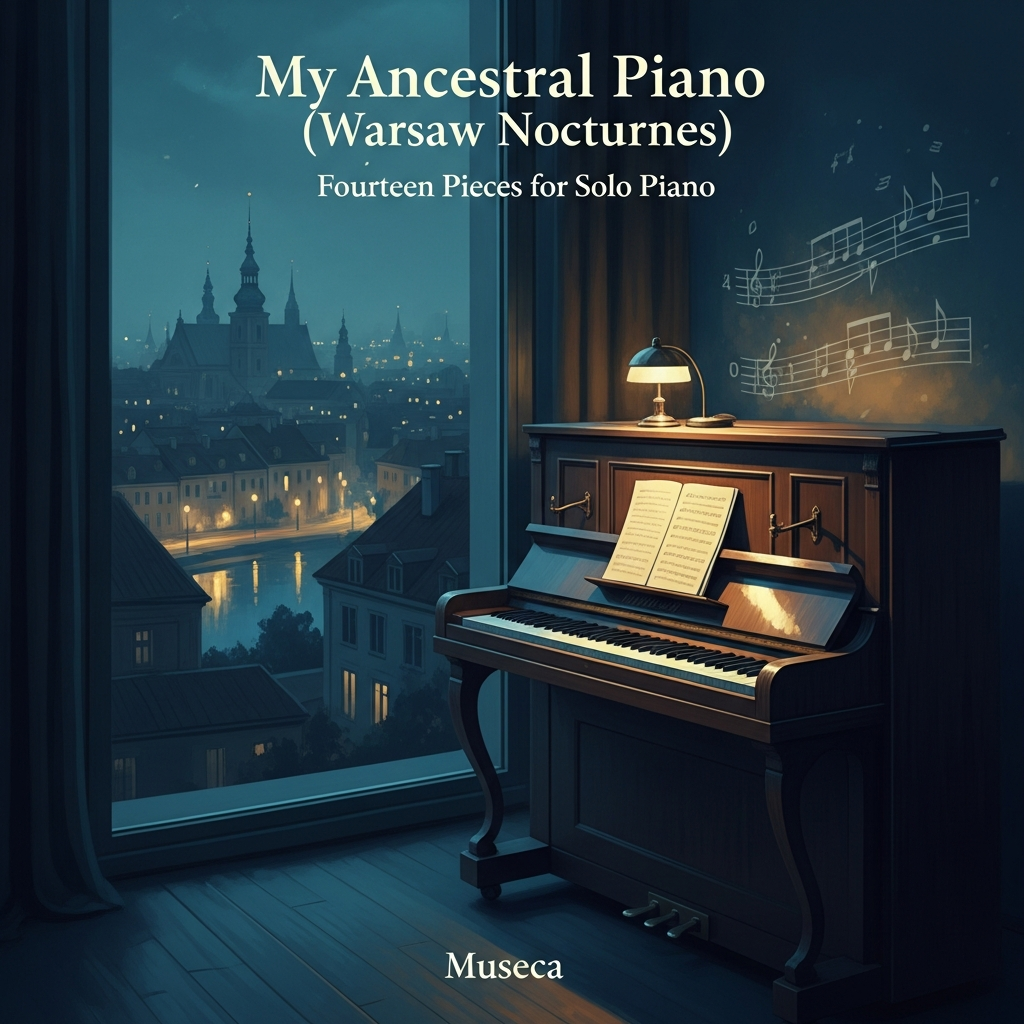
My Ancestral Piano (Warsaw Nocturnes)
Album Introduction
My Ancestral Piano (Warsaw Nocturnes) is a cycle of fourteen piano nocturnes shaped as an intimate pilgrimage through memory, heritage, and the emotional landscape of Poland. Each nocturne is a quiet reflection—sometimes fragile, sometimes solemn—on the inner world carried across generations, translated into sound.
Though composed far from Warsaw, these pieces resonate deeply with the city’s long history of lyrical, introspective piano writing. Polish musical tradition has always balanced sorrow with dignity, melancholy with resilience. Nowhere is this balance more eloquently expressed than in the legacy of Frédéric Chopin, whose nocturnes, mazurkas, and preludes captured the emotional temperament of an entire nation. His music taught the world that a single melodic line could contain nostalgia, longing, memory, and hope all at once.
Following Chopin, generations of Polish composers—Paderewski, Szymanowski, Bacewicz, Lutosławski—continued to explore the profound relationship between night, remembrance, and the inner life. Their works carried the unmistakable imprint of a people who endured profound hardship, yet preserved a luminous sense of introspection and beauty.
This album stands in that lineage—not as an imitation, but as a contemporary reflection.
The fourteen nocturnes are built around a tonal world that moves gently between D minor and D Dorian, two sound spaces that evoke quintessentially Polish emotional colors: sorrow that rises rather than collapses, memory that transforms into quiet determination, and darkness that gives way to a subtle glow. Each nocturne explores a different facet of this landscape:
unspoken stories carried in silence
echoes of places remembered through imagination as much as history
the tenderness of longing for one’s roots
the resilience that lives beneath grief
the quiet courage to step into a new chapter without forgetting the old
In this sense, My Ancestral Piano (Warsaw Nocturnes) becomes more than an album—it becomes a map of remembrance. A musical journey back to Warsaw, not by geography but by spirit. A way of touching heritage without being constrained by it. A way of honoring the past while gently reimagining the future.
For listeners, these nocturnes invite stillness and introspection. They feel like walking through Warsaw at night: faint church bells, soft lamplight on old stone streets, the calm hush of the Vistula drifting through the city, the sense of carrying history quietly within. They are modern works, yet they breathe with the unmistakable atmosphere of the Polish nocturne tradition.
This album is dedicated to the endurance of lineage, the power of musical memory, and the universal human desire to understand where we come from—not through textbooks, but through the deeper truth that music reveals.
Welcome to the nocturnes.
Welcome to Warsaw.
Welcome to the night in which memory becomes music.
Tracklist
My Ancestral Piano (Warsaw Nocturnes) No. 1
My Ancestral Piano (Warsaw Nocturnes) No. 2
My Ancestral Piano (Warsaw Nocturnes) No. 3
My Ancestral Piano (Warsaw Nocturnes) No. 4
My Ancestral Piano (Warsaw Nocturnes) No. 5
My Ancestral Piano (Warsaw Nocturnes) No. 6
My Ancestral Piano (Warsaw Nocturnes) No. 7
My Ancestral Piano (Warsaw Nocturnes) No. 8
My Ancestral Piano (Warsaw Nocturnes) No. 9
My Ancestral Piano (Warsaw Nocturnes) No. 10
My Ancestral Piano (Warsaw Nocturnes) No. 11
My Ancestral Piano (Warsaw Nocturnes) No. 12
My Ancestral Piano (Warsaw Nocturnes) No. 13
My Ancestral Piano (Warsaw Nocturnes) No. 14
Playlist
- My Ancestral Piano (Warsaw Nocturnes) No. 1 Museca 2:51
- My Ancestral Piano (Warsaw Nocturnes) No. 2 Museca 2:09
- My Ancestral Piano (Warsaw Nocturnes) No. 3 Museca 2:36
- My Ancestral Piano (Warsaw Nocturnes) No. 4 Museca 2:10
- My Ancestral Piano (Warsaw Nocturnes) No. 5 Museca 1:28
- My Ancestral Piano (Warsaw Nocturnes) No. 6 Museca 1:57
- My Ancestral Piano (Warsaw Nocturnes) No. 7 Museca 2:14
- My Ancestral Piano (Warsaw Nocturnes) No. 8 Museca 1:25
- My Ancestral Piano (Warsaw Nocturnes) No. 9 Museca 2:19
- My Ancestral Piano (Warsaw Nocturnes) No. 10 Museca 2:00
- My Ancestral Piano (Warsaw Nocturnes) No. 11 Museca 1:59
- My Ancestral Piano (Warsaw Nocturnes) No. 12 Museca 2:05
- My Ancestral Piano (Warsaw Nocturnes) No. 13 Museca 2:55
- My Ancestral Piano (Warsaw Nocturnes) No. 14 Museca 2:16
The Polish Nocturne Tradition
The word nocturne comes from the Latin nocturnus—“of the night.” As a musical genre, it was first shaped in the early 19th century by the Irish composer John Field, who wrote intimate piano pieces designed to evoke the stillness, mystery, and emotional depth of the night. But it was in Poland, through the work of Frédéric Chopin, that the nocturne reached its most profound and recognizable form.
Chopin transformed the nocturne from a graceful salon piece into a vehicle for deep psychological and poetic expression. Living in exile from his homeland for much of his life, he poured into these short works a uniquely Polish blend of longing, nostalgia, and interior strength. Under his hands, the nocturne became a kind of night meditation: a place where tenderness, sorrow, memory, and defiant dignity could coexist within a few minutes of music.
The historical context is crucial. During the 19th century, Poland endured partitions, occupation, and repeated suppression of its national identity. Public political expression was often dangerous or impossible, but music could still speak. Chopin’s nocturnes—along with his mazurkas and polonaises—came to embody the emotional life of a nation that could not always speak freely, but could remember and feel. In this sense, the Polish nocturne is not only a “night piece”; it is also a private language of resistance, remembrance, and hope.
After Chopin, other Polish composers carried forward this inward-looking, nocturnal sensibility. Figures such as Karol Szymanowski and later Grażyna Bacewicz and Witold Lutosławski did not always use the title nocturne, yet their piano and orchestral works often share the same characteristics: luminous harmonies emerging from darkness, a strong lyrical line, and a feeling of listening to one’s own soul in the silence after the world has grown quiet.
Today, to write a nocturne “in the shadow of Warsaw” is to enter into this tradition. It means treating the piano not just as an instrument, but as a night companion: a way of speaking with the past, with one’s own ancestry, and with the inner life that cannot always be expressed in words. Contemporary nocturnes that draw on Polish colors—minor modes tinged with hope, subtle dissonances that resolve gently, melodies that sing more than they display—stand in a living dialogue with this history.
My Ancestral Piano (Warsaw Nocturnes) takes its place within that lineage: modern in sound, yet shaped by the same elements that defined the great Polish nocturnes—silence, shadow, memory, and the quiet, unwavering light that persists even in the darkest hours.