
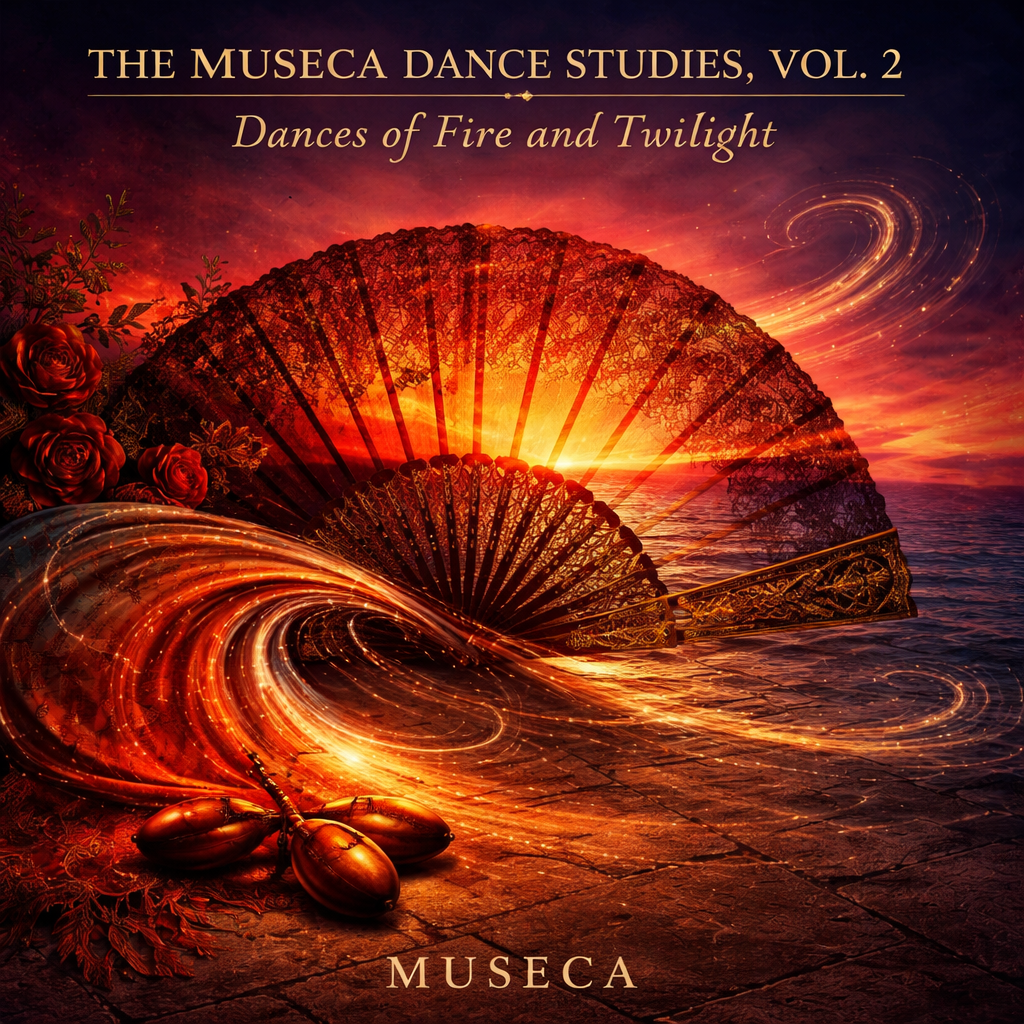
The Museca Dance Studies, Vol. 2: Dances of Fire and Twilight
If the first volume of The Museca Dance Studies explored the architecture of European court and salon dance, this second volume turns toward heat, color, and atmosphere. Dances of Fire and Twilight gathers a set of forms shaped less by formal restraint than by character: the sensual curve of the bolero, the smoldering pulse of the habanera, the guitar-lit brilliance of the fandango and jota, and the ecstatic whirl of the tarantella. These dances carry strong regional identities and rhythmic signatures, and for that reason they offer especially fertile ground for study.
As in Volume 1, each form appears in a paired design. First comes a historically grounded original composition, written to honor the defining traits of the dance—its meter, accent pattern, harmonic posture, instrumental color, and emotional stance. Then comes a Café del Mar reinterpretation, where the same rhythmic DNA is preserved but translated into a warm, ambient, coastal sound world. The result is not a remix in the commercial sense, but a continuation of the study method: a way of testing what remains essential when historical costume gives way to atmosphere.
This volume leans naturally toward the evening. Its dances are more overtly sensual, more regional in contour, and more immediately tied to gesture and pulse. Castanet-like clicks, guitar textures, swaying dotted rhythms, and circling 6/8 patterns all become part of the album’s language. Yet beneath the surface color lies the same compositional question that animates the series as a whole: what gives a dance form its identity? What element makes a habanera still a habanera when voiced through Rhodes, pads, and soft bass? What allows a tarantella to remain itself when its frenzy is slowed into trance?
In Dances of Fire and Twilight, Museca continues the work of writing from inside the form rather than merely decorating its surface. These pieces are studies in rhythmic essence, national character, and transformation across time. They begin in the historical world of floor, body, and gesture—but they end in air, dusk, and reflection. If Volume 1 moved from court to coastline, Volume 2 begins with flame and carries it gently into the night.
Liner Notes
Bolero (Classical/Romantic Spanish Style)
The volume opens with measured fire. The bolero is graceful, poised, and insistent, built on a repeated rhythmic cell that gives the music both elegance and quiet pressure. In this setting, Spanish color is expressed through guitar, strings, and castanet-like articulation, allowing the dance to unfold with a sensual dignity rather than overt spectacle.
Bolero at Dusk (Café Mix)
The bolero’s pulse remains, but its edges soften into twilight. Warm pads, nylon guitar, and gentle percussion preserve the dance’s swaying insistence while shifting its setting from salon or stage to the shoreline at evening. What was once a visible dance becomes an atmosphere of movement—still rhythmic, still intimate, but suspended in amber light.
Habanera (Moonlit Heat)
The habanera moves with unmistakable profile: a slow, sultry rhythmic pattern that creates tension through restraint. This track draws on the dance’s 19th-century aura of exotic refinement, balancing elegance with subtle provocation. Strings, clarinet, and guitar shape a sound world that feels nocturnal, poised, and deeply aware of its own stillness.
Habanera in the Harbor (Café Mix)
Here the habanera’s signature rhythm becomes a low, persistent undertow. Soft percussion, Rhodes, warm bass, and atmospheric textures recast the dance as a harbor-side meditation after dark. The sensuality remains, but it becomes interior—less theatrical, more reflective, as if the form were breathing in slow sea air.
Fandango (Embers and Lace)
The fandango introduces a brighter flame: rhythmic footwork, guitar-driven momentum, and a spirit that is both elegant and immediate. This traditional version leans into the dance’s Spanish energy through lively meter, ornamental gestures, and a sense of motion that feels festive without losing refinement. It is music of heat, gesture, and carefully held excitement.
Fandango Afterglow (Café Mix)
The fandango survives the transition beautifully because its rhythmic identity is so strong. In this reinterpretation, the strummed impulse is softened into downtempo sway, while pads and bass create a warm atmospheric field around it. The result is less a dance in full view than the glow that remains after the room has emptied.
Jota (Aragon Spark)
Quick, bright, and athletic, the jota brings a more folkloric brilliance into the album. Its rapid figures and uplifted character suggest open air, festivity, and regional pride. Guitar, strings, and lively articulation give the music a springing energy, as though the dance itself were made of turns, leaps, and flashes of sunlight.
Jota in Salt Air (Café Mix)
The Café version keeps the jota’s brightness but reframes it as breeze rather than blaze. The quick pulse is softened into a floating rhythmic shimmer, with muted instrumental colors and a coastal spaciousness that turns folk vitality into lightness. The dance does not disappear; it drifts, glints, and breathes.
Tarantella (Saint Elmo’s Steps)
With the tarantella, movement becomes urgency. The traditional form is driven by rapid 6/8 propulsion and the impression of unstoppable whirling energy. This track embraces that ecstatic quality while shaping it through clean form and instrumental clarity, allowing the dance to feel vivid and slightly dangerous without collapsing into chaos.
Tarantella in Slow Motion (Café Mix)
The reinterpretation poses a fascinating paradox: how can a frenzy become a trance? By slowing the surface while preserving the circular motor beneath it, the track turns the tarantella into hypnosis. Arpeggios, warm pads, and restrained percussion suggest that beneath all ecstatic motion lies a repeating center that can just as easily calm as ignite.
Playlist
- Bolero (Classical/Romantic Spanish Style) Museca 3:05
- Bolero at Dusk (Café Mix) Museca 2:51
- Habanera (Moonlit Heat) Museca 3:30
- Habanera in the Harbor (Café Mix) Museca 2:33
- Fandango (Embers and Lace) Museca 2:42
- Fandango Afterglow (Café Mix) Museca 3:42
- Jota (Aragon Spark) Museca 2:32
- Jota in Salt Air (Café Mix) Museca 4:08
- Tarantella (St. Elmo’s Steps) Museca 2:20
- Tarantella in Slow Motion (Café Mix) Museca 4:48