
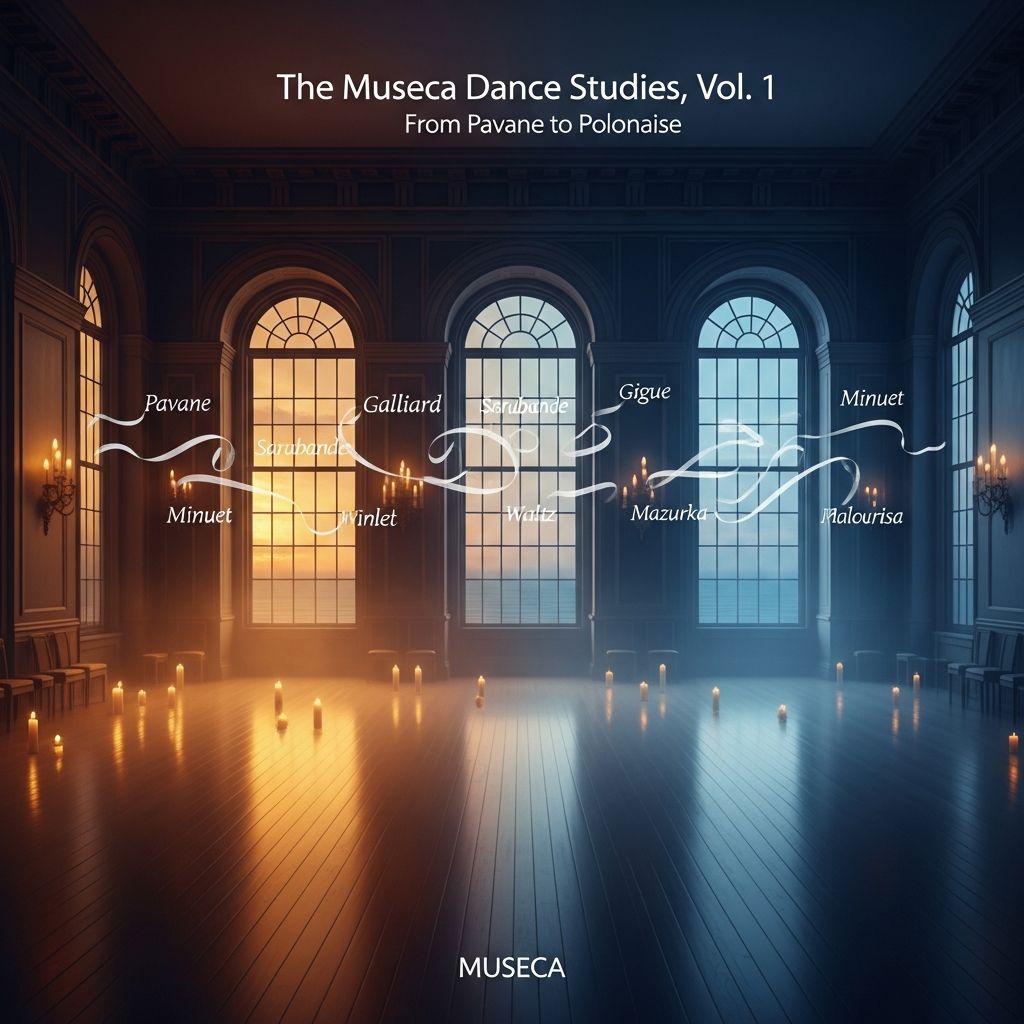
The Museca Dance Studies, Vol. 1: From Pavane to Polonaise
Dance forms are the hidden architecture of Western music. Long before the concert hall became music’s primary home, composition lived in motion—measured steps, ceremonial entrances, spinning rooms, and village floors where rhythm was not decoration but purpose. The Museca Dance Studies, Vol. 1: From Pavane to Polonaise presents eight foundational pre-modern dance forms spanning the Renaissance through the Romantic era, each chosen for the clarity of its identity and the richness of its compositional grammar.
This first volume is designed as a disciplined demonstration of craft. Each dance appears in a paired format: first as a historically informed original, written to honor period logic—meter, phrasing, harmonic behavior, and characteristic rhythmic cells—then as a Café del Mar reinterpretation that preserves the same structural DNA while translating it into a modern ambient, downtempo sound world. The goal is not parody, nor “remix” for its own sake, but a controlled experiment in musical essence: what makes a pavane remain a pavane when it leaves the candlelit court and arrives at the shoreline?
Across sixteen tracks, the album moves from the dignified processional gravity of the pavane to the athletic buoyancy of the galliard, then inward through the Baroque suite—sarabande and gigue—before stepping into Classical elegance with the minuet and the full Romantic bloom of the Viennese waltz. It culminates in two Polish forms where dance becomes identity: the off-center rustic pulse of the mazurka and the ceremonial grandeur of the polonaise. Each pairing invites the listener to hear a dance twice—first in its historical attire, then as a modern reflection—revealing which features are surface and which are soul.
In Volume 1, Museca’s intention is straightforward: to show competency not only in writing “in the style of,” but in composing from inside the form itself. These are studies in rhythm as character, harmony as posture, and form as the choreography of sound. The result is both a survey and a signature—an album where centuries of dance tradition remain intact, yet open, breathable, and newly illuminated.
Liner Notes
Pavane in G minor (Old Court)
A measured entrance into the album’s world: slow duple time, noble restraint, and a calm ceremonial gravity. The pavane’s identity is carried by long phrases and clear cadences, with a courtly surface that favors poise over display. Lute and consort colors suggest candlelit space and the quiet confidence of ritualized movement.
Pavane at Sunset (Café Mix)
The same pavane becomes a memory dissolved into atmosphere. Its melodic contours and harmonic spine remain intact, but they float inside warm pads and gentle pulse, as if the court has moved outdoors and the dance floor has become shoreline. The dignity stays—only the light changes.
Galliard in D major (Steps of Joy)
Bright, athletic, and unmistakably buoyant, the galliard lifts the mood with its long–short–short rhythmic engine. This track honors the dance’s celebratory purpose: a lively triple-meter flourish designed for leaps and turns, expressed through nimble lines and clear, optimistic harmonic motion.
Galliard Over the Sea (Café Mix)
Here the galliard’s rhythmic signature is preserved as a subtle hook rather than a shouted gesture. A relaxed 6/8 sway, airy textures, and soft instrumental colors transform exuberance into effervescence—joy refracted through distance, breeze, and salt air.
Sarabande in E minor (Grave and Still)
The album turns inward. A slow triple-meter pulse with weight on the second beat creates the sarabande’s characteristic sense of suspended gravity. Harpsichord and continuo speak with deliberate clarity—music that feels less like entertainment and more like a dignified confession made in measured steps.
Sarabande of the Tide (Café Mix)
The sarabande’s beat-two weight becomes a gentle swell, as if the accent were breathing rather than striking. Sparse piano, deep pads, and soft bass preserve the dance’s inwardness while recasting it as nocturnal drift. The form remains binary in spirit, but the edges blur like waterline into sand.
Gigue in A major (Dancing Lines)
A release of brightness and motion: quick 6/8 momentum, lively interplay, and the buoyant logic of Baroque closure. The gigue’s lines chase and answer one another, creating a sense of joyous inevitability—music that dances by virtue of its own internal engine.
Gigue in the Clouds (Café Mix)
The gigue rises into weightlessness. Its perpetual motion becomes arpeggios, echoes, and light percussion that imply movement without insisting on it. What was once a sprint becomes a glide; what was once footwork becomes airflow—still dancing, but above the floor.
Minuet in F major (Salon Light)
Poise returns in Classical form. The minuet’s elegance lies in proportion: balanced phrases, clean harmonic turns, and a gentle social brightness that never overreaches. This track is written with the sense of a small room, polite conversation, and the refined grace of restraint.
Midnight Minuet (Café Mix)
The minuet shifts into late-night intimacy, where the same triple meter feels more reflective than social. Warm electric-piano color, soft rhythm, and extended harmonies turn formal elegance into private reverie. The dance remains upright—but its shadow grows longer and more tender.
Viennese Waltz in A♭ (Turning Room)
Here the album opens into the Romantic ballroom: the spinning energy of the Viennese waltz, the lift of the second beat, and the unmistakable sensation of rotation. Lush harmony and sweeping phrasing give the waltz its emotional profile—romance not as sentimentality, but as motion that refuses to stand still.
Waltz on the Shore (Café Mix)
The waltz becomes a slow horizon. Its swirl is preserved, but softened into a gentle seaside pulse—more gaze than whirl, more memory than event. The triple meter lingers like a tide pattern, suggesting that the waltz’s true power may be its ability to turn time itself.
Mazurka in C minor (Village Echo)
With the mazurka, dance becomes identity. Accents fall off-center, dotted figures tilt the floor, and folk gesture is transformed into intimate art. This track leans into the mazurka’s rustic sophistication: a village imprint refined into piano language, where charm and melancholy coexist without needing to resolve.
Mazurka After Midnight (Café Mix)
The mazurka’s displaced accent survives as a quiet signature under a downtempo haze. Pads and soft percussion wrap the dance in nocturnal atmosphere, keeping the folk pulse while shifting the setting from village floor to city night. It remains slightly off-balance—in the most human way.
Polonaise in E major (Procession of Light)
The volume culminates in ceremony. The polonaise is a dance of entrances and declarations, built on a proud rhythmic stride and a sense of public grandeur. Bright tonality and stately pacing give this track its character: confident, elevated, and unmistakably processional—music that walks forward with purpose.
Polonaise by the Sea (Café Mix)
The final reflection takes the polonaise’s noble stride and lets it breathe in open air. The rhythm remains in the bass like footsteps on a long promenade, while the harmony widens into ambient light. The procession is still there—only now it moves toward the horizon, leaving Volume 1 with quiet radiance rather than a closing curtain.
Playlist
- Pavane in G minor (“Old Court”) Museca 2:12
- Pavane at Sunset Museca 3:04
- Galliard in D major (Steps of Joy) Museca 2:28
- Galliard Over the Sea (Café Mix) Museca 3:49
- Sarabande in E minor (Grave and Still) Museca 1:24
- Sarabande of the Tide (Café Mix) Museca 6:44
- Gigue in A major (Dancing Lines) Museca 1:30
- Gigue in the Clouds (Café Mix) Museca 5:01
- Minuet in F major (Salon Light) Museca 1:10
- Viennese Waltz in A♭ (Turning Room) Museca 2:13
- Waltz on the Shore (Café Mix) Museca 3:56
- Mazurka in C minor (Village Echo) Museca 2:05
- Mazurka After Midnight (Café Mix) Museca 3:40
- Polonaise in E major (Procession of Light) Museca 1:22
- Polonaise by the Sea (Café Mix) Museca 3:18