
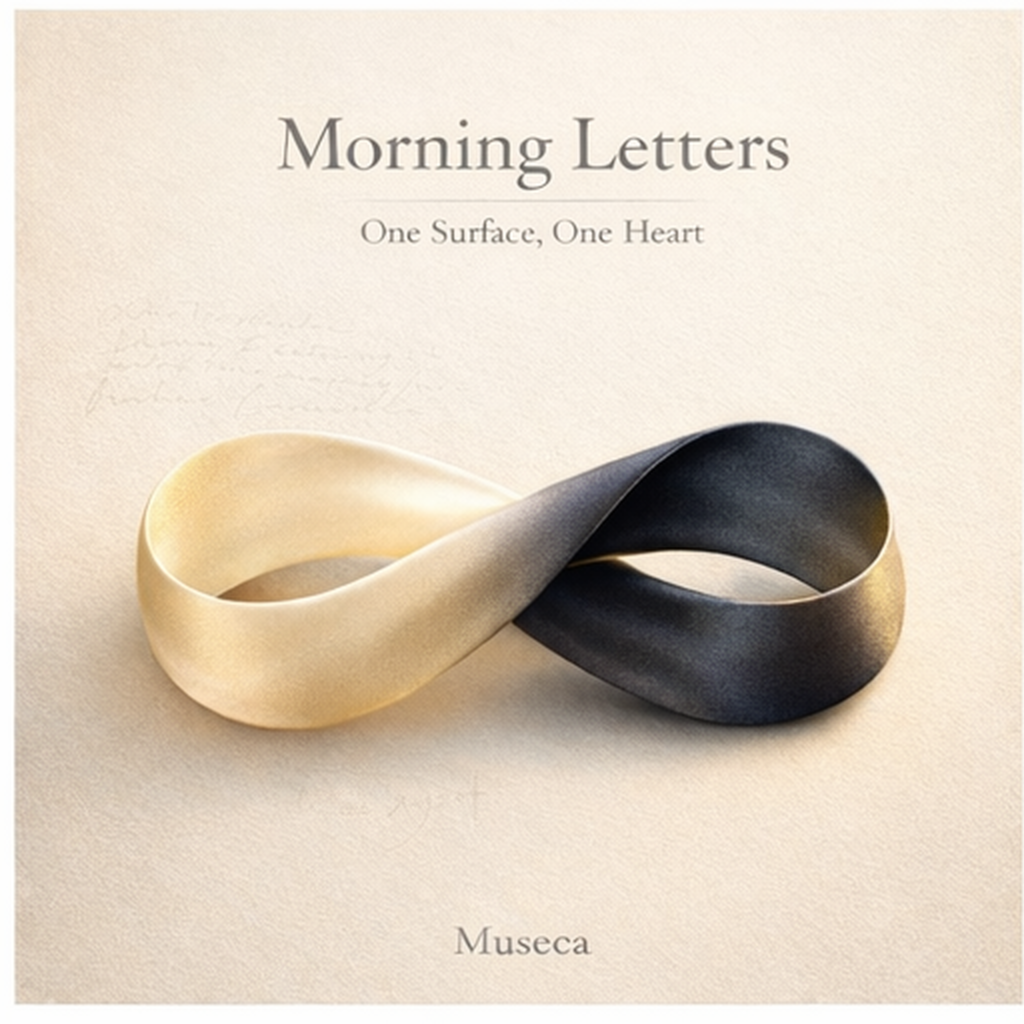
Morning Letters — One Surface, One Heart
Morning Letters is the second orientation of the Möbius concept: the same philosophy turned toward daylight, language, and intimacy. Where Night Rituals reveals continuity through pulse and trance, Morning Letters reveals it through recognition—through the tender, human act of putting experience into words.
The album is conceived as a cycle of songs written at dawn: acoustic, romantic, and emotionally direct. Its core palette blends cinematic folk songcraft (acoustic guitar and piano with warm lead vocals) with romantic orchestral writing (lush strings, harp, and gentle winds), occasionally lifting into art-song–style cinematic ballads that feel more through-composed and devotional. This is an intentional design: the album carries “one surface” across two musical orientations, moving between grounded letters and elevated revelations without breaking coherence.
Lyrically, the songs return again and again to the central insight: the division between the material and the spiritual is often a matter of perspective. The sacred is not a hidden compartment of reality; it is the ordinary seen with a softened gaze. Love, in this framing, is not an exception to separation—it is evidence that separation is not ultimate.
If Night Rituals asks you to feel the turn in your body, Morning Letters asks you to hear it in your heart: the same light, a new angle; the same life, reoriented. This is the album’s vow—quiet, romantic, and resolute: one surface, one heart.
Liner Notes
Morning Letters is the daylight orientation of the same Möbius philosophy: the sacred revealed through clarity, language, and human tenderness. Where Night Rituals works by pulse and trance, Morning Letters works by recognition—by turning attention toward what is already present. The album is conceived as a cycle of dawn-written songs: intimate enough to feel like private correspondence, yet expansive enough to carry romantic orchestral lift. Across the tracklist, the central idea returns in different emotional registers: the “veil” is not a barrier to break, but a rotation of perception; the material and spiritual are not separate worlds, but one continuous surface experienced from different orientations. Musically, the record alternates between cinematic folk songcraft and more through-composed art-song ballads, allowing the listener to move between grounded storytelling and elevated revelation without leaving the same core atmosphere.
Kettle Steam & First Light
A quiet opening that treats the morning as a sanctuary. Acoustic textures and warm voice establish immediacy, while the orchestra enters like sunlight—gradual, deliberate, and never overpowering. The song frames the album’s method: ordinary details become metaphysical not by changing what they are, but by changing how they are seen.
Lyrics
Verse 1
This morning, kettle-steam rose like prayer in the light,
Gold on the window, night loosening its grip.
I used to think the worlds were split—two separate skies—
Till something in me turned, and let you in.
Chorus
One surface, one heart, in morning air,
I don’t cross over—I find you there.
If I listen, the ordinary sings—
And every small thing turns into wings.
Verse 2
A spoon against a cup, a sparrow’s quick refrain,
The simplest notes undo my old refrain.
I wrote your name in quiet, not to prove—
Just to remember what is true.
Two Shores, One Water
Here the lyric turns toward the illusion of separation. The arrangement holds a gentle forward motion, letting the chorus widen like a horizon. The central emotional move is not triumph but soft certainty: the boundary that once felt real begins to feel like a habit of thought.
Lyrics
Verse 1
I walked the edge of “either/or” for years,
Calling one shore “real,” the other “near.”
But water doesn’t argue with the sky—
It holds both worlds, and so do I.
Chorus
Two shores, one water, one wide tide,
Love turns the page from side to side.
What I was chasing was never far—
It lived inside the way you are.
Verse 2
So I lay my fear down like a coat,
And let the morning teach me hope.
No gate to force, no line to break—
Just one long river, wide awake.
The Veil Is a Turn
A pivotal statement track that elevates the album’s philosophy into a more devotional, through-composed form. The harmonic pacing is slower and more spacious, allowing lines to land with weight. This song functions as an anchor point—less “letter,” more illumination—without breaking the album’s intimacy.
Lyrics
A
The veil is a turn, not a wall—
A hinge of light, a gentle tilt.
I thought I had to leave it all,
To find what never left.
B
I held my breath at every edge,
Mistaking fear for truth,
Till mercy rewrote what I’d said,
And morning widened through.
C
One surface, one heart, one continuous song—
Not two worlds, but one, seen differently.
The veil is a turn, not a wall;
I’m home the moment I can see.
Letters on the Windowsill
A return to songcraft and domestic imagery, but with heightened romantic sweep. The orchestration behaves like memory: swelling at the edges of the lyric, then receding to leave the voice exposed. The windowsill becomes a threshold symbol—an in-between place where light arrives and meaning shifts.
Lyrics
Verse 1
I left a note on the windowsill,
Where sunrise likes to land.
Not asking heaven for a sign—
Just reaching for your hand.
Chorus
Same light, new angle, morning learns my name,
The world turns tender, nothing stays the same.
I don’t cross over—I soften and I see,
The other side was waiting here in me.
Verse 2
Ink smudged by breath, by time, by grace,
By all I couldn’t say.
If love is real, it lives in this—
In how we turn today.
Non-Dual Hymn
The most prayer-like entry on the record. The vocal line carries a gentle solemnity, while the arrangement avoids spectacle in favor of depth. Rather than “solving” tension, the music dignifies it, presenting unity as something lived and practiced, not merely understood.
Lyrics
A
I bless the doorway I invented,
And the fear that called it real.
I bless the body, bless the breathing,
Bless the truth I used to seal.
B (refrain, twice max)
No crossing—only seeing.
No crossing—only seeing.
C
If spirit is the deeper color in the day,
Then let me turn toward it, here.
Let love be one continuous morning—
Not escape, but presence made clear.
Sparrow Stitch of Music
A lighter, more buoyant chapter that translates the theme into motion. The melodic writing feels conversational, almost smiling, but never cute. It suggests that the world is constantly offering invitations to reorient—small signals that become profound when received.
Lyrics
Verse 1
A sparrow stitched a melody across the porch rail,
Tiny notes that never ask permission to be real.
I followed like a child again, unarmed—
And felt the world re-form.
Chorus
One breath, one dawn, one steady line,
Love turns the ordinary into sign.
If I stop fighting what I feel—
The veil turns softly, and I heal.
Verse 2
So let the small things tutor me,
In quiet continuity.
I don’t need thunder to believe—
Just morning, and your name.
One Surface, One Heart
The emotional centerpiece, where the album’s romance and metaphysics merge most directly. The orchestral language opens fully—strings and harp widening the space around the vocal—while the lyric lands as a vow rather than an argument. This track makes the philosophical claim feel personal: unity is not an abstraction, it is love experienced without fear.
Lyrics
A
I loved you like a distant country,
A map I couldn’t enter.
I called the sacred “somewhere else,”
And missed it in the center.
B
But morning doesn’t split itself—
It only changes shade.
And love is not a second world;
It’s how this one is made.
Refrain
The veil is a turn, not a wall.
C
One surface, one heart—no seam, no end—
The same light learning how to bend.
The Ordinary Is Holy
A grounded reassurance that spiritual depth does not require extraordinary circumstances. The arrangement stays warm and steady, allowing the lyric to do the work. The power is in the restraint: holiness is portrayed as attention, not spectacle.
Lyrics
Verse 1
The ordinary is holy when I’m not in a rush—
When I hear the faucet’s rhythm and the city’s distant hush.
I used to chase a higher place, a cleaner sky—
Now I find it in your eyes.
Chorus
Same light, new angle, changing what I call “real,”
A little turn of mercy changes how I feel.
No ladder out, no door to force—
Just one wide life, and a gentler course.
Verse 2
So I fold today like a letter to your name,
And let the smallest moments hold the flame.
Rotation of Mercy
A more dramatic, cathartic moment where the “turn” becomes emotional rather than conceptual. The music supports a pivot from guardedness to release—often through a mid-song harmonic or dynamic change that feels like a door quietly opening. Mercy is presented as a reorientation that changes the same life into a new lived reality.
Lyrics
A
I carried old verdicts like stones in my sleeve,
Calling them “wisdom,” calling them “shield.”
But mercy arrived without spectacle—
A small rotation, and the bruise unsealed.
B (refrain, twice max)
The veil is a turn, not a wall.
C
Forgiveness is not forgetting—
It’s seeing without the blade.
It’s the same life, reoriented,
The same light, differently made.
Handwritten in the Air
A hopeful, forward-moving letter-song that feels like breath and daylight. The chorus carries lift without turning pop-glossy; it remains human and close. The imagery suggests that what we most need to say may not require ink at all—only the willingness to speak from the turned perspective.
Lyrics
Verse 1
I wrote you in the air with breath and morning sun,
A sentence made of silence, saying we are not two.
If love can be a compass, let it be this—
A gentle turn that leads me back to you.
Chorus
One surface, one heart, one widening day,
The veil turns softly when I stop the fight.
I don’t cross over—I let go,
And watch the world fill up with light.
Verse 2
So take this little letter—no proof, no plea—
Just how the dawn keeps teaching me.
The Edge That Isn’t
The darkest song on the album, where separation is confronted at its most convincing. The arrangement leans into lower colors—weightier strings, deeper piano space—before releasing into a clearer resolve. The edge is shown to be psychological rather than structural: it dissolves when the listener stops bracing against it.
Lyrics
A
I stood at an edge I invented,
Swearing it had teeth.
I named my fear “the boundary,”
And called it underneath.
B
But love kept leaning closer—
Not to conquer, just to stay.
And the edge dissolved to nothing
When I finally turned my face.
C
If there is any crossing, it’s this:
From clenched to open, from guarded to true.
The edge that isn’t ends here—
In the quiet return to you.
Start Again (Möbius Finale)
A luminous closer that completes the album’s letter-cycle with continuation rather than finality. The musical architecture expands toward a warm, satisfying cadence, then leaves room for the emotional afterglow—an outro that feels like the day still unfolding. The ending affirms the album’s thesis in the most practical way: there is no “other side” to reach. There is only the next turn, and the willingness to begin again.
Lyrics
A
Morning returns like a promise kept—
Not new, but newly seen.
The same world, turning toward the light,
The same heart, washing clean.
B (core refrain)
The veil is a turn, not a wall.
C
So I will start again—right here, right now—
No flight, no proof, no bend.
Love is one continuous letter
That turns its page… and doesn’t end.
Playlist
- TRACK 1 — Kettle Steam & First Light (2A) Museca 2:23
- TRACK 2 — Two Shores, One Water (2A) Museca 2:26
- TRACK 3 — The Veil Is a Turn (2B) Museca 2:10
- TRACK 3 — The Veil Is a Turn (2B) Museca 2:10
- TRACK 4 — Letters on the Windowsill (2A) Museca 2:41
- TRACK 5 — Non-Dual Hymn (2B) Museca 2:08
- TRACK 6 — Sparrow Stitch of Music (2A) Museca 2:24
- TRACK 7 — One Surface, One Heart (2B) Museca 2:29
- TRACK 8 — The Ordinary Is Holy (2A) Museca 2:13
- TRACK 9 — Rotation of Mercy (2B) Museca 2:15
- TRACK 10 — Handwritten in the Air (2A) Museca 2:17
- TRACK 11 — The Edge That Isn’t (2B) Museca 1:59
- TRACK 12 — Start Again (Möbius Finale) (2B) Museca 2:10